Short answer: the Neumann KH 310 A for better sound quality, the JBL 306P MKII for the lower price. The Neumann KH 310 A ranks #20 of 113 powered bookshelf speakers, rated 4.6/5, at $4,998. The JBL 306P MKII ranks #67, rated 4.1/5, at $238, $4,760 cheaper.
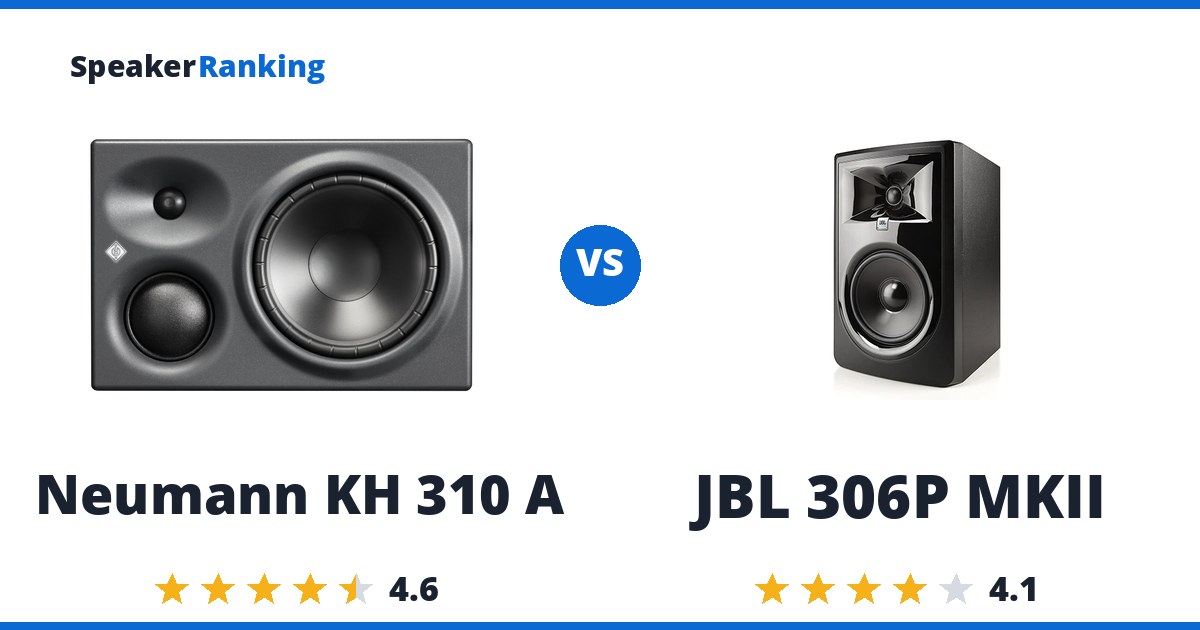
The Neumann KH 310 A is the more accurate, deeper-bass pick. The sealed three-way design combines 35.2Hz measured -3dB extension with low distortion in the review’s demanding playback tests. Its measured preference score, a predictor of how neutral it sounds, is 6.21 against 5.06 for the JBL 306P MKII. Its bass reaches about 35.2Hz before falling 3dB, against 46.9Hz for the JBL 306P MKII. Watch for: Its measured tonal balance is not as even as the Neumann KH 150 or the best coaxial alternatives.
Why pick the JBL 306P MKII: A 6.94 ideal-subwoofer score and 46.9Hz measured -3dB extension make this a useful affordable nearfield monitor. Watch for: The 3.4dB response span from 300Hz to 5kHz is less even than the JBL 308P MKII’s, with midrange resonances affecting neutrality.
Buy the Neumann KH 310 A when sound quality outweighs the price for you, and the JBL 306P MKII when the price outweighs sound quality instead.
Want more options? Browse the full Powered Home rankings.
Specifications Side By Side
| Neumann KH 310 A | JBL 306P MKII | |
|---|---|---|
| Price | $4,998 per pair | $238 per pair |
| Ranked | #20 of 113 in Large Size Powered Bookshelf Speakers | #67 of 113 in Large Size Powered Bookshelf Speakers |
| Bass Extension (-3dB) | 35.2Hz (measured, Audio Science Review) | 46.9Hz (measured, Audio Science Review) |
| Bass Extension (-10dB) | 28.3Hz (derived, log-interpolated between spinorama.org -9dB/-12dB points) | 38.6Hz (derived, log-interpolated between spinorama.org -9dB/-12dB points) |
| Frequency Response | 34Hz - 21kHz (+/-3dB) (Manufacturer specified) | 39Hz - 24kHz (-10dB) (Manufacturer specified) |
| Drivers | 8.25” woofer, 3” midrange, 1” tweeter | 6.5” woofer, 1” neodymium tweeter |
| App | No | No |
| EQ | No | No |
| DSP | No | No |
| Amplifier Power | 290W total (150W woofer, 70W mid, 70W tweeter) | 112W total |
| Spinorama Preference Score | 6.21 | 5.06 |
| Spinorama Preference Score with Perfect Sub | 7.70 | 6.94 |
| Inputs | XLR (balanced analog) | XLR, 1/4” TRS |
| XLR Input | Yes | Yes |
| RCA Input | No | No |
| TRS Input | No | Yes |
| Optical Input | No | No |
| Coaxial Input | No | No |
| USB Input | No | No |
| HDMI Input | No | No |
| AES Input | No | No |
| Aux Input | No | No |
| Bluetooth | No | No |
| Dimensions | 10” x 15.1” x 11.5” (253 x 383 x 292 mm) (H x W x D) | 16.1”H x 11.2”W x 12.9”D (408 x 285 x 328 mm) |
| Weight | 28.7 lbs (13.0 kg) | 13.4 lbs (6.1 kg) each |
Related Speaker Comparisons
How Neumann KH 310 A compares with other leading options:
- AsciLab C8C vs Neumann KH 310 A
- Neumann KH 310 A vs Mesanovic CDM65
- Genelec 8351B vs Neumann KH 310 A
- Neumann KH420 vs Neumann KH 310 A
- Genelec 8361A vs Neumann KH 310 A
Prices on this page were last checked October 9, 2026 at 8:01 AM UTC. Product prices and availability are accurate as of that date/time and are subject to change; the price and availability shown on Amazon at the time of purchase will apply to the purchase of this product.
As an eBay Partner, we may be compensated if you make a purchase.
The Two Speakers In Full
 Neumann KH 310 A: $4,998 per pair B&H Photo Video eBay
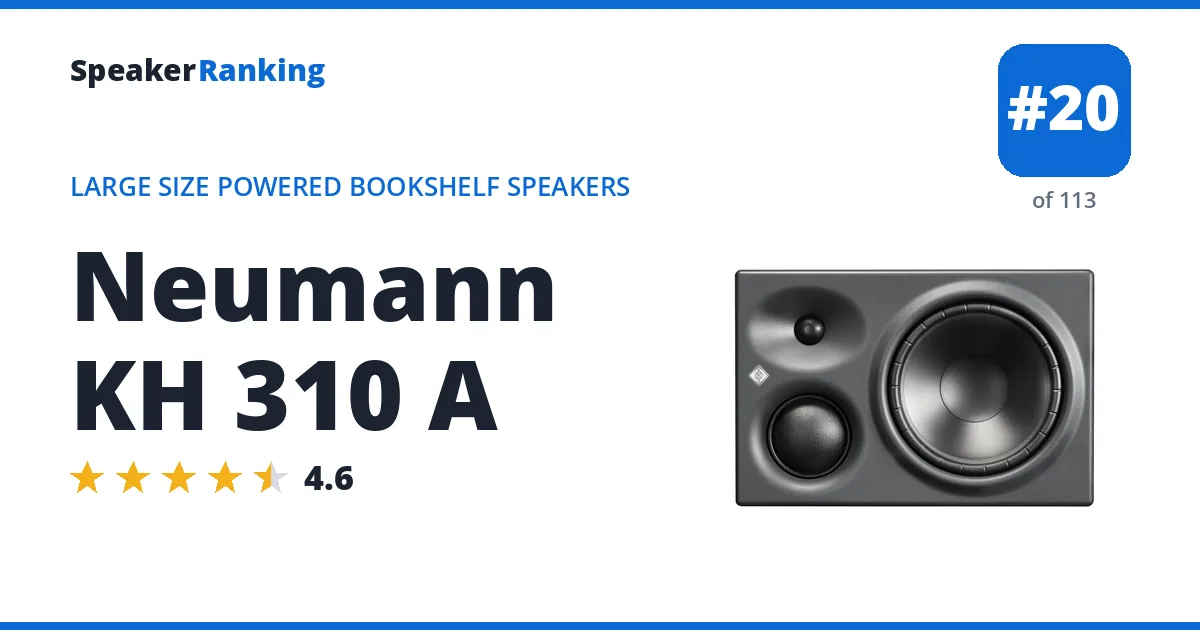
Same family: the Neumann KH80 DSP (smaller bookshelf, rated 4.6/5), the Neumann KH120 MKII (smaller bookshelf, rated 4.7/5), the Neumann KH 150 (smaller bookshelf, ranked higher, rated 4.8/5), the Neumann KH420 (larger bookshelf, ranked higher, rated 4.8/5) and the Neumann KH 750 DSP (subwoofer, rated 3.5/5).
Pros: The sealed three-way design combines 35.2Hz measured -3dB extension with low distortion in the review’s demanding playback tests. Its 2.2dB response span from 300Hz to 5kHz and 7.70 ideal-subwoofer score support balanced monitoring with useful full-range capability. Measured bass extension of 35.2Hz (-3dB).
Cons: Its measured tonal balance is not as even as the Neumann KH 150 or the best coaxial alternatives. Correct orientation and listening height matter for the separated drivers. The analog system lacks the integrated calibration workflow of newer DSP models, so room correction requires additional equipment. An unexplained dip around 80Hz shows in the measurements.
Full Neumann KH 310 A review and specifications →
| AES Input | No |
|---|---|
| Amplifier Power | 290W total (150W woofer, 70W mid, 70W tweeter) |
| App | No |
| Aux Input | No |
| Bass Extension (-10dB) | 28.3Hz (derived, log-interpolated between spinorama.org -9dB/-12dB points) |
| Bass Extension (-3dB) | 35.2Hz (measured, Audio Science Review) |
| Bluetooth | No |
| Coaxial Input | No |
| DSP | No |
| Dimensions | 10” x 15.1” x 11.5” (253 x 383 x 292 mm) (H x W x D) |
| Drivers | 8.25” woofer, 3” midrange, 1” tweeter |
| EQ | No |
| Frequency Response | 34Hz - 21kHz (+/-3dB) (Manufacturer specified) |
| HDMI Input | No |
| Inputs | XLR (balanced analog) |
| Optical Input | No |
| RCA Input | No |
| Spinorama Preference Score | 6.21 |
| Spinorama Preference Score with Perfect Sub | 7.70 |
| TRS Input | No |
| USB Input | No |
| Weight | 28.7 lbs (13.0 kg) |
| XLR Input | Yes |
- Links
- Reviews, Comparisons and Sound Samples
- Head-to-Head Comparisons
- Neumann KH 310 A vs LOGProfessional Alpha
- Neumann KH 310 A vs Adam Audio S2V
- Neumann KH 310 A vs HEDD Type 20 MK2
- Neumann KH 310 A vs Genelec S360
- Neumann KH 310 A vs Buchardt A10
- Neumann KH 310 A vs Neumann KH 150
- Neumann KH 310 A vs Genelec 8341A
- Neumann KH 310 A vs Genelec 8361A
- See all 35 comparisons
 JBL 306P MKII: $238 per pair B&H Photo Video eBay
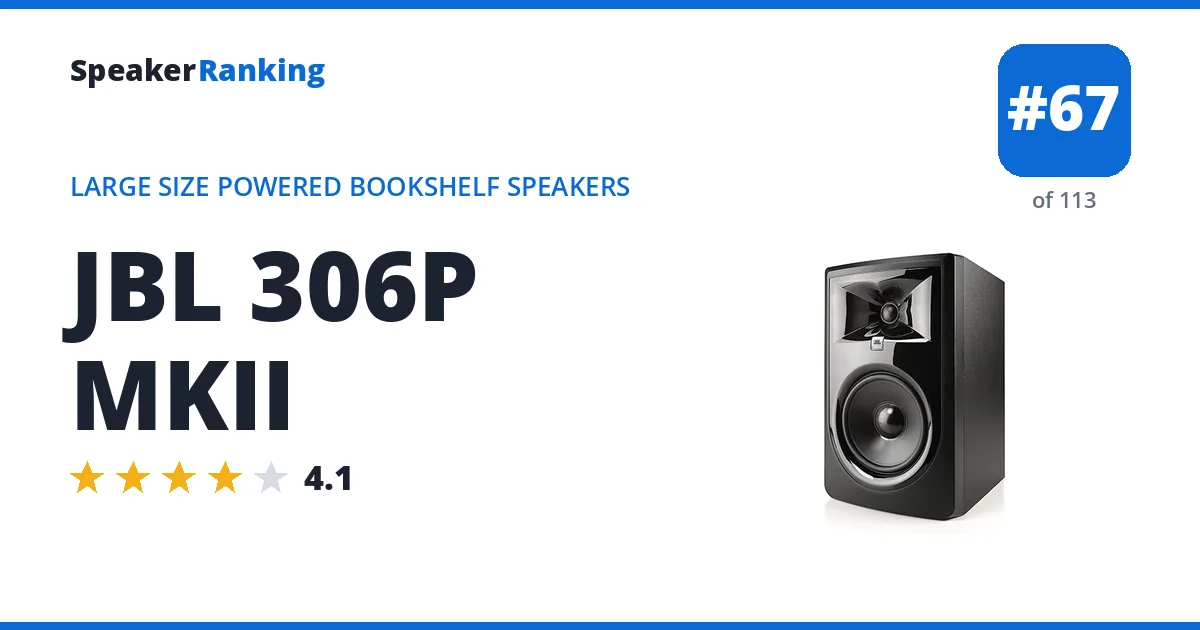
Same family: the JBL 305P MKII (smaller bookshelf, rated 4.3/5) and the JBL 308P MKII (larger bookshelf, ranked higher, rated 4.4/5).
Pros: A 6.94 ideal-subwoofer score and 46.9Hz measured -3dB extension make this a useful affordable nearfield monitor. The waveguide supports broad horizontal listening coverage, and basic boundary controls help with setup. Measured bass extension of 46.9Hz (-3dB).
Cons: The 3.4dB response span from 300Hz to 5kHz is less even than the JBL 308P MKII’s, with midrange resonances affecting neutrality. Hiss can matter at a quiet desk, while bass distortion limits demanding playback. A subwoofer improves bandwidth but does not remove the midrange irregularities. A narrow dip around 1.6kHz shows in the on-axis and listening-window curves.
Full JBL 306P MKII review and specifications →
| AES Input | No |
|---|---|
| Amplifier Power | 112W total |
| App | No |
| Aux Input | No |
| Bass Extension (-10dB) | 38.6Hz (derived, log-interpolated between spinorama.org -9dB/-12dB points) |
| Bass Extension (-3dB) | 46.9Hz (measured, Audio Science Review) |
| Bluetooth | No |
| Coaxial Input | No |
| DSP | No |
| Dimensions | 16.1”H x 11.2”W x 12.9”D (408 x 285 x 328 mm) |
| Drivers | 6.5” woofer, 1” neodymium tweeter |
| EQ | No |
| Frequency Response | 39Hz - 24kHz (-10dB) (Manufacturer specified) |
| HDMI Input | No |
| Inputs | XLR, 1/4” TRS |
| Optical Input | No |
| RCA Input | No |
| Spinorama Preference Score | 5.06 |
| Spinorama Preference Score with Perfect Sub | 6.94 |
| TRS Input | Yes |
| USB Input | No |
| Weight | 13.4 lbs (6.1 kg) each |
| XLR Input | Yes |
- Links
- Reviews, Comparisons and Sound Samples
- Head-to-Head Comparisons