Short answer: the GR-Research NX-Studio on measured sound quality, the GR-Research NX-Bravo on price. The GR-Research NX-Studio ranks #4 of 214 bookshelf speakers, rated 4.8/5, at $3,630. The GR-Research NX-Bravo ranks #26, rated 4.4/5, at $1,540, $2,090 cheaper.
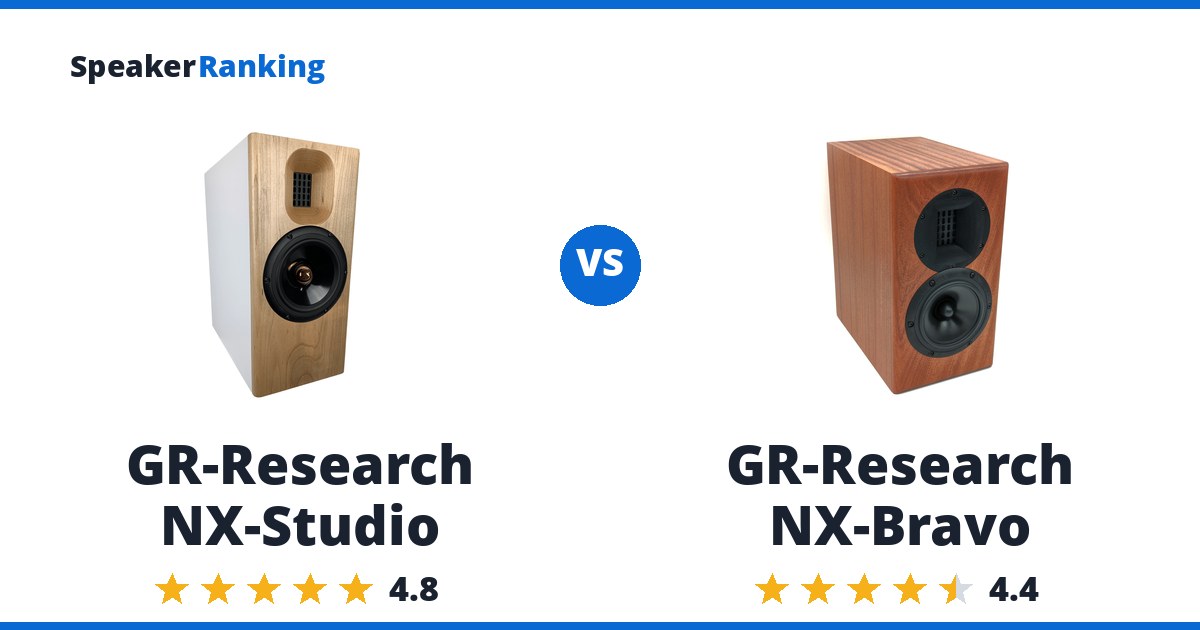
The GR-Research NX-Studio is the better-sounding choice. Ultra clean burst decay/waterfall plot. Watch for: Bass will be very tight but won’t be quite as deep as others due to the sealed woofer enclosure.
The case for the GR-Research NX-Bravo: Vertical dispersion is unusually wide for a two-way bookshelf: tonal matching holds from about 50° above the tweeter axis down to 20° below it, well beyond the roughly ±10-20° typical of most two-ways. The catch: Pointed straight on-axis there’s a deliberate ~5dB high-frequency bump meant to compensate for narrowing dispersion off-axis; it needs about 15° of toe-out (aimed to cross behind the listener) to sound balanced, which won’t suit every room layout.
Buy the GR-Research NX-Studio when sound quality outweighs the price for you, and the GR-Research NX-Bravo when the price outweighs sound quality instead.
Looking for alternatives? See the complete Passive Home rankings.
Specifications Side By Side
| GR-Research NX-Studio | GR-Research NX-Bravo | |
|---|---|---|
| Price | $3630 per pair | $1540 per pair kit with finished cabinets (assembly required) |
| Ranked | #4 of 214 in Large Size Bookshelf Speakers | #26 of 214 in Large Size Bookshelf Speakers |
| Dimensions | 18”H x 8.5”W x 15.5”D (457.2 x 215.9 x 393.7 mm) | 14”H x 7.5”W x 11.5”D (355.6 x 190.5 x 292.1 mm) |
| Impedance | 8 ohms | 6 ohms nominal, 5 ohms minimum (measured, Erin’s Audio Corner) |
| Sensitivity | 87dB | 84.8dB (measured, Erin’s Audio Corner) |
| Drivers | GR-Research M165NQ 6.5” paper cone, non-resonant polymer frame, copper shorting rings and aluminum phase plug sealed enclosure woofer, GR-Research Neo3 Planar Magnetic Ribbon open baffle tweeter | GR-Research M165 6.5” paper cone, non-resonant polymer frame woofer, GR-Research Neo3 Planar Magnetic Ribbon deep rear cup tweeter |
| Weight | 20.5 lbs (9.3 kg) each | 16.1 lbs (7.3 kg) each |
| Woofer Cabinet | sealed | ported |
| DIY Kit | Yes | Yes |
| Bass Extension (-10dB) | - | 45Hz (measured, Erin’s Audio Corner) |
| Bass Extension (-3dB) | - | 77Hz (measured, Erin’s Audio Corner) |
| Spinorama Preference Score | - | 5.18 |
| Spinorama Preference Score with Perfect Sub | - | 7.52 |
Watch Them Compared
Videos and reviews that test both speakers side by side.
Related Speaker Comparisons
How GR-Research NX-Studio compares with other leading options:
- GR-Research NX-Studio vs Perlisten S4b
- GR-Research NX-Studio vs KEF Reference 1 Meta
- GR-Research NX-Studio vs March Audio Sointuva AWG
- AsciLab C6B vs GR-Research NX-Studio
- Audio First Cadentia 3 vs GR-Research NX-Studio
Prices on this page were last checked October 10, 2026 at 5:37 PM UTC. Product prices and availability are accurate as of that date/time and are subject to change; the price and availability shown on Amazon at the time of purchase will apply to the purchase of this product.
As an eBay Partner, we may be compensated if you make a purchase.
The Two Speakers In Full
 GR-Research NX-Studio: $3630 per pair GR Research eBay
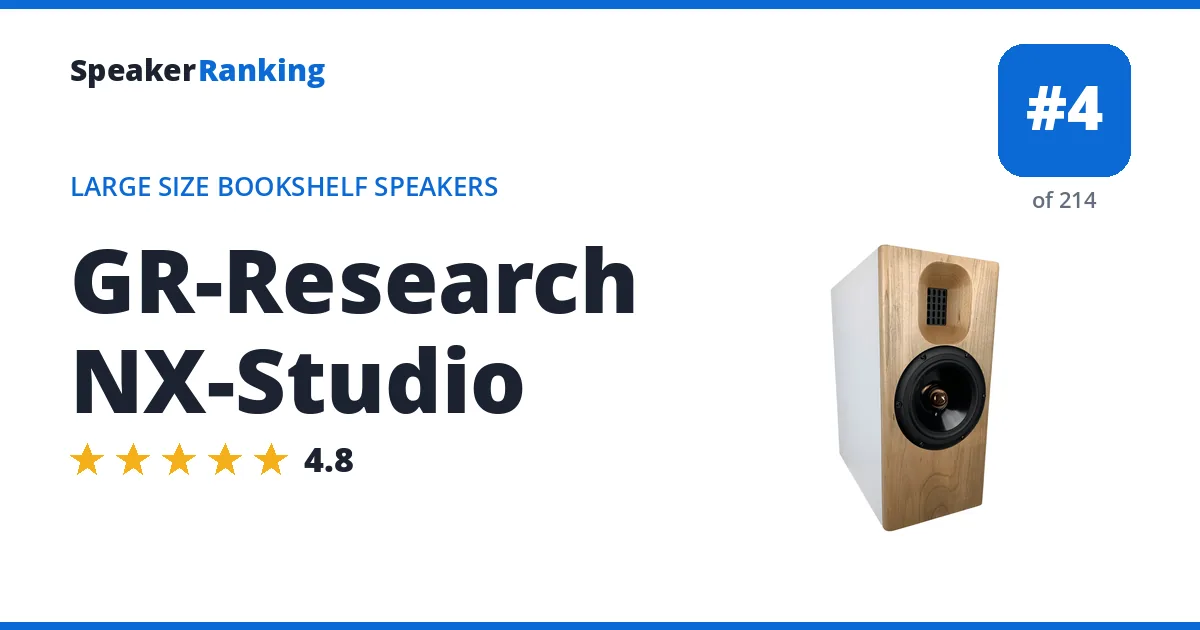
Same family: the GR-Research NX-Bravo (smaller bookshelf, ranked lower, rated 4.4/5) and the GR-Research NX-Treme (floorstanding, rated 4.8/5).
Pros: Ultra clean burst decay/waterfall plot. Amazingly open sounding due to the semi open baffle Neo3 ribbon tweeter, will image better than any other bookshelf speaker. Neo3 ribbon tweeter is one of the best ribbons around for detail. Bass will be very tight and fast due to the sealed enclosure, but may possibly need a sub.
Cons: Bass will be very tight but won’t be quite as deep as others due to the sealed woofer enclosure.
Full GR-Research NX-Studio review and specifications →
| Released | Feb 2020 (6 years ago) |
|---|---|
| DIY Kit | Yes |
| Dimensions | 18”H x 8.5”W x 15.5”D (457.2 x 215.9 x 393.7 mm) |
| Drivers | GR-Research M165NQ 6.5” paper cone, non-resonant polymer frame, copper shorting rings and aluminum phase plug sealed enclosure woofer, GR-Research Neo3 Planar Magnetic Ribbon open baffle tweeter |
| Impedance | 8 ohms |
| Sensitivity | 87dB |
| Weight | 20.5 lbs (9.3 kg) each |
| Woofer Cabinet | sealed |
- Links
- Reviews, Comparisons and Sound Samples
- Head-to-Head Comparisons
- GR-Research NX-Studio vs KEF Reference 1 Meta
- GR-Research NX-Studio vs March Audio Sointuva AWG
- GR-Research NX-Studio vs AsciLab C6B
- GR-Research NX-Studio vs Perlisten S4b
- GR-Research NX-Studio vs Audio First Cadentia 3
- GR-Research NX-Studio vs KEF R3 Meta
- GR-Research NX-Studio vs KEF Q Concerto Meta
- GR-Research NX-Studio vs Wharfedale Aura 2
- See all 50 comparisons
 GR-Research NX-Bravo: $1540 per pair kit with finished cabinets (assembly required) GR Research eBay
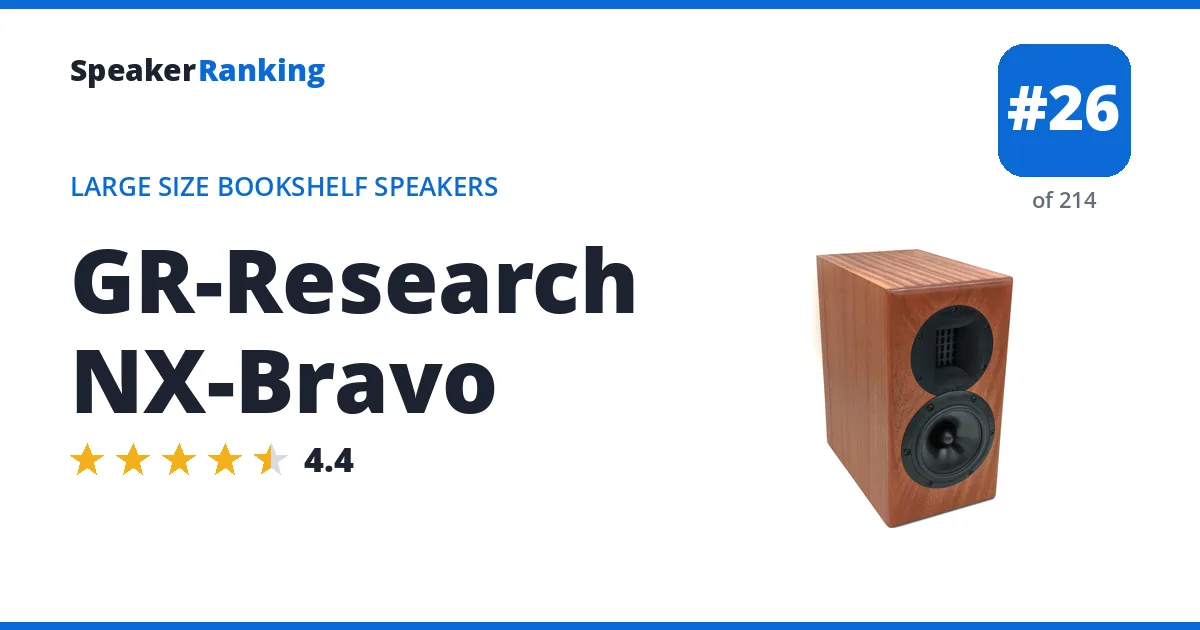
Same family: the GR-Research NX-Studio (larger bookshelf, ranked higher, rated 4.8/5) and the GR-Research NX-Treme (floorstanding, rated 4.8/5).
Pros: Vertical dispersion is unusually wide for a two-way bookshelf: tonal matching holds from about 50° above the tweeter axis down to 20° below it, well beyond the roughly ±10-20° typical of most two-ways. Horizontal dispersion is also wide at about ±70° through the midrange, widening further when toed out, so sidewall acoustic treatment isn’t really necessary. Burst decay is extremely clean with essentially no ringing: the reviewer compared it favorably to a $13,000/pair speaker that showed significant ringing at 120Hz and 500Hz. A deliberate dip around 7kHz reduces sibilance while the 1-4kHz upper-midrange stays neutral, so the sound doesn’t come across as laid-back or recessed. Easy to drive electrically, with a 5-ohm minimum impedance and 2.5-ohm minimum EPDR. Available from $700 as a kit up to about $2,500 fully finished, with the option of the designer’s flush-mount tube/banana-plug terminals for a cleaner look. Measured bass extension of 77Hz (-3dB), with a measured sensitivity of 84.8dB.
Cons: Pointed straight on-axis there’s a deliberate ~5dB high-frequency bump meant to compensate for narrowing dispersion off-axis; it needs about 15° of toe-out (aimed to cross behind the listener) to sound balanced, which won’t suit every room layout. Higher-than-normal high-frequency distortion becomes audible in sine-sweep testing at higher output, and multitone distortion crosses the reviewer’s 3% threshold around 96dB, making roughly 88dB the safer output ceiling. SPL-limited by the manufacturer’s own admission: not intended for loud, full-range playback and best paired with a subwoofer, as with most two-way bookshelf designs. F3 of 77Hz and F10 of 45Hz mean bass only reaches about 50-60Hz in-room. A minor enclosure or port resonance shows up in the frequency response (though not in burst decay), likely a non-issue but visible in measurements. Adding a subwoofer reduces midrange distortion but doesn’t address the elevated high-frequency distortion.
Full GR-Research NX-Bravo review and specifications →
| Bass Extension (-10dB) | 45Hz (measured, Erin’s Audio Corner) |
|---|---|
| Bass Extension (-3dB) | 77Hz (measured, Erin’s Audio Corner) |
| DIY Kit | Yes |
| Dimensions | 14”H x 7.5”W x 11.5”D (355.6 x 190.5 x 292.1 mm) |
| Drivers | GR-Research M165 6.5” paper cone, non-resonant polymer frame woofer, GR-Research Neo3 Planar Magnetic Ribbon deep rear cup tweeter |
| Impedance | 6 ohms nominal, 5 ohms minimum (measured, Erin’s Audio Corner) |
| Sensitivity | 84.8dB (measured, Erin’s Audio Corner) |
| Spinorama Preference Score | 5.18 |
| Spinorama Preference Score with Perfect Sub | 7.52 |
| Weight | 16.1 lbs (7.3 kg) each |
| Woofer Cabinet | ported |
- Links
- Reviews, Comparisons and Sound Samples
- Head-to-Head Comparisons
- GR-Research NX-Bravo vs MoFi SourcePoint 8
- GR-Research NX-Bravo vs Wharfedale Linton 85
- GR-Research NX-Bravo vs KEF R3
- GR-Research NX-Bravo vs KEF Q Concerto Meta
- GR-Research NX-Bravo vs KEF R3 Meta
- GR-Research NX-Bravo vs AsciLab C6B
- GR-Research NX-Bravo vs March Audio Sointuva AWG
- GR-Research NX-Bravo vs ELAC Debut 3.0 DB63
- See all 9 comparisons