Short answer: both are discontinued, so this only matters if you are buying used. Used, the Revel M105 is the better pick: it ranks #15 of 160 bookshelf speakers by sound quality (rated 4.2/5), against #131 (rated 2.4/5) for the KEF Q100. If you want one new, the Revel Performa4 M145 replaces the Revel M105 and is rated 4.3/5 at $1,999.95.
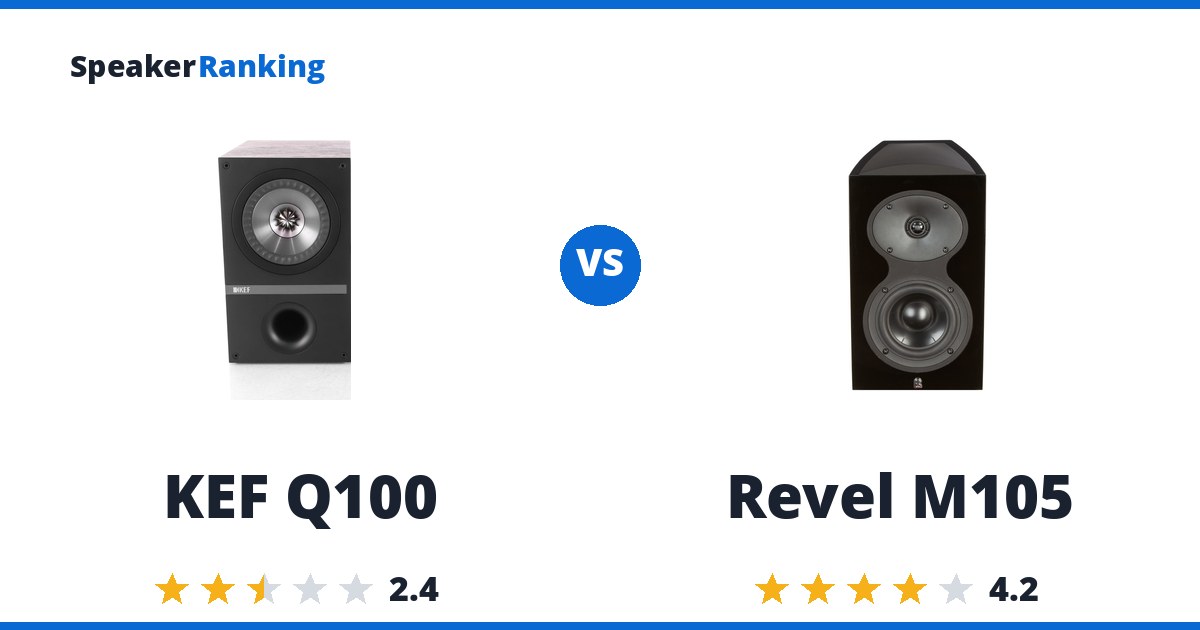
Why pick the KEF Q100: 5.25” Uni-Q coaxial driver keeps the tweeter and woofer point-source aligned for consistent imaging. The catch: CEA2034 spinorama shows broad, audible deviations from flat rather than narrow peaks: a lift from 700Hz-1.5kHz and again from 5kHz up, plus a cancellation notch around 1.4kHz from port/cabinet interaction.
The Revel M105 is the more accurate, deeper-bass choice. CEA2034 spinorama shows an essentially flat on-axis response with only a small 5kHz peak, a smooth listening window, and clean waterfall decay. Its measured preference score, a predictor of how neutral it sounds, is 5.76 against 4.96 for the KEF Q100. Its bass reaches about 63Hz before falling 3dB, against 85Hz for the KEF Q100. The tradeoff: Low nominal impedance demands a capable amplifier that can handle low-impedance loads.
Buy the Revel M105 only if you find one used in good condition; both are discontinued, and it is the better rated of the two. For a new speaker, buy the Revel Performa4 M145, which replaces the Revel M105.
Want more options? Browse the full Passive Home rankings.
Specifications Side By Side
| KEF Q100 | Revel M105 | |
|---|---|---|
| Price | $550 per pair Discontinued | $1,500 per pair Discontinued |
| Ranked | #131 of 160 in Medium Size Bookshelf Speakers | #15 of 160 in Medium Size Bookshelf Speakers |
| Bass Extension (-3dB) | 85Hz (measured, Audio Science Review) | 63Hz (measured, Audio Science Review) |
| Bass Extension (-10dB) | 65Hz (measured, Audio Science Review) | 49.8Hz (derived, log-interpolated between spinorama.org -9dB/-12dB points) |
| Sensitivity | 85dB (2.83V/1m, measured, Audio Science Review) | 85dB (2.83V/1m, measured, Audio Science Review) |
| Impedance | 8 ohms nominal | 8 ohms nominal, low minimum |
| Frequency Response | 49Hz - 40kHz (+/-3dB) (Manufacturer specified) | 60Hz - 44kHz (+/-3dB) (Manufacturer specified) |
| Drivers | 5.25” Uni-Q aluminum coaxial driver, 1” aluminum dome tweeter | 5.25” aluminum cone woofer, 1” aluminum tweeter with acoustic lens waveguide |
| Weight | 13 lbs (5.9 kg) each | 15.4 lbs (7 kg) each |
| Dimensions | 11.8”H x 7.1”W x 10.7”D (300 x 180 x 272 mm) | 14”H x 7.9”W x 9.8”D (355.6 x 200.7 x 248.9 mm) |
| Woofer Cabinet | ported, rear | ported, rear |
| Spinorama Preference Score | 4.96 (spinorama.org) | 5.76 |
| Spinorama Preference Score with Perfect Sub | 7.24 (spinorama.org) | 8.18 |
| DIY Kit | No | No |
Related Speaker Comparisons
More top alternatives to Revel M105:
- Ascend Sierra 1 v2 vs Revel M105
- KEF LS50 Meta vs Revel M105
- Arendal 1961 Monitor vs Revel M105
- Monitor Audio Silver 50 7G vs Revel M105
- Revel M105 vs Klipsch RP-500M II
Prices on this page were last checked October 9, 2026 at 8:01 AM UTC. Product prices and availability are accurate as of that date/time and are subject to change; the price and availability shown on Amazon at the time of purchase will apply to the purchase of this product.
As an eBay Partner, we may be compensated if you make a purchase.
The Two Speakers In Full
 KEF Q100: $550 per pair Discontinued eBay
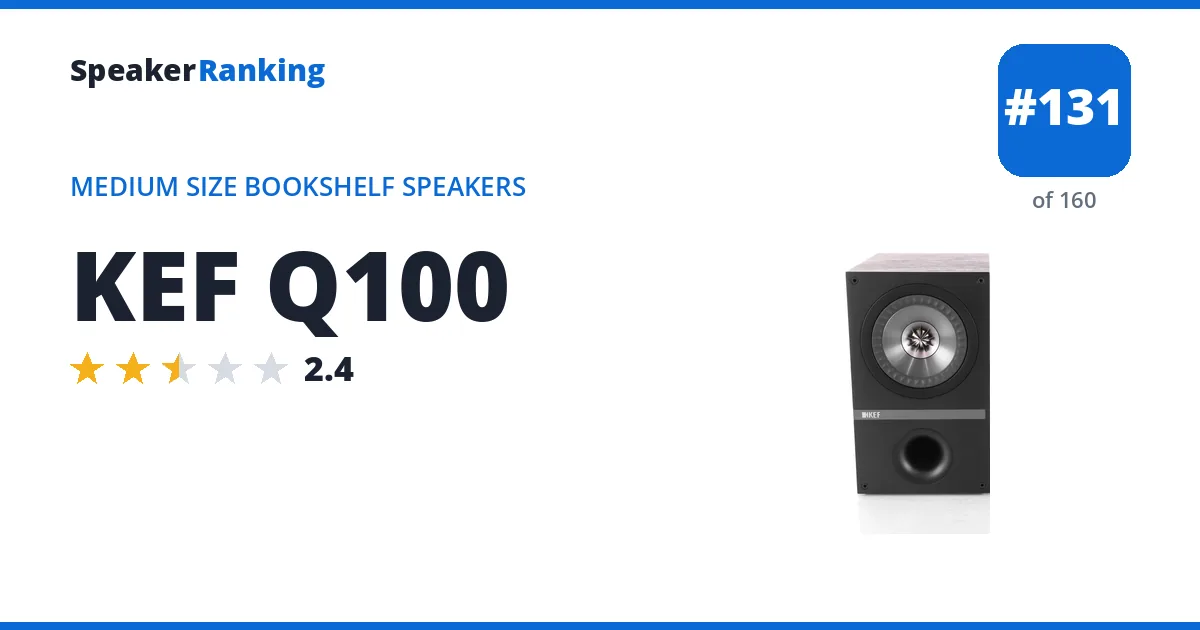
Newer model: the KEF Q1 Meta, ranked higher, rated 3.6/5.
Pros: 5.25” Uni-Q coaxial driver keeps the tweeter and woofer point-source aligned for consistent imaging. 86dB sensitivity is reasonably easy to drive. Measured bass extension of 85Hz (-3dB), with a measured sensitivity of 85dB.
Cons: CEA2034 spinorama shows broad, audible deviations from flat rather than narrow peaks: a lift from 700Hz-1.5kHz and again from 5kHz up, plus a cancellation notch around 1.4kHz from port/cabinet interaction. Bass sensitivity drops to about 80dB and impedance falls below 4 ohms in the bass, demanding a capable amplifier. The reviewer heard boomy, buzzing bass that improved somewhat with the port plugged, and could not recommend it, calling the famous reputation more about looks than sound. Discontinued.
Full KEF Q100 review and specifications →
| Bass Extension (-10dB) | 65Hz (measured, Audio Science Review) |
|---|---|
| Bass Extension (-3dB) | 85Hz (measured, Audio Science Review) |
| DIY Kit | No |
| Dimensions | 11.8”H x 7.1”W x 10.7”D (300 x 180 x 272 mm) |
| Drivers | 5.25” Uni-Q aluminum coaxial driver, 1” aluminum dome tweeter |
| Frequency Response | 49Hz - 40kHz (+/-3dB) (Manufacturer specified) |
| Impedance | 8 ohms nominal |
| Sensitivity | 85dB (2.83V/1m, measured, Audio Science Review) |
| Spinorama Preference Score | 4.96 (spinorama.org) |
| Spinorama Preference Score with Perfect Sub | 7.24 (spinorama.org) |
| Weight | 13 lbs (5.9 kg) each |
| Woofer Cabinet | ported, rear |
- Reviews, Comparisons and Sound Samples
- Head-to-Head Comparisons
 Revel M105: $1,500 per pair Discontinued eBay
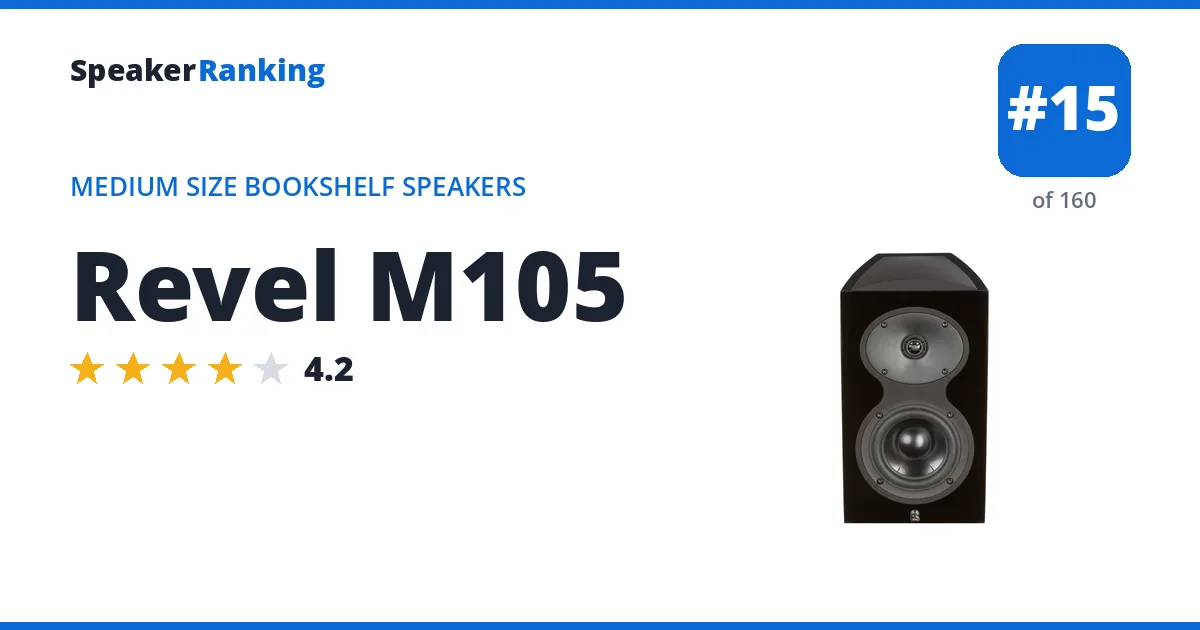
Newer model: the Revel Performa4 M145, ranked higher, estimated 4.3/5.
Same family: the Revel M106 (larger bookshelf, rated 4.6/5), the Revel F206 (smaller floorstanding, rated 4.5/5), the Revel F208 (larger floorstanding, rated 4.5/5), the Revel Performa3 C205 (smaller center, rated 4.1/5) and the Revel Performa3 C208 (larger center, rated 4/5).
Pros: CEA2034 spinorama shows an essentially flat on-axis response with only a small 5kHz peak, a smooth listening window, and clean waterfall decay. Wide horizontal dispersion gives flexibility with toe-in. The reviewer called it reference-quality performance with minor EQ correction applied. Measured bass extension of 63Hz (-3dB), with a measured sensitivity of 85dB.
Cons: Low nominal impedance demands a capable amplifier that can handle low-impedance loads. Bass distortion runs high in the 80-250Hz range from woofer displacement, and maximum output is limited compared to larger designs. Discontinued.
Full Revel M105 review and specifications →
| Bass Extension (-10dB) | 49.8Hz (derived, log-interpolated between spinorama.org -9dB/-12dB points) |
|---|---|
| Bass Extension (-3dB) | 63Hz (measured, Audio Science Review) |
| DIY Kit | No |
| Dimensions | 14”H x 7.9”W x 9.8”D (355.6 x 200.7 x 248.9 mm) |
| Drivers | 5.25” aluminum cone woofer, 1” aluminum tweeter with acoustic lens waveguide |
| Frequency Response | 60Hz - 44kHz (+/-3dB) (Manufacturer specified) |
| Impedance | 8 ohms nominal, low minimum |
| Sensitivity | 85dB (2.83V/1m, measured, Audio Science Review) |
| Spinorama Preference Score | 5.76 |
| Spinorama Preference Score with Perfect Sub | 8.18 |
| Weight | 15.4 lbs (7 kg) each |
| Woofer Cabinet | ported, rear |
- Links
- Reviews, Comparisons and Sound Samples
- Head-to-Head Comparisons