Short answer: the ELAC Debut 3.0 DB63. It ranks #50 of 203 bookshelf speakers by sound quality (rated 4.2/5) at $499 and is still sold new; the Yamaha NS-10 ranks #197 (rated 2.2/5) and is discontinued, so it is only an option used.
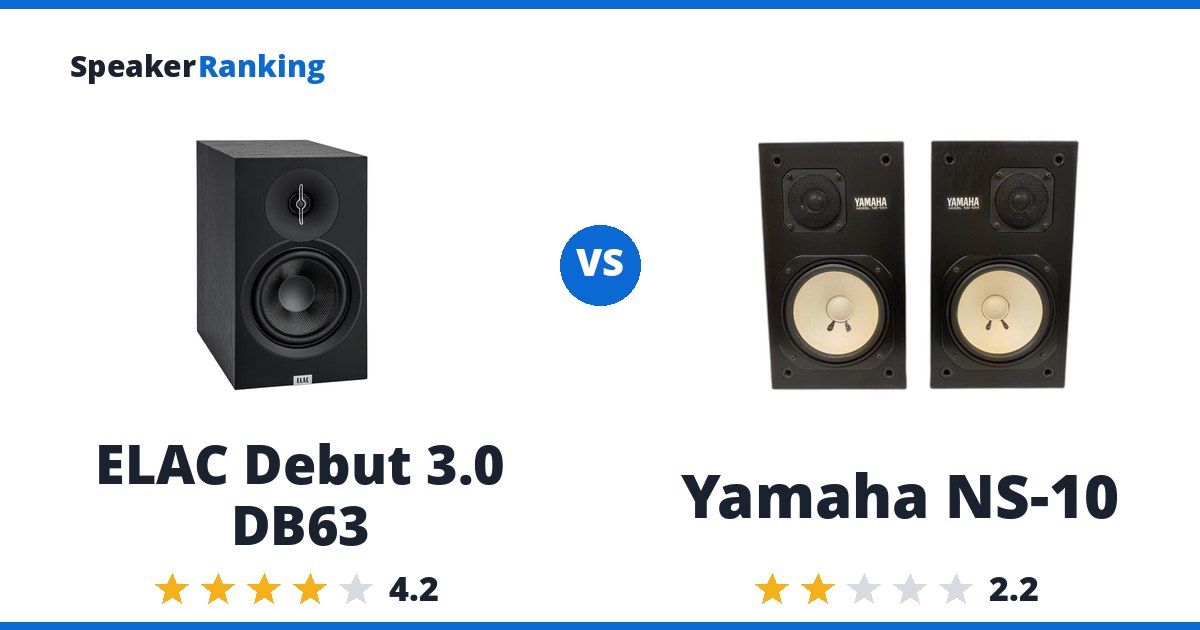
The ELAC Debut 3.0 DB63 is the better-sounding, deeper-bass pick. 1” aluminum dome tweeter with a distinctive partial-lens waveguide design paired with a 6.5” third-generation aramid fiber cone woofer, in a robustly built cabinet for the price. Its bass reaches about 76Hz before falling 3dB, against 126Hz for the Yamaha NS-10. The catch: A dip in the lower midrange (300-600Hz, about 1.5dB) reduces vocal warmth and can make voices sound slightly hollow.
Why pick the Yamaha NS-10: Legendary studio reference monitor with a well-documented history; Yamaha’s original spec sheet included genuine measured data (frequency response, distortion, impedance, polar response) rather than just marketing numbers, unusually transparent for the era. Watch for: A pronounced peak of about 7dB above the midrange average around 1.7kHz gives the sound a forward, bright, or “tinny” character: this is the real underlying issue, and it wasn’t actually fixed by the “Studio” revision.
Buy the ELAC Debut 3.0 DB63. It is rated higher for sound quality, and the Yamaha NS-10 is discontinued, so it is only available used.
Want more options? Browse the full Passive Home rankings.
Specifications Side By Side
| ELAC Debut 3.0 DB63 | Yamaha NS-10 | |
|---|---|---|
| Price | $499.00 per pair | $499 per pair Discontinued |
| Ranked | #50 of 203 in Large Size Bookshelf Speakers | #197 of 203 in Large Size Bookshelf Speakers |
| Bass Extension (-10dB) | 40Hz (measured, Erin’s Audio Corner) | 75Hz (measured, Erin’s Audio Corner) |
| Bass Extension (-3dB) | 76Hz (measured, Erin’s Audio Corner) | 126Hz (measured, Erin’s Audio Corner) |
| Dimensions | 13.3”H x 7.7”W x 11.7”D (337.8 x 195.6 x 297.2 mm) | 15”H x 8.5”W x 7.8”D (382.0 x 215.0 x 198.0 mm) |
| Impedance | 6 ohms nominal (4.4 ohms minimum, measured, Erin’s Audio Corner) | 8 ohms nominal, 5.4 ohms minimum (measured, Erin’s Audio Corner) |
| Sensitivity | 86.2dB (measured, Erin’s Audio Corner) | 90.2dB (measured, Erin’s Audio Corner) |
| Drivers | 6.5” Aramid Fiber woofer, 1” soft dome tweeter | 7.1” woofer, 1.4” soft dome tweeter |
| Weight | 17.2 lbs (7.8 kg) each | 9.5 lbs (4.3 kg) |
| Woofer Cabinet | ported, rear | sealed |
| DIY Kit | No | No |
| Spinorama Preference Score | - | 2.24 (spinorama.org) |
| Spinorama Preference Score with Perfect Sub | - | 5.63 (spinorama.org) |
Related Speaker Comparisons
How ELAC Debut 3.0 DB63 compares with other leading options:
- ELAC Debut 3.0 DB63 vs TAD Compact Reference One (CR1TX)
- ELAC Debut 3.0 DB63 vs Perlisten S4b
- ELAC Debut 3.0 DB63 vs KEF Reference 1 Meta
- ELAC Debut 3.0 DB63 vs GR-Research NX-Studio
- ELAC Debut 3.0 DB63 vs March Audio Sointuva AWG
Prices on this page were last checked October 9, 2026 at 8:01 AM UTC. Product prices and availability are accurate as of that date/time and are subject to change; the price and availability shown on Amazon at the time of purchase will apply to the purchase of this product.
As an eBay Partner, we may be compensated if you make a purchase.
The Two Speakers In Full
 ELAC Debut 3.0 DB63: $499.00 per pair Amazon Crutchfield eBay
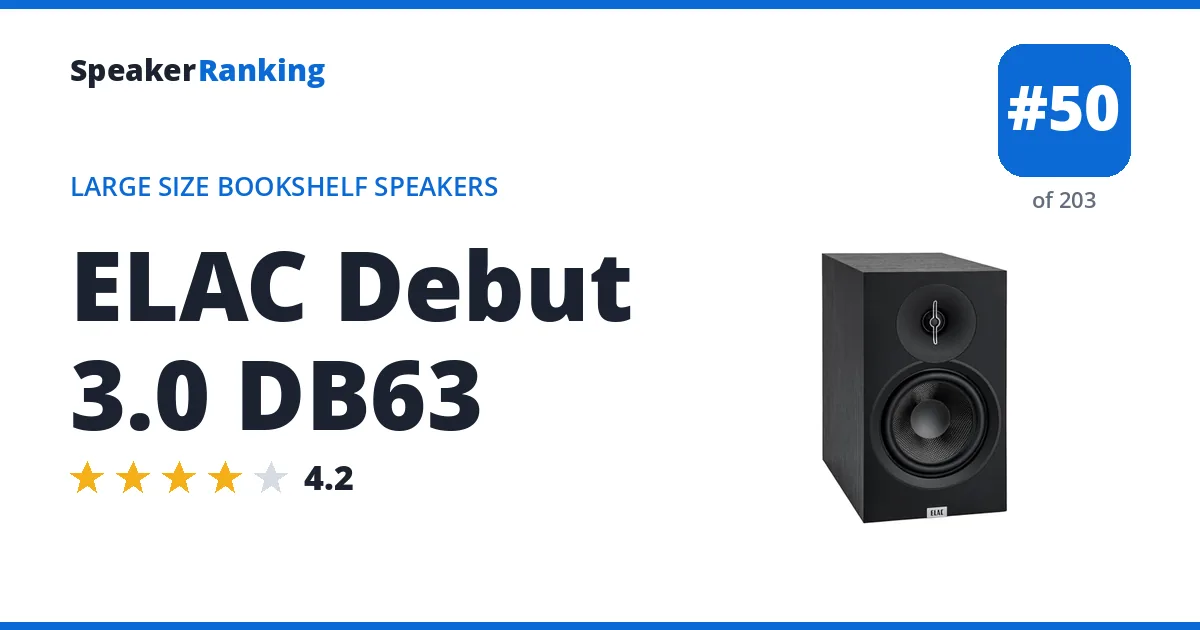
Older model: the ELAC Debut 2.0 B6.2 (ranked lower, rated 3.5/5).
Same family: the ELAC Debut 3.0 DB53 (smaller bookshelf, estimated 3.9/5), the ELAC Debut 3.0 DF53 (smaller floorstanding, estimated 4.2/5), the ELAC Debut 3.0 DF63 (larger floorstanding, rated 4.2/5), the ELAC Debut 3.0 DC53 (smaller center, estimated 3.4/5) and the ELAC Debut 3.0 DC63 (larger center, estimated 3.5/5).
Pros: 1” aluminum dome tweeter with a distinctive partial-lens waveguide design paired with a 6.5” third-generation aramid fiber cone woofer, in a robustly built cabinet for the price. Shallow bass rolloff (F3 76Hz, F10 40Hz) allows placement close to a wall without excessive boominess, useful for smaller living rooms. Solid measured performance for the price: on-axis linearity within about 2.5dB, impedance dipping only to about 4.4 ohms (easily AVR-driven), and roughly 20-26dB of usable dynamic range. A clear improvement over its sibling ELAC DB62, which has a sibilance issue tied to the crossover that can’t be fixed with EQ. Wide horizontal radiation of about ±60°, giving a spacious soundstage. Distortion looks good at a moderate 86dB and still reasonable at 96dB. Takes well to EQ correction: the reviewer provides a specific filter set (a low-shelf boost at 650Hz plus peaking cuts/boosts at 550Hz, 660Hz, and 3kHz) that meaningfully smooths out its known deviations. Measured bass extension of 76Hz (-3dB), with a measured sensitivity of 86.2dB.
Cons: A dip in the lower midrange (300-600Hz, about 1.5dB) reduces vocal warmth and can make voices sound slightly hollow. A high-Q resonance around 650-750Hz shows up clearly in measurements, though the reviewer couldn’t reliably hear it in his own A/B testing. A dip around 2-3kHz (roughly 1-2dB) slightly reduces speech intelligibility and attack in the upper midrange. Directivity droops above about 2kHz as the midwoofer narrows toward its beaming frequency while the tweeter’s pattern behaves differently: an inherent trade-off of physically separated drivers that can’t be fully corrected without introducing other issues. Multitone distortion crosses the reviewer’s 3% threshold in the 200Hz-1kHz range, and adding a subwoofer at an 80Hz crossover only modestly reduces it. Toeing the speaker away from the listener loses noticeable top-end air and cymbal energy, giving a softer upper register. Practical loudness ceiling is around 90dB at typical listening distance before midrange distortion and bass attack begin to degrade. Still needs a subwoofer for extension below about 40Hz.
Full ELAC Debut 3.0 DB63 review and specifications →
| Bass Extension (-10dB) | 40Hz (measured, Erin’s Audio Corner) |
|---|---|
| Bass Extension (-3dB) | 76Hz (measured, Erin’s Audio Corner) |
| DIY Kit | No |
| Dimensions | 13.3”H x 7.7”W x 11.7”D (337.8 x 195.6 x 297.2 mm) |
| Drivers | 6.5” Aramid Fiber woofer, 1” soft dome tweeter |
| Impedance | 6 ohms nominal (4.4 ohms minimum, measured, Erin’s Audio Corner) |
| Sensitivity | 86.2dB (measured, Erin’s Audio Corner) |
| Weight | 17.2 lbs (7.8 kg) each |
| Woofer Cabinet | ported, rear |
- Links
- Reviews, Comparisons and Sound Samples
- Head-to-Head Comparisons
- ELAC Debut 3.0 DB63 vs Emotiva Airmotiv XB2
- ELAC Debut 3.0 DB63 vs Arendal 1723 Bookshelf S THX
- ELAC Debut 3.0 DB63 vs Perlisten A3m
- ELAC Debut 3.0 DB63 vs JBL HDI-1600
- ELAC Debut 3.0 DB63 vs Aalto Speakers Aalto 3 Passive
- ELAC Debut 3.0 DB63 vs JTR Noesis 210HT
- ELAC Debut 3.0 DB63 vs Danley SH50
- ELAC Debut 3.0 DB63 vs Perlisten R5m
- See all 130 comparisons
 Yamaha NS-10: $499 per pair Discontinued eBay
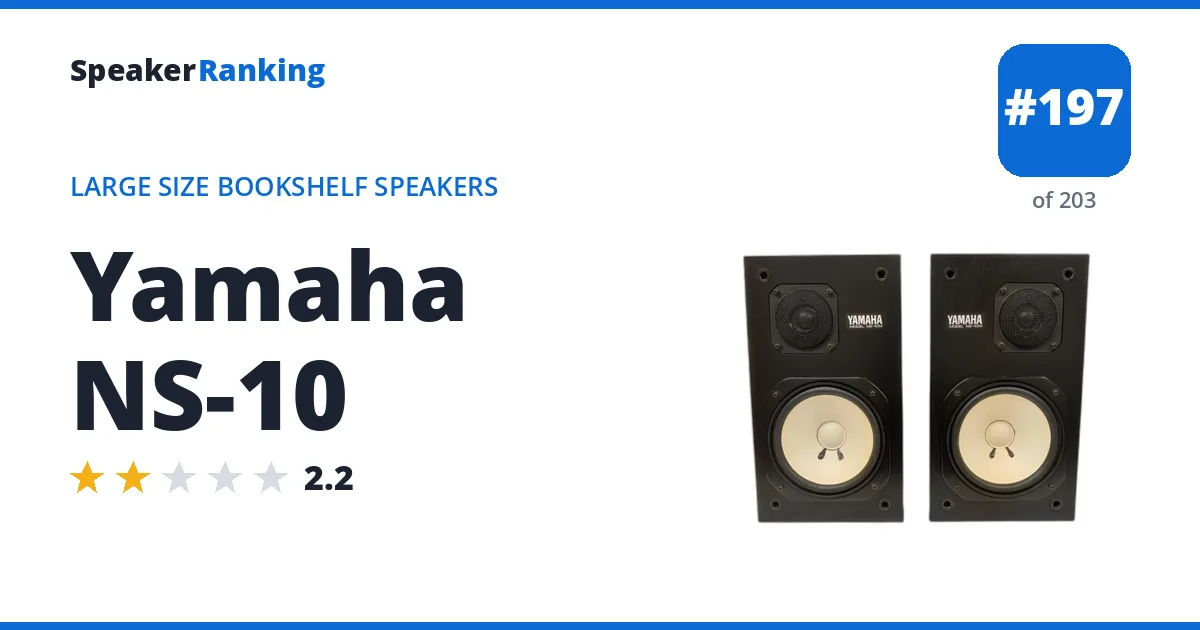
Pros: Legendary studio reference monitor with a well-documented history; Yamaha’s original spec sheet included genuine measured data (frequency response, distortion, impedance, polar response) rather than just marketing numbers, unusually transparent for the era. Distortion, compression, and multitone performance all measured better than the reviewer expected for a decades-old design: in some respects competitive with newer speakers he’s tested. Vertical dispersion holds up reasonably well for a speaker of this vintage. The redesigned “Studio” cabinet is more robust than the original, with crossover tweaks and nicer binding-post terminals. Sealed cabinet design allows placement close to a wall without added boominess, though at the cost of overall bass extension. Measured bass extension of 126Hz (-3dB), with a measured sensitivity of 90.2dB.
Cons: A pronounced peak of about 7dB above the midrange average around 1.7kHz gives the sound a forward, bright, or “tinny” character: this is the real underlying issue, and it wasn’t actually fixed by the “Studio” revision. Comparing the Studio version’s measured response to the original NS-10M’s published data, the original arguably measures more linear: Yamaha’s fix (lowering tweeter level by 2-3dB) left the core midrange peak largely untouched, addressing the wrong problem. The famous “tissue paper over the tweeter” mixing-engineer trick doesn’t actually help: testing it directly showed it adds diffraction and comb filtering rather than correcting the real midrange peak. Poor horizontal directivity, especially in its designed on-console orientation: usable window is only about ±20° off the tweeter axis before tonal character shifts noticeably. Directivity mismatches between direct and reflected sound make this difficult to properly correct with EQ in a typical farfield listening setup with nearby wall reflections. Bass is quite limited (F3 around 100Hz in most rooms once corrected for the inflated on-axis sensitivity reading), typical of a small sealed monitor design. Correcting the main midrange peak with EQ likely requires two bands rather than a single simple filter, since the peak isn’t perfectly symmetrical. Possible age-related tweeter compression at very high output, potentially from degraded ferrofluid affecting heat dissipation in these decades-old drivers. Discontinued.
Full Yamaha NS-10 review and specifications →
| Bass Extension (-10dB) | 75Hz (measured, Erin’s Audio Corner) |
|---|---|
| Bass Extension (-3dB) | 126Hz (measured, Erin’s Audio Corner) |
| DIY Kit | No |
| Dimensions | 15”H x 8.5”W x 7.8”D (382.0 x 215.0 x 198.0 mm) |
| Drivers | 7.1” woofer, 1.4” soft dome tweeter |
| Impedance | 8 ohms nominal, 5.4 ohms minimum (measured, Erin’s Audio Corner) |
| Sensitivity | 90.2dB (measured, Erin’s Audio Corner) |
| Spinorama Preference Score | 2.24 (spinorama.org) |
| Spinorama Preference Score with Perfect Sub | 5.63 (spinorama.org) |
| Weight | 9.5 lbs (4.3 kg) |
| Woofer Cabinet | sealed |
- Reviews, Comparisons and Sound Samples
- Head-to-Head Comparisons