Short answer: neither is a neutral choice, but the NS-10 is the flawed classic. The Yamaha NS-10 has a pronounced peak of about 7dB above the midrange average around 1.7kHz, the forward, bright character that was never fixed by the “Studio” revision. The NS-6490 lets all three drivers bleed into each other’s range, with only a capacitor separating the mid and tweeter, which Amir found causes rising amplitude. Both are rated below 3.0/5 among the 134 bookshelf speakers; for better sound, the Emotiva Airmotiv XB2 ranks #41 at $549.
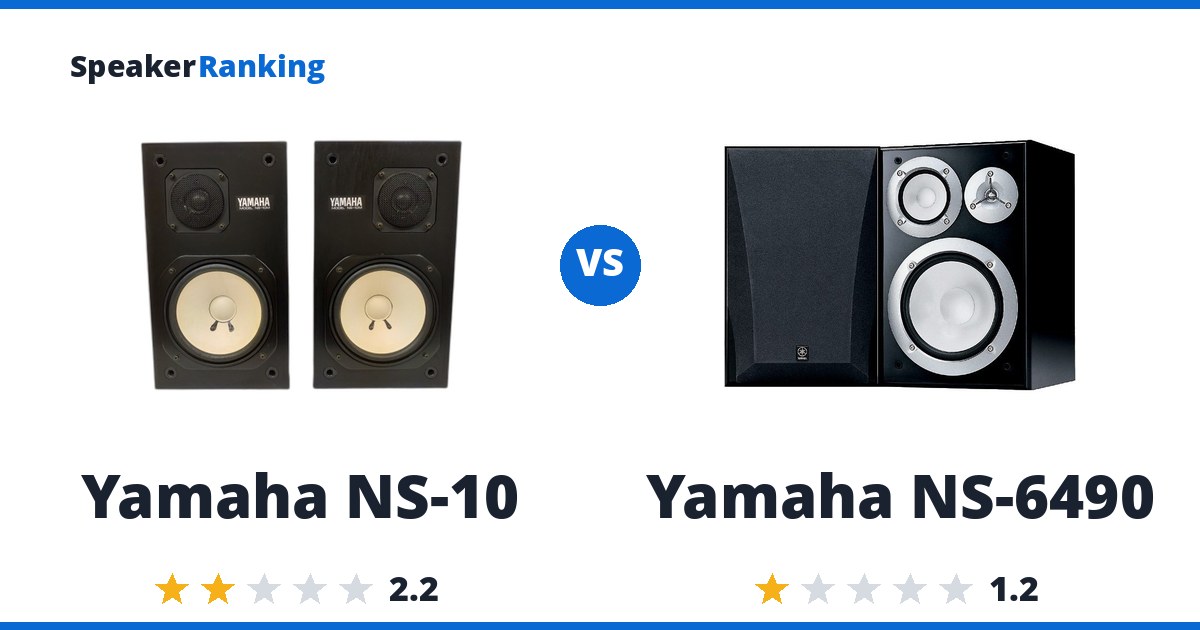
The Yamaha NS-10 is the better-sounding option. Legendary studio reference monitor with a well-documented history; Yamaha’s original spec sheet included genuine measured data (frequency response, distortion, impedance, polar response) rather than just marketing numbers, unusually transparent for the era. Watch for: A pronounced peak of about 7dB above the midrange average around 1.7kHz gives the sound a forward, bright, or “tinny” character: this is the real underlying issue, and it wasn’t actually fixed by the “Studio” revision.
Buy the Yamaha NS-10 only if you find one used in good condition; both are discontinued, and it is the better rated of the two. For a new speaker, start with the Emotiva Airmotiv XB2 instead.
Want more options? Browse the full Passive Home rankings.
Specifications Side By Side
| Yamaha NS-10 | Yamaha NS-6490 | |
|---|---|---|
| Price | $499 per pair Discontinued | $129.95 per pair Discontinued |
| Ranked | #129 of 134 in Large Size Bookshelf Speakers | #134 of 134 in Large Size Bookshelf Speakers |
| Bass Extension (-10dB) | 75Hz (measured, Erin’s Audio Corner) | 54.4Hz (measured, Audio Science Review) |
| Bass Extension (-3dB) | 126Hz (measured, Erin’s Audio Corner) | - |
| Drivers | 7.1” woofer, 1.4” soft dome tweeter | 8” woofer, 4” midrange cone, 7/8” balanced dome tweeter (3-way, acoustic suspension) |
| Weight | 9.5 lbs (4.3 kg) | 13.2 lbs (6 kg) each |
| Sensitivity | 90.2dB (measured, Erin’s Audio Corner) | 89.6dB (2.83V/1m, measured, Audio Science Review) |
| Impedance | 8 ohms nominal, 5.4 ohms minimum (measured, Erin’s Audio Corner) | 8 ohms |
| Dimensions | 15”H x 8.5”W x 7.8”D (382.0 x 215.0 x 198.0 mm) | 16.2H x 10.5W x 13.2D in |
| Woofer Cabinet | sealed | - |
| Spinorama Preference Score | 2.24 (spinorama.org) | 2.17 |
| Spinorama Preference Score with Perfect Sub | 5.63 (spinorama.org) | 5.05 |
| DIY Kit | No | No |
| Frequency Response | - | 45Hz - 23kHz (Manufacturer specified) |
| Power Handling | - | 70W nominal, 140W max |
Related Speaker Comparisons
More top alternatives to Yamaha NS-10:
- ELAC Debut 3.0 DB63 vs Yamaha NS-10
- Revel Performa M22 vs Yamaha NS-10
- Klipsch RP-600M vs Yamaha NS-10
- Triangle Borea BR03 vs Yamaha NS-10
- JBL 4319 vs Yamaha NS-10
Prices on this page were last checked October 2, 2026 at 10:18 PM UTC. Product prices and availability are accurate as of that date/time and are subject to change; the price and availability shown on Amazon at the time of purchase will apply to the purchase of this product.
As an eBay Partner, we may be compensated if you make a purchase.
The Two Speakers In Full
 Yamaha NS-10: $499 per pair Discontinued eBay
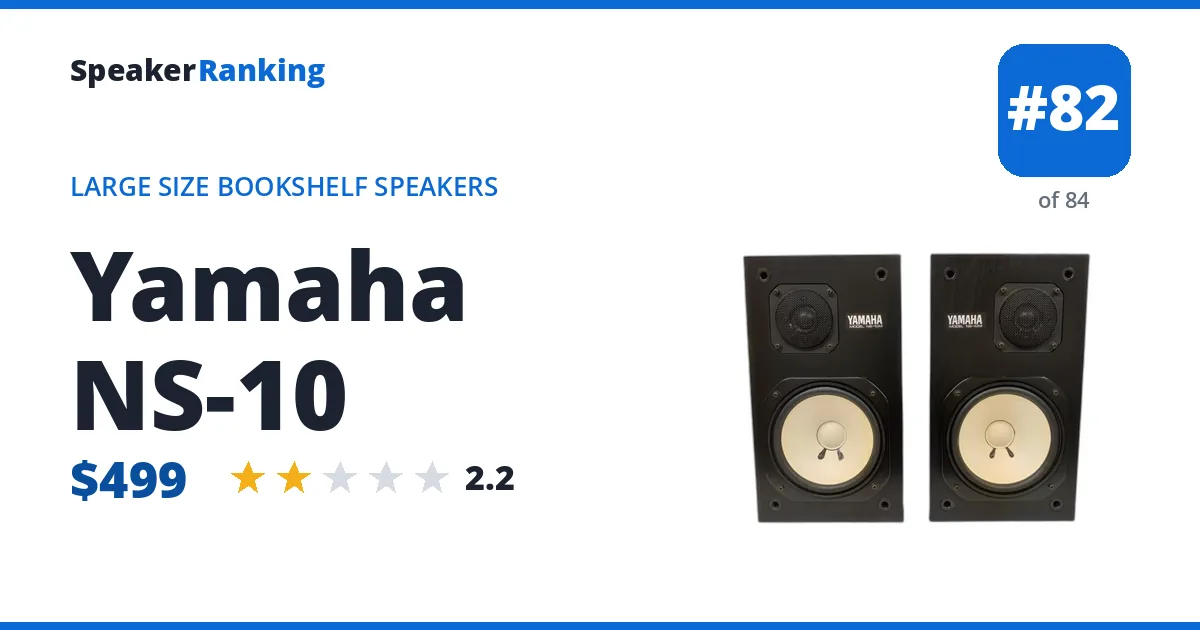
Pros: Legendary studio reference monitor with a well-documented history; Yamaha’s original spec sheet included genuine measured data (frequency response, distortion, impedance, polar response) rather than just marketing numbers, unusually transparent for the era. Distortion, compression, and multitone performance all measured better than the reviewer expected for a decades-old design: in some respects competitive with newer speakers he’s tested. Vertical dispersion holds up reasonably well for a speaker of this vintage. The redesigned “Studio” cabinet is more robust than the original, with crossover tweaks and nicer binding-post terminals. Sealed cabinet design allows placement close to a wall without added boominess, though at the cost of overall bass extension. Measured bass extension of 126Hz (-3dB), with a measured sensitivity of 90.2dB.
Cons: A pronounced peak of about 7dB above the midrange average around 1.7kHz gives the sound a forward, bright, or “tinny” character: this is the real underlying issue, and it wasn’t actually fixed by the “Studio” revision. Comparing the Studio version’s measured response to the original NS-10M’s published data, the original arguably measures more linear: Yamaha’s fix (lowering tweeter level by 2-3dB) left the core midrange peak largely untouched, addressing the wrong problem. The famous “tissue paper over the tweeter” mixing-engineer trick doesn’t actually help: testing it directly showed it adds diffraction and comb filtering rather than correcting the real midrange peak. Poor horizontal directivity, especially in its designed on-console orientation: usable window is only about ±20° off the tweeter axis before tonal character shifts noticeably. Directivity mismatches between direct and reflected sound make this difficult to properly correct with EQ in a typical farfield listening setup with nearby wall reflections. Bass is quite limited (F3 around 100Hz in most rooms once corrected for the inflated on-axis sensitivity reading), typical of a small sealed monitor design. Correcting the main midrange peak with EQ likely requires two bands rather than a single simple filter, since the peak isn’t perfectly symmetrical. Possible age-related tweeter compression at very high output, potentially from degraded ferrofluid affecting heat dissipation in these decades-old drivers. Discontinued.
Full Yamaha NS-10 review and specifications →
| Bass Extension (-10dB) | 75Hz (measured, Erin’s Audio Corner) |
|---|---|
| Bass Extension (-3dB) | 126Hz (measured, Erin’s Audio Corner) |
| DIY Kit | No |
| Dimensions | 15”H x 8.5”W x 7.8”D (382.0 x 215.0 x 198.0 mm) |
| Drivers | 7.1” woofer, 1.4” soft dome tweeter |
| Impedance | 8 ohms nominal, 5.4 ohms minimum (measured, Erin’s Audio Corner) |
| Sensitivity | 90.2dB (measured, Erin’s Audio Corner) |
| Spinorama Preference Score | 2.24 (spinorama.org) |
| Spinorama Preference Score with Perfect Sub | 5.63 (spinorama.org) |
| Weight | 9.5 lbs (4.3 kg) |
| Woofer Cabinet | sealed |
- Reviews, Comparisons and Sound Samples
- Head-to-Head Comparisons
 Yamaha NS-6490: $129.95 per pair Discontinued eBay
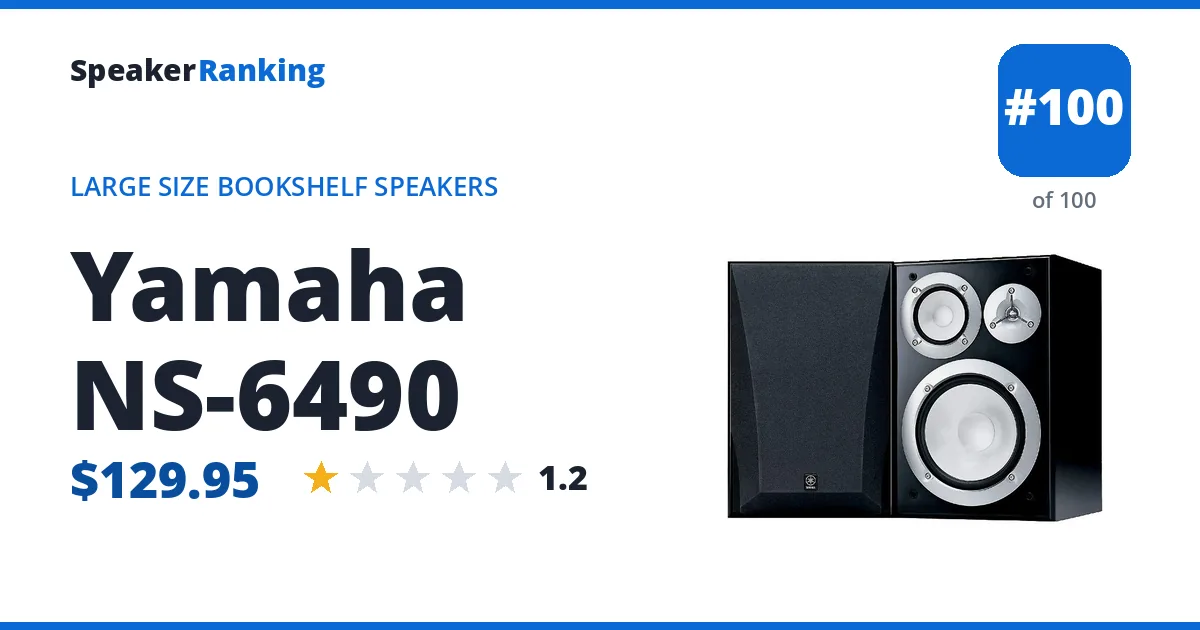
Pros: Attractive industrial design with a large 8-inch woofer for the price. Simple direct-driven woofer with capacitor-only mid/tweeter crossovers keeps the design straightforward. Measured bass extension of 54.4Hz (-10dB), with a measured sensitivity of 89.6dB.
Cons: Amir found the woofer runs essentially full-range with only a capacitor separating the mid and tweeter, letting all three drivers bleed into each other’s range and causing “rising amplitude” across the response. Extensive narrow peaking indicates numerous cabinet resonances: Amir noted, “we have more of them than I have ever seen.” Distortion is high across the measurement range, and directivity is highly variable, particularly vertically. With a 1.6 preference score, Amir concluded, “I just can’t recommend it,” noting that extensive EQ would not fix the underlying resonance issues. Discontinued and no longer sold new.
Full Yamaha NS-6490 review and specifications →
| Bass Extension (-10dB) | 54.4Hz (measured, Audio Science Review) |
|---|---|
| DIY Kit | No |
| Dimensions | 16.2H x 10.5W x 13.2D in |
| Drivers | 8” woofer, 4” midrange cone, 7/8” balanced dome tweeter (3-way, acoustic suspension) |
| Frequency Response | 45Hz - 23kHz (Manufacturer specified) |
| Impedance | 8 ohms |
| Power Handling | 70W nominal, 140W max |
| Sensitivity | 89.6dB (2.83V/1m, measured, Audio Science Review) |
| Spinorama Preference Score | 2.17 |
| Spinorama Preference Score with Perfect Sub | 5.05 |
| Weight | 13.2 lbs (6 kg) each |
- Links
- Reviews, Comparisons and Sound Samples
- Head-to-Head Comparisons