Short answer: the Ascend Sierra 1 v2. It ranks #3 of 160 bookshelf speakers by sound quality (rated 4.7/5) at $1,000 and is still sold new; the Pioneer Elite SP-EBS73-LR ranks #152 (rated 1.6/5) and is discontinued, so it is only an option used.
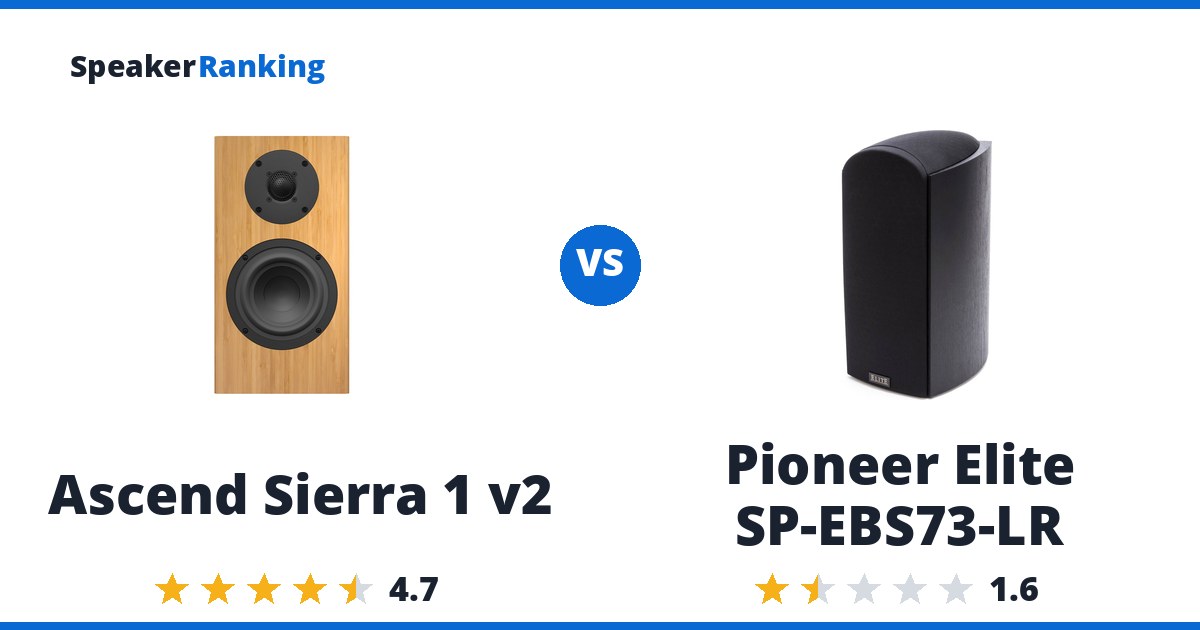
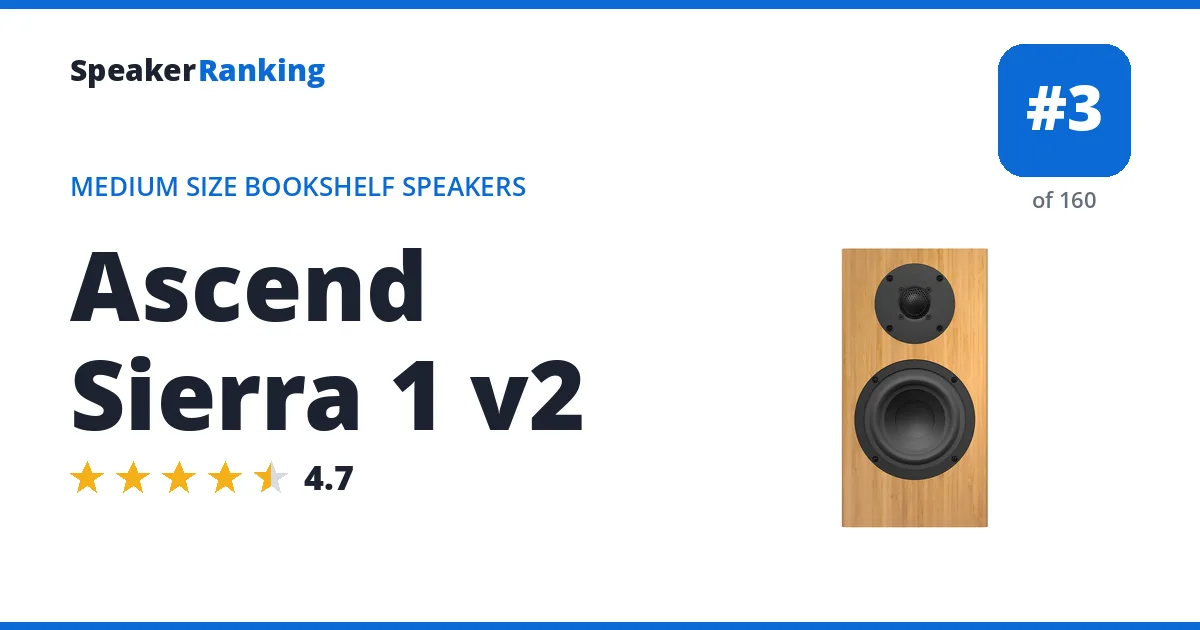
The Ascend Sierra 1 v2 is the more accurate, deeper-bass pick. Formaldehyde-free layered bamboo ply cabinet with a 1” dome tweeter over a 5.25” midwoofer, mated by a 4th-order acoustic crossover rather than a stock textbook design. Its measured preference score, a predictor of how neutral it sounds, is 6.65 against 3.22 for the Pioneer Elite SP-EBS73-LR. Its bass reaches about 55Hz before falling 3dB, against 64.5Hz for the Pioneer Elite SP-EBS73-LR. The catch: F3 of 55Hz and F10 of 39Hz mean in-room extension tops out in the mid-40s Hz; the reviewer still recommends a subwoofer for full-range material.
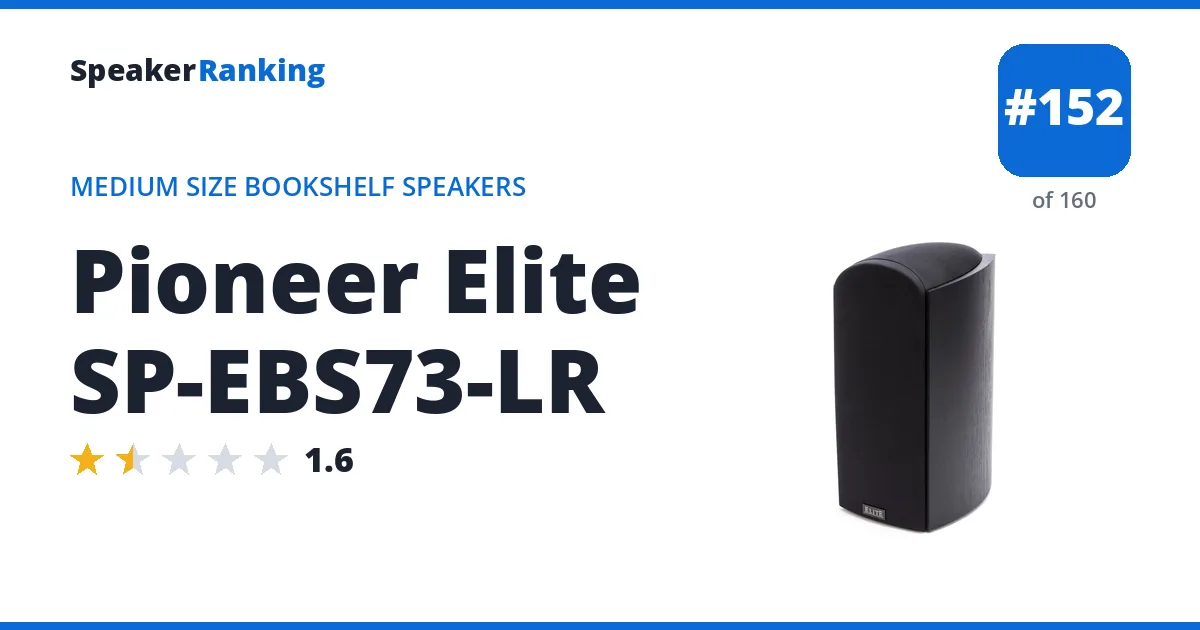
Why pick the Pioneer Elite SP-EBS73-LR: Unique dual-driver design combines a front-facing 3-way speaker with an up-firing 2-way Dolby Atmos coaxial driver in one cabinet, designed by Andrew Jones. The catch: A wide dip between 3-10kHz makes the front speaker sound “somewhat dull” without EQ, and impedance dips below 4 ohms demand a capable amplifier.
Buy the Ascend Sierra 1 v2. It is rated higher for sound quality, and the Pioneer Elite SP-EBS73-LR is discontinued, so it is only available used.
Still deciding? The full Passive Home rankings cover every ranked option.
Specifications Side By Side
| Ascend Sierra 1 v2 | Pioneer Elite SP-EBS73-LR | |
|---|---|---|
| Price | $1000 per pair | $749 per pair Discontinued |
| Ranked | #3 of 160 in Medium Size Bookshelf Speakers | #152 of 160 in Medium Size Bookshelf Speakers |
| Bass Extension (-10dB) | 39Hz (measured, Erin’s Audio Corner) | 45.9Hz (measured, Audio Science Review) |
| Bass Extension (-3dB) | 55Hz (measured, Erin’s Audio Corner) | 64.5Hz (measured, Audio Science Review) |
| Dimensions | 14.2”H x 7.5”W x 10.5”D (361.9 x 190.5 x 266.7 mm) | 15.7H x 7.4W x 9.7D in |
| Impedance | 8 ohms nominal, 7 ohms minimum (measured, Erin’s Audio Corner) | below 4 ohms minimum |
| Sensitivity | 81.5dB (measured, Erin’s Audio Corner) | 85dB (manufacturer specified) |
| Drivers | 5.25” proprietary mineral-filled polypropylene cone with cast aluminum frame woofer, 26mm aluminum/magnesium alloy dome tweeter with titanium former (SEAS Titan) | 5.25” aluminum-cone woofer, 2x 4” aluminum-cone midrange, 2x 1” silk dome tweeter (front 3-way + up-firing 2-way Atmos coaxial) |
| Weight | 18.5 lbs (8.4 kg) each | 15.7 lbs (7.1 kg) each |
| Woofer Cabinet | ported | - |
| Spinorama Preference Score | 6.65 | 3.22 |
| Spinorama Preference Score with Perfect Sub | 8.61 | 5.53 |
| DIY Kit | No | No |
Related Speaker Comparisons
More top alternatives to Ascend Sierra 1 v2:
- Ascend Sierra 1 v2 vs Audio First Fidelia
- Ascend Sierra 1 v2 vs Philharmonic Ceramic Mini
- Ascend Sierra 1 v2 vs KEF LS50 Meta
- Ascend Sierra 1 v2 vs XMechanik Mechano23 DIY
- Ascend Sierra 1 v2 vs Ascend Acoustics HTM-200SE2
Prices on this page were last checked October 9, 2026 at 8:01 AM UTC. Product prices and availability are accurate as of that date/time and are subject to change; the price and availability shown on Amazon at the time of purchase will apply to the purchase of this product.
As an eBay Partner, we may be compensated if you make a purchase.
The Two Speakers In Full
 Ascend Sierra 1 v2: $1000 per pair Ascend Acoustics eBay
Same family: the Ascend Acoustics Sierra-2EX V2 (larger bookshelf, rated 4.3/5), the Ascend Acoustics Sierra-LX (larger bookshelf, rated 4.3/5), the Ascend Acoustics Sierra Titan Tower (floorstanding, rated 4.4/5) and the Ascend Acoustics Sierra Horizon V2 (center, estimated 4.3/5).
Pros: Formaldehyde-free layered bamboo ply cabinet with a 1” dome tweeter over a 5.25” midwoofer, mated by a 4th-order acoustic crossover rather than a stock textbook design. In-room response is extremely linear (the reviewer called it “textbook”) a clear step up from the earlier V1, which had boxiness around 700Hz-1kHz and sibilance around 4-6kHz. Preference score of 8.4 with a subwoofer (6.8 without), which the reviewer calls topnotch. Wide, even horizontal radiation of about ±70° up to 6kHz. Better vertical directivity than its tweeter-to-woofer spacing would suggest, thanks to the steep 4th-order crossover slopes. No mechanical noise, port chuffing, or woofer bottoming even driven to 96dB/1m. In a three-way comparison against the Dynaudio Emit 20 and a Revel bookshelf model (all around $1,000/pair), measured as the most linear of the three and was the reviewer’s personal pick over both, despite the Dynaudio’s deeper bass and higher output capability. Independent ASR Klippel measurements corroborate Erin’s findings: superb off-axis response with only slight on-axis variations, and an in-room response the reviewer called “incredibly smooth and accurate. Amazing for a non-DSP speaker.” Distortion above 200Hz at 86dB/1m is very low for the class. Measured bass extension of 55Hz (-3dB), with a measured sensitivity of 81.5dB.
Cons: F3 of 55Hz and F10 of 39Hz mean in-room extension tops out in the mid-40s Hz; the reviewer still recommends a subwoofer for full-range material. Diffraction dips appear around 3kHz and 5-6kHz, and the 1” dome tweeter starts beaming above roughly 6.7kHz, narrowing the soundstage radiation in the top octave: a straightforward consequence of dome size rather than a design flaw. At 96dB/1m the 5.25” midwoofer shows increased distortion in the midrange, likely tied to motor topology; high-passing to a subwoofer around 80Hz largely clears it up. Moderate sensitivity (~81-82dB average) with a 7-ohm minimum impedance. ASR’s power-sweep testing found response holds steady up to 96dB SPL/1m, but pushing to 102dB causes midbass below 400Hz to sag with distortion “through the roof”: a harder output ceiling than the 96dB tests alone suggest. Vertical directivity also narrows above about 1kHz, so the reviewer recommends staying at tweeter-axis height for best results.
Full Ascend Sierra 1 v2 review and specifications →
| Bass Extension (-10dB) | 39Hz (measured, Erin’s Audio Corner) |
|---|---|
| Bass Extension (-3dB) | 55Hz (measured, Erin’s Audio Corner) |
| DIY Kit | No |
| Dimensions | 14.2”H x 7.5”W x 10.5”D (361.9 x 190.5 x 266.7 mm) |
| Drivers | 5.25” proprietary mineral-filled polypropylene cone with cast aluminum frame woofer, 26mm aluminum/magnesium alloy dome tweeter with titanium former (SEAS Titan) |
| Impedance | 8 ohms nominal, 7 ohms minimum (measured, Erin’s Audio Corner) |
| Sensitivity | 81.5dB (measured, Erin’s Audio Corner) |
| Spinorama Preference Score | 6.65 |
| Spinorama Preference Score with Perfect Sub | 8.61 |
| Weight | 18.5 lbs (8.4 kg) each |
| Woofer Cabinet | ported |
- Links
- Reviews, Comparisons and Sound Samples
- Erin’s Audio Corner: NEW! Ascend Acoustics Sierra-1 V2 Review More from Erin’s Audio Corner →
- Erin’s Audio Corner Website Ascend Sierra 1 v2
- Audio Science Review Ascend Sierra 1 v2 More from Audio Science Review →
- Erin’s Audio Corner: 5 AWESOME SPEAKERS Under $1000 You Won’t Regret
- Erin’s Audio Corner: I Tested 250 Speakers So You Don’t Have To!
- Erin’s Audio Corner: My Top Picks of 2023: Must-Haves Under $3000
- Manufacturer Measurements (spinorama.org)
- Head-to-Head Comparisons
- Ascend Sierra 1 v2 vs KEF LS50 Meta
- Ascend Sierra 1 v2 vs Philharmonic Ceramic Mini
- Ascend Sierra 1 v2 vs Audio First Fidelia
- Ascend Sierra 1 v2 vs XMechanik Mechano23 DIY
- Ascend Sierra 1 v2 vs Ascend Acoustics HTM-200SE2
- Ascend Sierra 1 v2 vs Arendal 1961 Monitor
- Ascend Sierra 1 v2 vs Ascend Acoustics Luna V2 Mini-Monitor Titan
- Ascend Sierra 1 v2 vs Aalto Speakers Aalto 1 EVO
- See all 48 comparisons
 Pioneer Elite SP-EBS73-LR: $749 per pair Discontinued eBay
Same family: the Pioneer Elite SP-EC73 (center, rated 3.3/5).
Pros: Unique dual-driver design combines a front-facing 3-way speaker with an up-firing 2-way Dolby Atmos coaxial driver in one cabinet, designed by Andrew Jones. With corrective EQ applied, the reviewer found “substantially more brilliance and detail,” and the up-firing Atmos driver produced “remarkable” spatial effects from a single box. Measured bass extension of 64.5Hz (-3dB).
Cons: A wide dip between 3-10kHz makes the front speaker sound “somewhat dull” without EQ, and impedance dips below 4 ohms demand a capable amplifier. Distortion is elevated at the crossover points, around 180Hz and 2600Hz. Amir concluded: “The hole in frequency response and high distortion around the crossover point rule out this speaker for any kind of hifi use, certainly at these prices.” Long discontinued.
Full Pioneer Elite SP-EBS73-LR review and specifications →
| Bass Extension (-10dB) | 45.9Hz (measured, Audio Science Review) |
|---|---|
| Bass Extension (-3dB) | 64.5Hz (measured, Audio Science Review) |
| DIY Kit | No |
| Dimensions | 15.7H x 7.4W x 9.7D in |
| Drivers | 5.25” aluminum-cone woofer, 2x 4” aluminum-cone midrange, 2x 1” silk dome tweeter (front 3-way + up-firing 2-way Atmos coaxial) |
| Impedance | below 4 ohms minimum |
| Sensitivity | 85dB (manufacturer specified) |
| Spinorama Preference Score | 3.22 |
| Spinorama Preference Score with Perfect Sub | 5.53 |
| Weight | 15.7 lbs (7.1 kg) each |
- Reviews, Comparisons and Sound Samples
- Head-to-Head Comparisons
- Pioneer Elite SP-EBS73-LR vs Ascend Sierra Luna
- Pioneer Elite SP-EBS73-LR vs Definitive Technology ProMonitor 1000
- Pioneer Elite SP-EBS73-LR vs Klipsch R-41M
- Pioneer Elite SP-EBS73-LR vs Polk T15
- Pioneer Elite SP-EBS73-LR vs JBL Control 1 Pro
- Pioneer Elite SP-EBS73-LR vs Fluance Signature HFS
- Pioneer Elite SP-EBS73-LR vs JBL Stage A130
- Pioneer Elite SP-EBS73-LR vs Q Acoustics 5020
- See all 29 comparisons