Short answer: the PSB Imagine T65. It ranks #61 of 188 floorstanding speakers by sound quality, rated 4.3/5, at $2,699; the Focal Aria Evo X N°2 ranks #136, rated 3.7/5, and costs $4,798, which makes this an easy call rather than a real tradeoff.
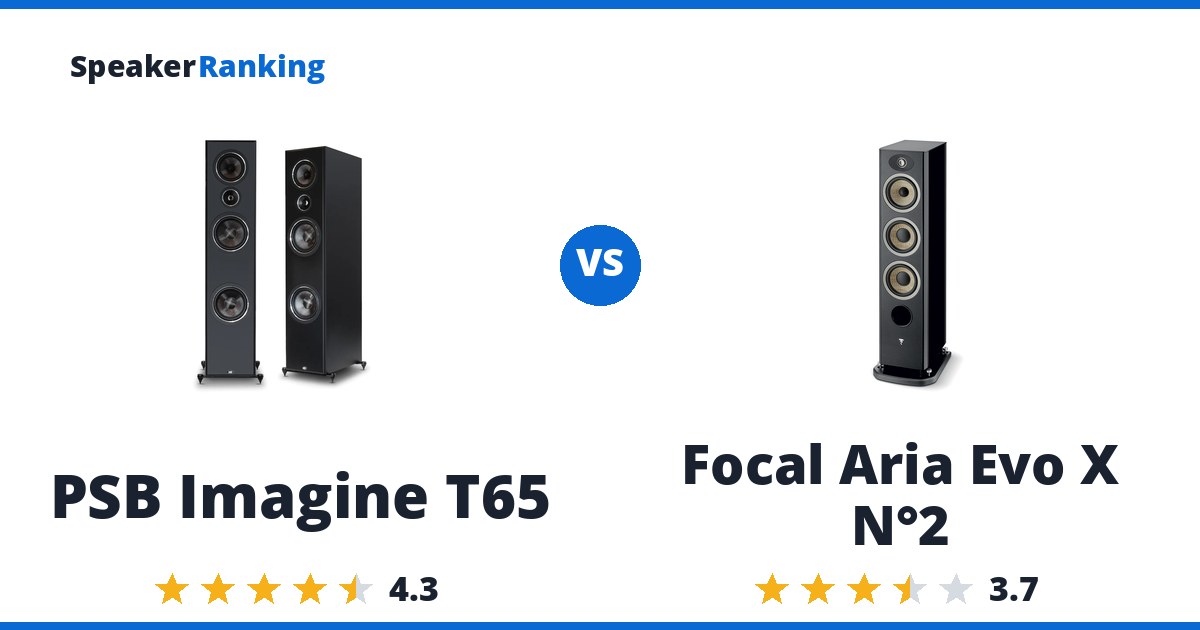
The PSB Imagine T65 is the better-sounding choice. Three-way design with dual 6.5” woven carbon fiber woofers delivers genuinely strong, extended low end for a $2699 tower: among the better performers Erin has measured in this price class. The catch: Noticeable dip in the midrange/crossover region that Erin flagged as affecting dialogue and vocal clarity, though he notes a couple bands of EQ smooths it out.
Why pick the Focal Aria Evo X N°2: Solid bass with a deliberate mid-bass bump (80-120Hz) that gives extra thump and weight, extending to about 40-50Hz in-room. The tradeoff: Sounds very bright pointed directly at the listener: the tweeter comes in 5-6dB above the midrange with an unusually wide, roughly two-octave dip (1kHz-4kHz) leading into it, giving a laid-back, low-attack character even after toeing out ~20 degrees.
Buy the PSB Imagine T65. It is rated higher for sound quality than the Focal Aria Evo X N°2 and costs less, so only choose the other one for a particular feature it does better.
Looking for alternatives? See the complete Passive Home rankings.
Specifications Side By Side
| PSB Imagine T65 | Focal Aria Evo X N°2 | |
|---|---|---|
| Price | $2,699 per pair | $4,798 per pair |
| Ranked | #61 of 188 in Large Size Floorstanding Speakers | #136 of 188 in Large Size Floorstanding Speakers |
| Drivers | 1” titanium dome tweeter, 5.25” woven carbon fiber midrange, 2x 6.5” woven carbon fiber woofers | Aluminum-magnesium inverted dome tweeter with waveguide, 6.5” flax midrange, dual 6.5” flax midbass woofers |
| Crossover Frequency | 600Hz & 2000Hz, 4th-order Linkwitz-Riley | - |
| Dimensions | 38.8” x 8.4” x 13.5” (986 x 213 x 343 mm) | 40.7”H x 14.6”W x 11.6”D (1035 x 371 x 294 mm) |
| Weight | 44.1 lbs (20 kg) each | 55.1 lbs (25 kg) each |
| Impedance | 8 ohms nominal (3.3 ohms minimum measured by Erin’s Audio Corner; manufacturer specifies 4 ohms minimum) | 8 ohms nominal (2.9 ohms minimum, Manufacturer specified; 3.4 ohms minimum measured by Erin’s Audio Corner) |
| Sensitivity | 85.1dB (measured average, Erin’s Audio Corner) | 88.2dB (2.83V/1m, measured by Erin’s Audio Corner; 91.5dB Manufacturer specified) |
| Recommended Power | 20-200W | 40-250W |
| Enclosure | Vented: dual rear slot ports, individual woofer chambers | - |
| Bass Extension (-3dB) | 47Hz (measured average, Erin’s Audio Corner) | 50Hz (measured, Erin’s Audio Corner) |
| Bass Extension (-10dB) | 26Hz (measured average, Erin’s Audio Corner) | 38Hz (measured, Erin’s Audio Corner) |
| Frequency Response | 28Hz - 20kHz (±1.5dB, manufacturer specified) | 45Hz - 30kHz (Manufacturer specified) |
| Spinorama Preference Score | 5.29 | 4.88 |
| Spinorama Preference Score with Perfect Sub | 6.51 | 6.82 |
| DIY Kit | No | No |
| Woofer Cabinet | - | 3-way, bass reflex (bottom-firing port, requires plinth) |
Related Speaker Comparisons
How PSB Imagine T65 compares with other leading options:
- PSB Imagine T65 vs KEF Blade Two Meta
- PSB Imagine T65 vs MoFi SourcePoint 888
- PSB Imagine T65 vs Revel F328Be
- PSB Imagine T65 vs KEF R5 Meta
- Revel F226Be vs PSB Imagine T65
Prices on this page were last checked October 7, 2026 at 9:25 PM UTC. Product prices and availability are accurate as of that date/time and are subject to change; the price and availability shown on Amazon at the time of purchase will apply to the purchase of this product.
As an eBay Partner, we may be compensated if you make a purchase.
The Two Speakers In Full
 PSB Imagine T65: $2,699 per pair PSB Speakers eBay
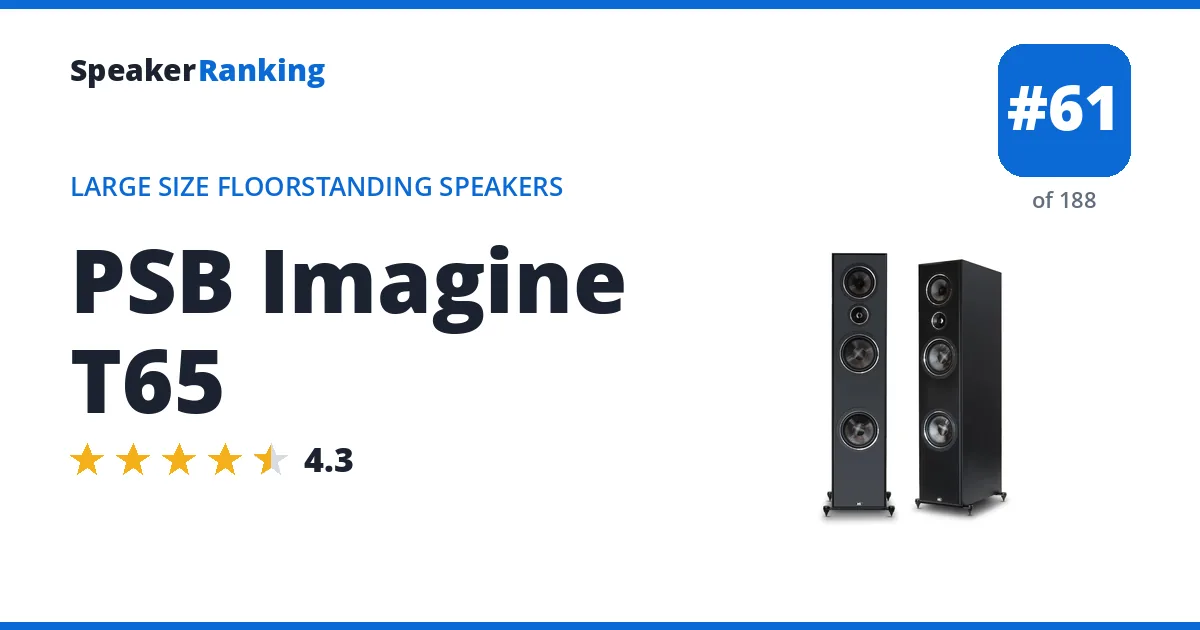
Same family: the PSB Imagine B50 (bookshelf, rated 3.7/5) and the PSB Imagine T54 (smaller floorstanding, ranked lower, estimated 4.2/5).
Pros: Three-way design with dual 6.5” woven carbon fiber woofers delivers genuinely strong, extended low end for a $2699 tower: among the better performers Erin has measured in this price class. Distortion shows a clean second-order character with clear separation from third-order all the way up to 96 dB, indicating a well-controlled motor. Compression data shows enhancement rather than compression below about 50-60 Hz, so the bass can sound louder as you turn it up rather than choking off. Wide, forgiving vertical listening window (about ±25°) thanks to the 3-way layout, giving more seating and placement flexibility than most towers. Plenty of dynamic headroom for home theater use or a two-channel system: 100W drove it comfortably in Erin’s room. Measured bass extension of 47Hz (-3dB), with a measured sensitivity of 85.1dB.
Cons: Noticeable dip in the midrange/crossover region that Erin flagged as affecting dialogue and vocal clarity, though he notes a couple bands of EQ smooths it out. Some horizontal dispersion mismatch (about 10-15° of ballooning between 1-3 kHz) between the midrange and tweeter can add extra perceived attack or detail if your room’s sidewalls are reflective. Dips to 4 ohms, so it wants an amplifier comfortable driving a 4-ohm load. Distortion climbs above 3% around 60 Hz at 96 dB, though it’s benign second-order distortion.
Full PSB Imagine T65 review and specifications →
| Bass Extension (-10dB) | 26Hz (measured average, Erin’s Audio Corner) |
|---|---|
| Bass Extension (-3dB) | 47Hz (measured average, Erin’s Audio Corner) |
| Crossover Frequency | 600Hz & 2000Hz, 4th-order Linkwitz-Riley |
| DIY Kit | No |
| Dimensions | 38.8” x 8.4” x 13.5” (986 x 213 x 343 mm) |
| Drivers | 1” titanium dome tweeter, 5.25” woven carbon fiber midrange, 2x 6.5” woven carbon fiber woofers |
| Enclosure | Vented: dual rear slot ports, individual woofer chambers |
| Frequency Response | 28Hz - 20kHz (±1.5dB, manufacturer specified) |
| Impedance | 8 ohms nominal (3.3 ohms minimum measured by Erin’s Audio Corner; manufacturer specifies 4 ohms minimum) |
| Recommended Power | 20-200W |
| Sensitivity | 85.1dB (measured average, Erin’s Audio Corner) |
| Spinorama Preference Score | 5.29 |
| Spinorama Preference Score with Perfect Sub | 6.51 |
| Weight | 44.1 lbs (20 kg) each |
- Links
- Reviews, Comparisons and Sound Samples
- Head-to-Head Comparisons
- PSB Imagine T65 vs Polk Audio Reserve R700
- PSB Imagine T65 vs JBL HDI-3600
- PSB Imagine T65 vs JBL Studio 698
- PSB Imagine T65 vs Emotiva Airmotiv T2+
- PSB Imagine T65 vs ELAC Debut 3.0 DF63
- PSB Imagine T65 vs Polk Reserve R500
- PSB Imagine T65 vs Arendal 1961 Tower
- PSB Imagine T65 vs Infinity Primus 360
- See all 41 comparisons
 Focal Aria Evo X N°2: $4,798 per pair Amazon eBay
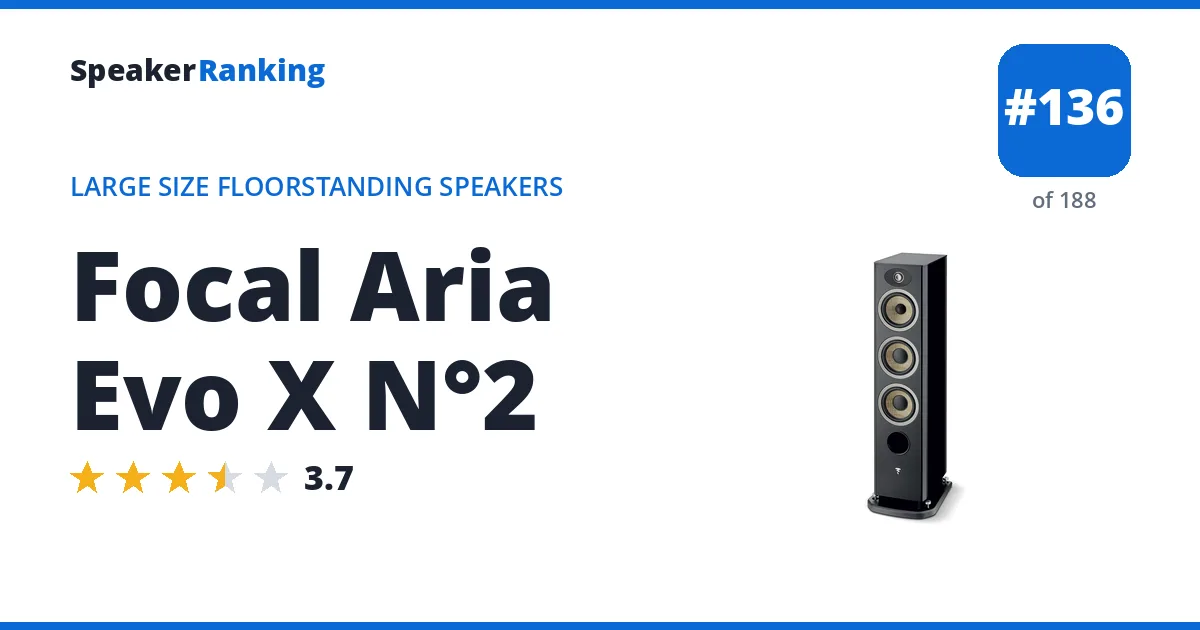
Same family: the Focal Aria Evo X N°1 (bookshelf, estimated 3.5/5), the Focal Aria Evo X N°3 (larger floorstanding, ranked higher, estimated 4.3/5), the Focal Aria Evo X N°4 (larger floorstanding, ranked higher, estimated 4.4/5) and the Focal Aria Evo X Center (center, estimated 3.7/5).
Pros: Solid bass with a deliberate mid-bass bump (80-120Hz) that gives extra thump and weight, extending to about 40-50Hz in-room. High sensitivity (measured 88.2dB) makes it easy to drive, and distortion is low throughout the range even at high output: the reviewer found only a minor compression “glare” around 4.5kHz at very high volumes, not a real concern. Directivity components (mid-range and tweeter) transition smoothly rather than abruptly, and the overall soundstage is wide and enveloping. Measured bass extension of 50Hz (-3dB), with a measured sensitivity of 88.2dB.
Cons: Sounds very bright pointed directly at the listener: the tweeter comes in 5-6dB above the midrange with an unusually wide, roughly two-octave dip (1kHz-4kHz) leading into it, giving a laid-back, low-attack character even after toeing out ~20 degrees. Fixing this properly requires real EQ (a mini DSP or similar), not just toe-out or absorption alone; without EQ, expect it to sound bright for stereo listening. A mild dip around 200Hz makes male vocals sound slightly subdued. Narrow vertical directivity (about +/-15 degrees) means you need to stay close to tweeter-axis height. Impedance dips to 3.4 ohms (EPDR 1.4 ohms), so it wants a 4-ohm-capable amplifier, and requires a plinth for floor clearance since it’s bottom-ported.
Full Focal Aria Evo X N°2 review and specifications →
| Bass Extension (-10dB) | 38Hz (measured, Erin’s Audio Corner) |
|---|---|
| Bass Extension (-3dB) | 50Hz (measured, Erin’s Audio Corner) |
| DIY Kit | No |
| Dimensions | 40.7”H x 14.6”W x 11.6”D (1035 x 371 x 294 mm) |
| Drivers | Aluminum-magnesium inverted dome tweeter with waveguide, 6.5” flax midrange, dual 6.5” flax midbass woofers |
| Frequency Response | 45Hz - 30kHz (Manufacturer specified) |
| Impedance | 8 ohms nominal (2.9 ohms minimum, Manufacturer specified; 3.4 ohms minimum measured by Erin’s Audio Corner) |
| Recommended Power | 40-250W |
| Sensitivity | 88.2dB (2.83V/1m, measured by Erin’s Audio Corner; 91.5dB Manufacturer specified) |
| Spinorama Preference Score | 4.88 |
| Spinorama Preference Score with Perfect Sub | 6.82 |
| Weight | 55.1 lbs (25 kg) each |
| Woofer Cabinet | 3-way, bass reflex (bottom-firing port, requires plinth) |
- Links
- Reviews, Comparisons and Sound Samples
- Head-to-Head Comparisons
- Focal Aria Evo X N°2 vs Polk T50
- Focal Aria Evo X N°2 vs SVS Ultra Evolution Pinnacle
- Focal Aria Evo X N°2 vs Polk Audio XT60
- Focal Aria Evo X N°2 vs Infinity Reference 253
- Focal Aria Evo X N°2 vs Definitive Technology BP-9020
- Focal Aria Evo X N°2 vs Magnepan LRS+
- Focal Aria Evo X N°2 vs JBL Stage 2 280F
- Focal Aria Evo X N°2 vs Klipsch RP-6000F II
- See all 46 comparisons