Short answer: the ELAC Debut 2.0 B5.2. It ranks #86 of 160 bookshelf speakers by sound quality, rated 3.2/5, at $269; the Definitive Technology ProMonitor 1000 ranks #149, rated 1.7/5, and costs $398.40, so there is little reason to consider the other one.
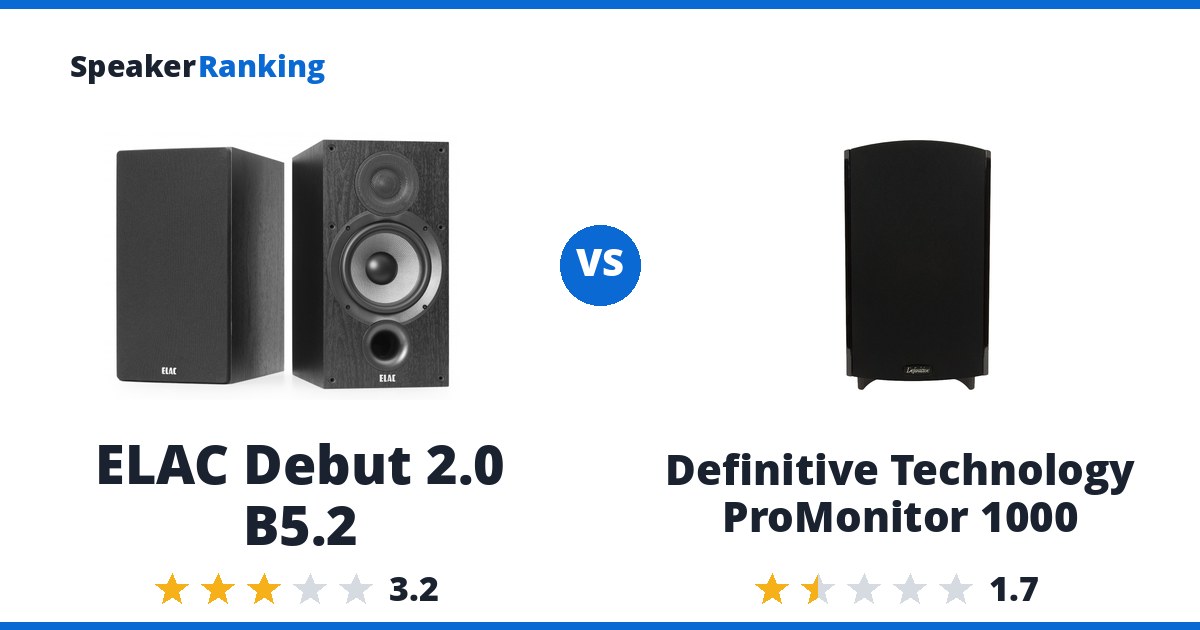
The ELAC Debut 2.0 B5.2 is the more accurate, deeper-bass option. Good horizontal directivity: the off-axis curves track the on-axis response closely, so the broad tonal error responds predictably to EQ. Its measured preference score, a predictor of how neutral it sounds, is 5.02 against 3.20 for the Definitive Technology ProMonitor 1000. Its bass reaches about 60Hz before falling 3dB, against 95Hz for the Definitive Technology ProMonitor 1000. Watch for: Erin measured a broad +3dB step beginning around 1.5kHz; the resulting elevated upper range sounds tonally uneven even though it is not a narrow, sharp resonance.
The case for the Definitive Technology ProMonitor 1000: Bass distortion is well controlled per the measurements, and the slow bass rolloff means it can be pushed fairly hard for its size. Watch for: CEA2034 spinorama shows severely reduced bass energy between 40-120Hz, a directivity mismatch between the tweeter and woofer, and a severe resonance/interference issue around 14kHz.
Buy the ELAC Debut 2.0 B5.2. It is rated higher for sound quality than the Definitive Technology ProMonitor 1000 and costs less, so it is the default pick unless a specific strength of the other one matters more to you.
Looking for alternatives? See the complete Passive Home rankings.
Specifications Side By Side
| ELAC Debut 2.0 B5.2 | Definitive Technology ProMonitor 1000 | |
|---|---|---|
| Price | $269.00 per pair | $398.40 per pair |
| Ranked | #86 of 160 in Medium Size Bookshelf Speakers | #149 of 160 in Medium Size Bookshelf Speakers |
| Bass Extension (-10dB) | 40Hz (measured, Erin’s Audio Corner) | 80Hz (measured, Audio Science Review) |
| Bass Extension (-3dB) | 60Hz (measured, Erin’s Audio Corner) | 95Hz (measured, Audio Science Review) |
| Dimensions | 13.4”H x 7.1”W x 9.2”D (341 x 180 x 234 mm) | 10.88H x 6.25W x 6.5D in |
| Impedance | 6 ohms nominal (manufacturer specified) | 8 ohms nominal |
| Sensitivity | About 83dB after recommended EQ (measured, Erin’s Audio Corner; 86dB manufacturer specified) | 86dB (2.83V/1m, measured, Audio Science Review - reviewer noted this vs. a manufacturer spec of 91dB) |
| Drivers | 5.25” aramid-fiber woofer, 1” cloth-dome tweeter | 1” aluminum dome tweeter, 5.25” BDSS mid/woofer, 5.25” planar bass radiator |
| Weight | 13 lbs (5.9 kg) each | 7.3 lbs (3.29 kg) each |
| Woofer Cabinet | ported, front | passive radiator |
| Spinorama Preference Score | 5.02 | 3.2 (spinorama.org) |
| Spinorama Preference Score with Perfect Sub | 7.27 | 6.58 (spinorama.org) |
| DIY Kit | No | No |
| Frequency Response | - | 47Hz - 30kHz (Manufacturer specified) |
Related Speaker Comparisons
How ELAC Debut 2.0 B5.2 compares with other leading options:
- ELAC Debut 2.0 B5.2 vs Audio First Fidelia
- ELAC Debut 2.0 B5.2 vs Philharmonic Ceramic Mini
- ELAC Debut 2.0 B5.2 vs Ascend Sierra 1 v2
- KEF LS50 Meta vs ELAC Debut 2.0 B5.2
- XMechanik Mechano23 DIY vs ELAC Debut 2.0 B5.2
Prices on this page were last checked October 7, 2026 at 9:25 PM UTC. Product prices and availability are accurate as of that date/time and are subject to change; the price and availability shown on Amazon at the time of purchase will apply to the purchase of this product.
As an eBay Partner, we may be compensated if you make a purchase.
The Two Speakers In Full
 ELAC Debut 2.0 B5.2: $269.00 per pair Amazon eBay
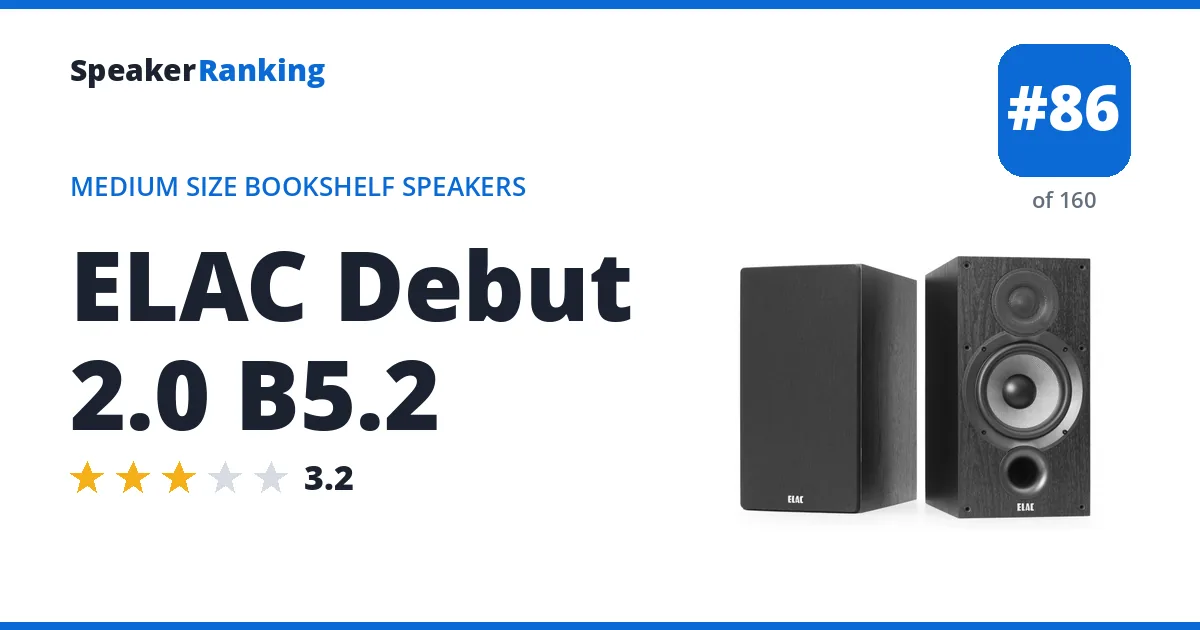
Newer model: the ELAC Debut 3.0 DB53, ranked higher, estimated 3.9/5.
Same family: the ELAC Debut 2.0 B6.2 (larger bookshelf, rated 3.5/5).
Pros: Good horizontal directivity: the off-axis curves track the on-axis response closely, so the broad tonal error responds predictably to EQ. Erin demonstrated that a single high-shelf filter centered near 1.6kHz, about -2dB with Q near 2, substantially improves linearity. Moderate roughly +/-50-60 degree horizontal coverage balances room interaction and image focus. The front port makes close-to-wall placement practical. Erin measured F3 near 60Hz and F10 near 40Hz, useful extension for a compact 5.25-inch two-way. Harmonic distortion is mostly below 1% at 86dB/1m, and low-frequency distortion is better than its size might suggest. Compact cabinet and inexpensive pair pricing make it a workable EQ-assisted desktop or small-room system. Measured bass extension of 60Hz (-3dB), with a measured sensitivity of 83dB.
Cons: Erin measured a broad +3dB step beginning around 1.5kHz; the resulting elevated upper range sounds tonally uneven even though it is not a narrow, sharp resonance. Native response spans roughly -2.6 to +4dB around the mean, so this is not a neutral speaker without correction. Sensitivity is only about 83dB after correcting the shelf, demanding materially more amplifier voltage than ELAC’s 86dB specification implies. Vertical response changes substantially outside roughly +/-10 degrees of tweeter height. Dynamic compression is the larger limitation: at the highest sweep level it loses roughly 1-1.5dB through the midrange, and even the 86dB trace shows unusual nonlinearity that may involve crossover heating. At about 96dB, multitone distortion rises audibly around 600Hz; an 80-120Hz subwoofer crossover helps but does not turn it into a high-output design. Erin recommends the larger B6.2 instead when EQ is unavailable.
Full ELAC Debut 2.0 B5.2 review and specifications →
| Bass Extension (-10dB) | 40Hz (measured, Erin’s Audio Corner) |
|---|---|
| Bass Extension (-3dB) | 60Hz (measured, Erin’s Audio Corner) |
| DIY Kit | No |
| Dimensions | 13.4”H x 7.1”W x 9.2”D (341 x 180 x 234 mm) |
| Drivers | 5.25” aramid-fiber woofer, 1” cloth-dome tweeter |
| Impedance | 6 ohms nominal (manufacturer specified) |
| Sensitivity | About 83dB after recommended EQ (measured, Erin’s Audio Corner; 86dB manufacturer specified) |
| Spinorama Preference Score | 5.02 |
| Spinorama Preference Score with Perfect Sub | 7.27 |
| Weight | 13 lbs (5.9 kg) each |
| Woofer Cabinet | ported, front |
- Links
- Reviews, Comparisons and Sound Samples
- Head-to-Head Comparisons
- ELAC Debut 2.0 B5.2 vs Sony SS-CS5 M2
- ELAC Debut 2.0 B5.2 vs Paradigm Monitor SE Atom
- ELAC Debut 2.0 B5.2 vs JBL Stage 250B
- ELAC Debut 2.0 B5.2 vs JBL Studio 530
- ELAC Debut 2.0 B5.2 vs Monoprice Monolith THX Compact Satellite
- ELAC Debut 2.0 B5.2 vs Dynaudio Emit M10
- ELAC Debut 2.0 B5.2 vs ELAC BS U5
- ELAC Debut 2.0 B5.2 vs Dynaudio X14
- See all 44 comparisons
 Definitive Technology ProMonitor 1000: $398.40 per pair Amazon eBay
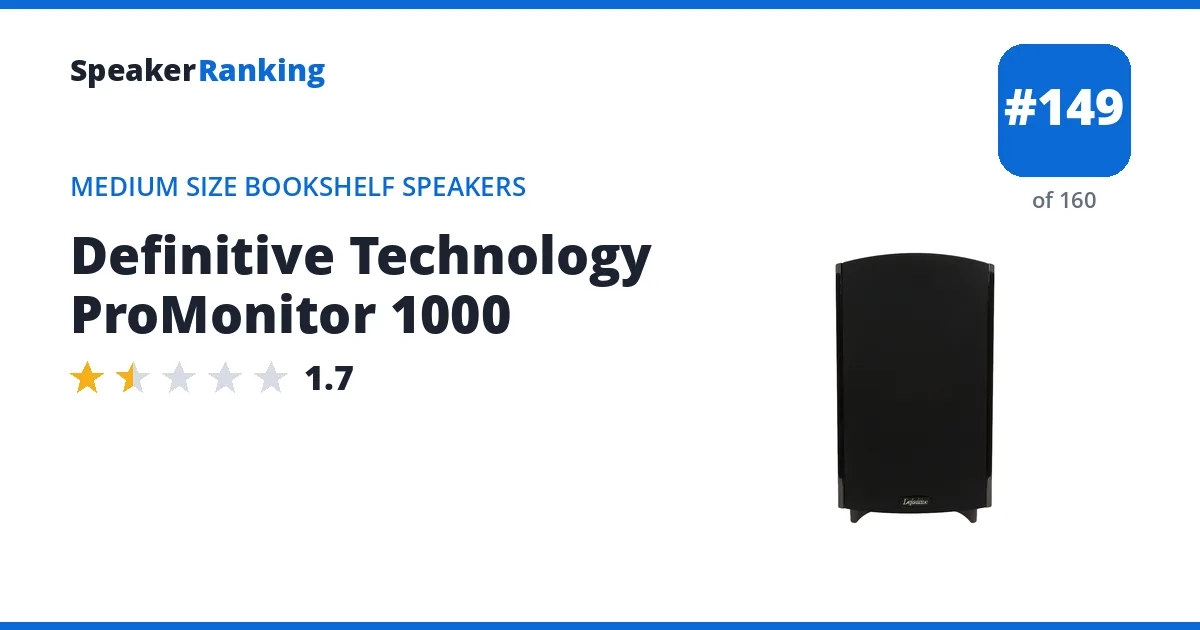
Pros: Bass distortion is well controlled per the measurements, and the slow bass rolloff means it can be pushed fairly hard for its size. Ships with a footer that keeps the small cabinet planted despite its light weight. Measured bass extension of 95Hz (-3dB), with a measured sensitivity of 86dB.
Cons: CEA2034 spinorama shows severely reduced bass energy between 40-120Hz, a directivity mismatch between the tweeter and woofer, and a severe resonance/interference issue around 14kHz. Distortion at 96dB SPL was so bad the reviewer limited testing to 86dB. Direct comparison to a $118/pair Pioneer SP-BS22-LR left the reviewer calling the $199/pair ProMonitor 1000 “a bad experiment that should be forgotten” and concluding “there is nothing Pro about it.”
Full Definitive Technology ProMonitor 1000 review and specifications →
| Bass Extension (-10dB) | 80Hz (measured, Audio Science Review) |
|---|---|
| Bass Extension (-3dB) | 95Hz (measured, Audio Science Review) |
| DIY Kit | No |
| Dimensions | 10.88H x 6.25W x 6.5D in |
| Drivers | 1” aluminum dome tweeter, 5.25” BDSS mid/woofer, 5.25” planar bass radiator |
| Frequency Response | 47Hz - 30kHz (Manufacturer specified) |
| Impedance | 8 ohms nominal |
| Sensitivity | 86dB (2.83V/1m, measured, Audio Science Review - reviewer noted this vs. a manufacturer spec of 91dB) |
| Spinorama Preference Score | 3.2 (spinorama.org) |
| Spinorama Preference Score with Perfect Sub | 6.58 (spinorama.org) |
| Weight | 7.3 lbs (3.29 kg) each |
| Woofer Cabinet | passive radiator |
- Links
- Reviews, Comparisons and Sound Samples
- Head-to-Head Comparisons
- Definitive Technology ProMonitor 1000 vs Sehlin Helium
- Definitive Technology ProMonitor 1000 vs Polk T15
- Definitive Technology ProMonitor 1000 vs Pioneer Elite SP-EBS73-LR
- Definitive Technology ProMonitor 1000 vs JBL Control 1 Pro
- Definitive Technology ProMonitor 1000 vs Fluance Signature HFS
- Definitive Technology ProMonitor 1000 vs JBL Stage A130
- Definitive Technology ProMonitor 1000 vs Klipsch R-41M
- Definitive Technology ProMonitor 1000 vs Q Acoustics 5020
- See all 32 comparisons