Short answer: the Dynaudio Emit 10, if you are buying new. The Dynaudio Emit M10 ranks higher than the Polk T15 (#102 vs #146 of 160 bookshelf speakers) but is discontinued; its replacement, the Dynaudio Emit 10, is rated 3.2/5 at $599 and is still sold new.
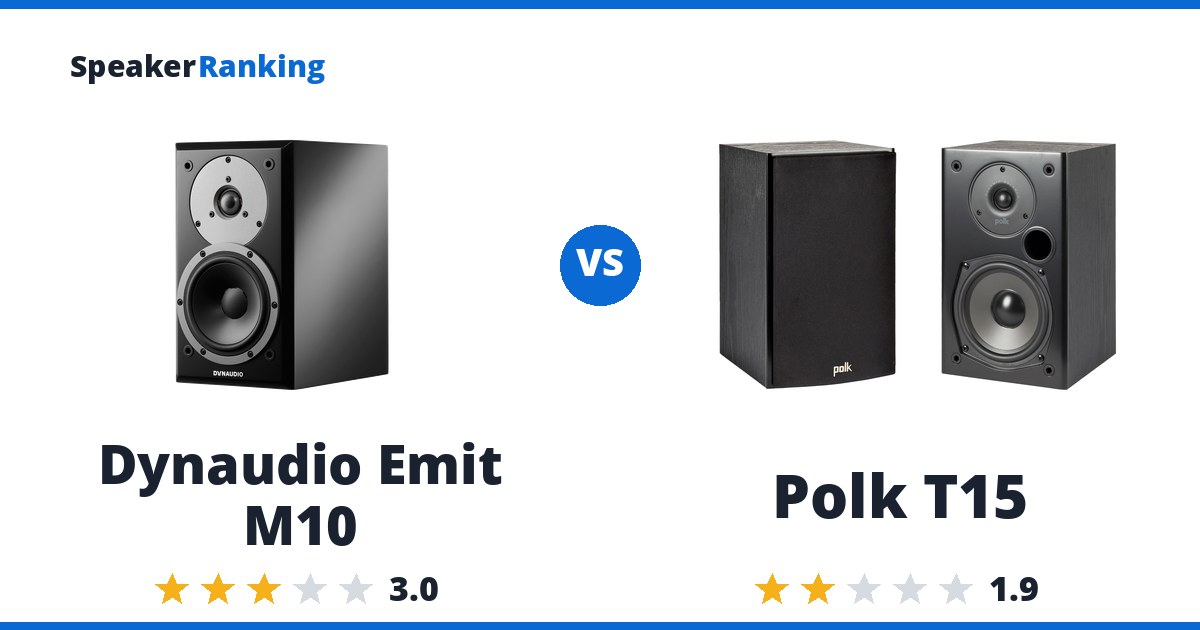
The Dynaudio Emit M10 is the more accurate, deeper-bass pick. CEA2034 spinorama shows impressive, headphone-level distortion through the midrange and tweeter at 86dB SPL, with a well-executed port that keeps resonance low below the crossover. Its measured preference score, a predictor of how neutral it sounds, is 4.56 against 0.34 for the Polk T15. Its bass reaches about 60.1Hz before falling 3dB, against 88.6Hz for the Polk T15. The tradeoff: Tuned toward a mild showroom sound with boosted upper bass and treble and a recessed midrange: the reviewer prefers speakers that get the 100Hz-3kHz range right, which this doesn’t.
The case for the Polk T15: Extremely affordable 2-way design that actually measured better at +/-20 degrees vertical off-axis than directly on-axis. Watch for: Spinorama analysis reveals what Amir called a “horrific drop in upper mids/lower treble region of 3 to 6 kHz,” likely from tweeter-woofer phase cancellation directly on-axis.
Buy the Dynaudio Emit 10, the replacement for the discontinued Dynaudio Emit M10; it is rated higher for sound quality than the Polk T15.
Want more options? Browse the full Passive Home rankings.
Specifications Side By Side
| Dynaudio Emit M10 | Polk T15 | |
|---|---|---|
| Price | $800 per pair Discontinued | $149.00 per pair |
| Ranked | #102 of 160 in Medium Size Bookshelf Speakers | #146 of 160 in Medium Size Bookshelf Speakers |
| Bass Extension (-3dB) | 60.1Hz (measured, Audio Science Review) | 88.6Hz (measured, Audio Science Review) |
| Bass Extension (-10dB) | 46.8Hz (derived, log-interpolated between spinorama.org -9dB/-12dB points) | 58.1Hz (measured, Audio Science Review) |
| Sensitivity | 83.5dB (2.83V/1m, measured, Audio Science Review) | 89dB (manufacturer specified, 1W/1m); 88.98dB measured, spinorama.org |
| Impedance | 6 ohms nominal | 8 ohms nominal |
| Frequency Response | 50Hz - 23kHz (+/-3dB) (Manufacturer specified) | 60Hz - 24kHz (Manufacturer specified) |
| Drivers | 28mm soft dome tweeter, 14cm MSP mid/bass driver | 0.75” tweeter, 5.25” woofer |
| Weight | 12.3 lbs (5.6 kg) each | 8.2 lbs (3.74 kg) each |
| Dimensions | 11.5”H x 6.7”W x 9.4”D (292 x 170 x 240 mm) | 10.63H x 6.5W x 7.25D in |
| Woofer Cabinet | ported | - |
| Spinorama Preference Score | 4.56 (spinorama.org) | 0.34 |
| Spinorama Preference Score with Perfect Sub | 6.93 (spinorama.org) | 3.39 |
| DIY Kit | No | No |
Related Speaker Comparisons
More worthwhile head-to-heads for Dynaudio Emit M10:
- Dynaudio Emit M10 vs Audio First Fidelia
- Dynaudio Emit M10 vs Philharmonic Ceramic Mini
- Dynaudio Emit M10 vs Ascend Sierra 1 v2
- KEF LS50 Meta vs Dynaudio Emit M10
- XMechanik Mechano23 DIY vs Dynaudio Emit M10
Prices on this page were last checked October 9, 2026 at 8:01 AM UTC. Product prices and availability are accurate as of that date/time and are subject to change; the price and availability shown on Amazon at the time of purchase will apply to the purchase of this product.
As an eBay Partner, we may be compensated if you make a purchase.
The Two Speakers In Full
 Dynaudio Emit M10: $800 per pair Discontinued eBay
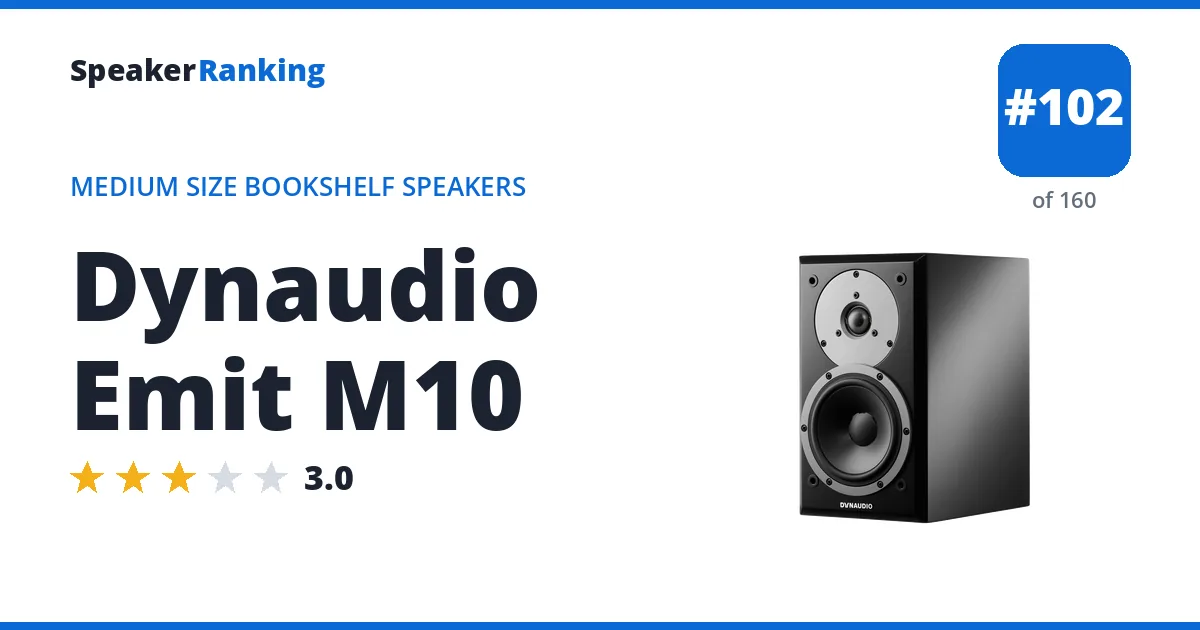
Newer model: the Dynaudio Emit 10, ranked higher, estimated 3.2/5.
Pros: CEA2034 spinorama shows impressive, headphone-level distortion through the midrange and tweeter at 86dB SPL, with a well-executed port that keeps resonance low below the crossover. 28mm soft dome tweeter and 14cm MSP mid/bass driver. Measured bass extension of 60.1Hz (-3dB), with a measured sensitivity of 83.5dB.
Cons: Tuned toward a mild showroom sound with boosted upper bass and treble and a recessed midrange: the reviewer prefers speakers that get the 100Hz-3kHz range right, which this doesn’t. His verdict: cheaper speakers deliver much more balanced tonality, so he wouldn’t buy it for himself. Discontinued.
Full Dynaudio Emit M10 review and specifications →
| Bass Extension (-10dB) | 46.8Hz (derived, log-interpolated between spinorama.org -9dB/-12dB points) |
|---|---|
| Bass Extension (-3dB) | 60.1Hz (measured, Audio Science Review) |
| DIY Kit | No |
| Dimensions | 11.5”H x 6.7”W x 9.4”D (292 x 170 x 240 mm) |
| Drivers | 28mm soft dome tweeter, 14cm MSP mid/bass driver |
| Frequency Response | 50Hz - 23kHz (+/-3dB) (Manufacturer specified) |
| Impedance | 6 ohms nominal |
| Sensitivity | 83.5dB (2.83V/1m, measured, Audio Science Review) |
| Spinorama Preference Score | 4.56 (spinorama.org) |
| Spinorama Preference Score with Perfect Sub | 6.93 (spinorama.org) |
| Weight | 12.3 lbs (5.6 kg) each |
| Woofer Cabinet | ported |
- Links
- Reviews, Comparisons and Sound Samples
- Head-to-Head Comparisons
- Dynaudio Emit M10 vs ELAC BS U5
- Dynaudio Emit M10 vs Dynaudio X14
- Dynaudio Emit M10 vs Pioneer SP-BS22-LR (Philharmonic AAM Mod)
- Dynaudio Emit M10 vs JBL Stage 250B
- Dynaudio Emit M10 vs Paradigm Monitor SE Atom
- Dynaudio Emit M10 vs Sony SS-CS5 M2
- Dynaudio Emit M10 vs ELAC Debut 2.0 B5.2
- Dynaudio Emit M10 vs JBL L52 Classic
- See all 38 comparisons
 Polk T15: $149.00 per pair Amazon eBay
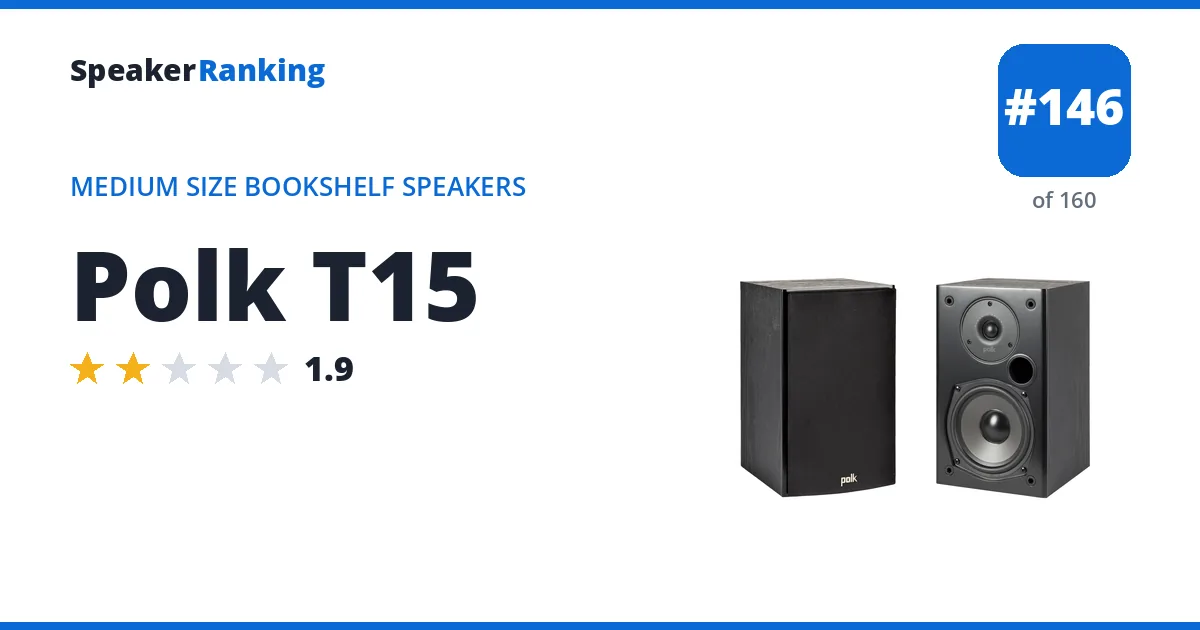
Same family: the Polk T50 (floorstanding, rated 3.8/5).
Pros: Extremely affordable 2-way design that actually measured better at +/-20 degrees vertical off-axis than directly on-axis. In near-field desktop use, the reviewer found the T15 “didn’t sound that horrible,” partly because nearby desk reflections mask the frequency response dip. Measured bass extension of 88.6Hz (-3dB), with a measured sensitivity of 89dB.
Cons: Spinorama analysis reveals what Amir called a “horrific drop in upper mids/lower treble region of 3 to 6 kHz,” likely from tweeter-woofer phase cancellation directly on-axis. Measured impedance ranges from 4-8 ohms, contradicting the specified 6-8 ohm range, and there’s a distortion peak around 400Hz. On- and off-axis response “vary a ton,” making listening position unusually important. The reviewer recommends saving up for the Pioneer SP-BS22-LR instead: “I can’t justify recommending the Polk T15 even though subjective performance was not horrible.”
Full Polk T15 review and specifications →
| Bass Extension (-10dB) | 58.1Hz (measured, Audio Science Review) |
|---|---|
| Bass Extension (-3dB) | 88.6Hz (measured, Audio Science Review) |
| DIY Kit | No |
| Dimensions | 10.63H x 6.5W x 7.25D in |
| Drivers | 0.75” tweeter, 5.25” woofer |
| Frequency Response | 60Hz - 24kHz (Manufacturer specified) |
| Impedance | 8 ohms nominal |
| Sensitivity | 89dB (manufacturer specified, 1W/1m); 88.98dB measured, spinorama.org |
| Spinorama Preference Score | 0.34 |
| Spinorama Preference Score with Perfect Sub | 3.39 |
| Weight | 8.2 lbs (3.74 kg) each |
- Links
- Reviews, Comparisons and Sound Samples
- Head-to-Head Comparisons