Coverage note. Speaker Ranking currently covers 20 Ascend Acoustics models across passive speakers. These are the products in our database, not a complete list of everything Ascend Acoustics makes.
What this page covers. The Ascend Acoustics models ranked here span passive speakers, including Ascend Acoustics ELX Ribbon Horizon, Ascend Acoustics Sierra 1 v2 and Ascend Acoustics Luna V2 Mini-Monitor Ribbon. Use each model’s category position to compare it with alternatives of the same size and use case.
This page lists all 20 Ascend Acoustics speakers ranked on this site across passive speakers. Each model is shown in the category where it competes, with its current rank and the size of that ranking.
Use the category position rather than the brand name alone: speakers from the same manufacturer can perform very differently by size, price and product family.
Prices on this page were last checked October 12, 2026 at 4:13 PM UTC. Product prices and availability are accurate as of that date/time and are subject to change; the price and availability shown on Amazon at the time of purchase will apply to the purchase of this product.
As an eBay Partner, we may be compensated if you make a purchase.
Quick Navigation
- Medium Size Bookshelf Speakers
- Large Size Bookshelf Speakers
- Large Size Floorstanding Speakers
- Center Channel Speakers
- Discontinued Ascend Acoustics Models
- Product Line History
Medium Size Bookshelf Speakers
 Ranked #3 of 168 in Medium Size Bookshelf Speakers - Ascend Acoustics Sierra 1 v2: $1000 per pair Ascend Acoustics $1000 eBay
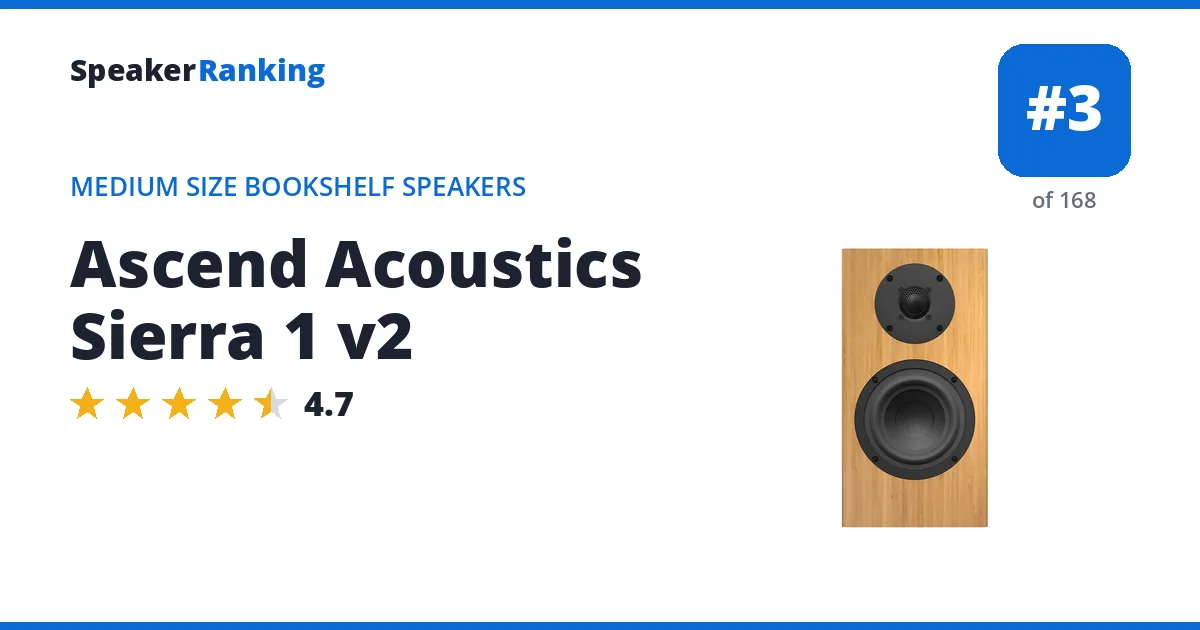
Same family: the Ascend Acoustics Sierra-2EX V2 (larger bookshelf, rated 4.3/5), the Ascend Acoustics Sierra-LX (larger bookshelf, rated 4.3/5), the Ascend Acoustics Sierra Titan Tower (floorstanding, rated 4.4/5) and the Ascend Acoustics Sierra Horizon V2 (center, estimated 4.3/5). See every Ascend Sierra generation.
Pros: Formaldehyde-free layered bamboo ply cabinet with a 1” dome tweeter over a 5.25” midwoofer, mated by a 4th-order acoustic crossover rather than a stock textbook design. In-room response is extremely linear (the reviewer called it “textbook”) a clear step up from the earlier V1, which had boxiness around 700Hz-1kHz and sibilance around 4-6kHz. Preference score of 8.4 with a subwoofer (6.8 without), which the reviewer calls topnotch. Wide, even horizontal radiation of about ±70° up to 6kHz. Better vertical directivity than its tweeter-to-woofer spacing would suggest, thanks to the steep 4th-order crossover slopes. No mechanical noise, port chuffing, or woofer bottoming even driven to 96dB/1m. In a three-way comparison against the Dynaudio Emit 20 and a Revel bookshelf model (all around $1,000/pair), measured as the most linear of the three and was the reviewer’s personal pick over both, despite the Dynaudio’s deeper bass and higher output capability. Independent ASR Klippel measurements corroborate Erin’s findings: superb off-axis response with only slight on-axis variations, and an in-room response the reviewer called “incredibly smooth and accurate. Amazing for a non-DSP speaker.” Distortion above 200Hz at 86dB/1m is very low for the class. Measured bass extension of 55Hz (-3dB), with a measured sensitivity of 81.5dB.
Cons: F3 of 55Hz and F10 of 39Hz mean in-room extension tops out in the mid-40s Hz; the reviewer still recommends a subwoofer for full-range material. Diffraction dips appear around 3kHz and 5-6kHz, and the 1” dome tweeter starts beaming above roughly 6.7kHz, narrowing the soundstage radiation in the top octave: a straightforward consequence of dome size rather than a design flaw. At 96dB/1m the 5.25” midwoofer shows increased distortion in the midrange, likely tied to motor topology; high-passing to a subwoofer around 80Hz largely clears it up. Moderate sensitivity (~81-82dB average) with a 7-ohm minimum impedance. ASR’s power-sweep testing found response holds steady up to 96dB SPL/1m, but pushing to 102dB causes midbass below 400Hz to sag with distortion “through the roof”: a harder output ceiling than the 96dB tests alone suggest. Vertical directivity also narrows above about 1kHz, so the reviewer recommends staying at tweeter-axis height for best results.
Full Ascend Acoustics Sierra 1 v2 review and specifications →
| Released | Dec 2023 (2 years ago) |
|---|---|
| Bass Extension (-10dB) | 39Hz (measured, Erin’s Audio Corner) |
| Bass Extension (-3dB) | 55Hz (measured, Erin’s Audio Corner) |
| DIY Kit | No |
| Dimensions | 14.2”H x 7.5”W x 10.5”D (361.9 x 190.5 x 266.7 mm) |
| Drivers | 5.25” proprietary mineral-filled polypropylene cone with cast aluminum frame woofer, 26mm aluminum/magnesium alloy dome tweeter with titanium former (SEAS Titan) |
| Impedance | 8 ohms nominal, 7 ohms minimum (measured, Erin’s Audio Corner) |
| Sensitivity | 81.5dB (measured, Erin’s Audio Corner) |
| Spinorama Preference Score | 6.65 |
| Spinorama Preference Score with Perfect Sub | 8.61 |
| Weight | 18.5 lbs (8.4 kg) each |
| Woofer Cabinet | ported |
- Links
- Reviews, Comparisons and Sound Samples
- Erin’s Audio Corner: NEW! Ascend Acoustics Sierra-1 V2 Review More from Erin’s Audio Corner →
- Erin’s Audio Corner: 5 AWESOME SPEAKERS Under $1000 You Won’t Regret
- Erin’s Audio Corner: I Tested 250 Speakers So You Don’t Have To!
- Erin’s Audio Corner: My Top Picks of 2023: Must-Haves Under $3000
- Erin’s Audio Corner Website Ascend Sierra 1 v2
- Audio Science Review Ascend Sierra 1 v2 More from Audio Science Review →
- Manufacturer Measurements (spinorama.org)
- Head-to-Head Comparisons
- Ascend Acoustics Sierra 1 v2 vs KEF LS50 Meta
- Ascend Acoustics Sierra 1 v2 vs Philharmonic Ceramic Mini
- Ascend Acoustics Sierra 1 v2 vs Audio First Fidelia
- Ascend Acoustics Sierra 1 v2 vs XMechanik Mechano23 DIY
- Ascend Acoustics Sierra 1 v2 vs Ascend Acoustics HTM-200SE2
- Ascend Acoustics Sierra 1 v2 vs Arendal 1961 Monitor
- Ascend Acoustics Sierra 1 v2 vs Ascend Acoustics Luna V2 Mini-Monitor Titan
- Ascend Acoustics Sierra 1 v2 vs Aalto Speakers Aalto 1 EVO
- See all 51 comparisons
 Ranked #5 of 168 in Medium Size Bookshelf Speakers - Ascend Acoustics Luna V2 Mini-Monitor Ribbon: $1,248 per pair Ascend Acoustics $1,248 eBay
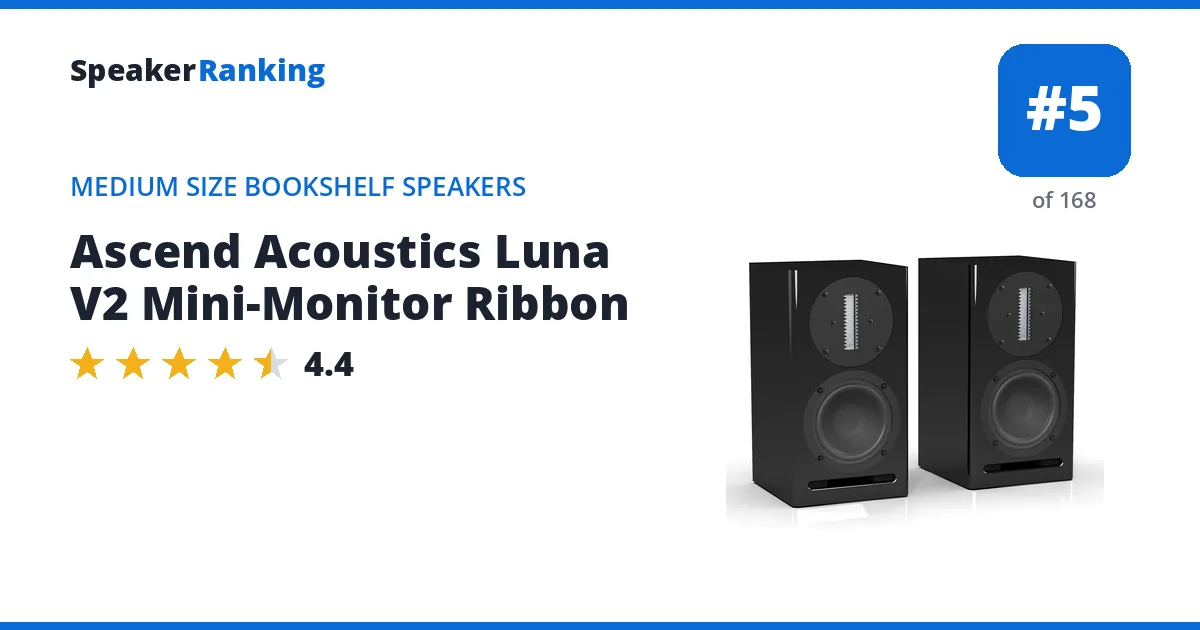
Older model: the Ascend Acoustics Sierra Luna (ranked lower, rated 1.6/5). See every Ascend Sierra Luna generation.
Same family: the Ascend Acoustics Luna V2 Mini-Monitor Titan (larger bookshelf, ranked lower, rated 4.3/5).
Pros: The same compact V-LAM bamboo cabinet and proprietary 4.5 inch glass fiber woofer as the Titan dome version, upgraded with a custom RAAL true ribbon tweeter that has roughly 1/50th the moving mass of a dome for faster transient response and more top end air. The sound power directivity index has a standard deviation of just 2.88, the tightest of any speaker added to this catalog from spinorama.org’s current measurement set, a real directivity benefit from the ribbon over the dome tweeter’s 3.14. Same 7 year warranty and hand matched pairs as the rest of Ascend’s lineup. Measured bass extension of 74.7Hz (-3dB).
Cons: On axis deviation still measures 0.573dB average, nearly as rough as the Titan dome version’s 0.599, so the ribbon upgrade mainly helps directivity consistency and top end extension rather than fixing on axis evenness. Costs about 39 percent more than the Titan dome version of this exact cabinet for what measures as very similar bass extension and sensitivity. Bass extension is still limited to a measured 74.7Hz at -3dB by the small woofer, and Ascend sells direct only with no dealer network for an in person audition.
Full Ascend Acoustics Luna V2 Mini-Monitor Ribbon review and specifications →
| Released | 2022 (4 years ago) |
|---|---|
| Bass Extension (-10dB) | 44.3Hz (measured, spinorama.org vendor data) |
| Bass Extension (-3dB) | 74.7Hz (measured, spinorama.org vendor data) |
| Country | United States |
| DIY Kit | No |
| Dimensions | 10.6”H x 5.7”W x 6”D (270 x 146 x 152 mm) |
| Drivers | Custom RAAL 10mm true ribbon tweeter, 4.5” long throw glass fiber cone woofer |
| Enclosure | ported |
| Frequency Response | 75-27,000Hz +/-3dB anechoic (manufacturer) |
| Impedance | 8 ohms nominal |
| Power Handling | 100W continuous, 150W peak |
| Sensitivity | 82dB @ 2.83V/1m anechoic (manufacturer) |
| Spinorama Preference Score | 4.89 |
| Spinorama Preference Score with Perfect Sub | 7.50 |
| Warranty | 7 years parts and labor |
| Weight | 8.3 lbs (3.75 kg) each |
- Links
- Reviews, Comparisons and Sound Samples
- Head-to-Head Comparisons
 Ranked #7 of 168 in Medium Size Bookshelf Speakers - Ascend Acoustics HTM-200SE2: $368 per pair Ascend Acoustics $368 eBay
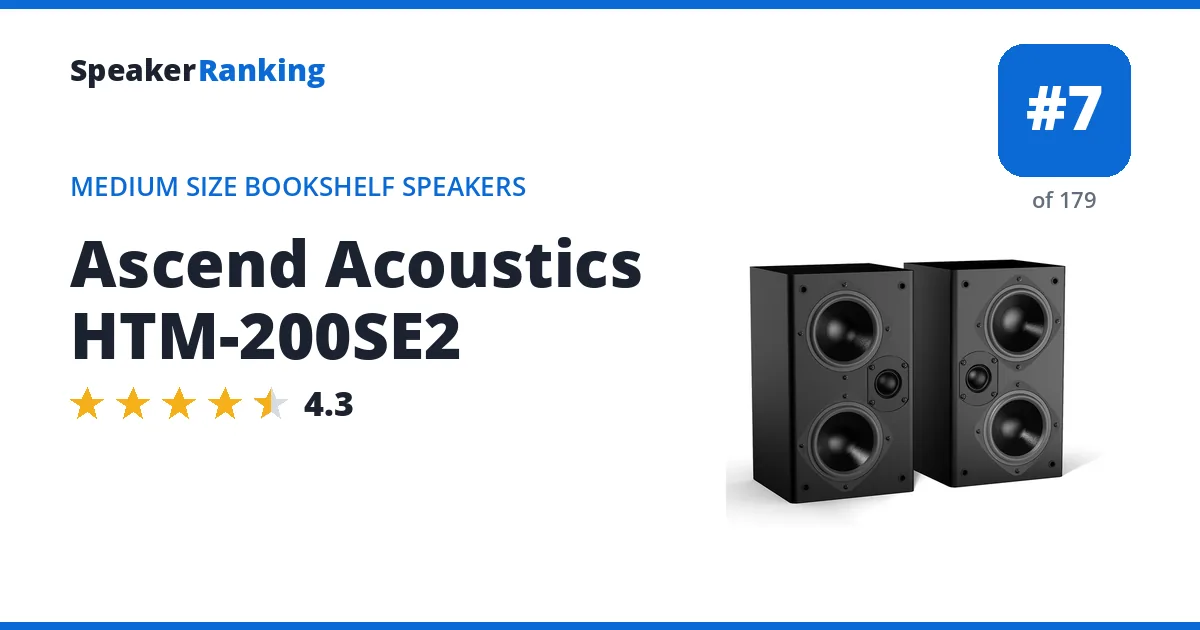
Same family: the Ascend Acoustics CBM-170 SE2 (smaller bookshelf, rated 3.8/5) and the Ascend Acoustics CMT-340 SE2 (larger bookshelf, rated 4.4/5). See every Ascend CBM, HTM and CMT generation.
Pros: High-quality manufacturer NFS data shows 0.385dB on-axis average absolute deviation, 0.428 listening-window smoothness, and unusually even 80-degree dispersion in both planes. The compact sealed cabinet is easy to place, while the preference score reaches 7.90 with a subwoofer. Measured bass extension of 87.9Hz (-3dB), with a measured sensitivity of 86.0dB.
Cons: Limited bass is the main tradeoff, measuring 87.9Hz at -3dB, 71.8Hz at -6dB, and 51.3Hz at -12dB; its preference score falls to 4.98 without a subwoofer. The 3.62 sound-power directivity-index standard deviation is respectable rather than exceptional, and the small woofers limit deep-bass output.
Full Ascend Acoustics HTM-200SE2 review and specifications →
| Released | Nov 2024 (1 year ago) |
|---|---|
| Bass Extension (-10dB) | approximately 56Hz (measured, spinorama.org) |
| Bass Extension (-3dB) | 87.9Hz (measured, spinorama.org) |
| DIY Kit | No |
| Dimensions | 11”H x 6.5”W x 6.4”D (279 x 165 x 162 mm) |
| Drivers | Two 4-inch woofers; soft-dome tweeter |
| Enclosure | Sealed |
| Impedance | 8 ohms nominal |
| Sensitivity | 86.0dB (manufacturer specified); 85.2dB (measured, spinorama.org) |
| Spinorama Preference Score | 4.98 |
| Spinorama Preference Score with Perfect Sub | 7.90 |
| Weight | 9.9 lbs (4.5 kg) each |
- Links
- Reviews, Comparisons and Sound Samples
- Head-to-Head Comparisons
- Ascend Acoustics HTM-200SE2 vs XMechanik Mechano23 DIY
- Ascend Acoustics HTM-200SE2 vs Arendal 1961 Monitor
- Ascend Acoustics HTM-200SE2 vs KEF LS50 Meta
- Ascend Acoustics HTM-200SE2 vs Ascend Acoustics Luna V2 Mini-Monitor Titan
- Ascend Acoustics HTM-200SE2 vs Ascend Acoustics Sierra 1 v2
- Ascend Acoustics HTM-200SE2 vs Aalto Speakers Aalto 1 EVO
- Ascend Acoustics HTM-200SE2 vs Philharmonic Ceramic Mini
- Ascend Acoustics HTM-200SE2 vs Audio First Fidelia
- See all 23 comparisons
 Ranked #10 of 168 in Medium Size Bookshelf Speakers - Ascend Acoustics Luna V2 Mini-Monitor Titan: $898 per pair Ascend Acoustics $898 eBay
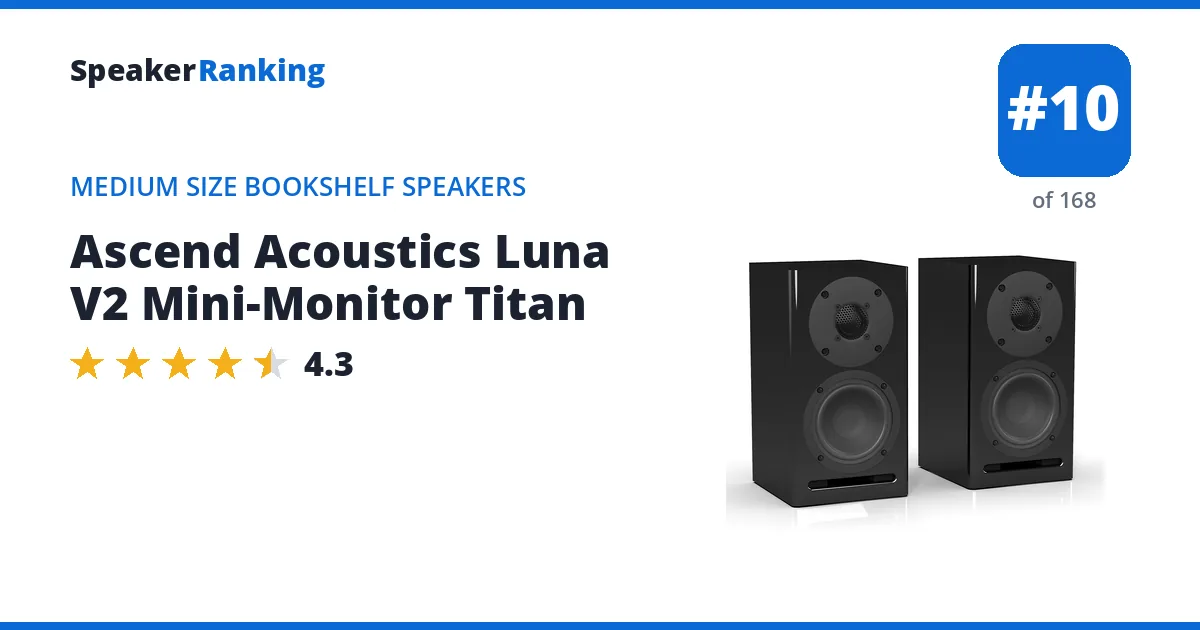
Same family: the Ascend Acoustics Luna V2 Mini-Monitor Ribbon (smaller bookshelf, ranked higher, rated 4.4/5). See every Ascend Sierra Luna generation.
Pros: A Klippel NFS optimized crossover and proprietary 4.5 inch long throw glass fiber woofer give this compact mini-monitor a large soundstage for its size, at Ascend’s most accessible price point. Backed by the same 7 year parts and labor warranty and hand matched pairs as Ascend’s larger models, with each unit shipped with its own production line frequency response printout. Measured bass extension of 74.7Hz (-3dB).
Cons: On axis deviation measures 0.599dB average, the roughest figure of any speaker added to this catalog from spinorama.org’s current measurement set, so a listener sitting dead center is more likely to notice unevenness than with the RAAL ribbon version of this same cabinet. Bass extension is limited by the small 4.5 inch woofer to a measured 74.7Hz at -3dB, so it needs a subwoofer for full range listening. Ascend sells direct only, with no dealer network for an in person audition.
Full Ascend Acoustics Luna V2 Mini-Monitor Titan review and specifications →
| Released | Nov 2024 (1 year ago) |
|---|---|
| Bass Extension (-10dB) | 45.7Hz (measured, spinorama.org vendor data) |
| Bass Extension (-3dB) | 74.7Hz (measured, spinorama.org vendor data) |
| Country | United States |
| DIY Kit | No |
| Dimensions | 10.6”H x 5.7”W x 6”D (270 x 146 x 152 mm) |
| Drivers | SEAS Titan 26mm aluminum/magnesium dome tweeter, 4.5” long throw glass fiber cone woofer |
| Enclosure | ported |
| Frequency Response | 75-27,000Hz +/-3dB anechoic (manufacturer) |
| Impedance | 8 ohms nominal |
| Power Handling | 100W continuous, 150W peak |
| Sensitivity | 82dB @ 2.83V/1m anechoic (manufacturer) |
| Spinorama Preference Score | 5.17 |
| Spinorama Preference Score with Perfect Sub | 7.78 |
| Warranty | 7 years parts and labor |
| Weight | 8.3 lbs (3.75 kg) each |
- Links
- Reviews, Comparisons and Sound Samples
- Head-to-Head Comparisons
- Ascend Acoustics Luna V2 Mini-Monitor Titan vs Aalto Speakers Aalto 1 EVO
- Ascend Acoustics Luna V2 Mini-Monitor Titan vs Arendal 1961 Monitor
- Ascend Acoustics Luna V2 Mini-Monitor Titan vs Ascend Acoustics HTM-200SE2
- Ascend Acoustics Luna V2 Mini-Monitor Titan vs Moondrop M4P MTM
- Ascend Acoustics Luna V2 Mini-Monitor Titan vs XMechanik Mechano23 DIY
- Ascend Acoustics Luna V2 Mini-Monitor Titan vs KEF LS50 Meta
- Ascend Acoustics Luna V2 Mini-Monitor Titan vs Monitor Audio Silver 50 7G
- Ascend Acoustics Luna V2 Mini-Monitor Titan vs Ascend Acoustics Sierra 1 v2
- See all 22 comparisons
Large Size Bookshelf Speakers
 Ranked #24 of 216 in Large Size Bookshelf Speakers - Ascend Acoustics CMT-340 SE2: $798 per pair Ascend Acoustics $798 eBay
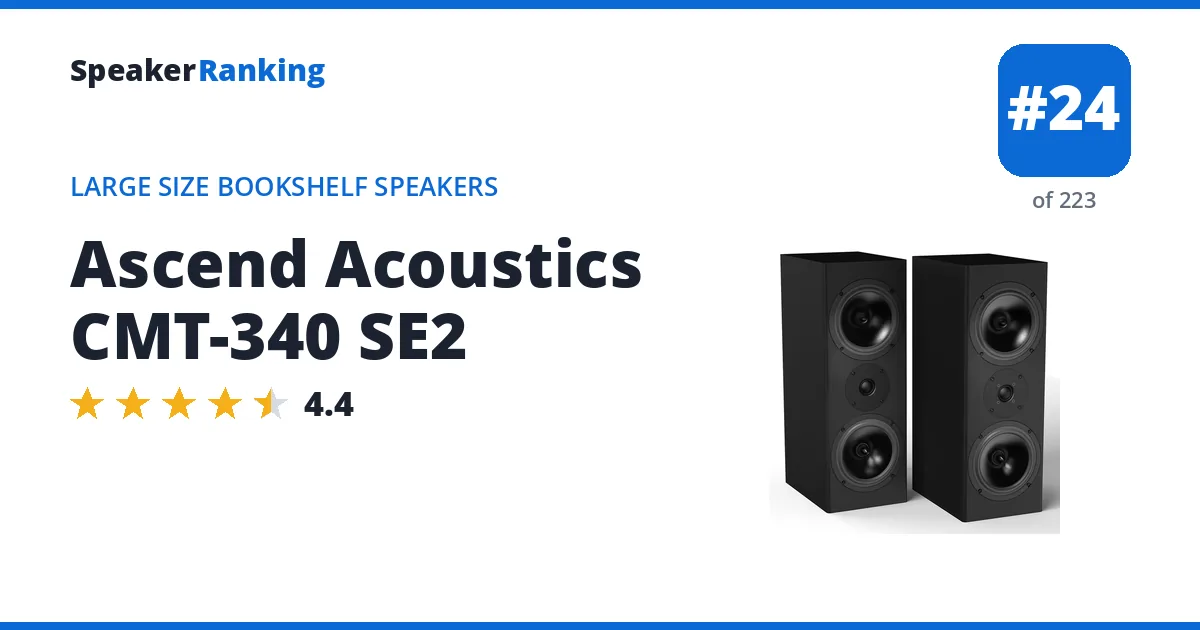
Older model: the Ascend Acoustics CMT-340 SE Center (rated 3.7/5). See every Ascend CBM, HTM and CMT generation.
Same family: the Ascend Acoustics CBM-170 SE2 (smaller bookshelf, ranked lower, rated 3.8/5) and the Ascend Acoustics HTM-200SE2 (smaller bookshelf, rated 4.3/5).
Pros: High-quality manufacturer Klippel NFS data shows 0.295dB on-axis average absolute deviation, 0.531 listening-window smoothness, and a strong 7.99 preference score with a subwoofer. Its dual 6.5-inch woofers, 92dB anechoic sensitivity, and 240W continuous power rating support high output and dynamics. Measured bass extension of 77.6Hz (-3dB).
Cons: Bass rolls off early for the cabinet size, measuring 77.6Hz at -3dB, 64.5Hz at -6dB, and 48.3Hz at -12dB; the preference score without a subwoofer is only 5.33. The 4.35 sound-power directivity-index standard deviation also indicates more off-axis variation than the strongest designs, and the rear port needs placement clearance.
Full Ascend Acoustics CMT-340 SE2 review and specifications →
| Released | Nov 2022 (3 years ago) |
|---|---|
| Bass Extension (-10dB) | approximately 53Hz (measured, spinorama.org) |
| Bass Extension (-3dB) | 77.6Hz (measured, spinorama.org) |
| DIY Kit | No |
| Dimensions | 21 x 7.5 x 10.5 in each |
| Drivers | Two 6.5-inch woofers; 27mm soft-dome tweeter |
| Impedance | 8 ohms nominal |
| Power Handling | 240W continuous; 400W short-term peak |
| Sensitivity | 92dB at 2.83V/1m anechoic |
| Spinorama Preference Score | 5.33 |
| Spinorama Preference Score with Perfect Sub | 7.99 |
| Weight | 29.1 lbs (13.2 kg) each |
- Links
- Reviews, Comparisons and Sound Samples
- Head-to-Head Comparisons
- Ascend Acoustics CMT-340 SE2 vs Arendal 1528 Monitor 8
- Ascend Acoustics CMT-340 SE2 vs Wharfedale Super Linton
- Ascend Acoustics CMT-340 SE2 vs MoFi SourcePoint 10
- Ascend Acoustics CMT-340 SE2 vs AsciLab F6Bs
- Ascend Acoustics CMT-340 SE2 vs Radiant Acoustics Clarity 6.2
- Ascend Acoustics CMT-340 SE2 vs Dynaudio Heritage Special
- Ascend Acoustics CMT-340 SE2 vs MoFi SourcePoint 8
- Ascend Acoustics CMT-340 SE2 vs Buchardt Audio E50
- See all 48 comparisons
 Ranked #37 of 216 in Large Size Bookshelf Speakers - Ascend Acoustics Sierra-LX: $1598 per pair Ascend Acoustics $1598 eBay
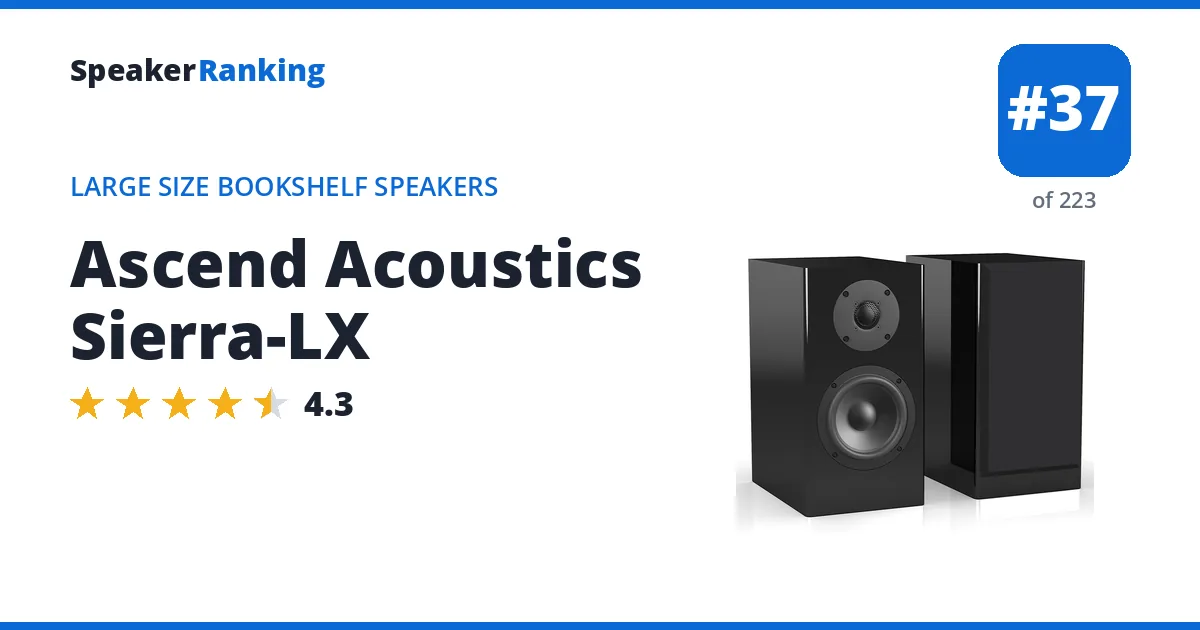
Same family: the Ascend Acoustics Sierra 1 v2 (smaller bookshelf, rated 4.7/5), the Ascend Acoustics Sierra-2EX V2 (smaller bookshelf, ranked lower, rated 4.3/5), the Ascend Acoustics Sierra Titan Tower (floorstanding, rated 4.4/5) and the Ascend Acoustics Sierra Horizon V2 (center, estimated 4.3/5). See every Ascend Sierra generation.
Pros: Very neutral, flat frequency response: within about plus or minus 1.5dB ignoring one narrow dip. Bass extension down to about 40Hz in-room despite the compact size. Wide, well-balanced soundstage (~60 degrees). Solid build quality with a laminated bamboo cabinet. Measured bass extension of 47Hz (-3dB), with a measured sensitivity of 81dB.
Cons: Very low sensitivity at about 81dB, so it needs a genuinely powerful amplifier to reach normal listening levels. Noticeable midrange distortion becomes audible above about 82-83dB SPL. A narrow dip around 3.5kHz on-axis in larger rooms without sidewall reflections: toeing the speakers out 10-20 degrees fills it in, but adds some brightness to the treble. Sensitive to listening height: sitting even slightly above or below tweeter level noticeably shifts the tonal balance.
Full Ascend Acoustics Sierra-LX review and specifications →
| Released | Apr 2022 (4 years ago) |
|---|---|
| Bass Extension (-10dB) | 38Hz (measured, Erin’s Audio Corner) |
| Bass Extension (-3dB) | 47Hz (measured, Erin’s Audio Corner) |
| Country | USA |
| DIY Kit | No |
| Dimensions | 14.3” x 7.5” x 10.5” (362 x 191 x 267 mm) |
| Drivers | 6” aluminum cone woofer, 26mm dome tweeter |
| Frequency Response | 28Hz - 23kHz (in-room, manufacturer specified) |
| Impedance | 8 ohms nominal (5.5 ohms minimum) |
| Power Handling | 350W continuous, 500W peak |
| Sensitivity | 81dB (2.83V/1m, measured by Erin’s Audio Corner) |
| Spinorama Preference Score | 6.63 |
| Spinorama Preference Score with Perfect Sub | 8.44 |
| Weight | 20.9 lbs (9.5 kg) |
| Woofer Cabinet | Bass reflex, flared rear port |
- Links
- Reviews, Comparisons and Sound Samples
- Head-to-Head Comparisons
- Ascend Acoustics Sierra-LX vs Wharfedale Linton 85
- Ascend Acoustics Sierra-LX vs Revel M126Be
- Ascend Acoustics Sierra-LX vs Philharmonic BMR (v1)
- Ascend Acoustics Sierra-LX vs Ascend Acoustics Sierra-2EX V2
- Ascend Acoustics Sierra-LX vs Dynaudio Heritage Special
- Ascend Acoustics Sierra-LX vs Radiant Acoustics Clarity 6.2
- Ascend Acoustics Sierra-LX vs MoFi SourcePoint 10
- Ascend Acoustics Sierra-LX vs Wharfedale Super Linton
- See all 50 comparisons
 Ranked #42 of 216 in Large Size Bookshelf Speakers - Ascend Acoustics Sierra-2EX V2: $1,748 per pair Ascend Acoustics $1,748 eBay
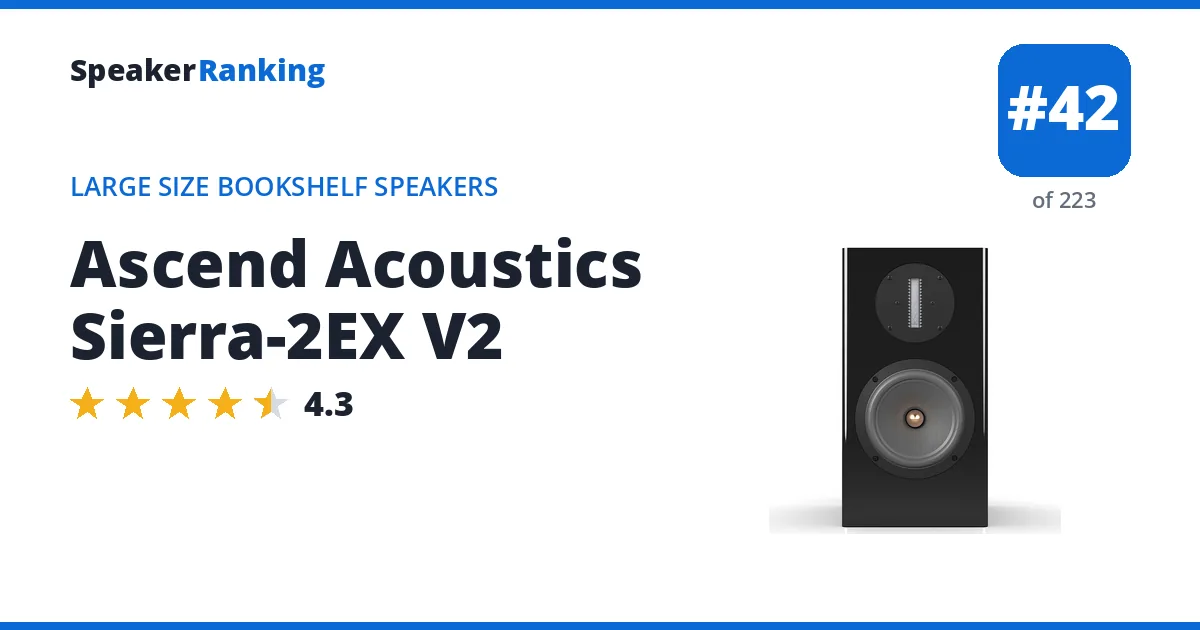
Older model: the Ascend Acoustics Sierra 2 (ranked lower, rated 3.7/5). See every Ascend Sierra generation.
Same family: the Ascend Acoustics Sierra 1 v2 (smaller bookshelf, rated 4.7/5), the Ascend Acoustics Sierra-LX (larger bookshelf, ranked higher, rated 4.3/5), the Ascend Acoustics Sierra Titan Tower (floorstanding, rated 4.4/5) and the Ascend Acoustics Sierra Horizon V2 (center, estimated 4.3/5).
Pros: A RAAL true ribbon tweeter is paired with a custom SEAS Excel Curv woofer, with the crossover optimized against Klippel NFS measurement data. Listening window smoothness measures 0.45, a moderate but usable figure for a compact standmount. Pairs are hand matched within +/-1.5dB and shipped with their own individual frequency response printout, backed by a 7 year parts and labor warranty from direct USA assembly in Orange County, California. Measured bass extension of 58.6Hz (-3dB).
Cons: On-axis response is relatively uneven, with an average deviation of about 0.45dB, so a listener sitting dead center may notice more unevenness than with smoother AsciLab or Ascend towers. Bass extension is modest for the price class at a measured 51.3Hz at -6dB. Ascend sells direct only, with no dealer network or third party retailers for an in person audition.
Full Ascend Acoustics Sierra-2EX V2 review and specifications →
| Released | Sep 2022 (4 years ago) |
|---|---|
| Bass Extension (-10dB) | 42.4Hz (measured, spinorama.org vendor data) |
| Bass Extension (-3dB) | 58.6Hz (measured, spinorama.org vendor data) |
| Bass Extension (-6dB) | 51.3Hz (measured, spinorama.org vendor data) |
| Country | United States |
| DIY Kit | No |
| Dimensions | 14.3”H x 7.5”W x 10.5”D (362 x 190 x 267 mm) |
| Drivers | RAAL 10mm true ribbon tweeter, 6” SEAS Excel Curv cone woofer |
| Enclosure | ported |
| Frequency Response | 51-27,000Hz +/-3dB (manufacturer) |
| Impedance | 8 ohms nominal |
| Power Handling | 150W continuous, 300W peak |
| Sensitivity | 85dB @ 2.83V/1m anechoic (manufacturer) |
| Spinorama Preference Score | 5.88 |
| Spinorama Preference Score with Perfect Sub | 7.95 |
| Warranty | 7 years parts and labor |
| Weight | 20.1 lbs (9.1 kg) each |
- Links
- Reviews, Comparisons and Sound Samples
- Head-to-Head Comparisons
- Ascend Acoustics Sierra-2EX V2 vs Selah Audio Integrity
- Ascend Acoustics Sierra-2EX V2 vs Philharmonic BMR (v1)
- Ascend Acoustics Sierra-2EX V2 vs Revel M126Be
- Ascend Acoustics Sierra-2EX V2 vs Ascend Acoustics Sierra-LX
- Ascend Acoustics Sierra-2EX V2 vs Wharfedale Linton 85
- Ascend Acoustics Sierra-2EX V2 vs Emotiva Airmotiv XB2
- Ascend Acoustics Sierra-2EX V2 vs ELAC Debut 3.0 DB63
- Ascend Acoustics Sierra-2EX V2 vs Perlisten A3m
- See all 47 comparisons
 Ranked #57 of 216 in Large Size Bookshelf Speakers - Ascend Acoustics Sierra Duo V2 Titan: $1,338 per pair Ascend Acoustics $1,338 eBay
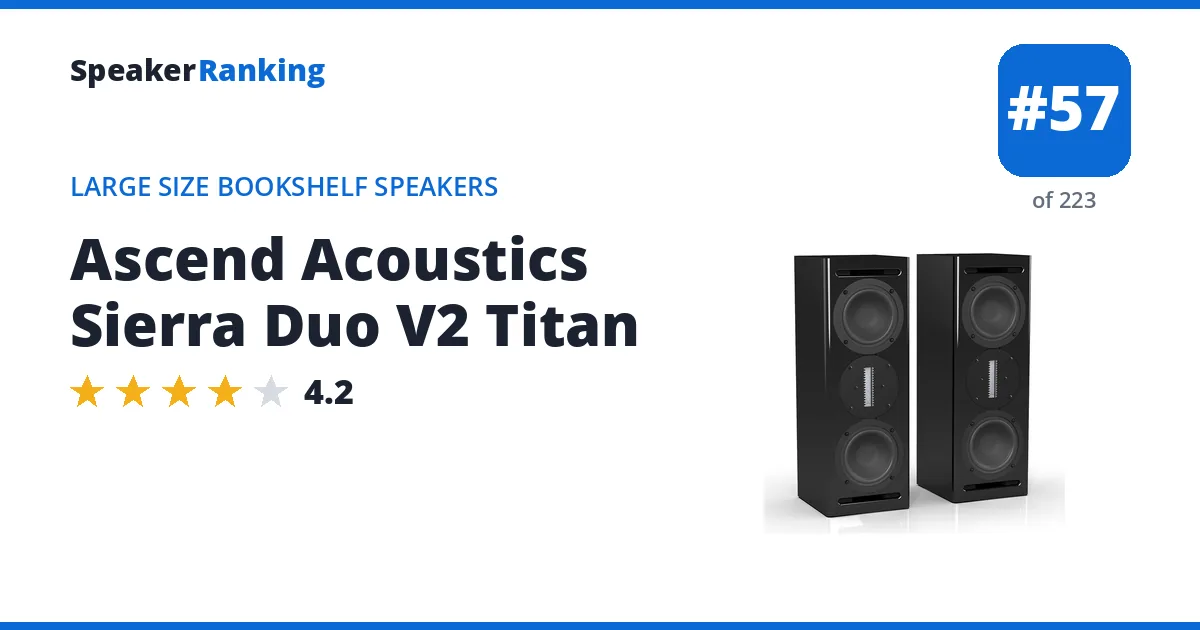
Same family: the Ascend Acoustics Sierra Duo V2 Ribbon (smaller bookshelf, ranked lower, rated 4.1/5). See every Ascend Sierra Duo generation.
Pros: High-quality manufacturer NFS data gives the Titan version a 0.585dB on-axis average absolute deviation and preference scores of 4.83 without a subwoofer and 7.45 with one, both better than the Ribbon version. Its 2.89 sound-power directivity-index standard deviation indicates reasonably consistent dispersion, while the compact bamboo cabinet and dual front slots simplify placement. Measured bass extension of 79.1Hz (-3dB).
Cons: Bass measures 79.1Hz at -3dB, 67.4Hz at -6dB, and 43.9Hz at -12dB, so a subwoofer is important. Listening-window smoothness is only 0.187, and horizontal MTM use narrows dispersion around the crossover; vertical orientation is preferable for stereo listening.
Full Ascend Acoustics Sierra Duo V2 Titan review and specifications →
| Released | Nov 2024 (1 year ago) |
|---|---|
| Bass Extension (-10dB) | approximately 50Hz (measured, spinorama.org) |
| Bass Extension (-3dB) | 79.1Hz (measured, spinorama.org) |
| DIY Kit | No |
| Dimensions | 16.25 x 5.75 x 6 in each |
| Drivers | Two 4.5-inch glass-fiber woofers; 26mm aluminum/magnesium Titan dome tweeter |
| Impedance | 8 ohms nominal |
| Sensitivity | 86dB at 2.83V/1m anechoic |
| Spinorama Preference Score | 4.83 |
| Spinorama Preference Score with Perfect Sub | 7.45 |
| Weight | 12.3 lbs (5.6 kg) each |
- Links
- Reviews, Comparisons and Sound Samples
- Head-to-Head Comparisons
- Ascend Acoustics Sierra Duo V2 Titan vs Monitor Audio Silver 50 8G
- Ascend Acoustics Sierra Duo V2 Titan vs ELAC Debut 3.0 DB63
- Ascend Acoustics Sierra Duo V2 Titan vs KEF R3
- Ascend Acoustics Sierra Duo V2 Titan vs KEF Q Concerto Meta
- Ascend Acoustics Sierra Duo V2 Titan vs KEF R3 Meta
- Ascend Acoustics Sierra Duo V2 Titan vs Klipsch RP-600M II
 Ranked #65 of 216 in Large Size Bookshelf Speakers - Ascend Acoustics Sierra Duo V2 Ribbon: $1,688 per pair Ascend Acoustics $1,688 eBay
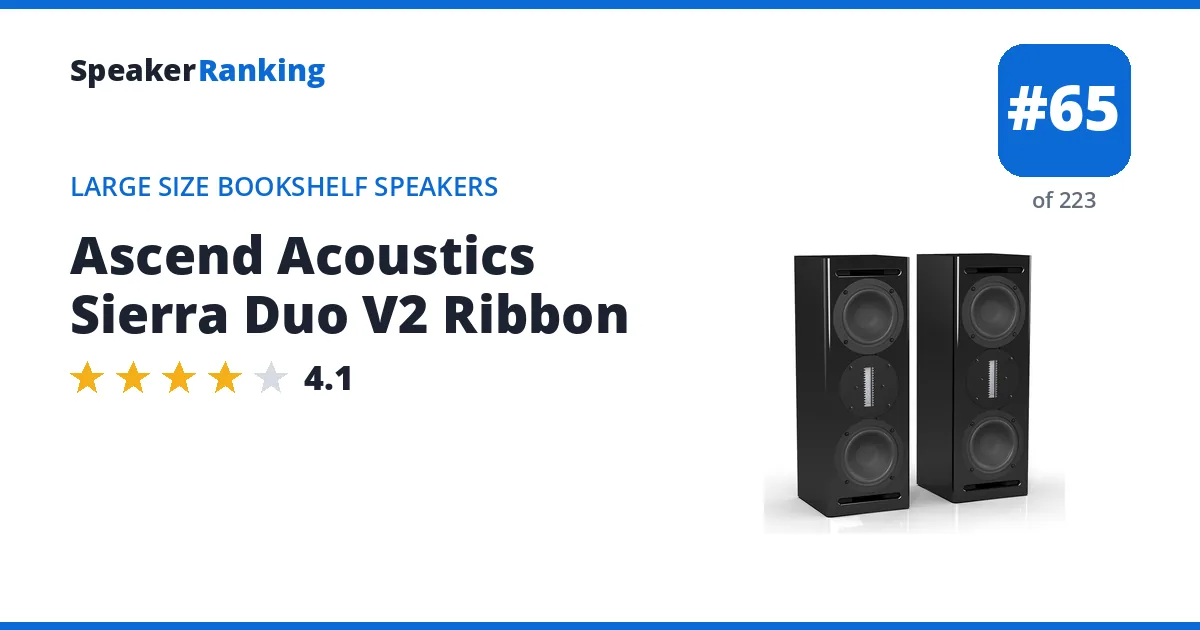
Older model: the Ascend Acoustics Sierra Luna Duo (rated 1.2/5). See every Ascend Sierra Duo generation.
Same family: the Ascend Acoustics Sierra Duo V2 Titan (larger bookshelf, ranked higher, rated 4.2/5).
Pros: High-quality manufacturer NFS data gives the RAAL version a low 2.09 sound-power directivity-index standard deviation, the most consistent dispersion of the two Duo V2 variants. Its preference score improves from 4.53 to 7.15 with a subwoofer, while the compact bamboo cabinet, dual front slots, and vertical or horizontal mounting options are unusually flexible. Measured bass extension of 79.1Hz (-3dB).
Cons: Bass measures 79.1Hz at -3dB, 64.5Hz at -6dB, and 43.9Hz at -12dB, and the 0.645dB on-axis average absolute deviation trails the Titan version’s 0.585dB. The 0.410 normalized listening-window deviation and narrow horizontal dispersion when the MTM cabinet is placed horizontally make vertical orientation preferable; a subwoofer is strongly recommended.
Full Ascend Acoustics Sierra Duo V2 Ribbon review and specifications →
| Released | 2022 (4 years ago) |
|---|---|
| Bass Extension (-10dB) | approximately 50Hz (measured, spinorama.org) |
| Bass Extension (-3dB) | 79.1Hz (measured, spinorama.org) |
| DIY Kit | No |
| Dimensions | 16.25 x 5.75 x 6 in each |
| Drivers | Two 4.5-inch glass-fiber woofers; custom RAAL true ribbon tweeter |
| Impedance | 8 ohms nominal |
| Sensitivity | 86dB at 2.83V/1m anechoic |
| Spinorama Preference Score | 4.53 |
| Spinorama Preference Score with Perfect Sub | 7.15 |
| Weight | 12.3 lbs (5.6 kg) each |
- Links
- Reviews, Comparisons and Sound Samples
- Head-to-Head Comparisons
- Ascend Acoustics Sierra Duo V2 Ribbon vs ELAC Debut 3.0 DB63
- Ascend Acoustics Sierra Duo V2 Ribbon vs ELAC DBR62
- Ascend Acoustics Sierra Duo V2 Ribbon vs Wharfedale Linton 85
- Ascend Acoustics Sierra Duo V2 Ribbon vs Wharfedale Super Linton
- Ascend Acoustics Sierra Duo V2 Ribbon vs KEF R3
- Ascend Acoustics Sierra Duo V2 Ribbon vs KEF Q Concerto Meta
- Ascend Acoustics Sierra Duo V2 Ribbon vs KEF R3 Meta
- Ascend Acoustics Sierra Duo V2 Ribbon vs Klipsch RP-600M II
 Ranked #112 of 216 in Large Size Bookshelf Speakers - Ascend Acoustics CBM-170 SE2: $468 per pair Ascend Acoustics $468 eBay
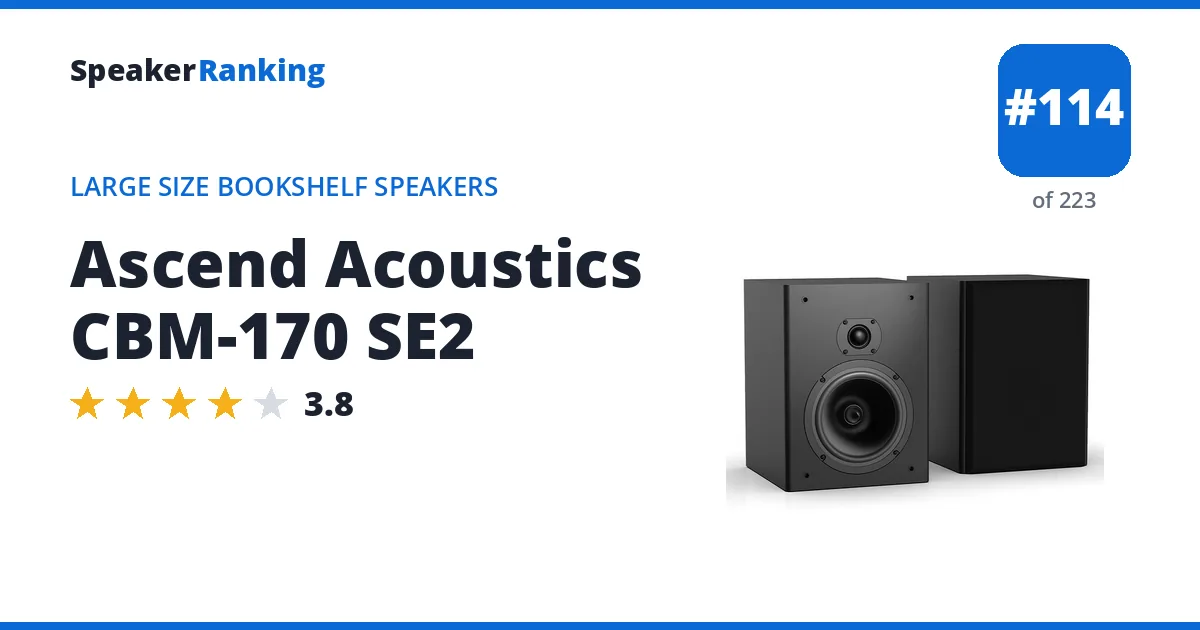
Older model: the Ascend Acoustics CBM-170 SE (ranked lower, rated 2.1/5). See every Ascend CBM, HTM and CMT generation.
Same family: the Ascend Acoustics HTM-200SE2 (larger bookshelf, rated 4.3/5) and the Ascend Acoustics CMT-340 SE2 (larger bookshelf, ranked higher, rated 4.4/5).
Pros: On-axis response is impressively flat from about 100Hz to 2kHz, staying within roughly ±1dB, with a clean, gradual bass rolloff below that. The directivity index rises smoothly and predictably through the crossover region, and the estimated in-room response shows a smooth, consistent downward tilt from 100Hz to 10kHz with no major discontinuities: close to the ideal in-room target shape. Measured sensitivity of 86.8dB nearly matches Ascend’s 87dB spec. The manufacturer’s own preference-score modeling comes out to 6.30 unequalized (rising to 8.66 with an ideal subwoofer, or 6.79/8.86 with EQ applied): a strong result for a compact 2-way, and a clear step up from the original Ascend Acoustics CBM-170 SE this replaces. Measured sensitivity of 86.8dB.
Cons: A narrow dip in the on-axis and listening-window response appears in the 3-5kHz range (down to about -2.7dB), mirrored by a matching dip in the directivity index at the same frequencies: likely a brief widening of dispersion right at the tweeter/woofer crossover. High-frequency directivity narrows substantially above 10kHz, typical for a small dome tweeter, so the top octave will sound more reserved off-axis than on-axis. Bass rolls off as expected for a compact 2-way monitor: -3dB around 70Hz and -10dB around 50Hz, so a subwoofer is needed for full-range use. This data comes from the manufacturer’s own Klippel measurements rather than an independent third-party review, so there’s no outside verification of channel matching, distortion, or unit-to-unit consistency.
Full Ascend Acoustics CBM-170 SE2 review and specifications →
| Released | Jul 2026 (3 months ago) |
|---|---|
| Bass Extension (-10dB) | 50Hz (measured, manufacturer spinorama data) |
| Bass Extension (-3dB) | 70Hz (measured, manufacturer spinorama data) |
| DIY Kit | No |
| Dimensions | 12H x 9W x 9.5D in |
| Drivers | 27mm custom SEAS soft dome tweeter, 6.5” proprietary composite polygel cone woofer |
| Impedance | 8 ohms |
| Power Handling | 200W continuous, 400W peak |
| Sensitivity | 86.8dB (2.83V/1m, measured, manufacturer spinorama data; 87dB manufacturer specified) |
| Spinorama Preference Score | 6.30 |
| Spinorama Preference Score with Perfect Sub | 8.66 |
| Weight | 15 lbs (6.8 kg) each |
| Woofer Cabinet | ported, rear |
- Links
- Reviews, Comparisons and Sound Samples
- Head-to-Head Comparisons
- Ascend Acoustics CBM-170 SE2 vs Polk Signature Elite ES20
- Ascend Acoustics CBM-170 SE2 vs Klipsch RP-600M II
- Ascend Acoustics CBM-170 SE2 vs Dynaudio Contour 20i
- Ascend Acoustics CBM-170 SE2 vs Dynaudio Emit 20
- Ascend Acoustics CBM-170 SE2 vs Philharmonic BMR Monitor
- Ascend Acoustics CBM-170 SE2 vs Mission LX-3 MKII
- Ascend Acoustics CBM-170 SE2 vs GR-Research X-LS Encore
- Ascend Acoustics CBM-170 SE2 vs Dynaudio Special Forty
- See all 49 comparisons
Large Size Floorstanding Speakers
 Ranked #12 of 226 in Large Size Floorstanding Speakers - Ascend Acoustics ELX Ribbon Tower: $5,698 per pair Ascend Acoustics $5,698 eBay
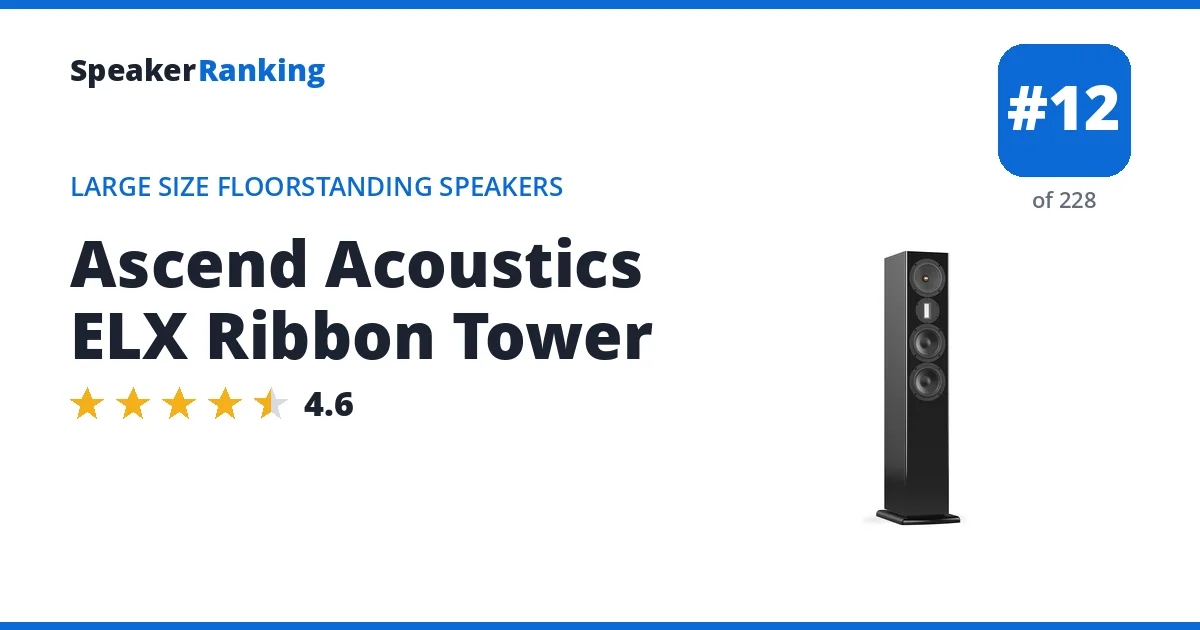
Same family: the Ascend Acoustics ELX Ribbon Horizon (center, rated 4.6/5).
Pros: A RAAL 70-20xram ribbon tweeter and dual SEAS Excel aluminum woofers in a 3-way, 4-driver bamboo tower measure a genuine 38.7Hz extension point with a nearly flat on axis slope of 0.05dB per octave, one of the flattest measured towers we list. The bass alignment Q of 0.62 keeps the low end well damped rather than peaky. Backed by a 7 year parts and labor warranty and hand assembled in Orange County, California, with each pair matched within +/-1.5dB. Measured bass extension of 38.7Hz (-3dB).
Cons: Listening window smoothness measures a moderate 0.40 and on axis deviation runs 0.286dB average, both trailing the tighter figures posted by some of the passive AsciLab and Ascend bookshelf models in this same batch. At $5698/pair it is Ascend’s most expensive tower, well above the Titan dome tweeter version of the same cabinet. The manufacturer’s own claimed sensitivity (87.5dB) runs nearly 1.5dB higher than the independently measured average (86.1dB), worth accounting for when matching an amplifier.
Full Ascend Acoustics ELX Ribbon Tower review and specifications →
| Bass Extension (-10dB) | 28.5Hz (measured, spinorama.org vendor data) |
|---|---|
| Bass Extension (-3dB) | 38.7Hz (measured, spinorama.org vendor data) |
| Country | United States |
| DIY Kit | No |
| Dimensions | 43”H x 7.5”W x 10.5”D (1092 x 190 x 267 mm) |
| Drivers | RAAL 70-20xram ribbon tweeter, 6” SEAS Excel Curv midrange (sealed sub-chamber), 2x 6” SEAS Excel aluminum woofers |
| Enclosure | ported |
| Frequency Response | 36-27,000Hz +/-3dB anechoic (manufacturer) |
| Impedance | 8 ohms nominal |
| Power Handling | 400W continuous, 600W peak |
| Sensitivity | 87.5dB @ 2.83V/1m anechoic (manufacturer) |
| Spinorama Preference Score | 6.97 |
| Spinorama Preference Score with Perfect Sub | 8.42 |
| Warranty | 7 years parts and labor |
| Weight | 56 lbs (25.4 kg) each |
- Links
- Reviews, Comparisons and Sound Samples
- Head-to-Head Comparisons
- Ascend Acoustics ELX Ribbon Tower vs Radiant Acoustics Clarity 66
- Ascend Acoustics ELX Ribbon Tower vs Revel F328Be
- Ascend Acoustics ELX Ribbon Tower vs Revel F226Be
- Ascend Acoustics ELX Ribbon Tower vs MoFi SourcePoint 888
- Ascend Acoustics ELX Ribbon Tower vs JBL 4367
- Ascend Acoustics ELX Ribbon Tower vs MoFi SourcePoint V10 Master Edition
- Ascend Acoustics ELX Ribbon Tower vs KEF Blade Two Meta
- Ascend Acoustics ELX Ribbon Tower vs JBL HDI-3800
- See all 25 comparisons
 Ranked #45 of 226 in Large Size Floorstanding Speakers - Ascend Acoustics Sierra Titan Tower: $2,998 per pair Ascend Acoustics $2,998 eBay
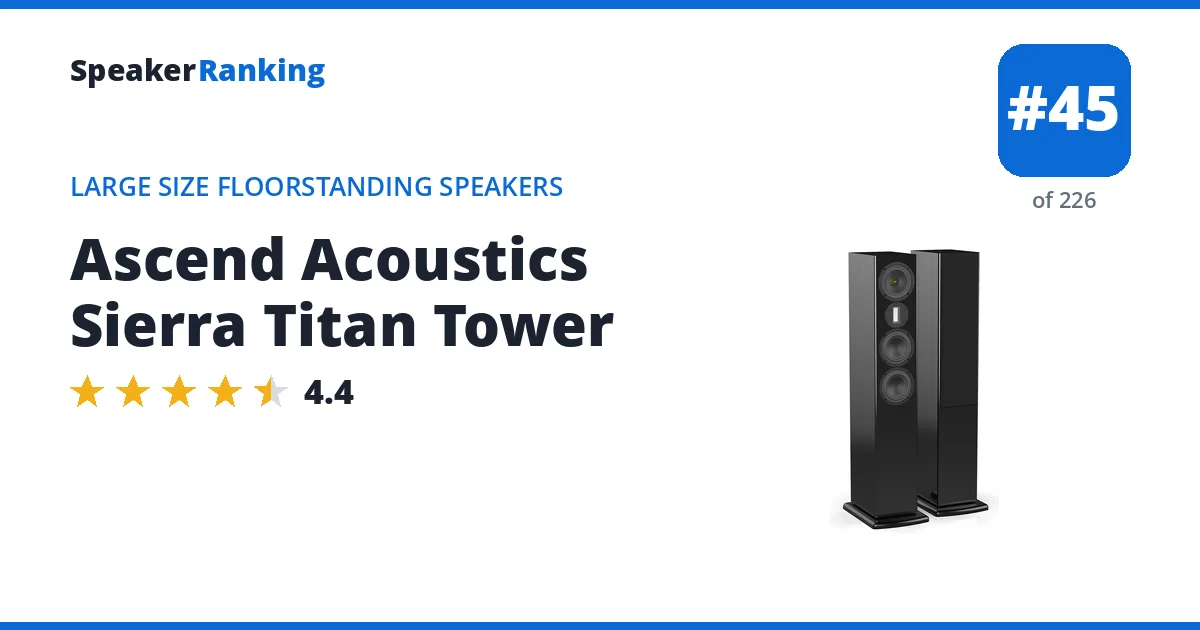
Same family: the Ascend Acoustics Sierra 1 v2 (smallest bookshelf, rated 4.7/5), the Ascend Acoustics Sierra-2EX V2 (bookshelf, rated 4.3/5), the Ascend Acoustics Sierra-LX (largest bookshelf, rated 4.3/5) and the Ascend Acoustics Sierra Horizon V2 (center, estimated 4.3/5). See every Ascend Sierra generation.
Pros: A SEAS Titan dome tweeter and dual 5.25 inch long throw woofers in a bamboo V-LAM tower reach a measured 58.6Hz extension point at a more accessible price than Ascend’s ribbon tweeter ELX line. The bass alignment Q of 0.72 keeps the low end reasonably well controlled. Backed by the same 7 year parts and labor warranty and hand matched +/-1.5dB pairs, each shipped with its own production line frequency response printout. Measured bass extension of 58.6Hz (-3dB).
Cons: Its listening window response is the least smooth of Ascend’s measured towers, trailing the pricier Ascend Acoustics ELX Ribbon Tower. Sound power response falls off more steeply above the crossover than the ribbon version, so off axis and in room treble energy rolls off faster. Ascend sells direct only, with no dealer network or third party retailers for an in person audition.
Full Ascend Acoustics Sierra Titan Tower review and specifications →
| Released | Dec 2022 (3 years ago) |
|---|---|
| Bass Extension (-10dB) | 34.6Hz (measured, spinorama.org vendor data) |
| Bass Extension (-3dB) | 58.6Hz (measured, spinorama.org vendor data) |
| Country | United States |
| DIY Kit | No |
| Dimensions | 43”H x 7.5”W x 10.5”D (1092 x 190 x 267 mm) |
| Drivers | SEAS Titan dome tweeter, 1x 5.25” midrange (sealed sub-chamber), 2x 5.25” mineral filled polypropylene woofers |
| Enclosure | ported |
| Frequency Response | 32-27,000Hz typical in-room (manufacturer) |
| Impedance | 8 ohms nominal |
| Power Handling | 300W continuous, 500W peak |
| Sensitivity | 88dB @ 2.83V/1m in-room (manufacturer) |
| Spinorama Preference Score | 6.05 |
| Spinorama Preference Score with Perfect Sub | 8.00 |
| Warranty | 7 years parts and labor |
| Weight | 45 lbs (20.4 kg) each |
- Links
- Reviews, Comparisons and Sound Samples
- Head-to-Head Comparisons
- Ascend Acoustics Sierra Titan Tower vs KEF R11 Meta
- Ascend Acoustics Sierra Titan Tower vs Focal Aria Evo X N°4
- Ascend Acoustics Sierra Titan Tower vs Paradigm Founder 100F
- Ascend Acoustics Sierra Titan Tower vs JBL Studio 698
- Ascend Acoustics Sierra Titan Tower vs JBL HDI-3600
- Ascend Acoustics Sierra Titan Tower vs Polk Audio Reserve R700
- Ascend Acoustics Sierra Titan Tower vs Focal Aria Evo X N°3
- Ascend Acoustics Sierra Titan Tower vs KEF R7 Meta
- See all 9 comparisons
Center Channel Speakers
 Ranked #2 of 131 in Center Channel Speakers - Ascend Acoustics ELX Ribbon Horizon: $3,098 each Ascend Acoustics $3,098 eBay
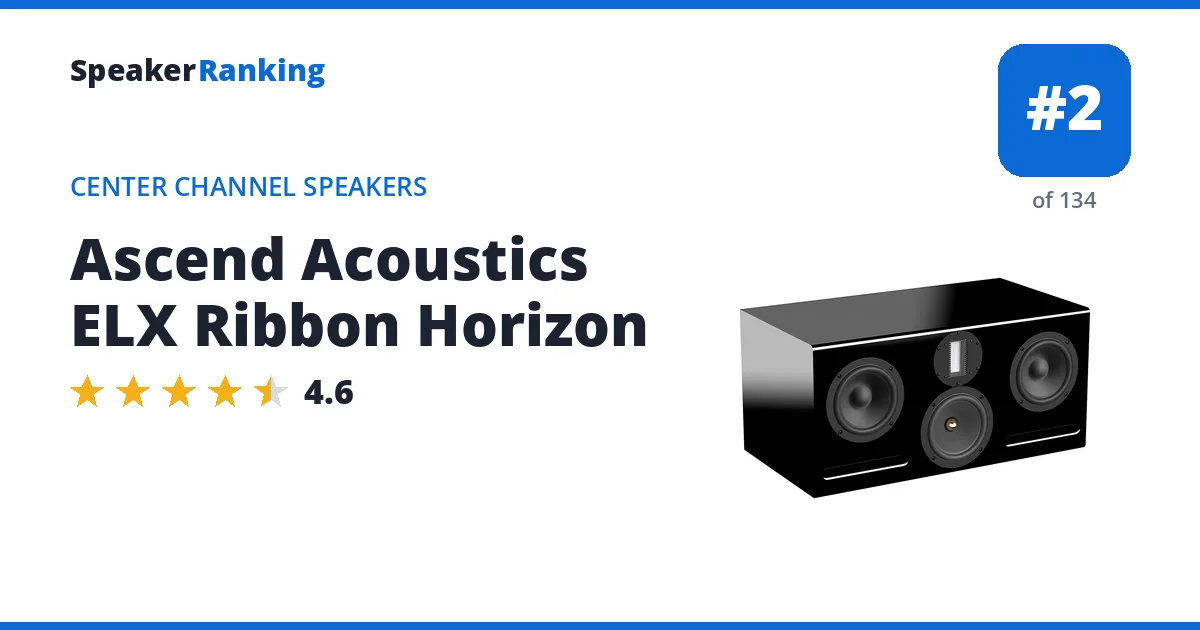
Same family: the Ascend Acoustics ELX Ribbon Tower (floorstanding, rated 4.6/5).
Pros: A RAAL true ribbon tweeter and a 6” SEAS Curv midrange in its own sealed chamber sit between two 6” long-throw SEAS woofers in a laminated bamboo cabinet. Ascend’s Klippel near-field measurements show the lowest on-axis deviation of any current center channel ranked here (0.15) and a listening window within 1.9dB from 300Hz to 5kHz, and its preference score of 6.17 without a subwoofer is second only to the Perlisten S7c. Bass is among the deepest of any center here, reaching 51.3Hz (-3dB) and about 30Hz (-10dB), so it can play full range in most rooms. Dispersion is wide horizontally (about ±60 degrees), which keeps dialogue consistent for off-center seats.
Cons: The measurements come from Ascend itself, not an independent reviewer. The ribbon’s vertical dispersion is narrow (about ±25 degrees), so aim the tweeter at ear height rather than tilting it from far above or below the screen. It is sold only direct from Ascend, and at 584mm wide and 52 lb it needs a deep, sturdy shelf.
Full Ascend Acoustics ELX Ribbon Horizon review and specifications →
| Bass Extension (-10dB) | about 29.8Hz (measured, manufacturer data via spinorama.org) |
|---|---|
| Bass Extension (-3dB) | 51.3Hz (measured, manufacturer data via spinorama.org) |
| DIY Kit | No |
| Dimensions | 11”H x 23”W x 12.5”D (279 x 584 x 318 mm) |
| Drivers | RAAL 70-20xram ribbon tweeter, 6” SEAS Curv cone midrange (sealed chamber), 2x 6” aluminum cone woofers |
| Frequency Response | 36Hz-27kHz ±3dB anechoic (manufacturer specified) |
| Impedance | 8 ohms nominal (manufacturer specified) |
| Sensitivity | 88dB anechoic, 91dB in-room (2.83V/1m, manufacturer specified) |
| Spinorama Preference Score | 6.17 |
| Spinorama Preference Score with Perfect Sub | 7.83 |
| Weight | 52 lbs (23.6 kg) |
| Woofer Cabinet | ported (dual front slots) |
- Links
- Reviews, Comparisons and Sound Samples
- Head-to-Head Comparisons
 Ranked #12 of 131 in Center Channel Speakers - Ascend Acoustics Sierra Horizon V2: $1,998 each Ascend Acoustics $1,998 eBay
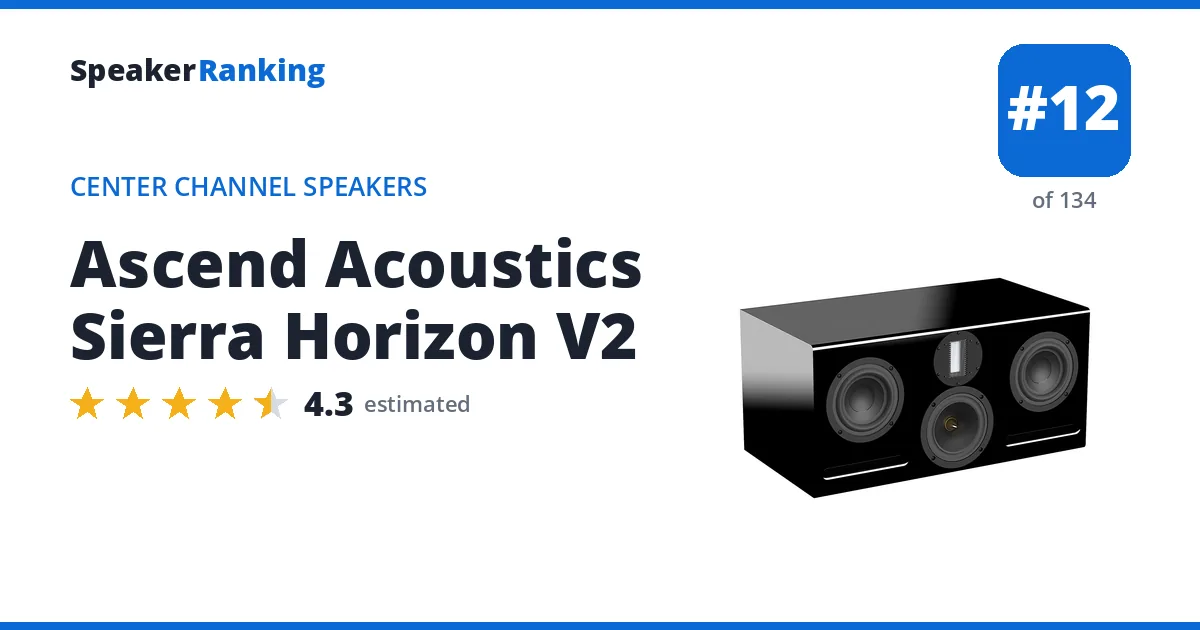
Older model: the Ascend Acoustics Sierra Horizon (ranked lower, rated 4.2/5). See every Ascend Sierra generation.
Same family: the Ascend Acoustics Sierra 1 v2 (smallest bookshelf, rated 4.7/5), the Ascend Acoustics Sierra-2EX V2 (bookshelf, rated 4.3/5), the Ascend Acoustics Sierra-LX (largest bookshelf, rated 4.3/5) and the Ascend Acoustics Sierra Titan Tower (floorstanding, rated 4.4/5).
Pros: The revised Sierra Horizon center with a custom RAAL true ribbon tweeter, an underhung mineral-filled polypropylene midrange and two long-throw woofers on cast aluminum frames, in a laminated bamboo cabinet. Ascend rates it from Klippel near-field measurements at 60Hz to 27kHz (±3dB) anechoic and 48Hz at -6dB, with 88dB anechoic sensitivity.
Cons: No independent measurements yet, so its tonal balance and directivity can’t be compared directly with measured centers; the rating is estimated from its predecessor’s measurements. Ascend publishes Klippel-based specifications but not the full Spinorama data. It is sold only direct from Ascend.
Full Ascend Acoustics Sierra Horizon V2 review and specifications →
| Released | Feb 2023 (3 years ago) |
|---|---|
| Bass Extension (-3dB) | 60Hz (manufacturer specified) |
| Dimensions | 11”H x 23”W x 12.5”D (279 x 584 x 318 mm) |
| Drivers | RAAL true ribbon tweeter, mineral-filled polypropylene midrange, 2x mineral-filled polypropylene woofers |
| Frequency Response | 60Hz-27kHz ±3dB anechoic, -6dB at 48Hz (manufacturer specified) |
| Impedance | 8 ohms nominal (manufacturer specified) |
| Sensitivity | 88dB anechoic, 91dB in-room (2.83V/1m, manufacturer specified) |
| Weight | 41.9 lbs (19 kg) |
- Links
- Reviews, Comparisons and Sound Samples
- No independent measurement review is linked for this model; it is ranked from hands-on listening and comparison against similarly priced speakers.
- Head-to-Head Comparisons
Discontinued Ascend Acoustics Models
Still ranked, and often still worth buying used, but no longer in production. Check availability before planning around one of these.
Medium Size Bookshelf Speakers
 Ranked #158 of 168 in Medium Size Bookshelf Speakers - Ascend Acoustics Sierra Luna: $1,176 per pair superseded by Luna V2 Discontinued eBay
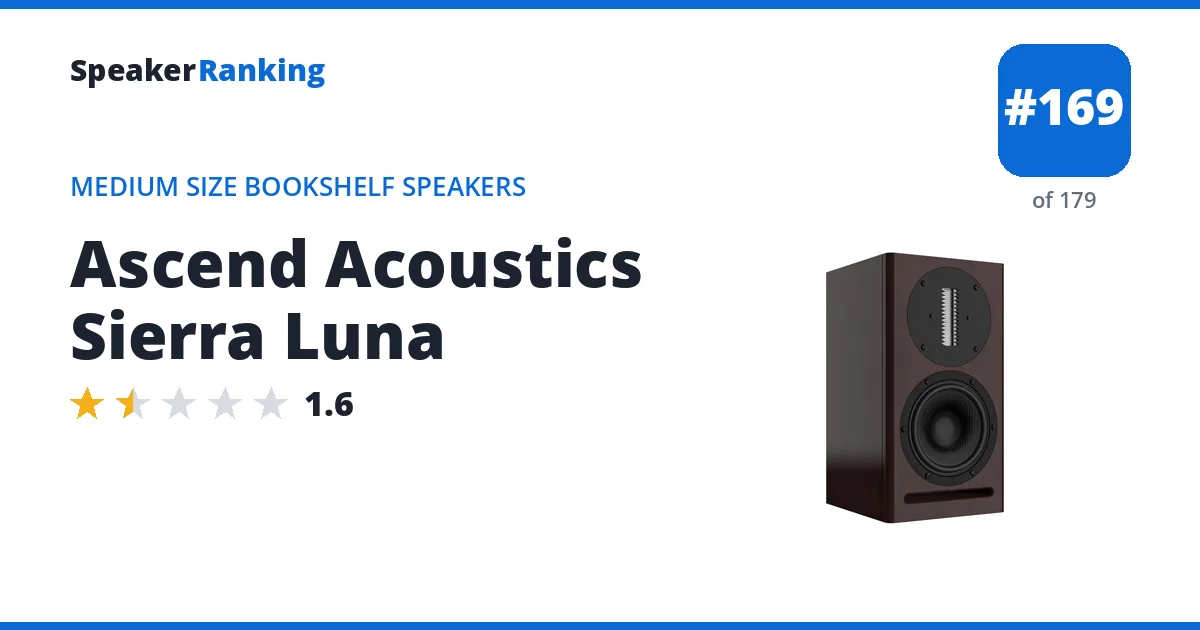
Newer model: the Ascend Acoustics Luna V2 Mini-Monitor Ribbon, ranked higher, rated 4.4/5, released 2022. See every Ascend Sierra Luna generation.
Pros: Ribbon tweeter and a dense, low-resonance bamboo cabinet give it well-controlled horizontal directivity, since the driver sizes blend together effectively. Solid build quality and impressive power handling for such a compact enclosure. Measured bass extension of 88.9Hz (-3dB), with a measured sensitivity of 80.9dB.
Cons: Dramatic peaks in the bass region around 400Hz, 800Hz, and 1.2kHz: Amir questioned, “A woofer doesn’t dance up and down so sharply by itself in a few hundred hertz?” The port resonates excessively, actually exceeding the woofer’s own output and creating problematic bass “horns.” Measured sensitivity of 80.9dB falls well short of the 83dB spec, requiring about 6dB more amplifier gain than typical speakers. Vertical directivity is poor, making tweeter-height listening position critical. Initial impressions were bright and fatiguing; even after aggressive EQ, Amir called the result “still a bit too bright but much more manageable” and could not recommend the speaker standalone. Discontinued.
Full Ascend Acoustics Sierra Luna review and specifications →
| Released | Mar 2017 (9 years ago) |
|---|---|
| Bass Extension (-10dB) | 52.1Hz (measured, Audio Science Review) |
| Bass Extension (-3dB) | 88.9Hz (measured, Audio Science Review) |
| DIY Kit | No |
| Dimensions | 10.5H x 5.75W x 6D in |
| Drivers | Custom RAAL true ribbon tweeter (10mm), 4.5” long-throw dual compliant CURV woofer |
| Frequency Response | 60Hz - 27kHz (+/-3dB) (Manufacturer specified) |
| Impedance | 8 ohms nominal |
| Sensitivity | 80.9dB (2.83V/1m, measured, Audio Science Review; 83dB manufacturer specified) |
| Spinorama Preference Score | 1.87 |
| Spinorama Preference Score with Perfect Sub | 4.94 |
| Weight | 9 lbs (4.1 kg) each |
| Woofer Cabinet | ported, front |
- Reviews, Comparisons and Sound Samples
- Head-to-Head Comparisons
 Ranked #168 of 168 in Medium Size Bookshelf Speakers - Ascend Acoustics Sierra Luna Duo: $1,624 per pair superseded by Luna Duo V2 Discontinued eBay
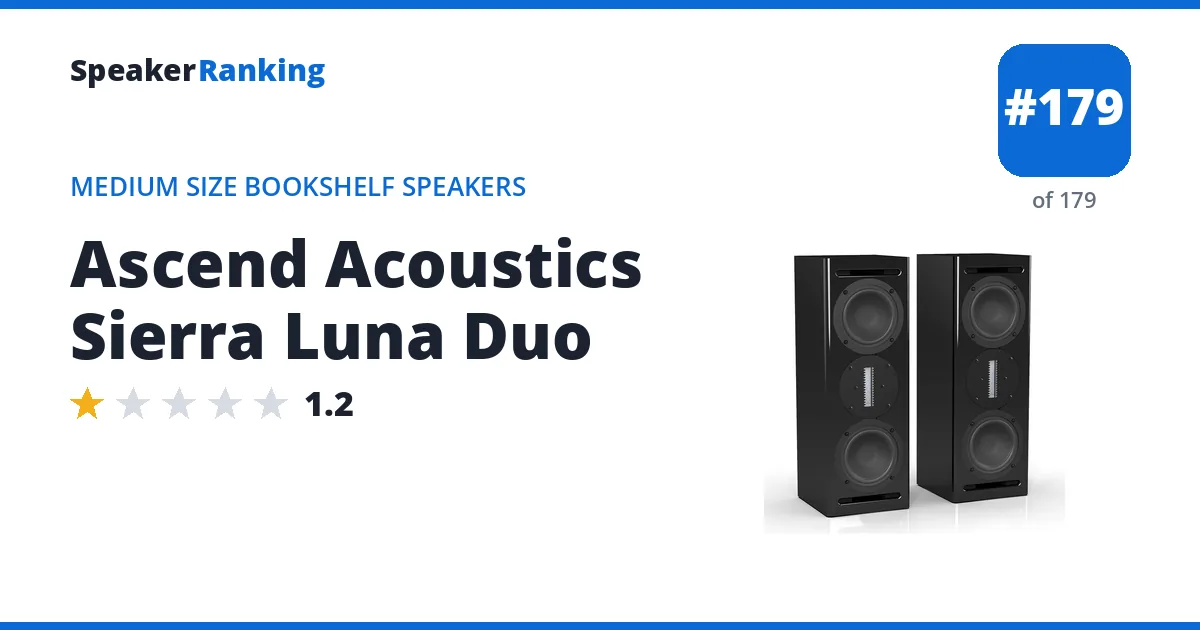
Newer model: the Ascend Acoustics Sierra Duo V2 Ribbon, rated 4.1/5, released 2022. See every Ascend Sierra Duo generation.
Pros: Adding a second Luna woofer improves efficiency and reduces distortion versus the standard Ascend Acoustics Sierra Luna, and the RAAL ribbon tweeter carries over. Flexible orientation lets it work vertically as a main/LCR speaker or horizontally as a center channel. Measured bass extension of 85.0Hz (-3dB), with a measured sensitivity of 84.9dB.
Cons: Amir called it “one of the worse measuring and sounding [speakers] I have tested out of near 100 this year” and stated he “can not in any form or fashion recommend the Ascend Sierra Luna Duo.” On-axis response shows significant midrange irregularities, off-axis performance is uneven, and the port design creates notable frequency response disturbances. Vertical directivity has an extremely narrow optimal listening window. The reviewer noted a stark contrast with the Revel M105, which showed clearly superior tonality and clarity. Discontinued.
Full Ascend Acoustics Sierra Luna Duo review and specifications →
| Released | Sep 2019 (7 years ago) |
|---|---|
| Bass Extension (-10dB) | 52.2Hz (measured, Audio Science Review) |
| Bass Extension (-3dB) | 85.0Hz (measured, Audio Science Review) |
| DIY Kit | No |
| Drivers | Custom RAAL true ribbon tweeter, dual 4.5” long-throw dual compliant CURV woofers |
| Sensitivity | 84.9dB (2.83V/1m, measured, Audio Science Review) |
| Spinorama Preference Score | 1.03 (spinorama.org) |
| Spinorama Preference Score with Perfect Sub | 3.91 (spinorama.org) |
| Woofer Cabinet | ported, front |
- Reviews, Comparisons and Sound Samples
- Head-to-Head Comparisons
Large Size Bookshelf Speakers
 Ranked #122 of 216 in Large Size Bookshelf Speakers - Ascend Acoustics Sierra 2: $1,500 per pair Discontinued eBay
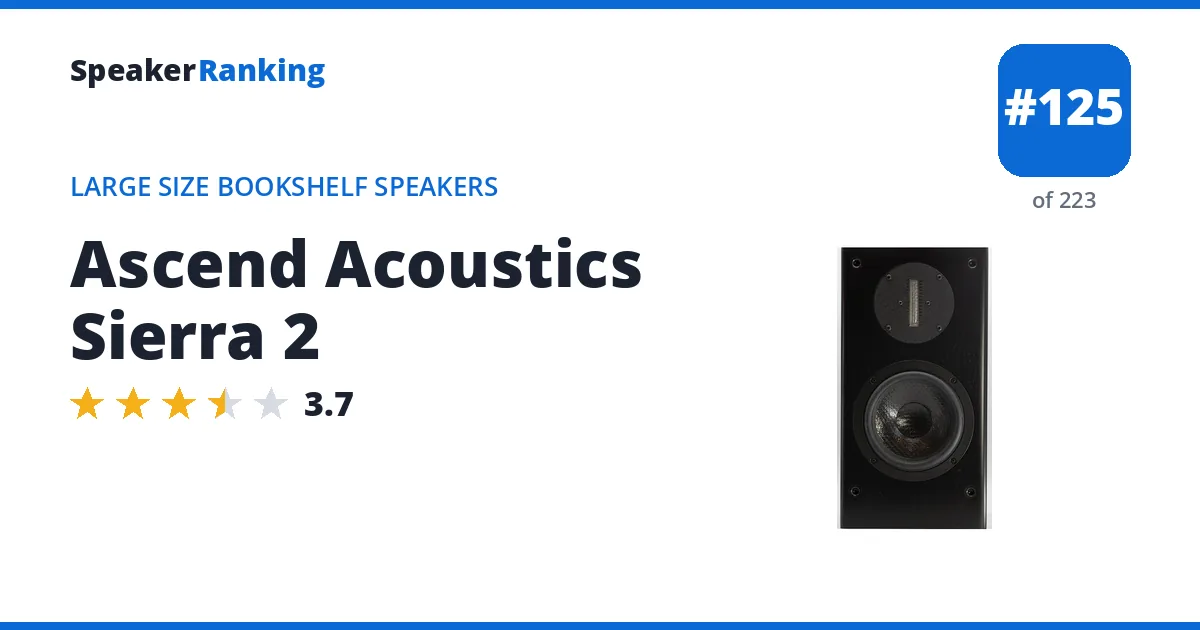
Newer model: the Ascend Acoustics Sierra-2EX V2, ranked higher, rated 4.3/5, released Sep 2022. See every Ascend Sierra generation.
Same family: the Ascend Acoustics Sierra Horizon (center, rated 4.2/5).
Pros: A two-way standmount with a ribbon tweeter and a woven cone woofer. Audio Science Review measured a fairly even on-axis response (0.58 deviation), a smooth predicted in-room response (0.70) and wide horizontal coverage of about ±65 degrees, for a preference score of 4.22 that rises to 6.56 with an ideal subwoofer. Measured bass extension of 85.7Hz (-3dB), with a measured sensitivity of 86.4dB.
Cons: Bass rolls off early for its size, at 56.4Hz (-6dB) and about 45.8Hz (-10dB), so it benefits from a subwoofer. The vertical listening window is narrow at about ±20 degrees, so keep the tweeter near ear height. Replaced by the Ascend Acoustics Sierra-2EX V2. Discontinued.
Full Ascend Acoustics Sierra 2 review and specifications →
| Released | Mar 2014 (12 years ago) |
|---|---|
| Bass Extension (-10dB) | 45.8Hz (derived, log-interpolated between spinorama.org -9dB/-12dB points) |
| Bass Extension (-3dB) | 85.7Hz (measured, Audio Science Review) |
| Country | United States |
| DIY Kit | No |
| Dimensions | 14.3”H x 7.5”W x 10.5”D (362 x 191 x 267 mm) |
| Drivers | ribbon tweeter, woven cone woofer |
| Enclosure | ported |
| Impedance | 8 ohms nominal (manufacturer specified) |
| Sensitivity | 86.4dB (measured, Audio Science Review via spinorama.org) |
| Spinorama Preference Score | 4.22 |
| Spinorama Preference Score with Perfect Sub | 6.56 |
| Weight | 20.1 lbs (9.1 kg) |
- Reviews, Comparisons and Sound Samples
- Head-to-Head Comparisons
 Ranked #212 of 216 in Large Size Bookshelf Speakers - Ascend Acoustics CBM-170 SE: $384 per pair superseded by CBM-170SE2 Discontinued eBay
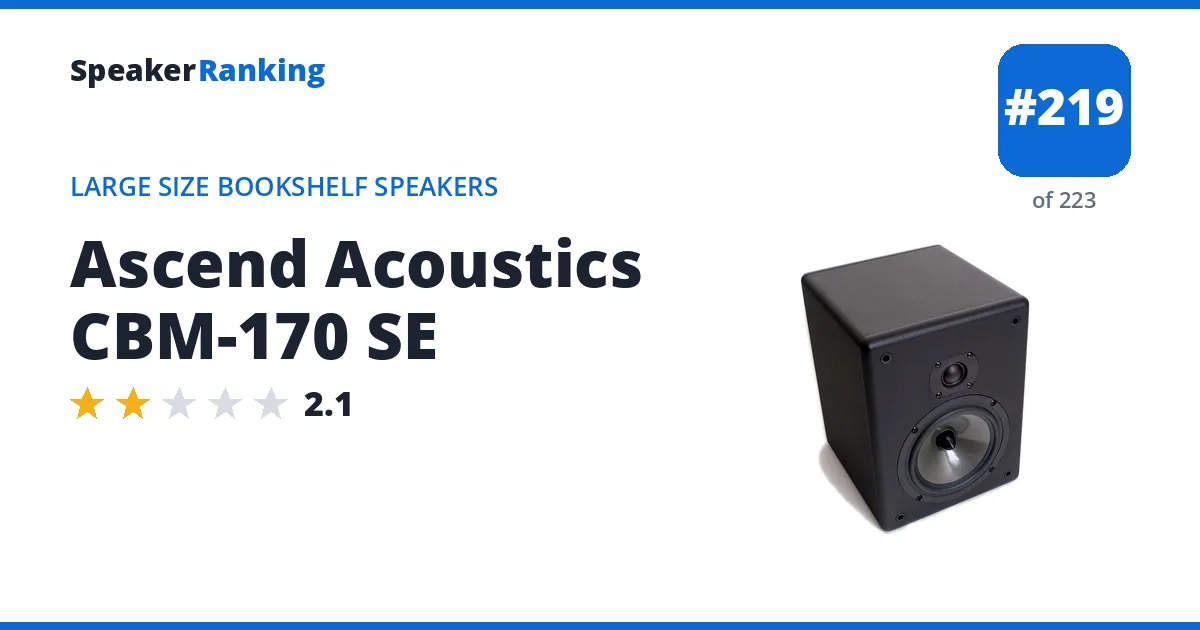
Newer model: the Ascend Acoustics CBM-170 SE2, ranked higher, rated 3.8/5, released Jul 2026. See every Ascend CBM, HTM and CMT generation.
Same family: the Ascend Acoustics CMT-340 SE Center (center, rated 3.7/5).
Pros: US-manufactured 2-way with a custom SEAS silk dome tweeter and low harmonic distortion. Solid cabinet construction for the price class. Measured bass extension of 80Hz (-3dB).
Cons: On-axis response starts peaking above 1kHz and keeps rising, which Amir predicted would create a bright, potentially fatiguing tonal balance: a character he says “can become grating” over time. The small tweeter paired with a larger woofer lacking a waveguide causes significant off-axis coloration, contradicting the manufacturer’s accuracy claims. Impedance dips below 4 ohms in the bass, and cabinet flex was noted, comparable to cheaper competitors. Amir suggests “looking elsewhere for a better design.”. Discontinued.
Full Ascend Acoustics CBM-170 SE review and specifications →
| Released | Jan 2022 (4 years ago) |
|---|---|
| Bass Extension (-10dB) | approx. 50Hz (measured, Audio Science Review) |
| Bass Extension (-3dB) | approx. 80Hz (measured, Audio Science Review) |
| DIY Kit | No |
| Dimensions | 12H x 9W x 10D in |
| Drivers | 6.5” proprietary composite polygel cone woofer, 27mm custom SEAS soft dome tweeter |
| Impedance | 8 ohms |
| Sensitivity | 91dB (2.83V/1m, manufacturer specified, in-room) |
| Spinorama Preference Score | 4.27 |
| Spinorama Preference Score with Perfect Sub | 7.06 |
| Weight | 14 lbs (6.35 kg) each |
- Reviews, Comparisons and Sound Samples
- Head-to-Head Comparisons
Center Channel Speakers
 Ranked #15 of 131 in Center Channel Speakers - Ascend Acoustics Sierra Horizon: $1,490 each Discontinued eBay
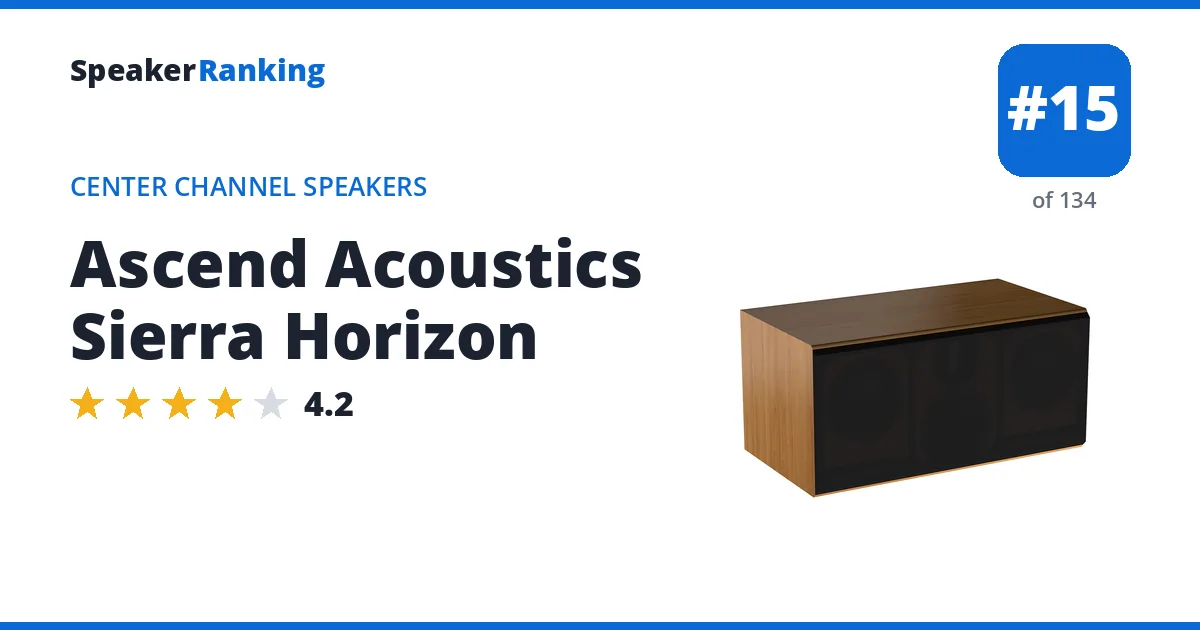
Newer model: the Ascend Acoustics Sierra Horizon V2, ranked higher, estimated 4.3/5, released Feb 2023. See every Ascend Sierra generation.
Same family: the Ascend Acoustics Sierra 2 (bookshelf, rated 3.7/5).
Pros: Ascend’s original Horizon center uses the same drivers and internal volume as its Sierra Tower, with a RAAL ribbon tweeter in a laminated bamboo cabinet. Audio Science Review measured very low on-axis deviation (0.20), consistent directivity (2.69dB directivity index deviation) and deep bass for a center, 63.0Hz (-3dB) and about 37Hz (-10dB), for a preference score of 5.24 that reaches 7.44 with an ideal subwoofer. Measured bass extension of 63.0Hz (-3dB).
Cons: The ribbon’s horizontal coverage in this measurement is narrow (about ±20 degrees), and the listening window spans 3.1dB from 300Hz to 5kHz. Ascend now sells the revised Ascend Acoustics Sierra Horizon V2. Discontinued.
Full Ascend Acoustics Sierra Horizon review and specifications →
| Released | 2012 (14 years ago) |
|---|---|
| Bass Extension (-10dB) | about 36.6Hz (measured, Audio Science Review) |
| Bass Extension (-3dB) | 63.0Hz (measured, Audio Science Review) |
| DIY Kit | No |
| Dimensions | 11”H x 23”W x 12.5”D (279 x 584 x 318 mm) |
| Drivers | RAAL ribbon tweeter, midrange and woofers shared with the Sierra Tower |
| Spinorama Preference Score | 5.24 |
| Spinorama Preference Score with Perfect Sub | 7.44 |
- Reviews, Comparisons and Sound Samples
- Head-to-Head Comparisons
 Ranked #58 of 131 in Center Channel Speakers - Ascend Acoustics CMT-340 SE Center: $299 each Discontinued eBay
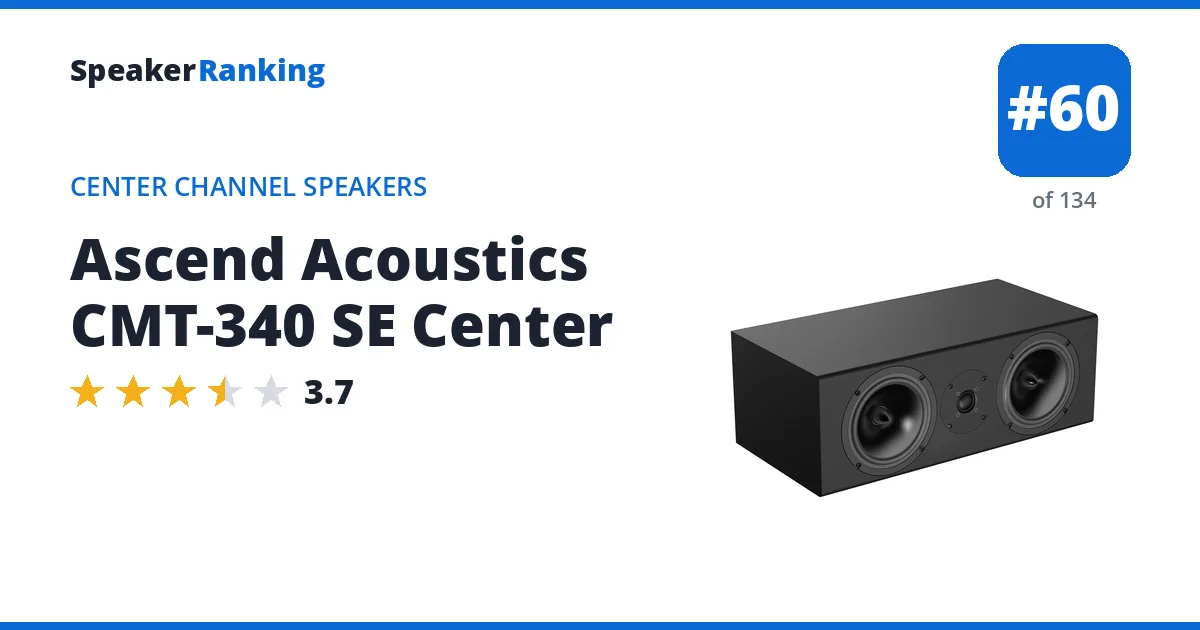
Newer model: the Ascend Acoustics CMT-340 SE2, rated 4.4/5, released Nov 2022. Ascend sells the SE2 both as this horizontal center and as the vertical mini-tower pair. See every Ascend CBM, HTM and CMT generation.
Same family: the Ascend Acoustics CBM-170 SE (bookshelf, rated 2.1/5).
Pros: A two-way center with a SEAS 27mm soft dome tweeter between two 6.5” long-throw woofers and a high 90dB anechoic sensitivity. Audio Science Review measured wide horizontal coverage (about ±60 degrees) and a preference score that reaches 6.59 with an ideal subwoofer. Measured bass extension of 85.7Hz (-3dB).
Cons: On-axis deviation is moderate (0.84) and the listening window spans 3.6dB from 300Hz to 5kHz. Bass rolls off at 85.7Hz (-3dB) and about 57Hz (-10dB), so its score without a subwoofer is 3.65. Ascend now sells the revised CMT-340SE2. Discontinued.
Full Ascend Acoustics CMT-340 SE Center review and specifications →
| Released | Jan 2006 (20 years ago) |
|---|---|
| Bass Extension (-10dB) | about 56.7Hz (measured, Audio Science Review) |
| Bass Extension (-3dB) | 85.7Hz (measured, Audio Science Review) |
| DIY Kit | No |
| Dimensions | 7.5”H x 21”W x 10.5”D (191 x 533 x 267 mm) |
| Drivers | 27mm SEAS soft dome tweeter, 2x 6.5” long-throw polygel woofers |
| Frequency Response | 48Hz-22kHz ±3dB (manufacturer specified) |
| Sensitivity | 90dB anechoic (2.83V/1m, manufacturer specified) |
| Spinorama Preference Score | 3.65 |
| Spinorama Preference Score with Perfect Sub | 6.59 |
| Weight | 26 lbs (11.8 kg) |
| Woofer Cabinet | ported (rear) |
- Reviews, Comparisons and Sound Samples
Product Line History
How these product lines changed from one generation to the next.