Short answer: both are discontinued, so this only matters if you are buying used. Used, the JBL Studio 530 is the better pick: it ranks #80 of 160 bookshelf speakers by sound quality (rated 3.3/5), against #152 (rated 1.6/5) for the Pioneer Elite SP-EBS73-LR. If you want one new, the Philharmonic Ceramic Mini ranks #2 at $900.
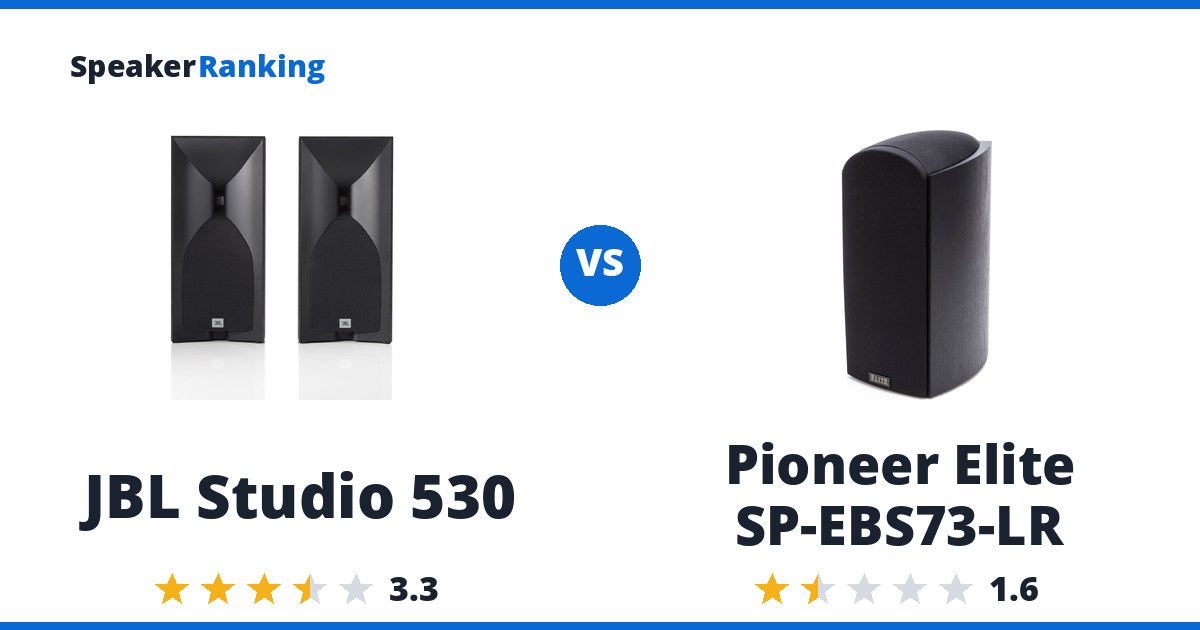
The JBL Studio 530 is the more accurate option. CEA2034 spinorama shows a fairly flat on-axis response. Its measured preference score, a predictor of how neutral it sounds, is 5.21 against 3.22 for the Pioneer Elite SP-EBS73-LR. The tradeoff: A peak around 1.4kHz is attributed to a tweeter resonance, and shows up as a distinct spike in harmonic distortion at that frequency along with a second resonance-driven bump around 2kHz.
The Pioneer Elite SP-EBS73-LR is the deeper-bass option. Unique dual-driver design combines a front-facing 3-way speaker with an up-firing 2-way Dolby Atmos coaxial driver in one cabinet, designed by Andrew Jones. Its bass reaches about 64.5Hz before falling 3dB, against 73.2Hz for the JBL Studio 530. The catch: A wide dip between 3-10kHz makes the front speaker sound “somewhat dull” without EQ, and impedance dips below 4 ohms demand a capable amplifier.
Buy the JBL Studio 530 only if you find one used in good condition; both are discontinued, and it is the better rated of the two. For a new speaker, start with the Philharmonic Ceramic Mini instead.
Want more options? Browse the full Passive Home rankings.
Specifications Side By Side
| JBL Studio 530 | Pioneer Elite SP-EBS73-LR | |
|---|---|---|
| Price | $399 per pair Discontinued | $749 per pair Discontinued |
| Ranked | #80 of 160 in Medium Size Bookshelf Speakers | #152 of 160 in Medium Size Bookshelf Speakers |
| Bass Extension (-3dB) | 73.2Hz (measured, Audio Science Review) | 64.5Hz (measured, Audio Science Review) |
| Bass Extension (-10dB) | 40Hz (derived, log-interpolated between spinorama.org -9dB/-12dB points) | 45.9Hz (measured, Audio Science Review) |
| Crossover Frequency | 1.5kHz | - |
| Dimensions | 18.4”H x 8.4”W x 8.7”D (467 x 214 x 222 mm) | 15.7H x 7.4W x 9.7D in |
| Impedance | 6 ohms nominal (4 ohms minimum, measured by Audio Science Review) | below 4 ohms minimum |
| Sensitivity | ~85dB (measured by Audio Science Review) | 85dB (manufacturer specified) |
| Drivers | 5.25” (130mm) PolyPlas™ cone woofer with SFG magnet, 1” (25mm) compression driver with Teonex® diaphragm on Bi-Radial® horn | 5.25” aluminum-cone woofer, 2x 4” aluminum-cone midrange, 2x 1” silk dome tweeter (front 3-way + up-firing 2-way Atmos coaxial) |
| Weight | 17 lbs (7.7 kg) each | 15.7 lbs (7.1 kg) each |
| Woofer Cabinet | ported | - |
| Spinorama Preference Score | 5.21 (spinorama.org) | 3.22 |
| Spinorama Preference Score with Perfect Sub | 7.29 (spinorama.org) | 5.53 |
| DIY Kit | No | No |
Related Speaker Comparisons
More top alternatives to JBL Studio 530:
- JBL Studio 530 vs Ascend Sierra 1 v2
- KEF LS50 Meta vs JBL Studio 530
- JBL Studio 530 vs Arendal 1961 Monitor
- JBL Studio 530 vs Moondrop M4P MTM
- Revel M105 vs JBL Studio 530
Prices on this page were last checked October 7, 2026 at 9:25 PM UTC. Product prices and availability are accurate as of that date/time and are subject to change; the price and availability shown on Amazon at the time of purchase will apply to the purchase of this product.
As an eBay Partner, we may be compensated if you make a purchase.
The Two Speakers In Full
 JBL Studio 530: $399 per pair Discontinued eBay
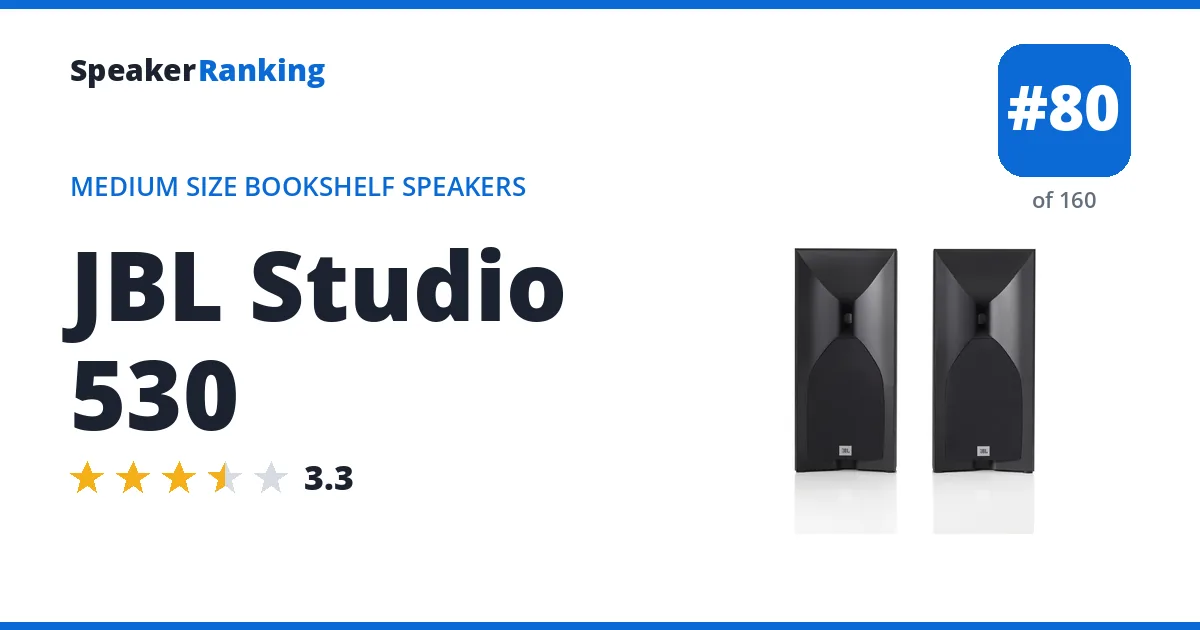
Same family: the JBL Studio 590 (floorstanding, rated 2.8/5) and the JBL Studio 520C (center, rated 3.4/5).
Pros: CEA2034 spinorama shows a fairly flat on-axis response. Predicted in-room response is very smooth aside from the high-frequency roll-off. Measured bass extension of 73.2Hz (-3dB), with a measured sensitivity of 85dB.
Cons: A peak around 1.4kHz is attributed to a tweeter resonance, and shows up as a distinct spike in harmonic distortion at that frequency along with a second resonance-driven bump around 2kHz. Response rolls off in the high frequencies and the tuning is a bit bass-shy overall. Cumulative spectral decay (waterfall) shows the same 1kHz-region resonances lingering in time. Discontinued.
Full JBL Studio 530 review and specifications →
| Bass Extension (-10dB) | 40Hz (derived, log-interpolated between spinorama.org -9dB/-12dB points) |
|---|---|
| Bass Extension (-3dB) | 73.2Hz (measured, Audio Science Review) |
| Crossover Frequency | 1.5kHz |
| DIY Kit | No |
| Dimensions | 18.4”H x 8.4”W x 8.7”D (467 x 214 x 222 mm) |
| Drivers | 5.25” (130mm) PolyPlas™ cone woofer with SFG magnet, 1” (25mm) compression driver with Teonex® diaphragm on Bi-Radial® horn |
| Impedance | 6 ohms nominal (4 ohms minimum, measured by Audio Science Review) |
| Sensitivity | ~85dB (measured by Audio Science Review) |
| Spinorama Preference Score | 5.21 (spinorama.org) |
| Spinorama Preference Score with Perfect Sub | 7.29 (spinorama.org) |
| Weight | 17 lbs (7.7 kg) each |
| Woofer Cabinet | ported |
- Links
- Reviews, Comparisons and Sound Samples
- Head-to-Head Comparisons
- JBL Studio 530 vs ELAC Debut 2.0 B5.2
- JBL Studio 530 vs Sony SS-CS5 M2
- JBL Studio 530 vs Paradigm Monitor SE Atom
- JBL Studio 530 vs JBL Stage 250B
- JBL Studio 530 vs Boston Acoustics A25
- JBL Studio 530 vs Dynaudio Emit M10
- JBL Studio 530 vs ELAC BS U5
- JBL Studio 530 vs Polk Audio XT15
- See all 40 comparisons
 Pioneer Elite SP-EBS73-LR: $749 per pair Discontinued eBay
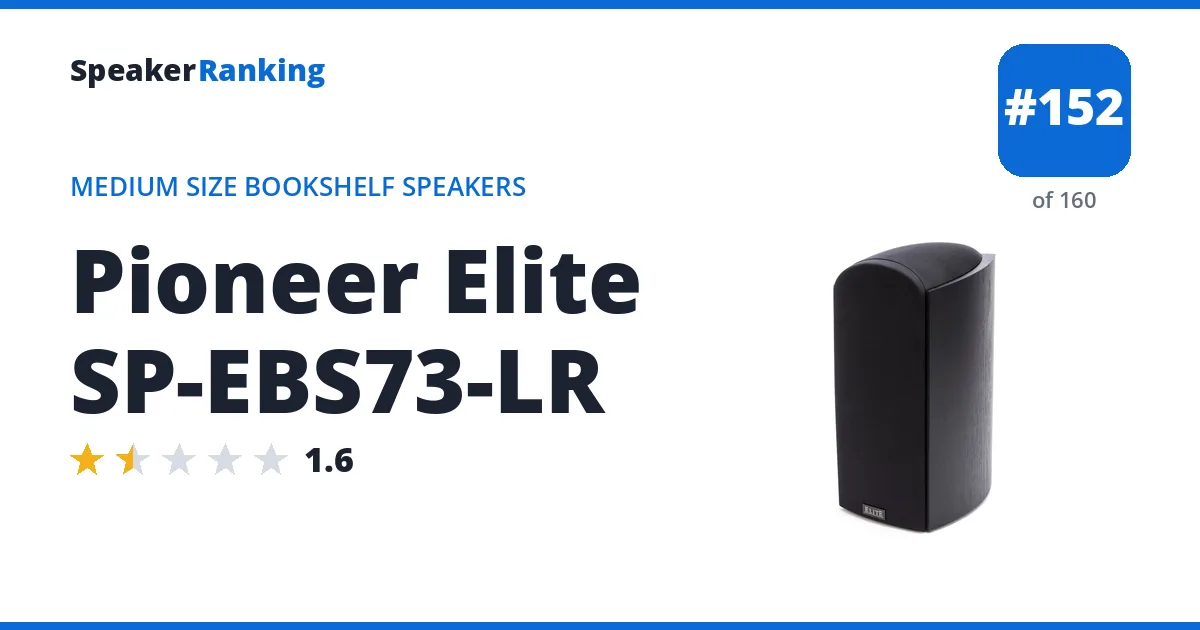
Same family: the Pioneer Elite SP-EC73 (center, rated 3.3/5).
Pros: Unique dual-driver design combines a front-facing 3-way speaker with an up-firing 2-way Dolby Atmos coaxial driver in one cabinet, designed by Andrew Jones. With corrective EQ applied, the reviewer found “substantially more brilliance and detail,” and the up-firing Atmos driver produced “remarkable” spatial effects from a single box. Measured bass extension of 64.5Hz (-3dB).
Cons: A wide dip between 3-10kHz makes the front speaker sound “somewhat dull” without EQ, and impedance dips below 4 ohms demand a capable amplifier. Distortion is elevated at the crossover points, around 180Hz and 2600Hz. Amir concluded: “The hole in frequency response and high distortion around the crossover point rule out this speaker for any kind of hifi use, certainly at these prices.” Long discontinued.
Full Pioneer Elite SP-EBS73-LR review and specifications →
| Bass Extension (-10dB) | 45.9Hz (measured, Audio Science Review) |
|---|---|
| Bass Extension (-3dB) | 64.5Hz (measured, Audio Science Review) |
| DIY Kit | No |
| Dimensions | 15.7H x 7.4W x 9.7D in |
| Drivers | 5.25” aluminum-cone woofer, 2x 4” aluminum-cone midrange, 2x 1” silk dome tweeter (front 3-way + up-firing 2-way Atmos coaxial) |
| Impedance | below 4 ohms minimum |
| Sensitivity | 85dB (manufacturer specified) |
| Spinorama Preference Score | 3.22 |
| Spinorama Preference Score with Perfect Sub | 5.53 |
| Weight | 15.7 lbs (7.1 kg) each |
- Reviews, Comparisons and Sound Samples
- Head-to-Head Comparisons
- Pioneer Elite SP-EBS73-LR vs Ascend Sierra Luna
- Pioneer Elite SP-EBS73-LR vs Definitive Technology ProMonitor 1000
- Pioneer Elite SP-EBS73-LR vs Klipsch R-41M
- Pioneer Elite SP-EBS73-LR vs Polk T15
- Pioneer Elite SP-EBS73-LR vs JBL Control 1 Pro
- Pioneer Elite SP-EBS73-LR vs Fluance Signature HFS
- Pioneer Elite SP-EBS73-LR vs JBL Stage A130
- Pioneer Elite SP-EBS73-LR vs Q Acoustics 5020
- See all 29 comparisons