Short answer: the JBL L52 Classic, if you are buying new. The Boston Acoustics A25 ranks higher than it (#59 vs #119 of 160 bookshelf speakers, 3.6/5 vs 2.6/5) but is discontinued, so only consider it used; the JBL L52 Classic is still sold new at $999.
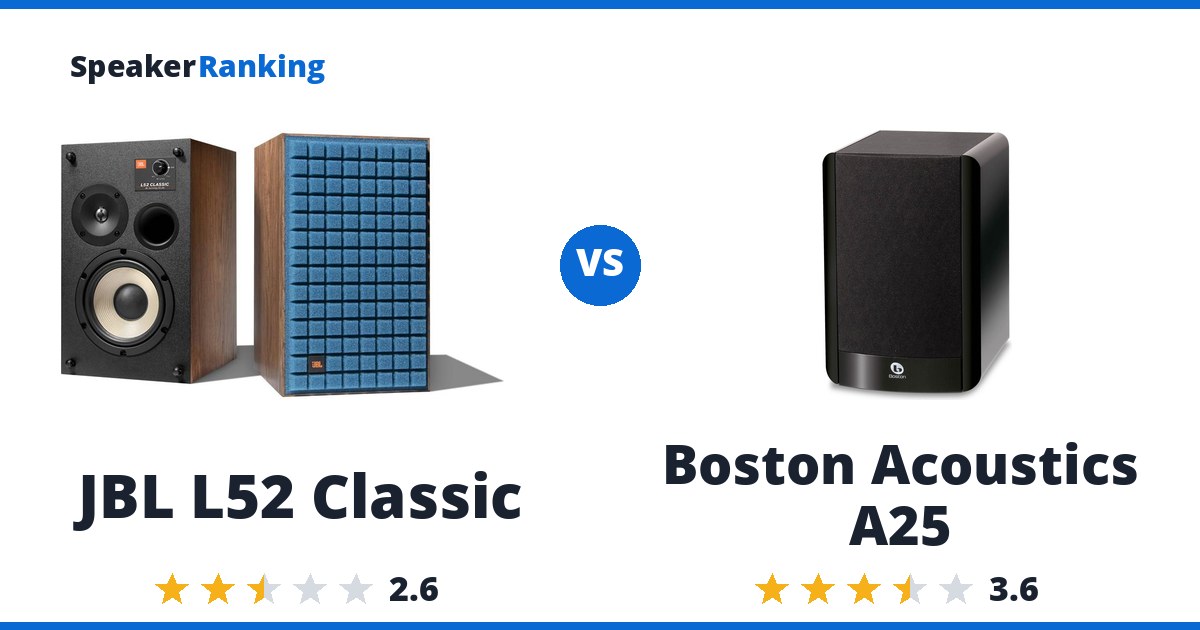
The JBL L52 Classic is the more accurate, deeper-bass pick. Genuine walnut wood veneer cabinet with a retro Quadrex foam grille (black, orange, or dark blue) reviving JBL’s classic L-series look. Its measured preference score, a predictor of how neutral it sounds, is 4.54 against 3.53 for the Boston Acoustics A25. Its bass reaches about 62Hz before falling 3dB, against 90Hz for the Boston Acoustics A25. Watch for: Measured compression and distortion behavior from about 1-5 kHz was inconsistent (“wonky”) across output levels, and didn’t clean up even at lower volume; adding a subwoofer high-pass didn’t fix the high-frequency distortion either.
The Boston Acoustics A25 is the better-sounding option. CEA2034 spinorama is decent once you ignore a peak around 900Hz and a dip around 3kHz: directivity is good enough that the response can be EQed and won’t be too room-dependent. The catch: A crazy port resonance and a tweeter with a steeper rolloff than the woofer both show up in the near-field driver measurements, creating the 900Hz peak and the crossover-region dip.
Buy the JBL L52 Classic, since the Boston Acoustics A25 is discontinued and only worth hunting down used.
Looking for alternatives? See the complete Passive Home rankings.
Specifications Side By Side
| JBL L52 Classic | Boston Acoustics A25 | |
|---|---|---|
| Price | $999.00 per pair | $299.98 per pair Discontinued |
| Ranked | #119 of 160 in Medium Size Bookshelf Speakers | #59 of 160 in Medium Size Bookshelf Speakers |
| Drivers | 5.25” pure pulp cone woofer, 0.75” titanium dome tweeter with waveguide | 1” Kortec soft dome tweeter, 5.25” ceramic/glass-fiber polymer mid/woofer |
| Dimensions | 13-1/16”H x 7-13/16”W x 8-11/16”D | 10.7H x 7.25W x 8.9D in |
| Weight | 11 lbs (5 kg) each | 10.1 lbs (4.58 kg) each |
| Impedance | 4 ohms nominal, 3.7 ohms minimum (measured, Erin’s Audio Corner) | 8 ohms nominal |
| Sensitivity | 85dB (measured average, Erin’s Audio Corner) | 85dB (2.83V/1m, measured, Audio Science Review) |
| Frequency Response | 47Hz - 24kHz (-6dB, manufacturer specified) | 55Hz - 25kHz (Manufacturer specified) |
| Power Handling | 10-75W RMS | 10-150W recommended |
| Bass Extension (-3dB) | 62Hz (measured average, Erin’s Audio Corner) | 90Hz (measured, Audio Science Review) |
| Bass Extension (-10dB) | 45Hz (measured average, Erin’s Audio Corner) | 55Hz (measured, Audio Science Review) |
| Crossover Frequency | 2.8kHz | - |
| Spinorama Preference Score | 4.54 | 3.53 |
| Spinorama Preference Score with Perfect Sub | 6.96 | 6.19 |
| DIY Kit | No | No |
| Woofer Cabinet | - | ported, rear |
Related Speaker Comparisons
More top alternatives to Boston Acoustics A25:
- Ascend Sierra 1 v2 vs Boston Acoustics A25
- KEF LS50 Meta vs Boston Acoustics A25
- Arendal 1961 Monitor vs Boston Acoustics A25
- Revel M105 vs Boston Acoustics A25
- Klipsch RP-500M II vs Boston Acoustics A25
Prices on this page were last checked October 7, 2026 at 9:25 PM UTC. Product prices and availability are accurate as of that date/time and are subject to change; the price and availability shown on Amazon at the time of purchase will apply to the purchase of this product.
As an eBay Partner, we may be compensated if you make a purchase.
The Two Speakers In Full
 JBL L52 Classic: $999.00 per pair Amazon eBay
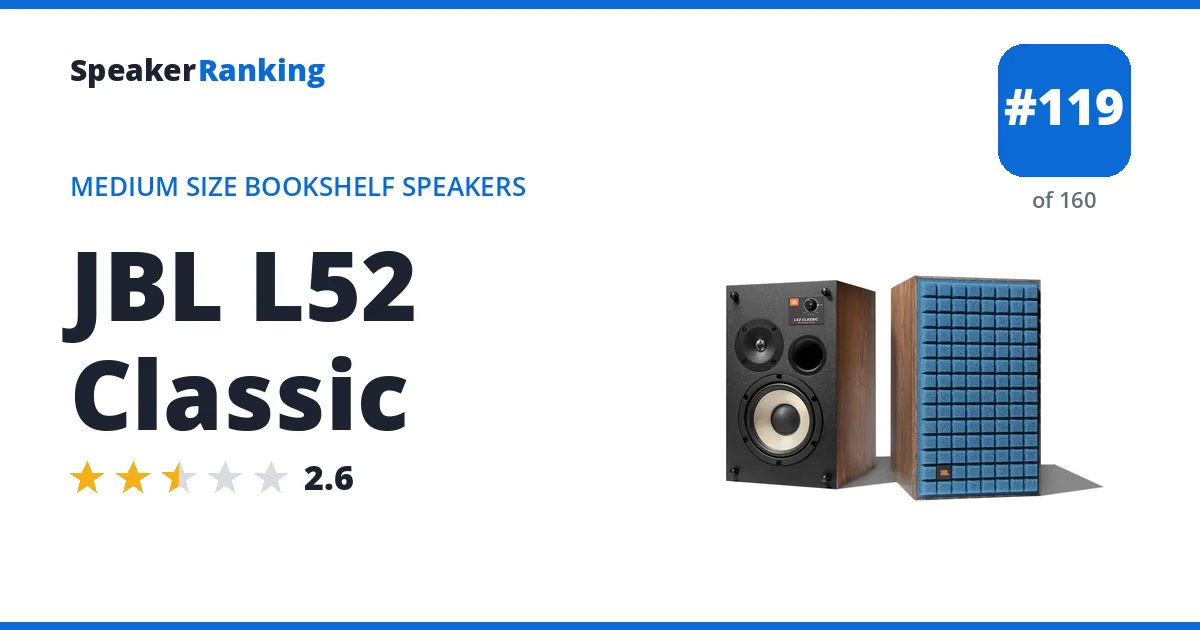
Same family: the JBL L82 Classic (larger bookshelf, rated 3.9/5) and the JBL L100 Classic (larger bookshelf, estimated 3.7/5).
Pros: Genuine walnut wood veneer cabinet with a retro Quadrex foam grille (black, orange, or dark blue) reviving JBL’s classic L-series look. 5.25” pure pulp cone woofer and 0.75” titanium dome tweeter on a waveguide, front-firing bass reflex port, in a compact stand-mount cabinet. A pronounced upper-bass bump around 100 Hz gives kick drums a punchy, textured character. Measured bass extension of 62Hz (-3dB), with a measured sensitivity of 85dB.
Cons: Measured compression and distortion behavior from about 1-5 kHz was inconsistent (“wonky”) across output levels, and didn’t clean up even at lower volume; adding a subwoofer high-pass didn’t fix the high-frequency distortion either. Response rolls off quickly above the upper-bass bump, so there’s punch and impact but not real low-end rumble or fundamental weight below about 60 Hz without a subwoofer. Soundstage width was inconsistent track to track, with imaging not staying locked to where instruments should be. Vocals could sound hot and slightly grainy in the 2.5-5 kHz region; pointing the speakers off-axis reduced that sharpness but also killed high-frequency air.
Full JBL L52 Classic review and specifications →
| Bass Extension (-10dB) | 45Hz (measured average, Erin’s Audio Corner) |
|---|---|
| Bass Extension (-3dB) | 62Hz (measured average, Erin’s Audio Corner) |
| Crossover Frequency | 2.8kHz |
| DIY Kit | No |
| Dimensions | 13-1/16”H x 7-13/16”W x 8-11/16”D |
| Drivers | 5.25” pure pulp cone woofer, 0.75” titanium dome tweeter with waveguide |
| Frequency Response | 47Hz - 24kHz (-6dB, manufacturer specified) |
| Impedance | 4 ohms nominal, 3.7 ohms minimum (measured, Erin’s Audio Corner) |
| Power Handling | 10-75W RMS |
| Sensitivity | 85dB (measured average, Erin’s Audio Corner) |
| Spinorama Preference Score | 4.54 |
| Spinorama Preference Score with Perfect Sub | 6.96 |
| Weight | 11 lbs (5 kg) each |
- Links
- Reviews, Comparisons and Sound Samples
- Head-to-Head Comparisons
- JBL L52 Classic vs Pioneer SP-BS22-LR (Philharmonic AAM Mod)
- JBL L52 Classic vs Dynaudio X14
- JBL L52 Classic vs JBL Stage A120
- JBL L52 Classic vs ELAC BS U5
- JBL L52 Classic vs ELAC Uni-Fi 2.0 UB52
- JBL L52 Classic vs KEF Q100
- JBL L52 Classic vs Q Acoustics 3020i
- JBL L52 Classic vs Dynaudio Emit M10
- See all 34 comparisons
 Boston Acoustics A25: $299.98 per pair Discontinued eBay
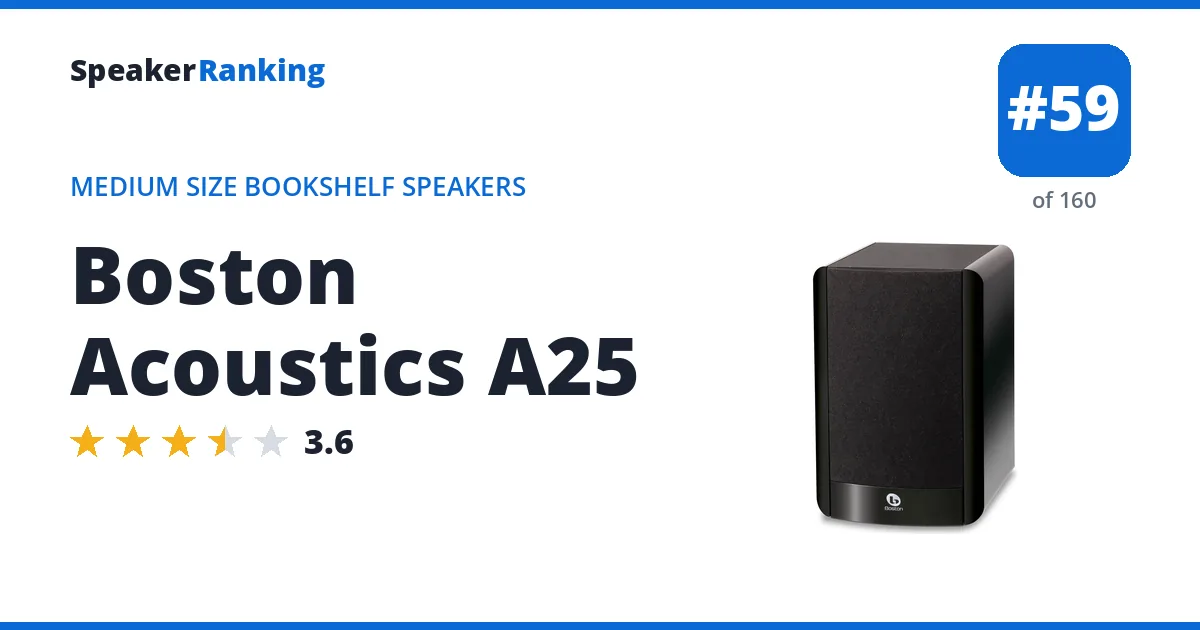
Pros: CEA2034 spinorama is decent once you ignore a peak around 900Hz and a dip around 3kHz: directivity is good enough that the response can be EQed and won’t be too room-dependent. Cabinet fit and finish is well above its price class, and dynamics were strong with no distortion audible even at high volume on well-recorded material. Discontinued, but the reviewer suggests hunting for clearance pricing on remaining stock. Measured bass extension of 90Hz (-3dB), with a measured sensitivity of 85dB.
Cons: A crazy port resonance and a tweeter with a steeper rolloff than the woofer both show up in the near-field driver measurements, creating the 900Hz peak and the crossover-region dip. The rear port itself measured audibly distorted up close, though it wasn’t noticeable from normal listening distance in the reviewer’s room. Discontinued.
Full Boston Acoustics A25 review and specifications →
| Bass Extension (-10dB) | 55Hz (measured, Audio Science Review) |
|---|---|
| Bass Extension (-3dB) | 90Hz (measured, Audio Science Review) |
| DIY Kit | No |
| Dimensions | 10.7H x 7.25W x 8.9D in |
| Drivers | 1” Kortec soft dome tweeter, 5.25” ceramic/glass-fiber polymer mid/woofer |
| Frequency Response | 55Hz - 25kHz (Manufacturer specified) |
| Impedance | 8 ohms nominal |
| Power Handling | 10-150W recommended |
| Sensitivity | 85dB (2.83V/1m, measured, Audio Science Review) |
| Spinorama Preference Score | 3.53 |
| Spinorama Preference Score with Perfect Sub | 6.19 |
| Weight | 10.1 lbs (4.58 kg) each |
| Woofer Cabinet | ported, rear |
- Reviews, Comparisons and Sound Samples
- Head-to-Head Comparisons
- Boston Acoustics A25 vs Polk Audio XT15
- Boston Acoustics A25 vs Wharfedale Diamond 220
- Boston Acoustics A25 vs KEF Q150
- Boston Acoustics A25 vs JBL Studio 530
- Boston Acoustics A25 vs ELAC Debut 2.0 B5.2
- Boston Acoustics A25 vs Wharfedale Diamond 12.1
- Boston Acoustics A25 vs Sony SS-CS5 M2
- Boston Acoustics A25 vs Paradigm Monitor SE Atom
- See all 30 comparisons