Coverage note. Speaker Ranking currently covers 16 ELAC models across passive speakers and subwoofers (plus 1 not yet ranked). These are the products in our database, not a complete list of everything ELAC makes.
What this page covers. The ELAC models ranked here span passive speakers and subwoofers, including Elac Carina BS243.4, ELAC VELA BS 403 and ELAC SUB3070. Use each model’s category position to compare it with alternatives of the same size and use case.
This page lists all 16 ELAC speakers ranked on this site across passive speakers and subwoofers. Each model is shown in the category where it competes, with its current rank and the size of that ranking.
Use the category position rather than the brand name alone: speakers from the same manufacturer can perform very differently by size, price and product family.
Prices on this page were last checked September 30, 2026 at 2:57 PM UTC. Product prices and availability are accurate as of that date/time and are subject to change; the price and availability shown on Amazon at the time of purchase will apply to the purchase of this product.
As an eBay Partner, we may be compensated if you make a purchase.
Quick Navigation
- Medium Size Bookshelf Speakers
- Large Size Bookshelf Speakers
- Large Size Floorstanding Speakers
- Small Home Subwoofers (Under 30 lbs)
- Medium Home Subwoofers (30-75 lbs)
- Discontinued ELAC Models
- ELAC Models Not Yet Ranked
Medium Size Bookshelf Speakers
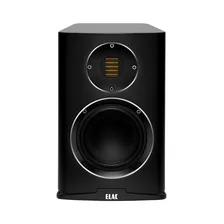 Ranked #16 of 90 in Medium Size Bookshelf Speakers - Elac Carina BS243.4: $1,199 per pair B&H Photo Video ELAC eBay
Pros: JET folded-ribbon tweeter (ELAC’s signature technology, normally reserved for its pricier lines) mounted over a 5.25” aluminum-cone woofer, a genuinely differentiated tweeter for a sub-$1,200/pair stand-mount. Positively reviewed by Stereophile and The Absolute Sound for fatigue-free treble detail. Measured bass extension of 55.7Hz (-3dB).
Cons: On-axis response shows more ripple than pricier active speakers, with an average deviation of about 0.53dB, and its listening window is only middling in smoothness. Moderate 85dB sensitivity paired with a 4.8-ohm minimum impedance wants a reasonably powerful amp. Bass extension is average for a 5.25” 2-way at 55.7Hz (-3dB) / 41.5Hz (-10dB).
Full Elac Carina BS243.4 review and specifications →
| Bass Extension (-10dB) | 41.5Hz (measured, spinorama.org) |
|---|---|
| Bass Extension (-3dB) | 55.7Hz (measured, spinorama.org) |
| DIY Kit | No |
| Dimensions | 8.5” x 12.6” x 9.6” (216 x 319 x 245 mm) each |
| Drivers | JET folded-ribbon tweeter, 5.25” aluminum cone woofer |
| Impedance | 6 ohm nominal, 4.8 ohm minimum |
| Sensitivity | 85dB (2.83V/1m) |
| Spinorama Preference Score | 4.85 |
| Spinorama Preference Score with Perfect Sub | 6.99 |
| Weight | 14.8 lbs (6.7 kg) each |
| Woofer Cabinet | Bass reflex |
- Links
- Reviews, Comparisons and Sound Samples
- Head-to-Head Comparisons
- Elac Carina BS243.4 vs Arendal Sound 1961 Bookshelf
- Elac Carina BS243.4 vs Monitor Audio Silver 50 7G
- Elac Carina BS243.4 vs Wharfedale Super Denton
- Elac Carina BS243.4 vs Aalto Speakers Aalto 1 EVO
- Elac Carina BS243.4 vs Ascend Acoustics Luna V2 Mini-Monitor Titan
- Elac Carina BS243.4 vs Arendal 1961 Monitor
- Elac Carina BS243.4 vs Ascend Acoustics HTM-200SE2
- Elac Carina BS243.4 vs KEF Q150
- See all 22 comparisons
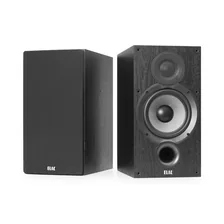 Ranked #48 of 90 in Medium Size Bookshelf Speakers - ELAC Debut 2.0 B5.2: $269.00 per pair Amazon eBay
Pros: Good horizontal directivity: the off-axis curves track the on-axis response closely, so the broad tonal error responds predictably to EQ. Erin demonstrated that a single high-shelf filter centered near 1.6kHz, about -2dB with Q near 2, substantially improves linearity. Moderate roughly +/-50-60 degree horizontal coverage balances room interaction and image focus. The front port makes close-to-wall placement practical. Erin measured F3 near 60Hz and F10 near 40Hz, useful extension for a compact 5.25-inch two-way. Harmonic distortion is mostly below 1% at 86dB/1m, and low-frequency distortion is better than its size might suggest. Compact cabinet and inexpensive pair pricing make it a workable EQ-assisted desktop or small-room system. Measured bass extension of 60Hz (-3dB), with a measured sensitivity of 83dB.
Cons: Erin measured a broad +3dB step beginning around 1.5kHz; the resulting elevated upper range sounds tonally uneven even though it is not a narrow, sharp resonance. Native response spans roughly -2.6 to +4dB around the mean, so this is not a neutral speaker without correction. Sensitivity is only about 83dB after correcting the shelf, demanding materially more amplifier voltage than ELAC’s 86dB specification implies. Vertical response changes substantially outside roughly +/-10 degrees of tweeter height. Dynamic compression is the larger limitation: at the highest sweep level it loses roughly 1-1.5dB through the midrange, and even the 86dB trace shows unusual nonlinearity that may involve crossover heating. At about 96dB, multitone distortion rises audibly around 600Hz; an 80-120Hz subwoofer crossover helps but does not turn it into a high-output design. Erin recommends the larger B6.2 instead when EQ is unavailable.
Full ELAC Debut 2.0 B5.2 review and specifications →
| Bass Extension (-10dB) | 40Hz (measured, Erin’s Audio Corner) |
|---|---|
| Bass Extension (-3dB) | 60Hz (measured, Erin’s Audio Corner) |
| DIY Kit | No |
| Dimensions | 13.4”H x 7.1”W x 9.2”D (341 x 180 x 234 mm) |
| Drivers | 5.25” aramid-fiber woofer, 1” cloth-dome tweeter |
| Impedance | 6 ohms nominal (manufacturer specified) |
| Sensitivity | About 83dB after recommended EQ (measured, Erin’s Audio Corner; 86dB manufacturer specified) |
| Spinorama Preference Score | 5.02 |
| Spinorama Preference Score with Perfect Sub | 7.27 |
| Weight | 13 lbs (5.9 kg) each |
| Woofer Cabinet | ported, front |
- Links
- Reviews, Comparisons and Sound Samples
- Head-to-Head Comparisons
- ELAC Debut 2.0 B5.2 vs Sony SS-CS5 M2
- ELAC Debut 2.0 B5.2 vs Paradigm Monitor SE Atom
- ELAC Debut 2.0 B5.2 vs JBL Studio 530
- ELAC Debut 2.0 B5.2 vs JBL Stage 250B
- ELAC Debut 2.0 B5.2 vs Monoprice Monolith THX Compact Satellite
- ELAC Debut 2.0 B5.2 vs Dynaudio Emit M10
- ELAC Debut 2.0 B5.2 vs ELAC BS U5
- ELAC Debut 2.0 B5.2 vs Boston Acoustics A25
- See all 45 comparisons
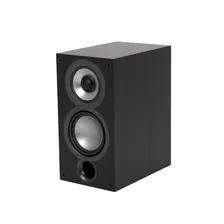 Ranked #70 of 90 in Medium Size Bookshelf Speakers - ELAC Uni-Fi 2.0 UB52: $599.00 per pair Amazon eBay
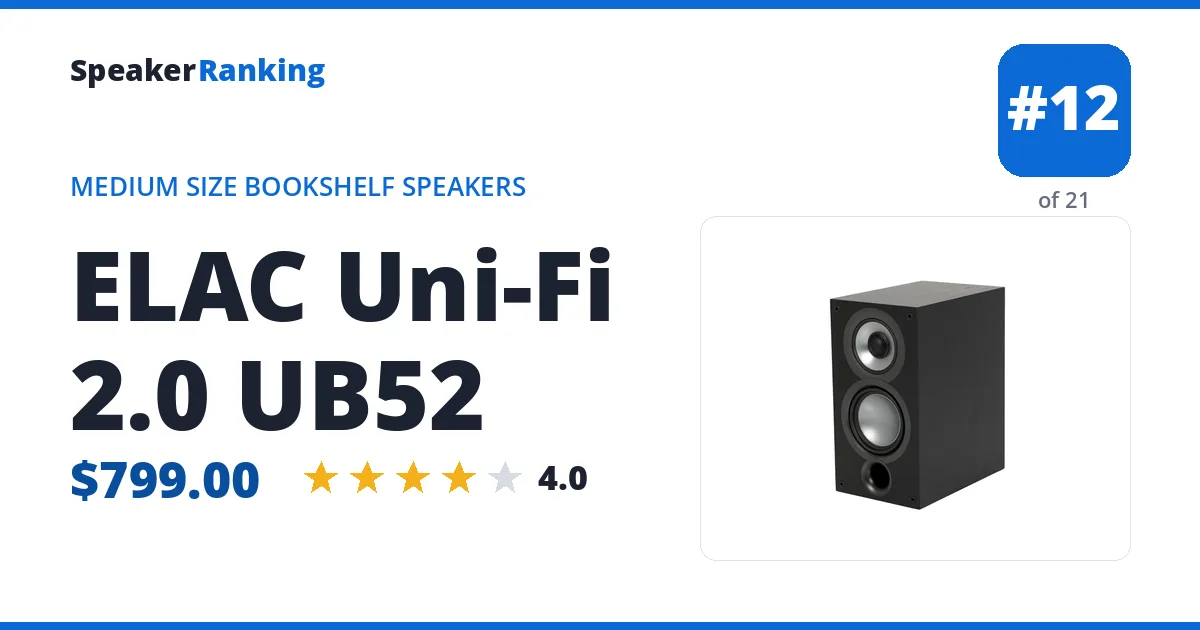
Pros: Wide, smooth horizontal directivity: beamwidth holds to about ±60 degrees up to 8kHz before narrowing. Vertical directivity is substantially better than average, giving more listening-height leeway than most two-way bookshelf speakers. Measured bass extension of 55.7Hz (-3dB), with a measured sensitivity of 83.3dB.
Cons: Dipped 3db from 1.5-3kHz. On-axis response shelves down above 1.5kHz along with multiple resonances, leading the reviewer to predict it will “likely sound dull.” Nasty resonance at 600Hz: audible as an actual buzzing artifact on some recordings (the reviewer demonstrated it with an Eva Cassidy track), and it shows up as a sharp distortion spike exceeding 4% at 585Hz when driven to 96dB SPL/1m. Not recommended.
Full ELAC Uni-Fi 2.0 UB52 review and specifications →
| Bass Extension (-10dB) | 38.6Hz (measured, Audio Science Review) |
|---|---|
| Bass Extension (-3dB) | 55.7Hz (measured, Audio Science Review) |
| Crossover Frequency | 200Hz / 2000Hz |
| DIY Kit | No |
| Dimensions | 13.6”H x 7.3”W x 10.8”D (346 x 185 x 275 mm) |
| Drivers | 5.25” aluminum woofer, 4” aluminum midrange, 1” soft dome tweeter |
| Impedance | 6 ohms |
| Power Handling | 140W max |
| Sensitivity | 83.3dB (measured by Audio Science Review; 85dB manufacturer specified) |
| Spinorama Preference Score | 5.32 (spinorama.org) |
| Spinorama Preference Score with Perfect Sub | 7.34 (spinorama.org) |
| Weight | 7.7 lbs (3.5 kg) |
| Woofer Cabinet | ported |
- Links
- Reviews, Comparisons and Sound Samples
- Head-to-Head Comparisons
- ELAC Uni-Fi 2.0 UB52 vs KEF Q100
- ELAC Uni-Fi 2.0 UB52 vs JBL Stage A120
- ELAC Uni-Fi 2.0 UB52 vs Q Acoustics 3020i
- ELAC Uni-Fi 2.0 UB52 vs JBL L52 Classic
- ELAC Uni-Fi 2.0 UB52 vs Micca RB42
- ELAC Uni-Fi 2.0 UB52 vs Q Acoustics 5020
- ELAC Uni-Fi 2.0 UB52 vs Pioneer SP-BS22-LR (Philharmonic AAM Mod)
- ELAC Uni-Fi 2.0 UB52 vs Dynaudio X14
- See all 42 comparisons
Large Size Bookshelf Speakers
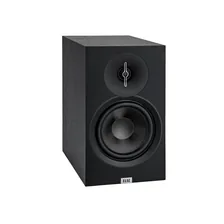 Ranked #42 of 134 in Large Size Bookshelf Speakers - ELAC Debut 3.0 DB63: $499.00 per pair Amazon Crutchfield eBay
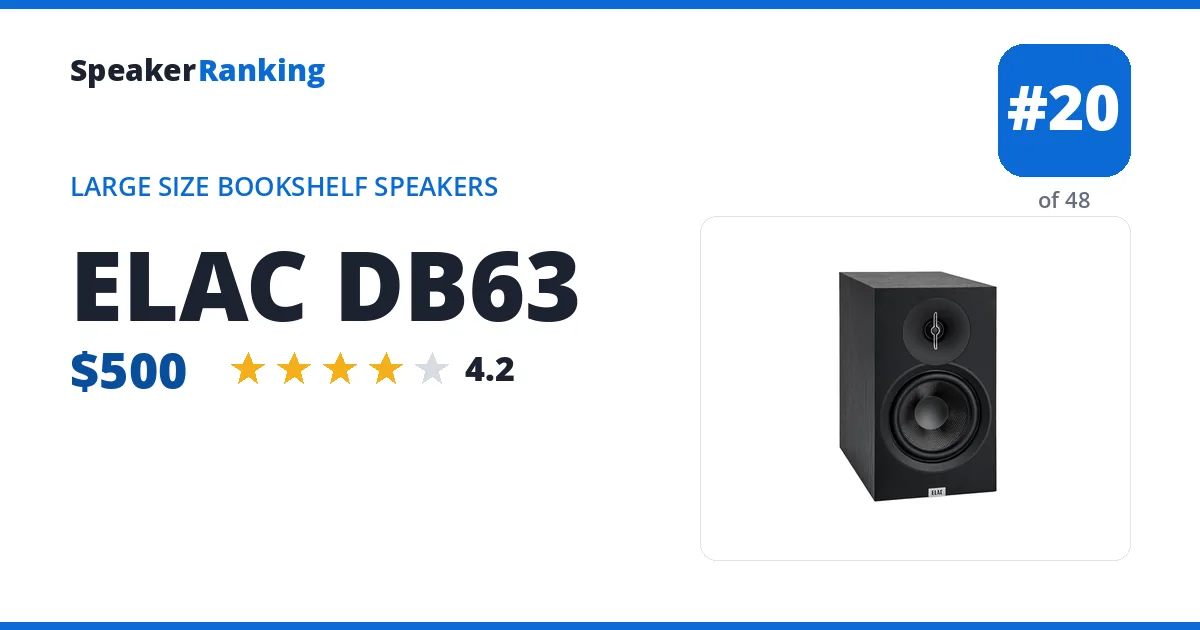
Pros: 1” aluminum dome tweeter with a distinctive partial-lens waveguide design paired with a 6.5” third-generation aramid fiber cone woofer, in a robustly built cabinet for the price. Shallow bass rolloff (F3 76Hz, F10 40Hz) allows placement close to a wall without excessive boominess, useful for smaller living rooms. Solid measured performance for the price: on-axis linearity within about 2.5dB, impedance dipping only to about 4.4 ohms (easily AVR-driven), and roughly 20-26dB of usable dynamic range. A clear improvement over its sibling ELAC DB62, which has a sibilance issue tied to the crossover that can’t be fixed with EQ. Wide horizontal radiation of about ±60°, giving a spacious soundstage. Distortion looks good at a moderate 86dB and still reasonable at 96dB. Takes well to EQ correction: the reviewer provides a specific filter set (a low-shelf boost at 650Hz plus peaking cuts/boosts at 550Hz, 660Hz, and 3kHz) that meaningfully smooths out its known deviations. Measured bass extension of 76Hz (-3dB), with a measured sensitivity of 86.2dB.
Cons: A dip in the lower midrange (300-600Hz, about 1.5dB) reduces vocal warmth and can make voices sound slightly hollow. A high-Q resonance around 650-750Hz shows up clearly in measurements, though the reviewer couldn’t reliably hear it in his own A/B testing. A dip around 2-3kHz (roughly 1-2dB) slightly reduces speech intelligibility and attack in the upper midrange. Directivity droops above about 2kHz as the midwoofer narrows toward its beaming frequency while the tweeter’s pattern behaves differently: an inherent trade-off of physically separated drivers that can’t be fully corrected without introducing other issues. Multitone distortion crosses the reviewer’s 3% threshold in the 200Hz-1kHz range, and adding a subwoofer at an 80Hz crossover only modestly reduces it. Toeing the speaker away from the listener loses noticeable top-end air and cymbal energy, giving a softer upper register. Practical loudness ceiling is around 90dB at typical listening distance before midrange distortion and bass attack begin to degrade. Still needs a subwoofer for extension below about 40Hz.
Full ELAC Debut 3.0 DB63 review and specifications →
| Bass Extension (-10dB) | 40Hz (measured, Erin’s Audio Corner) |
|---|---|
| Bass Extension (-3dB) | 76Hz (measured, Erin’s Audio Corner) |
| DIY Kit | No |
| Dimensions | 13.3”H x 7.7”W x 11.7”D (337.8 x 195.6 x 297.2 mm) |
| Drivers | 6.5” Aramid Fiber woofer, 1” soft dome tweeter |
| Impedance | 6 ohms nominal (4.4 ohms minimum, measured, Erin’s Audio Corner) |
| Sensitivity | 86.2dB (measured, Erin’s Audio Corner) |
| Weight | 17.2 lbs (7.8 kg) each |
| Woofer Cabinet | ported, rear |
- Links
- Reviews, Comparisons and Sound Samples
- Head-to-Head Comparisons
- ELAC Debut 3.0 DB63 vs Emotiva Airmotiv XB2
- ELAC Debut 3.0 DB63 vs Arendal 1723 Bookshelf S THX
- ELAC Debut 3.0 DB63 vs JTR Noesis 210HT
- ELAC Debut 3.0 DB63 vs Perlisten A3m
- ELAC Debut 3.0 DB63 vs JBL HDI-1600
- ELAC Debut 3.0 DB63 vs Perlisten R5m
- ELAC Debut 3.0 DB63 vs Ascend Acoustics Sierra-2EX V2
- ELAC Debut 3.0 DB63 vs Aalto Speakers Aalto 3 Passive
- See all 130 comparisons
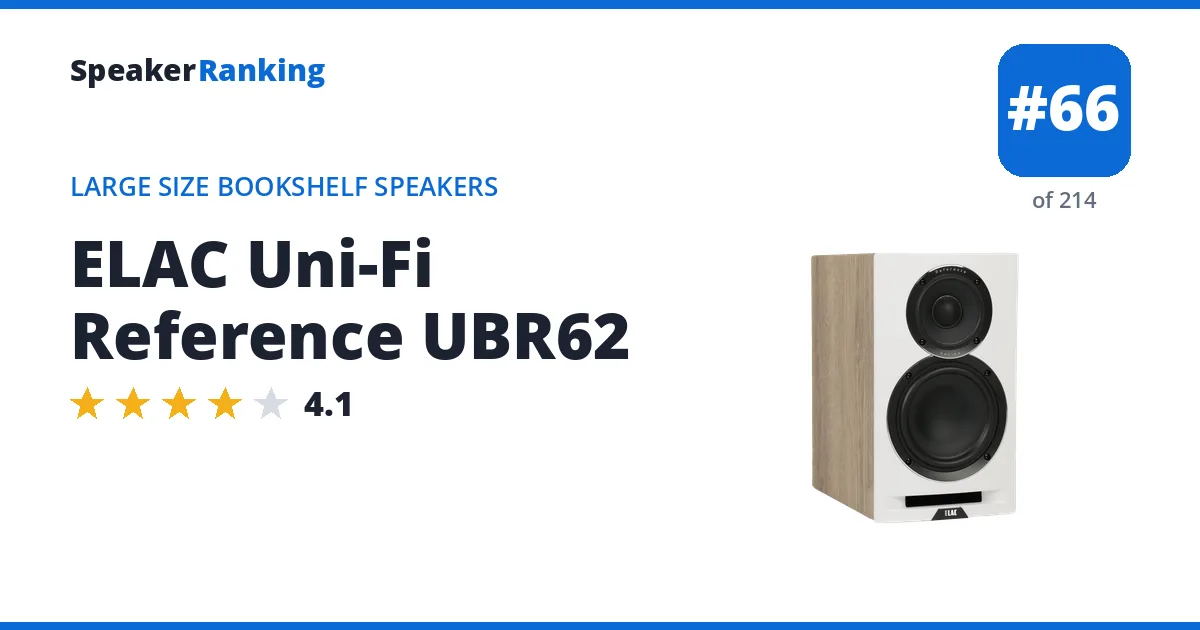
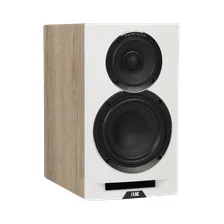 Ranked #54 of 134 in Large Size Bookshelf Speakers - ELAC Uni-Fi Reference UBR62: $1,199 per pair Amazon eBay
Pros: True three-way stand-mount using a 1-inch tweeter concentrically mounted in a 4-inch aluminum midrange plus a dedicated 6.5-inch aluminum woofer. Erin found the directivity and overall tonality well controlled, with dual front slot vents minimizing placement sensitivity and cabinet bracing suppressing obvious coloration. The mostly 5-ohm-or-higher load is manageable for a genuinely 4-ohm-capable amplifier, and the coherent concentric upper range supports stable imaging across seats. Measured bass extension of 58.6Hz (-3dB), with a measured sensitivity of 83dB.
Cons: Erin measured very low 83dB/2.83V/1m sensitivity; his 110W Parasound was insufficient for the high-level test and the more powerful HINT 6 was needed. Impedance reaches 4 ohms near 50Hz (Erin), while woofer excursion and bass output were less capable than expected for the cabinet size. A broad 500-700Hz rise and associated lower/female-vocal coloration were audible, and the slightly subdued listening-window treble is necessary to avoid an overly bright in-room balance rather than evidence of ruler-flat axial tuning.
Full ELAC Uni-Fi Reference UBR62 review and specifications →
| Bass Extension | 41Hz manufacturer specified; Erin’s response-linearity graph shows limited high-output bass headroom |
|---|---|
| Bass Extension (-10dB) | 41.9Hz (measured, Erin’s Audio Corner) |
| Bass Extension (-3dB) | 58.6Hz (measured, Erin’s Audio Corner) |
| DIY Kit | No |
| Dimensions | 14.1”H x 8.2”W x 13.1”D |
| Drivers | 1” tweeter coaxial with 4” midrange; 6.5” woofer |
| Impedance | 4 ohms minimum near 50Hz (measured, Erin’s Audio Corner) |
| Sensitivity | 83dB/2.83V/1m (measured, Erin’s Audio Corner) |
| Spinorama Preference Score | 5.44 (measured, spinorama.org) |
| Spinorama Preference Score with Perfect Sub | 7.7 (measured, spinorama.org) |
| Weight | 23.5 lbs (10.68 kg) each |
| Woofer Cabinet | ported, dual front slot vents |
- Links
- Reviews, Comparisons and Sound Samples
- Head-to-Head Comparisons
- ELAC Uni-Fi Reference UBR62 vs Power Sound Audio MT-110-M
- ELAC Uni-Fi Reference UBR62 vs ELAC DBR62
- ELAC Uni-Fi Reference UBR62 vs Revel Concerta2 M16
- ELAC Uni-Fi Reference UBR62 vs Yamaha NS-800A
- ELAC Uni-Fi Reference UBR62 vs Definitive Technology Demand D11
- ELAC Uni-Fi Reference UBR62 vs Technics SB-C700
- ELAC Uni-Fi Reference UBR62 vs Dynaudio Contour 20i
- ELAC Uni-Fi Reference UBR62 vs JBL HDI-1600
- See all 26 comparisons
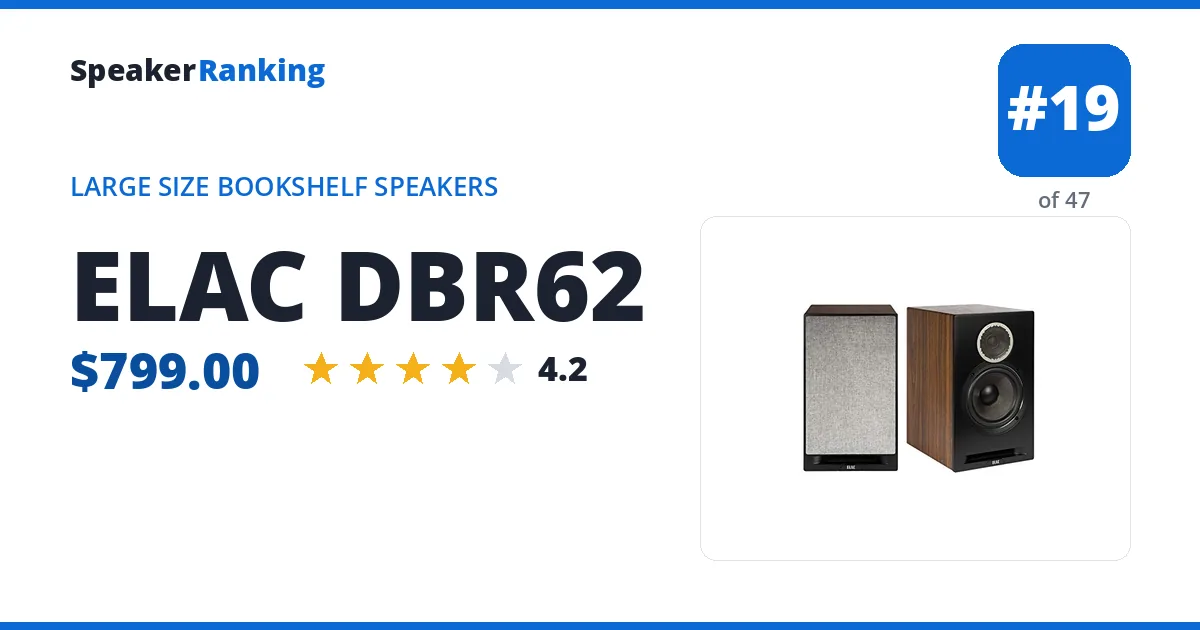
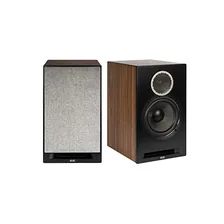 Ranked #57 of 134 in Large Size Bookshelf Speakers - ELAC DBR62: $799.00 per pair Amazon Crutchfield eBay
Pros: Two-way design with a 6.5” woofer and 1” dome tweeter in a shallow waveguide, with the tweeter positioned close to the woofer for near-point-source coherence: giving more vertical listening leeway than typical two-ways. Notably forgiving of placement and aiming: sounds good from directly on-axis all the way to 30° of toe-out (parallel with the rear wall), making it more room-independent than many speakers this price. Wide horizontal radiation of about ±70° until the tweeter starts beaming, right in the reviewer’s preferred sweet spot. A mild, wide-Q bass bump centered around 100Hz adds a bit of extra punch that the reviewer personally likes. On-axis linearity within about ±2.5dB, with a strong measured preference score of 5.3. Distortion stays below 3% at both 86dB and 96dB until around 50Hz. Vertical sweet spot of about ±10-20° works well for multi-row home theater seating. The reviewer calls it “the epitome of a good speaker” for its price, with no reservations recommending it. Measured bass extension of 53Hz (-3dB), with a measured sensitivity of 84.3dB.
Cons: A slight recess in the 1-2kHz region reduces vocal presence somewhat compared to other speakers in direct comparison. A mild hot spot around 4-5kHz can read as slight sibilance when pointed directly on-axis. Low-to-mid sensitivity (about 84.3dB) combined with a current draw that behaves like roughly 2.4 ohms between 100-200Hz means it’s best driven by a dedicated 4-ohm-capable amplifier rather than an AVR. A diffraction dip from the baffle edge is visible in measurements: typical of any standard rectangular-baffle speaker and not correctable without a much more expensive curved-baffle design. Multitone distortion testing suggests some potential midrange distortion could be audible on certain material, though the reviewer didn’t personally notice it. Minor resonances appear around 700Hz and 1-1.5kHz, possibly tied to the enclosure, port, or cone/surround edge termination, though their audible impact appears minimal. F3 of 53Hz means a subwoofer is still needed for real bass extension below about 40Hz.
Full ELAC DBR62 review and specifications →
| Bass Extension (-10dB) | 41Hz (measured, Erin’s Audio Corner) |
|---|---|
| Bass Extension (-3dB) | 53Hz (measured, Erin’s Audio Corner) |
| DIY Kit | No |
| Dimensions | 14.1”H x 8.2”W x 10.8”D (358.1 x 208.3 x 274.3 mm) |
| Drivers | 6.5” Aramid Fiber woofer, 1” soft dome tweeter |
| Impedance | 6 ohms nominal, 5.2 ohms minimum (measured above 80Hz, Erin’s Audio Corner) |
| Sensitivity | 84.3dB (measured average 300Hz-3kHz @ 2.83V/1m, Erin’s Audio Corner; 86dB manufacturer specified) |
| Spinorama Preference Score | 5.07 |
| Spinorama Preference Score with Perfect Sub | 7.27 |
| Weight | 18.1 lbs (8.2 kg) each |
| Woofer Cabinet | ported, front |
- Links
- Reviews, Comparisons and Sound Samples
- Erin’s Audio Corner: Top 3 Things You Need to Know About ELAC DBR62 Before You Buy More from Erin’s Audio Corner →
- Erin’s Audio Corner Website Elac DBR62
- Erin’s Audio Corner: 5 AWESOME SPEAKERS Under $1000 You Won’t Regret
- Erin’s Audio Corner: My Top Picks of 2023: Must-Haves Under $3000
- Audio Science Review Measurements More from Audio Science Review →
- Erin’s Audio Corner Measurements (spinorama.org)
- Head-to-Head Comparisons
- ELAC DBR62 vs Yamaha NS-800A
- ELAC DBR62 vs Definitive Technology Demand D11
- ELAC DBR62 vs ELAC Uni-Fi Reference UBR62
- ELAC DBR62 vs Technics SB-C700
- ELAC DBR62 vs Ascend Acoustics Sierra Duo V2 Ribbon
- ELAC DBR62 vs Dynaudio Contour 20i
- ELAC DBR62 vs Revel Concerta2 M16
- ELAC DBR62 vs SVS Ultra Bookshelf
- See all 68 comparisons
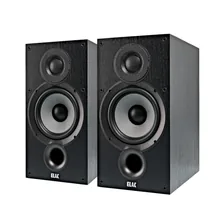 Ranked #89 of 134 in Large Size Bookshelf Speakers - ELAC Debut 2.0 B6.2: $329.00 per pair Amazon Crutchfield eBay
Pros: Reasonably flat on-axis and listening-window response with reasonably even horizontal directivity, holding about ±60° up to roughly 8kHz for consistent stereo width whether aimed directly at the listener or toed out. Its larger-than-typical woofer lets it play very loud with minimal distortion, staying under about 1% THD down to 50Hz at 86dB, and minimum impedance stays a comfortable 5-6 ohms. In-room bass extension reaches about 50Hz without much trouble, enough for a solid kick-drum sound. Takes equalization very well: correcting the on-axis response doesn’t cost sensitivity through the midrange, and the underlying directivity behavior (diffraction, vertical mismatch) is mild enough that EQ alone gets most of the way to a well-balanced sound. Vertical tolerance is asymmetric and fairly forgiving: about 10° above the tweeter axis and 20° below it before tonal balance meaningfully shifts. One reviewer called it “a good speaker” with “a good price” rather than just good-for-the-price, and found it fairly neutral overall in-room. Measured bass extension of 64Hz (-3dB), with a measured sensitivity of 86.5dB.
Cons: A good size resonant peak around 700Hz stands out from an otherwise smooth response and lingers in cumulative spectral decay (waterfall) measurements: in one reviewer’s sighted A/B test, reducing it by about 5dB via EQ made a noticeable but not dramatic difference. Directivity error shows up around 3.3kHz, and the upper-midrange around 4-6kHz stood out as edgy and sharp, almost sibilant at times, in casual listening: the predicted in-room response shows a lack of energy between 1-2kHz and a bit too much above that, which one reviewer thought would sound bright. Distortion at 96dB SPL/1m shows two harmonic peaks the reviewer says “should not be there,” one from woofer breakup around 400Hz and another around 7-8kHz from the tweeter, and multitone distortion approaches 10% in the 500-800Hz range at that output level. Real compression shows up even at moderate volume and worsens at 96dB and above, with the woofer clearly giving up around 60-70Hz: a subwoofer is recommended for anyone wanting to listen loud, since running it full-range at high output costs real dynamic range in the midbass and bass. Don’t place it close to a wall: boundary reinforcement adds a midbass bump that undoes the otherwise smooth, linear response. Getting the best out of it takes EQ (taming the 700Hz peak, filling in the 1-2kHz dip, and trimming the highs).
Full ELAC Debut 2.0 B6.2 review and specifications →
| Bass Extension (-10dB) | 40Hz (measured, Erin’s Audio Corner) |
|---|---|
| Bass Extension (-3dB) | 64Hz (measured, Erin’s Audio Corner) |
| DIY Kit | No |
| Dimensions | 14.8”H x 7.7”W x 10.6”D (375.0 x 195.0 x 268.0 mm) |
| Drivers | 25mm tweeter + 165mm woofer |
| Impedance | 6 ohms nominal, 5.2 ohms minimum (measured, Erin’s Audio Corner) |
| Sensitivity | 86.5dB (measured, Audio Science Review) |
| Spinorama Preference Score | 4.75 (spinorama.org) |
| Spinorama Preference Score with Perfect Sub | 7.0 (spinorama.org) |
| Weight | 29.1 lbs (13.2 kg) |
| Woofer Cabinet | ported, front |
- Links
- Reviews, Comparisons and Sound Samples
- Head-to-Head Comparisons
- ELAC Debut 2.0 B6.2 vs SVS Prime Bookshelf
- ELAC Debut 2.0 B6.2 vs Dynaudio Special Forty
- ELAC Debut 2.0 B6.2 vs Infinity IL10
- ELAC Debut 2.0 B6.2 vs GR-Research X-LS Encore
- ELAC Debut 2.0 B6.2 vs KEF Q3 Meta
- ELAC Debut 2.0 B6.2 vs Polk Monitor XT20
- ELAC Debut 2.0 B6.2 vs Parts Express Samba MT
- ELAC Debut 2.0 B6.2 vs Sonus Faber Lumina II
- See all 64 comparisons
Large Size Floorstanding Speakers
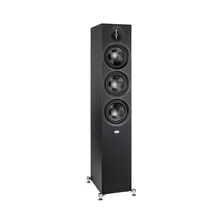 Ranked #36 of 74 in Large Size Floorstanding Speakers - ELAC Debut 3.0 DF63: $1,298 per pair Amazon eBay
Pros: Three-driver floorstanding layout: two 6” dedicated midbase drivers plus a separate 6” mid-range driver (confirmed by measuring different driver impedance/inductance) and a 1” dome tweeter, each woofer given its own stuffed chamber inside the cabinet. The dedicated midrange driver keeps distortion low even at higher output, avoiding the intermodulation grain typical of two-way bookshelf designs. The waveguide keeps high-frequency directivity well controlled, and overall horizontal directivity is good up to about 2kHz. Harmonic distortion looks good at both 86dB and 96dB, and multitone distortion stays below the reviewer’s 3% threshold. A shallow bass rolloff (F3 71Hz, F10 29Hz) lets it extend fairly low without a hard cutoff. Preferred by the reviewer over the similarly-priced Polk R500 (too much high-frequency narrowing, less neutral) and considered ahead of the Polk R700 as well. Measured bass extension of 71Hz (-3dB), with a measured sensitivity of 86.6dB.
Cons: A genuine measured resonance around 200-300Hz (visible in frequency response, impedance, and group delay) causes an audible “droning” coloration on female vocals. A mild peak around 10kHz makes shakers and similar high-frequency percussion jump too far forward in the mix; needed about 2dB of EQ to tame in testing. A dip in the 1-3kHz range gives the speaker a warm, slightly veiled character: the reviewer suspects the tweeter crossover point (around 2-3kHz) is set a bit high and could be lowered to fill this in. Directivity shows a noticeable handoff mismatch around 2.5kHz where the midrange driver hands off to the tweeter, though it’s minor at the -6dB point. Vertical directivity is narrower than horizontal, so listeners need to stay close to the tweeter axis. Low EPDR (about 1.5 ohms minimum) means a Class AB amplifier should be well-ventilated. Best positioned pointed directly at the listener and closer to the front wall: toeing it out into the room causes too much high-frequency rolloff.
Full ELAC Debut 3.0 DF63 review and specifications →
| Bass Extension (-10dB) | 29Hz (measured, Erin’s Audio Corner) |
|---|---|
| Bass Extension (-3dB) | 71Hz (measured, Erin’s Audio Corner) |
| DIY Kit | No |
| Dimensions | 43.1”H x 7.7”W x 10.6”D (1094.7 x 195.6 x 269.2 mm) |
| Drivers | Two 6.5” Aramid Fiber woofer, 6.5” Aramid Fiber midrange, 1” Aluminum Dome tweeter |
| Impedance | 6 ohms nominal (3.4 ohms minimum, measured, Erin’s Audio Corner) |
| Sensitivity | 86.6dB (measured, Erin’s Audio Corner) |
| Spinorama Preference Score | 5.83 |
| Spinorama Preference Score with Perfect Sub | 7.33 |
| Weight | 58.2 lbs (26.4 kg) each |
| Woofer Cabinet | ported, rear |
- Links
- Reviews, Comparisons and Sound Samples
- Head-to-Head Comparisons
- ELAC Debut 3.0 DF63 vs Polk Reserve R500
- ELAC Debut 3.0 DF63 vs Emotiva Airmotiv T2+
- ELAC Debut 3.0 DF63 vs Linkwitz Lab LXmini
- ELAC Debut 3.0 DF63 vs PSB Imagine T65
- ELAC Debut 3.0 DF63 vs Polk Audio Reserve R700
- ELAC Debut 3.0 DF63 vs Infinity Primus 360
- ELAC Debut 3.0 DF63 vs Q Acoustics 5040
- ELAC Debut 3.0 DF63 vs JBL HDI-3600
- See all 42 comparisons
Small Home Subwoofers (Under 30 lbs)
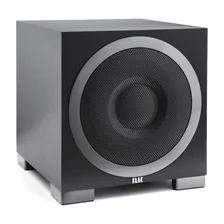 Ranked #21 of 48 in Small Home Subwoofers (Under 30 lbs) - ELAC IW-S10EQ in-wall: $2,199.00 Crutchfield eBay
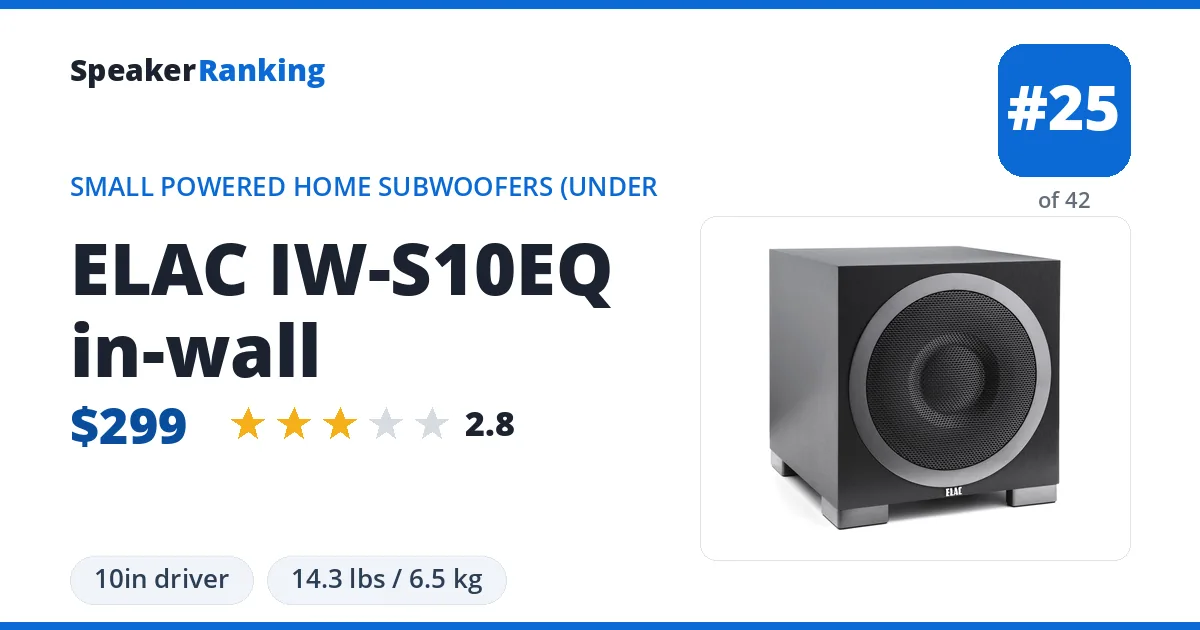
Pros: 10-inch in-wall driver delivers 103.9dB CEA-2010-A average with EQ-adjustable response for flush installation where a floor-standing cabinet isn’t an option.
Cons: Requires in-wall installation, limited output vs standalone cabinets, and space constraints for placement.
Full ELAC IW-S10EQ in-wall review and specifications →
| CEA-2010-A Average (40-80Hz) | 109.9 dB |
|---|---|
| Cabinet Color | black |
| Country | Germany |
| Dimensions | 12.2”H x 12.2”W x 4.2”D (309.9 x 309.9 x 107.4 mm) |
| Drivers | 10” (254mm) driver |
| Enclosure | in-wall |
| Measurement Source | Brent Butterworth |
| Output SPL at 16 Hz | 92.0 dB |
| Output SPL at 20 Hz | 96.2 dB |
| Output SPL at 25 Hz | 103.3 dB |
| Output SPL at 31.5 Hz | 103.9 dB |
| Output SPL at 40 Hz | 106.3 dB |
| Output SPL at 50 Hz | 109.0 dB |
| Output SPL at 63 Hz | 110.5 dB |
| Output SPL at 80 Hz | 113.9 dB |
| Warranty | 3/1 |
| Weight | 14.3 lbs (6.5 kg) |
- Links
- Reviews, Comparisons and Sound Samples
- Independently measured by Brent Butterworth; the published figures above come from this ASR subwoofer measurement thread.
- Head-to-Head Comparisons
- ELAC IW-S10EQ in-wall vs MartinLogan Dynamo 700w
- ELAC IW-S10EQ in-wall vs GoldenEar ForceField 3
- ELAC IW-S10EQ in-wall vs SVS 3000 In-Wall
- ELAC IW-S10EQ in-wall vs Polk Audio PSW10
- ELAC IW-S10EQ in-wall vs Klipsch HD Theater 600
- ELAC IW-S10EQ in-wall vs ELAC SUB1010
- ELAC IW-S10EQ in-wall vs Monitor Audio BRW10
- ELAC IW-S10EQ in-wall vs Klipsch R-10SW
- See all 19 comparisons
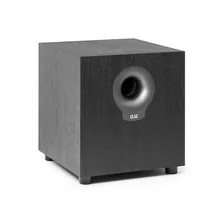 Ranked #26 of 48 in Small Home Subwoofers (Under 30 lbs) - ELAC SUB1010: $550 eBay
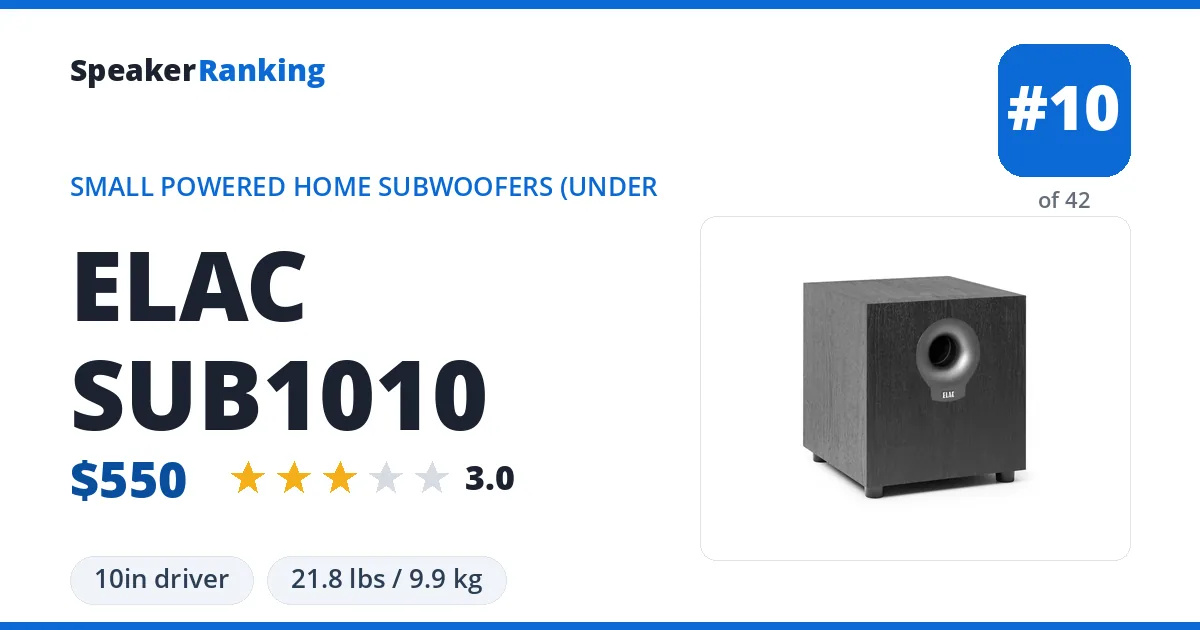
Pros: A compact 10-inch ported subwoofer with useful measured output through the upper-bass range: 102.7dB at 40Hz and 110.8dB at 63Hz. Its small cabinet makes it an approachable option for a modest room or a first 2.1 setup, where careful placement can add satisfying weight without taking much floor space.
Cons: Deep-bass output is limited compared with larger subwoofers, with 96.5dB measured at 31.5Hz, so it is not the right choice for demanding home-theater effects or a large room. Ported-room placement can also become boomy; experiment with position and crossover rather than expecting a plug-and-play upgrade.
Full ELAC SUB1010 review and specifications →
| CEA-2010-A Average (40-80Hz) | 108.1 dB |
|---|---|
| Cabinet Color | black |
| Country | Germany |
| Dimensions | 14.8”H x 12.2”W x 12.2”D (376.2 x 309.4 x 309.4 mm) |
| Drivers | 10” (254mm) driver |
| Enclosure | ported, rear |
| Measurement Source | ErinsAudioCorner |
| Output SPL at 31.5 Hz | 96.5 dB |
| Output SPL at 40 Hz | 102.7 dB |
| Output SPL at 50 Hz | 107.0 dB |
| Output SPL at 63 Hz | 110.8 dB |
| Output SPL at 80 Hz | 111.9 dB |
| Output SPL at 100 Hz | 111.2 dB |
| Output SPL at 125 Hz | 109.5 dB |
| Warranty | 3/1 |
| Weight | 21.8 lbs (9.9 kg) |
- Links
- Reviews, Comparisons and Sound Samples
- Head-to-Head Comparisons
- ELAC SUB1010 vs Klipsch HD Theater 600
- ELAC SUB1010 vs Monitor Audio BRW10
- ELAC SUB1010 vs Q Acoustics 3060S
- ELAC SUB1010 vs ELAC IW-S10EQ in-wall
- ELAC SUB1010 vs Dayton Audio SUB-1000L
- ELAC SUB1010 vs Klipsch R-10SW
- ELAC SUB1010 vs Monoprice Premium Select 8in 200-Watt
- ELAC SUB1010 vs MartinLogan Dynamo 700w
- See all 17 comparisons
Medium Home Subwoofers (30-75 lbs)
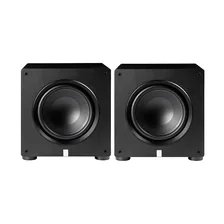 Ranked #85 of 146 in Medium Home Subwoofers (30-75 lbs) - ELAC PS350: $1,698.00 Amazon eBay
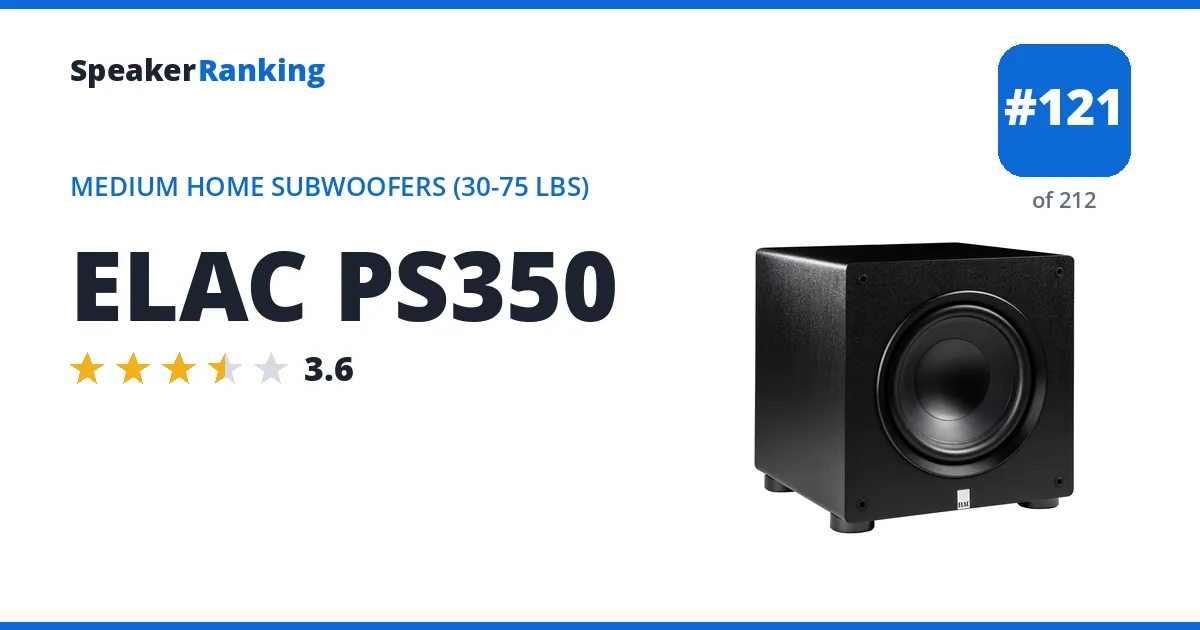
Pros: 12” woofer (24Hz) with 350W RMS, 700W peak. Large 2” voice coil for power handling. Auto EQ system compensates for room acoustics. App control (iOS/Android) for multiple subs.
Full ELAC PS350 review and specifications →
| Amplifier Power | 350W RMS |
|---|---|
| CEA-2010-A Average (40-80Hz) | 112.2 dB |
| Cabinet Color | black |
| Country | Germany |
| Dimensions | 17.2”H x 16.4”W x 16.4”D (436.9 x 415.8 x 417.8 mm) |
| Drivers | 12” (305mm) driver |
| Enclosure | ported, bottom |
| Frequency Response | 24-150Hz |
| Measurement Source | Brent Butterworth |
| Output SPL at 20 Hz | 85.5 dB |
| Output SPL at 25 Hz | 99.4 dB |
| Output SPL at 31.5 Hz | 105.4 dB |
| Output SPL at 40 Hz | 111.4 dB |
| Output SPL at 50 Hz | 112.5 dB |
| Output SPL at 63 Hz | 114.1 dB |
| Output SPL at 80 Hz | 110.9 dB |
| Weight | 48.1 lbs (21.8 kg) |
- Links
- Reviews, Comparisons and Sound Samples
- Independently measured by Brent Butterworth; the published figures above come from this ASR subwoofer measurement thread.
- Head-to-Head Comparisons
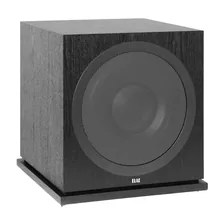 Ranked #105 of 146 in Medium Home Subwoofers (30-75 lbs) - ELAC SUB3010: $499.00 Amazon eBay
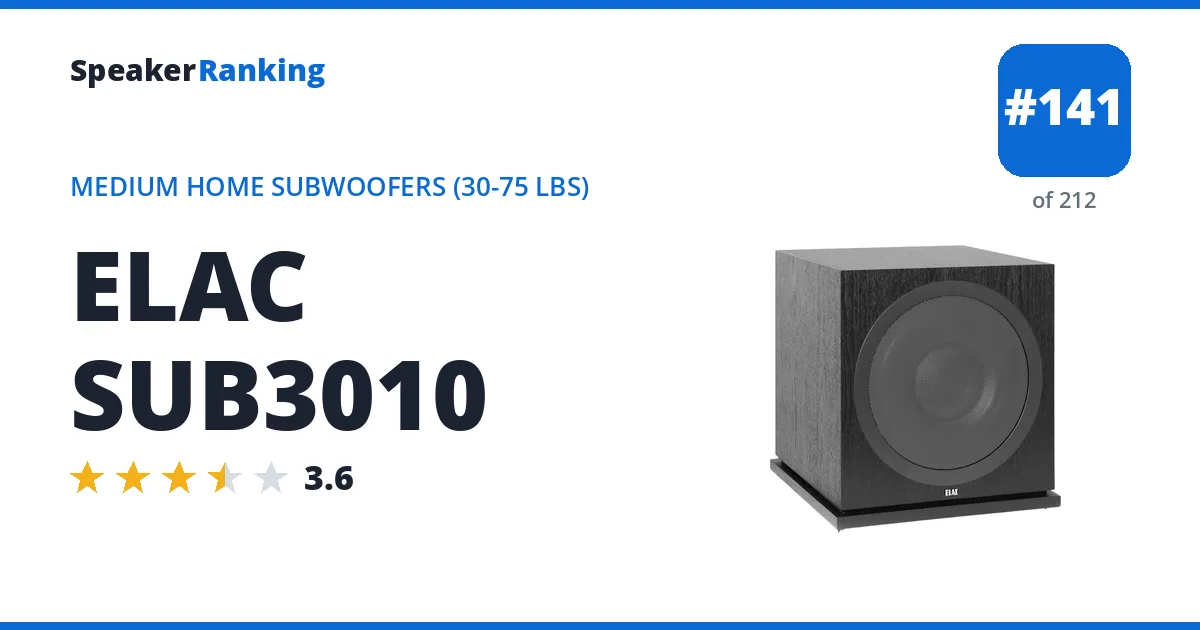
Pros: 10-inch woofer with 10-inch passive radiator delivers tight punchy bass. 400W peak power with 28-150Hz frequency response. Bluetooth control via ELAC SubEQ app with AutoEQ using smartphone microphone for accurate room EQ. 8 parametric curves plus EQ modes (Night/Flat/Cinema/Music). Advanced Bluetooth control optimizes room EQ automatically without calibration hassle.
Full ELAC SUB3010 review and specifications →
| Amplifier Power | 200W RMS |
|---|---|
| CEA-2010-A Average (40-80Hz) | 111.4 dB |
| Cabinet Color | black |
| Country | Germany |
| Dimensions | 14.3”H x 13.5”W x 13.5”D (364.0 x 342.9 x 342.9 mm) |
| Drivers | 10” (254mm) driver |
| Enclosure | passive radiator |
| Frequency Response | 28-150Hz |
| Measurement Source | Brent Butterworth |
| Output SPL at 20 Hz | 83.8 dB |
| Output SPL at 25 Hz | 97.9 dB |
| Output SPL at 31.5 Hz | 103.9 dB |
| Output SPL at 40 Hz | 106.1 dB |
| Output SPL at 50 Hz | 110.6 dB |
| Output SPL at 63 Hz | 114.5 dB |
| Output SPL at 80 Hz | 114.6 dB |
| Warranty | 3/1 |
| Weight | 32.2 lbs (14.6 kg) |
- Links
- Reviews, Comparisons and Sound Samples
- Independently measured by Brent Butterworth; the published figures above come from this ASR subwoofer measurement thread.
- Head-to-Head Comparisons
Discontinued ELAC Models
Still ranked, and often still worth buying used, but no longer in production. Check availability before planning around one of these.
Medium Size Bookshelf Speakers
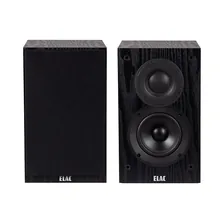 Ranked #41 of 90 in Medium Size Bookshelf Speakers - ELAC BS41: $180.00 per pair Discontinued Amazon eBay
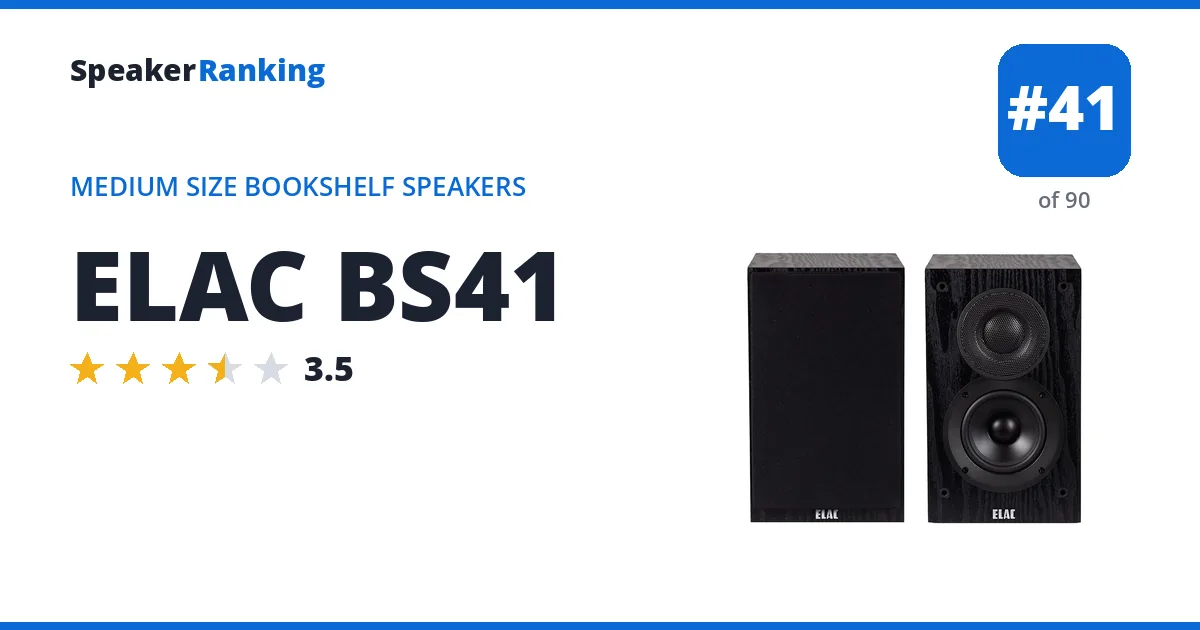
Pros: A small sealed two-way with a 4-inch woofer and a 1-inch tweeter that measures more evenly than its low price suggests. Erin’s Audio Corner found the listening window within a 2.5dB span from 300Hz to 5kHz and a predicted in-room response smoothness of 0.60, for a preference score of 4.29 (6.57 with an ideal subwoofer). Bass reaches about 54Hz (-3dB) and 47Hz (-10dB), and the sealed box makes it easy to place near a wall. Measured bass extension of 54.2Hz (-3dB).
Cons: The sealed 4-inch woofer limits output and deep bass, so it suits small rooms or pairing with a subwoofer. Sensitivity is a modest 84.5dB. It is discontinued and mostly found used.
Full ELAC BS41 review and specifications →
| Bass Extension (-10dB) | 46.9Hz (measured, Erin’s Audio Corner) |
|---|---|
| Bass Extension (-3dB) | 54.2Hz (measured, Erin’s Audio Corner) |
| DIY Kit | No |
| Drivers | 4” woofer, 1” tweeter |
| Frequency Response | 48Hz-20kHz (manufacturer specified) |
| Impedance | 6 ohms nominal (manufacturer specified) |
| Sensitivity | 84.5dB (manufacturer specified) |
| Spinorama Preference Score | 4.29 |
| Spinorama Preference Score with Perfect Sub | 6.57 |
| Woofer Cabinet | sealed |
- Reviews, Comparisons and Sound Samples
- Head-to-Head Comparisons
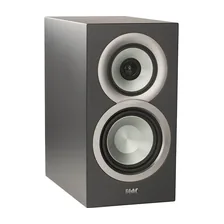 Ranked #60 of 90 in Medium Size Bookshelf Speakers - ELAC BS U5: $856 per pair Discontinued eBay
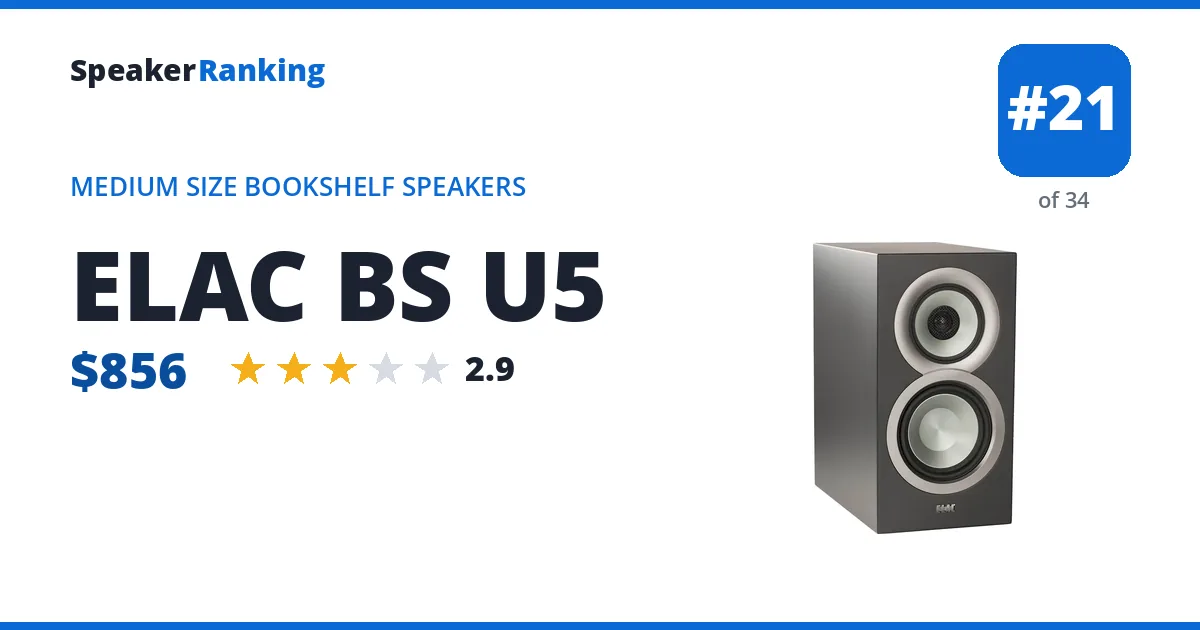
Pros: This slim three-way coaxial design (an Andrew Jones creation) shows a fairly even on-axis response up to 3kHz, with off-axis behavior notably smoother than the on-axis curve. Predicted in-room response looks like it should give good tonality. Vertical directivity is better than average, a benefit of the coaxial layout. Measured bass extension of 63Hz (-3dB), with a measured sensitivity of 83dB.
Cons: Distortion is very high right at both crossover points (around 270Hz (mid-range) and 2700Hz (tweeter)) at both 86dB and 96dB SPL/1m, exceeding 3% at the mid-range crossover. Minimum impedance dips to 3.4 ohms with a possible resonance around 500Hz visible in the impedance/phase curve. Discontinued.
Full ELAC BS U5 review and specifications →
| Bass Extension (-10dB) | 41Hz (derived, log-interpolated between spinorama.org -9dB/-12dB points) |
|---|---|
| Bass Extension (-3dB) | 63Hz (measured, Audio Science Review) |
| DIY Kit | No |
| Dimensions | 13.4”H x 7”W x 11.5”D (339.1 x 178.0 x 293.1 mm) |
| Drivers | 1” tweeter + 5.25” woofer |
| Impedance | 4 ohms nominal (3.4 ohms minimum) |
| Sensitivity | 83dB (2.83V/1m, measured, Audio Science Review) |
| Spinorama Preference Score | 4.71 (spinorama.org) |
| Spinorama Preference Score with Perfect Sub | 6.79 (spinorama.org) |
| Weight | 13.2 lbs (6 kg) |
| Woofer Cabinet | ported, rear |
- Reviews, Comparisons and Sound Samples
- Head-to-Head Comparisons
- ELAC BS U5 vs Acoustic Energy AE100 Mk2
- ELAC BS U5 vs Dynaudio Emit M10
- ELAC BS U5 vs Dynaudio X14
- ELAC BS U5 vs Pioneer SP-BS22-LR (Philharmonic AAM Mod)
- ELAC BS U5 vs JBL L52 Classic
- ELAC BS U5 vs JBL Stage 250B
- ELAC BS U5 vs JBL Stage A120
- ELAC BS U5 vs Paradigm Monitor SE Atom
- See all 33 comparisons
Large Size Bookshelf Speakers
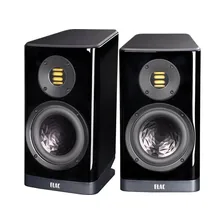 Ranked #35 of 134 in Large Size Bookshelf Speakers - ELAC VELA BS 403: $2,899 per pair Discontinued eBay
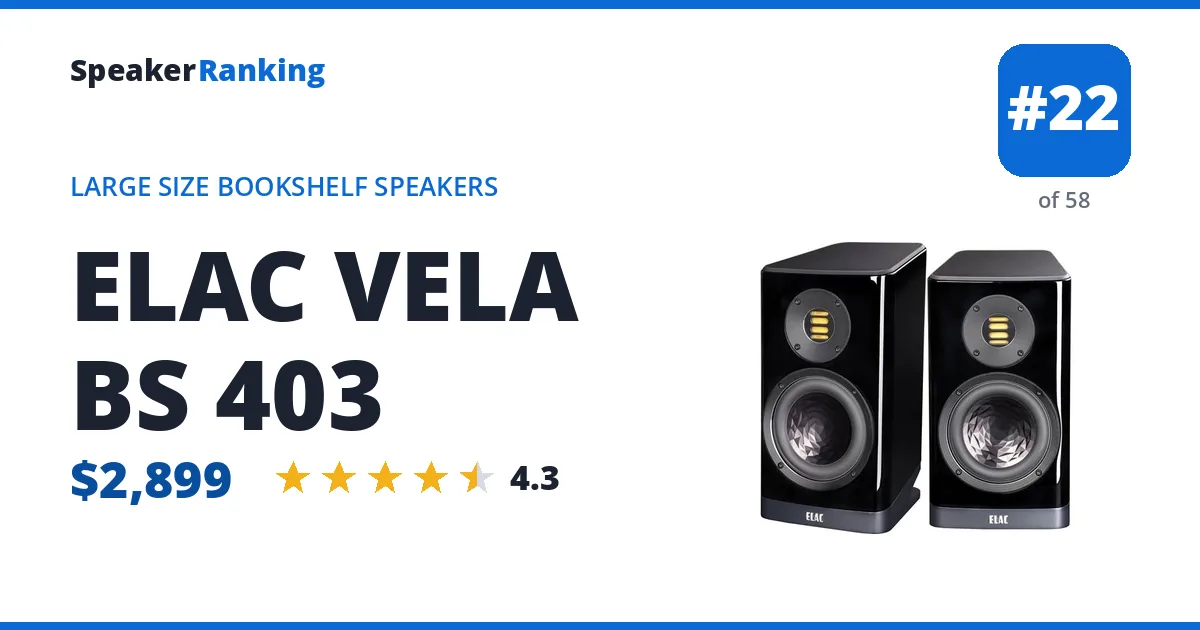
Newer model: the ELAC Vela BS 403.2. It’s likely to perform similarly, though we don’t have measurements to confirm that yet.
Pros: JET 5 folded ribbon tweeter pairs with a 6” aluminum/paper sandwich woofer for extended, well-controlled bass: Erin measured usable in-room extension to about 50 Hz, deeper than JBL’s competing L52 Classic despite lacking that speaker’s mild upper-bass bump. Compression stays within about 1 dB above 100 Hz up to 102 dB, on the better side of normal for a bookshelf this size, indicating good dynamic and transient capability. Wide, spacious soundstage radiation. Overall neutral voicing that Erin called “a really good speaker,” from the looks to the sound. Measured bass extension of 59Hz (-3dB), with a measured sensitivity of 84.3dB.
Cons: Deliberate dip-and-peak voicing in the crossover region around 2 kHz reduces attack and clarity in the mids and highs: intentional per ELAC’s design, but not to Erin’s personal preference. Lower measured sensitivity (84.3 dB) means it wants more amplifier power than average to reach the same levels. Multitone distortion roughly triples, from about 1% to 3%, between 88 dB and 96 dB output, so it’s happiest at moderate listening levels. A minor distortion bump shows up around 800 Hz in the data, though Erin didn’t hear it. Discontinued and no longer sold new.
Full ELAC VELA BS 403 review and specifications →
| Bass Extension (-10dB) | 46Hz (measured average, Erin’s Audio Corner) |
|---|---|
| Bass Extension (-3dB) | 59Hz (measured average, Erin’s Audio Corner) |
| Crossover Frequency | 2.4kHz |
| DIY Kit | No |
| Dimensions | 14-3/16”H x 7-1/2”W x 9-3/8”D |
| Drivers | JET 5 folded ribbon tweeter, 6” aluminum/paper sandwich cone woofer |
| Frequency Response | 41Hz - 50kHz (manufacturer specified) |
| Impedance | 4 ohms nominal, 3.2 ohms minimum (measured, Erin’s Audio Corner) |
| Recommended Power | up to 100W RMS |
| Sensitivity | 84.3dB (measured average, Erin’s Audio Corner) |
| Spinorama Preference Score | 3.94 |
| Spinorama Preference Score with Perfect Sub | 6.28 |
| Weight | 15.7 lbs (7.1 kg) each |
- Reviews, Comparisons and Sound Samples
- Head-to-Head Comparisons
- ELAC VELA BS 403 vs Philharmonic BMR (v1)
- ELAC VELA BS 403 vs Revel M126Be
- ELAC VELA BS 403 vs Wharfedale Linton 85
- ELAC VELA BS 403 vs Selah Audio Purezza
- ELAC VELA BS 403 vs JTR Noesis 210HT
- ELAC VELA BS 403 vs Emotiva Airmotiv XB2
- ELAC VELA BS 403 vs ELAC Debut 3.0 DB63
- ELAC VELA BS 403 vs Dynaudio Heritage Special
- See all 15 comparisons
Large Home Subwoofers (Over 75 lbs)
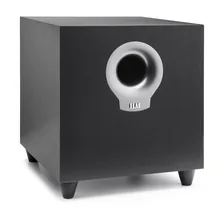 Ranked #34 of 109 in Large Home Subwoofers (Over 75 lbs) - ELAC SUB3070: $999 Discontinued eBay
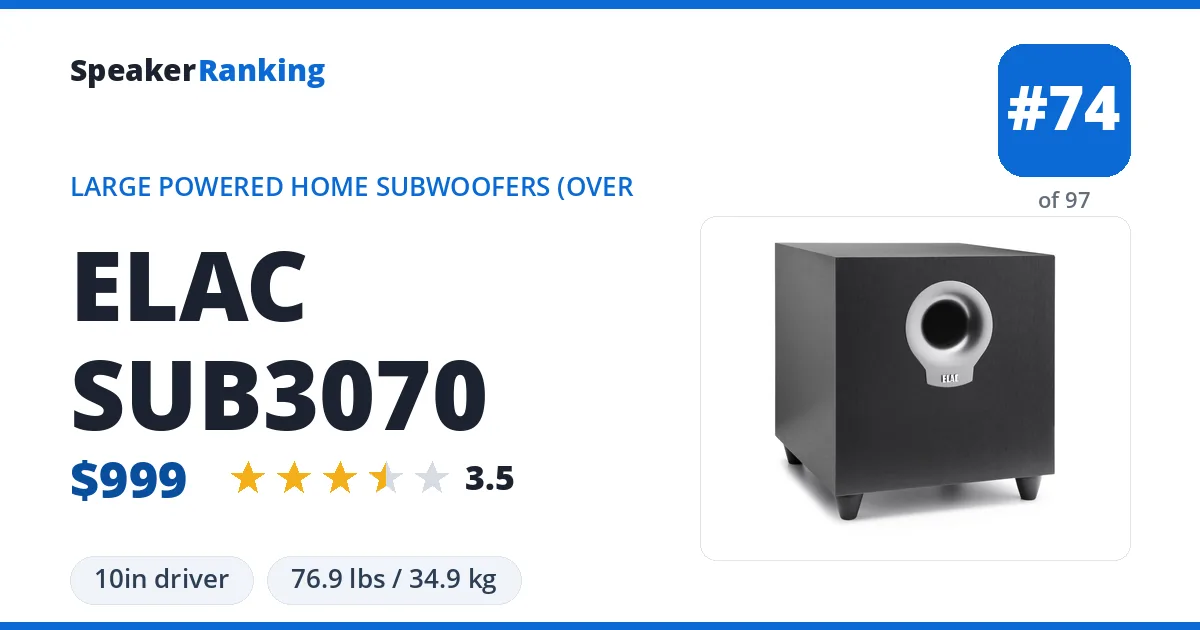
Pros: Independent CEA-2010 testing records 101.8 dB at 20 Hz and 123.9 dB through 40-80 Hz. The sealed enclosure with 2x 12” (305mm) driver delivers substantial upper-bass output for movie effects and music.
Cons: Deep-bass output is more limited than the strong 40-80 Hz result suggests, so it is not the right choice when the lowest movie effects are the priority. The 435.1H x 517.9W x 476.2D mm cabinet and 34.9 kg mass still require deliberate placement and calibration. Discontinued.
Full ELAC SUB3070 review and specifications →
| AES Input | No |
|---|---|
| Aux Input | No |
| CEA-2010-A Average (40-80Hz) | 123.9 dB |
| Cabinet Color | black, white, wood |
| Coaxial Input | No |
| Country | Germany |
| Dimensions | 17.1”H x 20.4”W x 18.7”D (435.1 x 517.9 x 476.2 mm) |
| Drivers | 2x 12” (305mm) driver |
| Enclosure | sealed |
| HDMI Input | No |
| Inputs | XLR (balanced stereo, right channel can be dedicated LFE), RCA (stereo), speaker-level |
| Measurement Source | Brent Butterworth |
| Optical Input | No |
| Output SPL at 16 Hz | 98.9 dB |
| Output SPL at 20 Hz | 101.8 dB |
| Output SPL at 25 Hz | 105.2 dB |
| Output SPL at 31.5 Hz | 110.7 dB |
| Output SPL at 40 Hz | 118.0 dB |
| Output SPL at 50 Hz | 123.7 dB |
| Output SPL at 63 Hz | 127.3 dB |
| Output SPL at 80 Hz | 126.5 dB |
| RCA Input | Yes |
| TRS Input | No |
| USB Input | No |
| Warranty | 3/1 |
| Weight | 76.9 lbs (34.9 kg) |
| XLR Input | Yes |
- Links
- Reviews, Comparisons and Sound Samples
- Independently measured by Brent Butterworth; the published figures above come from this ASR subwoofer measurement thread.
- Head-to-Head Comparisons
ELAC Models Not Yet Ranked
Newer or recently added ELAC models we track but haven’t ranked yet, because no measurements we can rank them on have been published. See speakers not yet ranked for how that works.
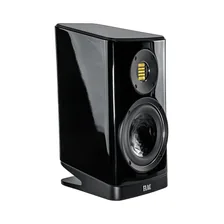 Not yet ranked, replaces ELAC VELA BS 403 - ELAC Vela BS 403.2: $3,299 per pair ELAC eBay
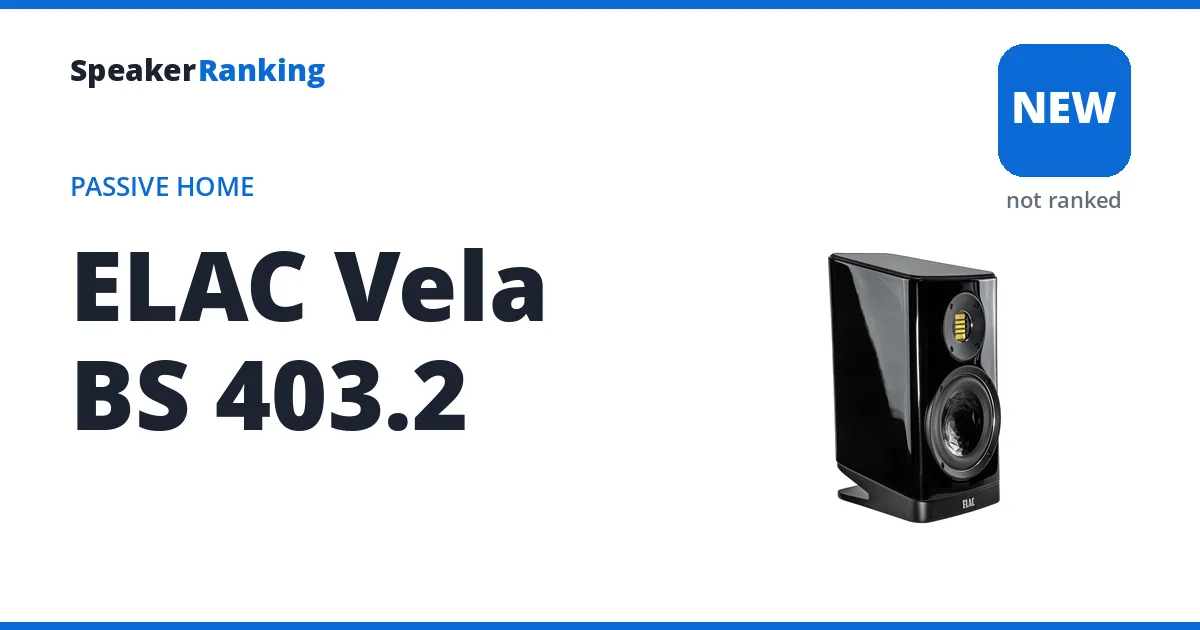
Older model: the ELAC VELA BS 403 (rated 4.3/5).
Pros: Two-way bass reflex stand mount with the JET 6 folded ribbon tweeter, a revised version of the JET 5 in the original Vela BS 403, and a 150mm AS-XR aluminum sandwich woofer crossed over at 2.4kHz. ELAC rates it at 41Hz to 50kHz and 86dB sensitivity. Three high gloss finishes.
Cons: No independent measurements yet, so its tonal balance and directivity can’t be compared with ranked speakers. It is a 4 ohm load dipping to 3.2 ohms at 260Hz, so it needs an amplifier comfortable with low impedance, and it costs noticeably more than the BS 403 did.
Full ELAC Vela BS 403.2 review and specifications →
| Crossover Frequency | 2.4kHz |
|---|---|
| Dimensions | 14.3”H x 7.5”W x 9.4”D (362 x 191 x 240 mm) |
| Drivers | JET 6 folded ribbon tweeter, 150mm (6”) AS-XR cone woofer |
| Frequency Response | 41Hz - 50kHz (Manufacturer specified) |
| Impedance | 4 ohms nominal (3.2 ohms minimum) |
| Power Handling | 40-200W |
| Sensitivity | 86dB (2.83V/1m, manufacturer specified) |
| Weight | 15.7 lbs (7.1 kg) each |
| Woofer Cabinet | ported |
- Links
- Reviews, Comparisons and Sound Samples
- These figures are manufacturer-specified rather than independently measured.
- Head-to-Head Comparisons