36 ranked speakers support aptX Adaptive, Qualcomm’s variable-bitrate codec. Unlike standard aptX or aptX HD, which run at a fixed bitrate, aptX Adaptive shifts between roughly 279 kbps and 420 kbps in real time depending on radio conditions and content - prioritizing a stable low-latency connection during video or gaming, and higher quality during music playback when the link has headroom to spare. Both ends need aptX Adaptive support specifically; a phone with plain aptX or aptX HD won’t invoke it.
For every aptX variant together, see aptX speakers, or Bluetooth codecs explained for the full picture on why codec choice matters far less on a speaker than on headphones.
The Speakers
Prices on this page were last checked October 15, 2026 at 5:41 PM UTC. Product prices and availability are accurate as of that date/time and are subject to change; the price and availability shown on Amazon at the time of purchase will apply to the purchase of this product.
As an eBay Partner, we may be compensated if you make a purchase.
Portable Bluetooth Speakers
Medium Size Portable Bluetooth Speakers
 Ranked #11 of 175 in Medium Size Portable Bluetooth Speakers - B&O Beosound A1 2nd gen: $395.00 Amazon $395.00 eBay
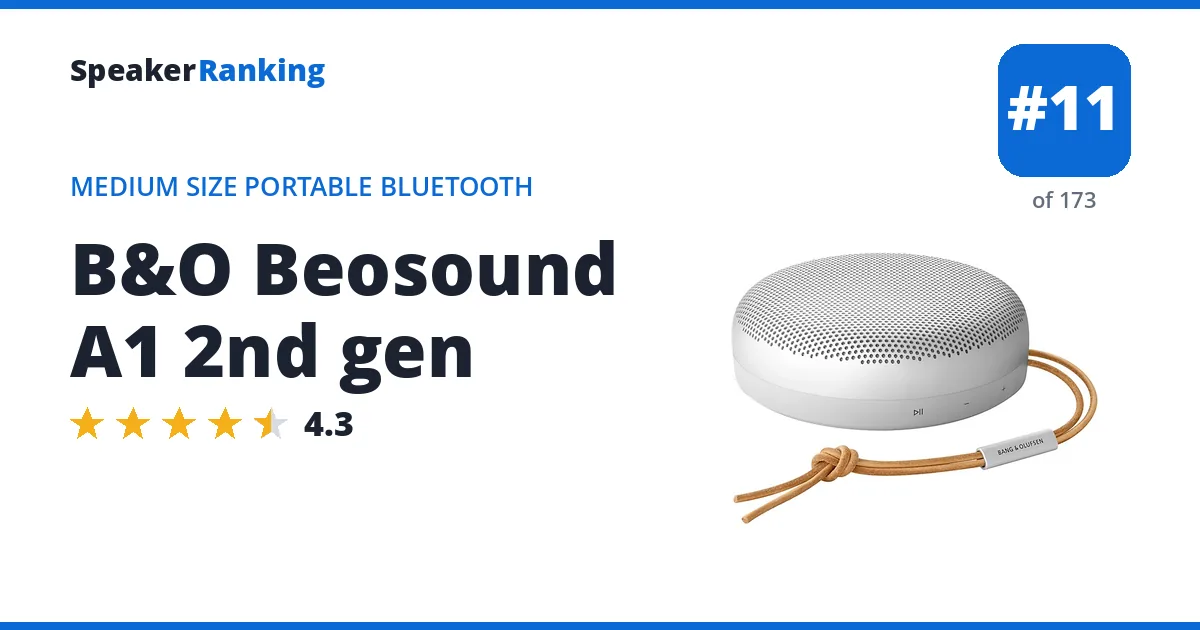
Newer model: the B&O Beosound A1 3rd gen, ranked lower, rated 4.1/5, released May 2025. Battery life goes from 18 to 24 hours.
Older model: the B&O Beosound A1 (ranked higher, rated 4.3/5). See every B&O Beosound A1 generation.
Pros: B&O Beosound A1 2nd gen uses 3.5mm aluminium driver + 0.75 inch silk dome tweeter. Its 558 g, claimed 18 hours (Manufacturer specified) battery life, IP67 protection, up to 93dB and mono playback make it a practical option for its intended room or portable use. Measured bass extension of 58Hz (-10dB).
Cons: Bass is limited by its 58Hz specification.
Full B&O Beosound A1 2nd gen review and specifications →
| Released | May 2020 (6 years ago) |
|---|---|
| Amplifier Power | 60W total (2x 30W Class D) |
| App | Yes |
| Aux Input | No |
| Bass Extension (-10dB) | 58Hz |
| Battery Life | 18 hours (Manufacturer specified) |
| Bluetooth | Yes |
| Bluetooth Codecs | SBC, AAC, aptX Adaptive |
| Bluetooth Latency | 90ms |
| Bluetooth Version | 5.1 |
| Built-in Microphone | Yes |
| Digital Aux Input | Yes (USB-C) |
| Dimensions | 5.2”W x 5.2”D x 1.8”H (133 x 133 x 46 mm) |
| Drivers | 3.5mm aluminium driver + 0.75 inch silk dome tweeter |
| EQ | Yes |
| IP Rating | IP67 |
| Maximum SPL | 93dB (measured by Alan Ross Reviews) |
| Omnidirectional | Pointing up |
| Power Bank | No |
| Power Input | USB-C |
| Stereo | No |
| Strap | Yes (built-in strap) |
| TWS | Yes |
| Weight | 1.2 lbs (558 g) |
- Links
- Reviews, Comparisons and Sound Samples
- JOY‘s 🎧3D🔈Audio-Show: B&O Beosound A1 3rd gen vs 2nd gen - worth the premium? More from Oluv’Sone →
- JOY‘s 🎧3D🔈Audio-Show: B&O Beoplay/Beosound A1 - all 3 generations compared
- Oluv Patreon: (Anker) Soundcore Motion 300 - first impressions
- Oluv Patreon: B&O Beosound A1 2nd gen vs Beoplay A1 outdoors with a bit of Anker Soundcore Motion+ too
- Alan Ross Reviews: B&O Beoplay A1 2nd gen vs Minirig mk3 bluetooth speaker More from alanrossreviews →
- Alan Ross Reviews: Soundcore Motion Plus vs Beoplay A1 2nd gen - The Match!
- Storytripper HD: JBL Clip 4 vs B&O A1 2nd vs Klipsch Austin More from storytripperhd →
- techkiste.net: B&O Beosound A1 (2nd Gen) vs Bose Revolve 2 vs Bose Revolve+ 2 sound-comparison
- Head-to-Head Comparisons
- B&O Beosound A1 2nd gen vs B&O Beosound A1
- B&O Beosound A1 2nd gen vs JBL Charge 6
- B&O Beosound A1 2nd gen vs JBL Flip 6
- B&O Beosound A1 2nd gen vs Minirig 2
- B&O Beosound A1 2nd gen vs Minirig 3
- B&O Beosound A1 2nd gen vs Soundcore Boost “original model” pre-2021
- B&O Beosound A1 2nd gen vs JBL Flip 7
- B&O Beosound A1 2nd gen vs Minirig 4
- See all 87 comparisons
 Ranked #19 of 175 in Medium Size Portable Bluetooth Speakers - B&O Beosound A1 3rd gen: $299.99 Amazon $299.99 Lowest B&H Photo Video $399.00 eBay
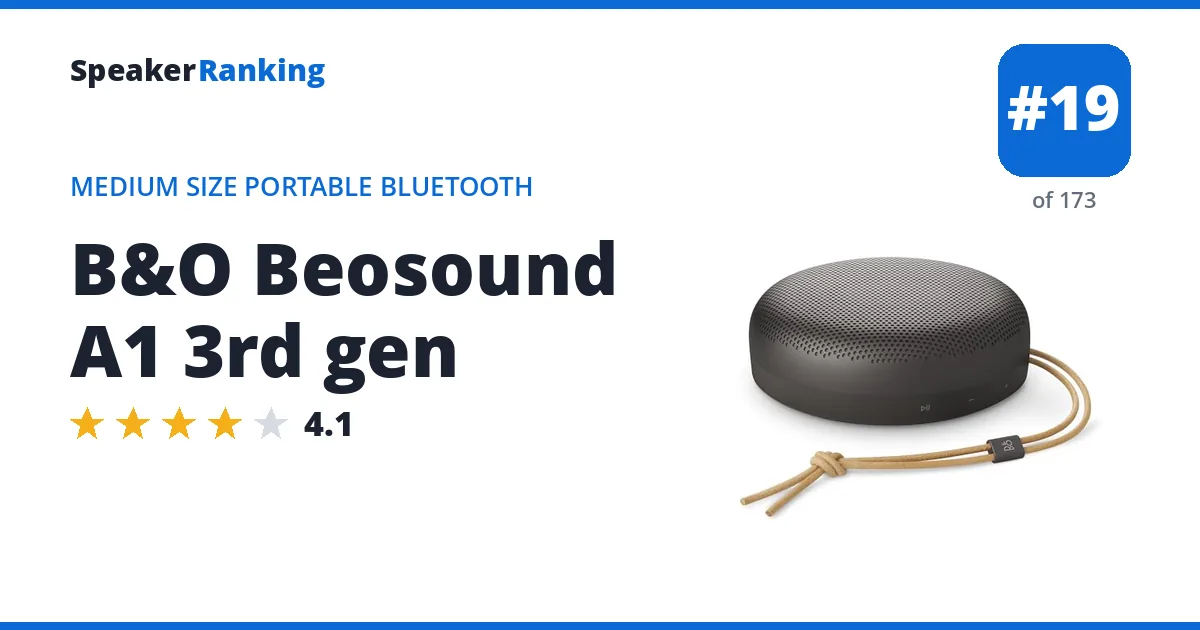
Older models: the B&O Beosound A1 2nd gen (ranked higher, rated 4.3/5) and the B&O Beosound A1 (ranked higher, rated 4.3/5). See every B&O Beosound A1 generation.
Pros: Longer battery than the 2nd gen (~24 hours at sensible volumes). IP67 rated with a serviceable, replaceable battery: the first Bluetooth speaker with Cradle to Cradle certification. Multipoint connectivity and aptX Adaptive.
Cons: Distorts easier than the 2nd gen with deeper bass. Dipped area in the upper mids. Not as deep of bass as the 2nd gen
Full B&O Beosound A1 3rd gen review and specifications →
| Released | May 2025 (1 year ago) |
|---|---|
| Amplifier Power | 60W |
| App | Yes |
| Aux Input | No |
| Battery Life | 24 hours (Manufacturer specified) |
| Bluetooth | Yes |
| Bluetooth Codecs | SBC, AAC, aptX Adaptive |
| Bluetooth Version | 5.1 |
| Built-in Microphone | Yes |
| Digital Aux Input | Yes (USB-C) |
| Dimensions | 5.2” x 1.8” x 5.2” (133 x 46 x 133 mm) |
| Drivers | 82.5mm woofer, 15mm tweeter |
| EQ | Yes |
| IP Rating | IP67 |
| Omnidirectional | Pointing up |
| Power Bank | No |
| Power Input | USB-C |
| Stereo | No |
| Strap | Yes (built-in strap) |
| TWS | Yes |
| Weight | 1.2 lbs (558 g) |
- Links
- Reviews, Comparisons and Sound Samples
- JOY‘s 🎧3D🔈Audio-Show: B&O Beosound A1 3rd gen - outdoor sound test More from Oluv’Sone →
- JOY‘s 🎧3D🔈Audio-Show: B&O Beosound A1 3rd gen vs 2nd gen - worth the premium?
- JOY‘s 🎧3D🔈Audio-Show: B&O Beoplay/Beosound A1 - all 3 generations compared
- Oluv Patreon: B&O Beosound A1 3rd gen - soundcheck
- Oluv Patreon: B&O Beosound A1 3rd gen - outdoor test
- Head-to-Head Comparisons
- B&O Beosound A1 3rd gen vs Xiaomi Sound Party
- B&O Beosound A1 3rd gen vs Tribit Xsound Mega
- B&O Beosound A1 3rd gen vs Tribit Maxsound Plus
- B&O Beosound A1 3rd gen vs JBL Flip 7
- B&O Beosound A1 3rd gen vs Soundcore Boost “original model” pre-2021
- B&O Beosound A1 3rd gen vs JBL Flip 6
- B&O Beosound A1 3rd gen vs Harman Kardon Luna 2
- B&O Beosound A1 3rd gen vs Harman Kardon Luna
- See all 84 comparisons
 Ranked #37 of 175 in Medium Size Portable Bluetooth Speakers - Bose Soundlink Flex 2nd gen: $159.00 Amazon $159.00 eBay
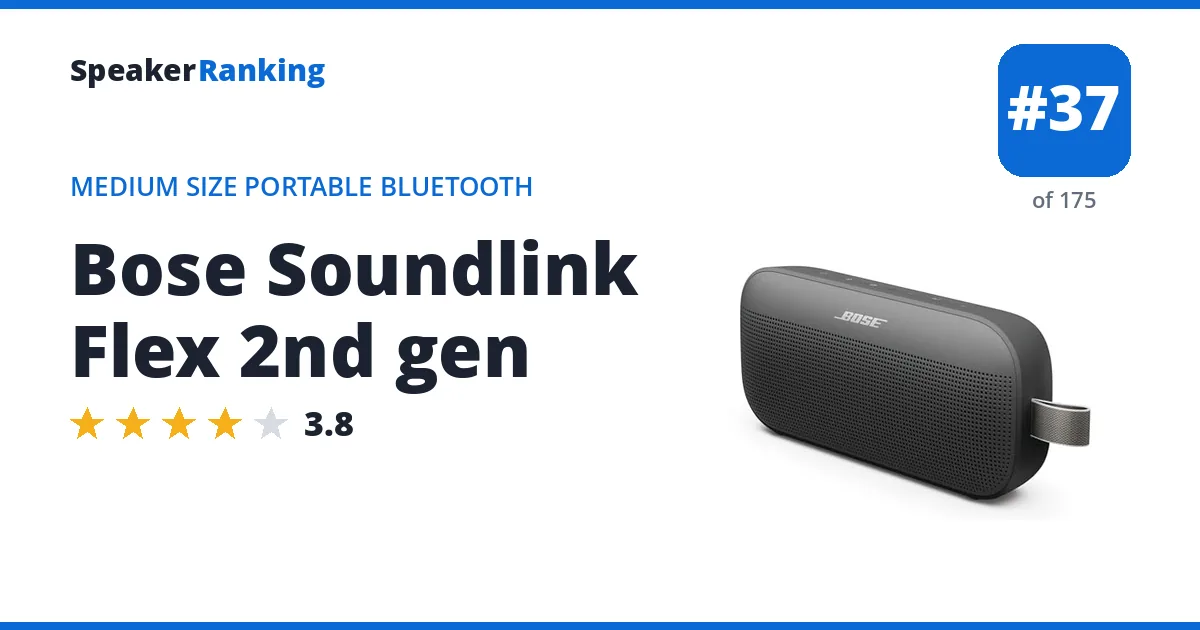
Older model: the Bose Soundlink Flex (ranked lower, rated 3.8/5). See every Bose SoundLink Flex, Micro, Max and Plus generation.
Same family: the Bose SoundLink Max (larger model, rated 4.3/5), the Bose Soundlink Micro 2 (larger model, rated 3.6/5) and the Bose SoundLink Plus (larger model, rated 4.2/5).
Pros: A very portable 586g, IP67-rated speaker with a clear, well-balanced midrange that keeps voices and instruments intelligible. The second generation adds a Bose app with 3-band EQ, better-placed controls and stereo pairing with another Bose Soundlink Flex 2nd gen. It supports AAC and aptX Adaptive in addition to SBC, making it a stronger wireless option than most small rivals.
Cons: One Flex remains mono and cannot deliver genuine low-bass rumble; RTINGS also found the elevated treble can turn hi-hats and other high-frequency detail piercing. The claimed battery life is only 12 hours, and some owners report accelerated standby drain after firmware updates. It is expensive for its size, so the added app and codec support, not a transformational sound upgrade over the original, are the main reasons to choose it.
Full Bose Soundlink Flex 2nd gen review and specifications →
| Released | Sep 2024 (2 years ago) |
|---|---|
| App | Yes |
| Aux Input | No |
| Battery Life | 12 hours (Manufacturer specified) |
| Bluetooth | Yes |
| Bluetooth Codecs | SBC, AAC, aptX Adaptive |
| Bluetooth Version | 5.3 |
| Built-in Microphone | Yes |
| Digital Aux Input | No |
| Dimensions | 7.9” x 3.5” x 2” (201 x 90 x 52 mm) |
| Drivers | 60mm full-range driver with passive radiators |
| EQ | Yes (3 band) |
| IP Rating | IP67 |
| Omnidirectional | No |
| Party Mode | Yes (Bose Party mode) |
| Power Input | USB-C |
| Stereo | No |
| Strap | Yes (built-in loop) |
| TWS | Yes |
| Weight | 1.3 lbs (586 g) |
- Links
- Reviews, Comparisons and Sound Samples
- Joy & Oluv’Sone: Bose Soundlink Flex 2nd gen vs Flex More from Oluv’Sone →
- Joy & Oluv’Sone: Bose Soundlink Flex 2nd gen & Soundcore Motion 300 sound test
- Oluv Patreon: Bose Soundlink Flex 2nd gen - sound demo
- Alan Ross: Hall of Fame classic vs latest Bose tech! More from alanrossreviews →
- Alan Ross - The Anti Shill!: Small speaker, mighty sound, The Flex gen 2 shatters physics!
- Alan Ross - The Anti Shill!: DBSONO X-Blast F37 vs Bose Soundlink Flex 2 - They all want to be me 😊
- Mateusz Cholewa: JBL Charge Essential 3 SE vs BOSE SoundLink FLEX 2 More from Mateusz Cholewa →
- CEONTHEMAKING: Bose Soundlink Flex 2nd Gen VS Marshall Emberton III - What’s NEW?? More from CEONTHEMAKING →
- Tô Thái Trí Hùng: Unbox & Sound Test - Bose Soundlink Flex 2
- Musou1: JBL flip 7 vs KEF muo vs Bose flex 2
- Head-to-Head Comparisons
- Bose Soundlink Flex 2nd gen vs Bose Soundlink Flex
- Bose Soundlink Flex 2nd gen vs Tribit Xsound Plus 2
- Bose Soundlink Flex 2nd gen vs JBL Charge Essential 2
- Bose Soundlink Flex 2nd gen vs Teufel Rockster XS
- Bose Soundlink Flex 2nd gen vs Huawei Sound Joy
- Bose Soundlink Flex 2nd gen vs Cleer Audio Scene
- Bose Soundlink Flex 2nd gen vs Soundcore Boom 3i
- Bose Soundlink Flex 2nd gen vs JBL Charge Essential 3 SE
- See all 147 comparisons
 Ranked #97 of 175 in Medium Size Portable Bluetooth Speakers - KEF Muo gen2: $249.99 Amazon $249.99 eBay
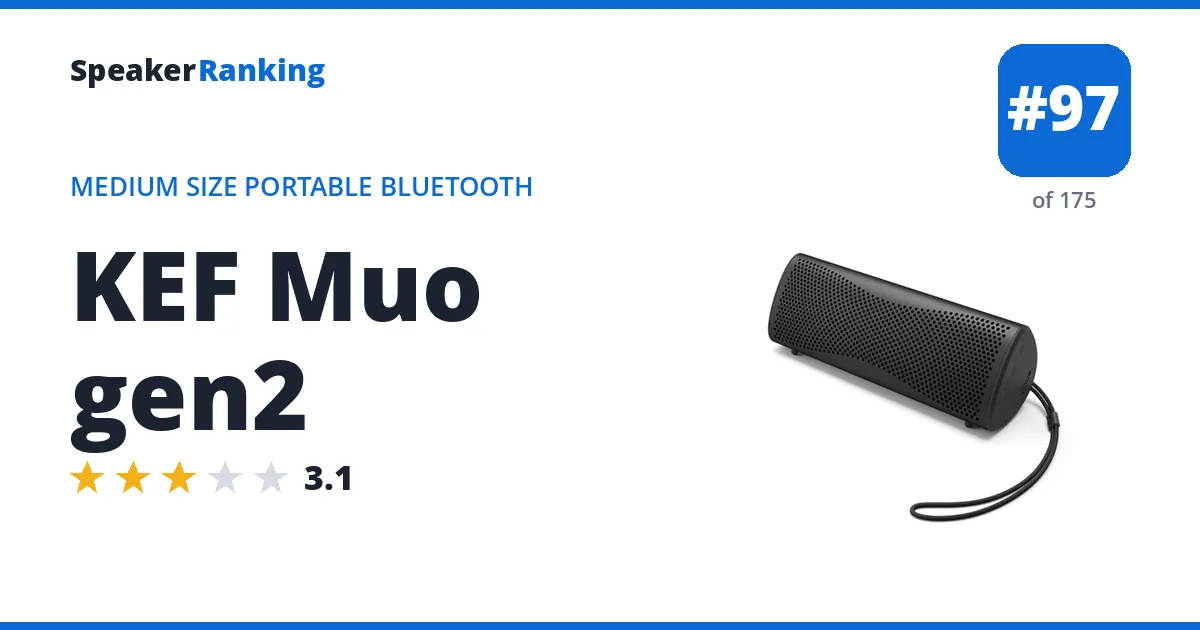
Pros: KEF seemed to have fixed the rolled off treble and overall balance
Cons: Lacking deeper bass. Very thuddy bass. Appears to be the exact same hardware but with updated tuning. Bass distorts as volume increases, and the claimed 43Hz extension is really only audible at low listening volumes, with a few seconds of lag after volume changes. Loses most of its bass off-axis. Customer reviews are mixed, ranging from praise for detail at low volume to complaints of a boxy, hollow sound.
Full KEF Muo gen2 review and specifications →
| Amplifier Power | 40W |
|---|---|
| App | Yes |
| Aux Input | No |
| Battery Life | 24 hours (Manufacturer specified) |
| Bluetooth | Yes |
| Bluetooth Codecs | SBC, aptX Adaptive up to 48 kHz 24 bit |
| Bluetooth Version | 5.4 |
| Digital Aux Input | Yes (USB-C) |
| Dimensions | 8.5” x 3.2” x 2.3” (216 x 82 x 59 mm) |
| Drivers | 1x 58x117mm racetrack woofer, 1x 20mm tweeter |
| EQ | Yes |
| Frequency Response | 43Hz - 20kHz (Manufacturer specified) |
| IP Rating | IP67 |
| Maximum SPL | 90dB (Manufacturer specified) |
| Omnidirectional | No |
| Party Mode | Yes (Auracast) |
| Power Input | USB-C |
| Stereo | Yes |
| TWS | Yes |
| Weight | 1.6 lbs (740 g) |
- Links
- Reviews, Comparisons and Sound Samples
- Head-to-Head Comparisons
Powered Speakers
Large Size Powered Desktop Speakers
 Ranked #1 of 10 in Large Size Powered Desktop Speakers - Bowers & Wilkins Zeppelin Pro: $899.00 each Amazon $899.00 eBay
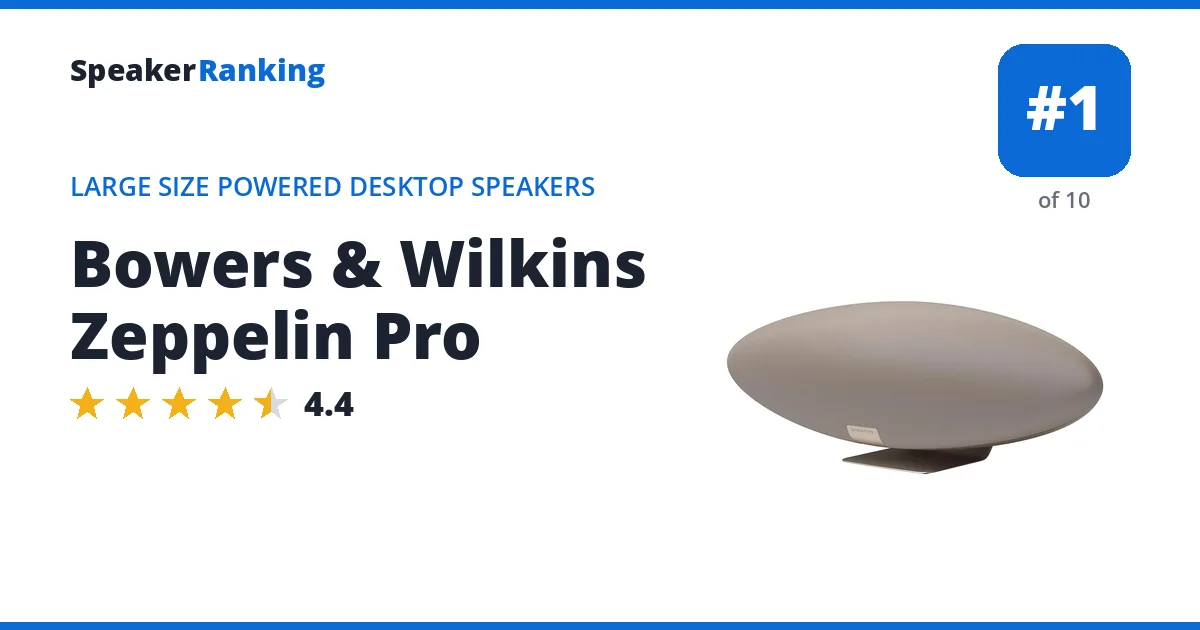
Older model: the Bowers & Wilkins Zeppelin (ranked lower, rated 4.3/5). See every Bowers & Wilkins Zeppelin generation.
Pros: Titanium dome tweeters and an improved 24-bit DAC over the standard Bowers & Wilkins Zeppelin for slightly better high-frequency detail on hi-res streams. Dynamic EQ DSP. Customizable downward-firing light. Same wide soundstage and deep bass extension as the standard Bowers & Wilkins Zeppelin.
Cons: Same price as the standard Bowers & Wilkins Zeppelin for a fairly modest tweeter/DAC upgrade. Nothing besides the lack of battery, lack of waterproofing, high cost and the EarFun Uboom X that’s so close to it in terms of sound quality for 7x less money. Basically an indoor only speaker. At this price point the Top Recommended Bookshelf Speakers are the better buy, with even better soundstage.
Full Bowers & Wilkins Zeppelin Pro review and specifications →
| Released | Oct 2024 (2 years ago) |
|---|---|
| AES Input | No |
| Amplifier Power | 240W (80W woofer, 2x 40W midrange, 2x 40W tweeter) |
| App | No |
| Aux Input | No |
| Battery Life | No Battery |
| Bluetooth | Yes |
| Bluetooth Codecs | aptX Adaptive, AAC, SBC |
| Bluetooth Version | 5.0 |
| Coaxial Input | No |
| DSP | Yes |
| Dimensions | 25.6” x 8.3” x 7.6” (650 x 210 x 194 mm) |
| Drivers | 150mm woofer, 2x 90mm FST midrange drivers, 2x 25mm Titanium Dome tweeters |
| EQ | Yes (Dynamic EQ) |
| Frequency Response | 35Hz - 24kHz (Manufacturer specified) |
| HDMI Input | No |
| IP Rating | None |
| Inputs | Bluetooth, AirPlay 2, Spotify Connect |
| Optical Input | No |
| Party Mode | No |
| Power Bank | No |
| Power Input | AC Power cord |
| RCA Input | No |
| Stereo | Yes |
| Streaming Services | AirPlay 2, Spotify Connect |
| TRS Input | No |
| TWS | No |
| USB Input | No |
| Weight | 14.6 lbs (6.6 kg) |
| Wi-Fi | Yes |
| XLR Input | No |
- Links
- Reviews, Comparisons and Sound Samples
- Head-to-Head Comparisons
- Bowers & Wilkins Zeppelin Pro vs Bowers & Wilkins Zeppelin
- Bowers & Wilkins Zeppelin Pro vs Sonos Five
- Bowers & Wilkins Zeppelin Pro vs JBL Authentics 500
- Bowers & Wilkins Zeppelin Pro vs Sonos Era 300
- Bowers & Wilkins Zeppelin Pro vs B&O Beosound 2
- Bowers & Wilkins Zeppelin Pro vs Denon Home 350
- Bowers & Wilkins Zeppelin Pro vs Devialet Mania
- Bowers & Wilkins Zeppelin Pro vs Sonos Move 2
- See all 10 comparisons
 Ranked #2 of 10 in Large Size Powered Desktop Speakers - Bowers & Wilkins Zeppelin: $899 each Discontinued eBay
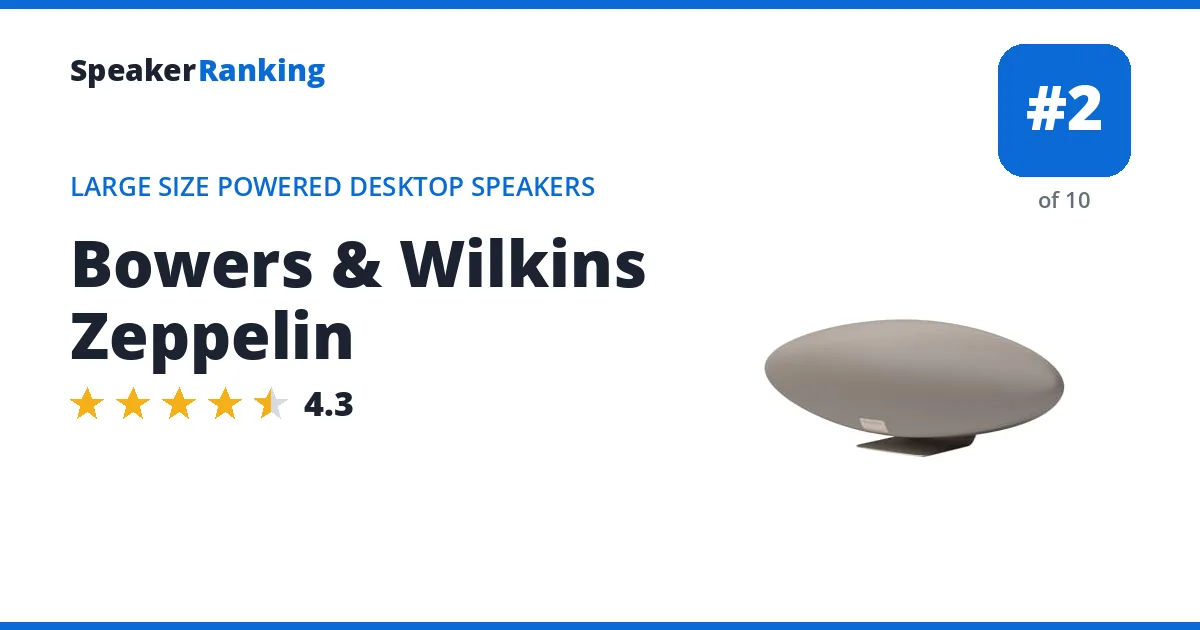
Newer model: the Bowers & Wilkins Zeppelin Pro, ranked higher, rated 4.4/5, released Oct 2024. It adds adjustable EQ. See every Bowers & Wilkins Zeppelin generation.
Pros: Amazingly neutral, quite a wide soundstage due to the width. Bass extension deeper than all others in category. Measured bass extension of ~32Hz (-10dB).
Cons: Nothing besides the lack of battery, lack of waterproofing, high cost and the EarFun Uboom X that’s so close to it in terms of sound quality for 7x less money. Basically an indoor only speaker. At this price point the Top Recommended Bookshelf Speakers are the better buy, with even better soundstage. Discontinued.
Full Bowers & Wilkins Zeppelin review and specifications →
| Released | Oct 2021 (5 years ago) |
|---|---|
| AES Input | No |
| Amplifier Power | 240W (80W woofer, 2x 40W midrange, 2x 40W tweeter) |
| App | No |
| Aux Input | No |
| Bass Extension (-10dB) | ~32Hz |
| Battery Life | No Battery |
| Bluetooth | Yes |
| Bluetooth Codecs | aptX Adaptive, AAC, SBC |
| Bluetooth Version | 5.0 |
| Coaxial Input | No |
| DSP | No |
| Dimensions | 25.6” x 8.3” x 7.6” (650 x 210 x 194 mm) |
| Drivers | 150mm woofer, 2x 90mm FST midrange drivers, 2x 25mm Decoupled Double-Dome aluminium tweeters |
| EQ | No |
| Frequency Response | 35Hz - 24kHz (Manufacturer specified) |
| HDMI Input | No |
| IP Rating | None |
| Inputs | Bluetooth, AirPlay 2, Spotify Connect |
| Optical Input | No |
| Party Mode | No |
| Power Bank | No |
| Power Input | AC Power cord |
| RCA Input | No |
| Stereo | Yes |
| Streaming Services | AirPlay 2, Spotify Connect |
| TRS Input | No |
| TWS | No |
| USB Input | No |
| Weight | 14.6 lbs (6.6 kg) |
| Wi-Fi | Yes |
| XLR Input | No |
- Links
- Reviews, Comparisons and Sound Samples
- Head-to-Head Comparisons
Medium Size Powered Bookshelf Speakers
 Ranked #40 of 108 in Medium Size Powered Bookshelf Speakers - KEF Coda W: $999.99 per pair Amazon $999.99 KEF $999.99 eBay
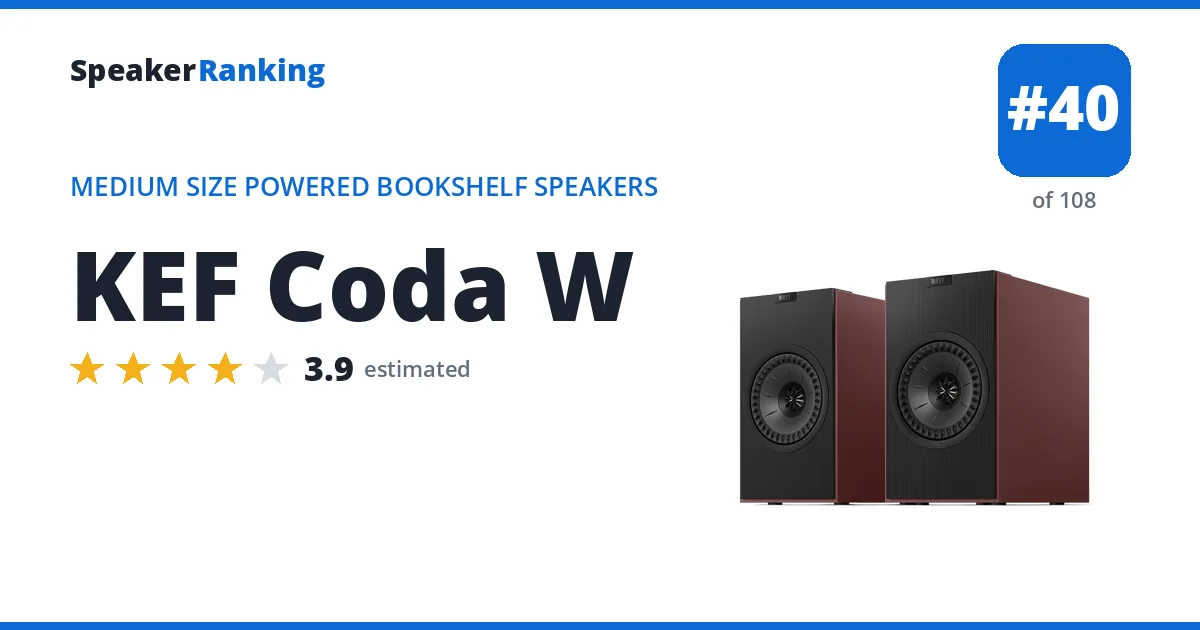
Pros: Active stereo hub system powered by 200W Class-D amplification (70W LF / 30W HF bi-amped per speaker). Employs a 5.25-inch magnesium/aluminum Uni-Q driver with a coincident 1-inch aluminum dome tweeter. Connectivity includes a built-in MM phono stage for turntables, HDMI ARC for television audio, USB-C (24-bit/192kHz), optical, RCA line in, Bluetooth 5.4 with aptX Lossless and aptX Adaptive, and dedicated subwoofer output.
Cons: Lacks onboard Wi-Fi / network streaming capabilities, requiring a wired source or Bluetooth connection for wireless playback.
Full KEF Coda W review and specifications →
| Released | Oct 2025 (1 year ago) |
|---|---|
| Amplifier Power | 200W |
| Bluetooth | Yes |
| Bluetooth Codecs | aptX Lossless, aptX Adaptive, AAC, SBC |
| Bluetooth Version | 5.4 |
| Cabinet Color | Dark Titanium, Midnight Blue, Moss Green, Nickel Grey, Vintage Burgundy |
| Country | United Kingdom |
| Dimensions | 11.2”H x 6.6”W x 10.6”D (285 x 168 x 268 mm) |
| Drivers | 1” aluminum dome tweeter, 5.25” magnesium/aluminum alloy cone woofer |
| Enclosure | ported, rear |
| Frequency Response | 41Hz - 20kHz (±3dB) (manufacturer specified) |
| HDMI Input | Yes |
| Maximum SPL | 102 dB |
| Optical Input | Yes |
| RCA Input | Yes |
| Stereo | pair |
| Subwoofer Output | Yes |
| USB Input | Yes |
| Weight | 24.9 lbs (11.3 kg) |
- Links
- Reviews, Comparisons and Sound Samples
- No independent measurement review is linked for this model; it is ranked from hands-on listening and comparison against similarly priced speakers.
- Head-to-Head Comparisons
 Ranked #44 of 108 in Medium Size Powered Bookshelf Speakers - Kanto Tuk G2: $899.99 per pair Crutchfield $899.99 eBay
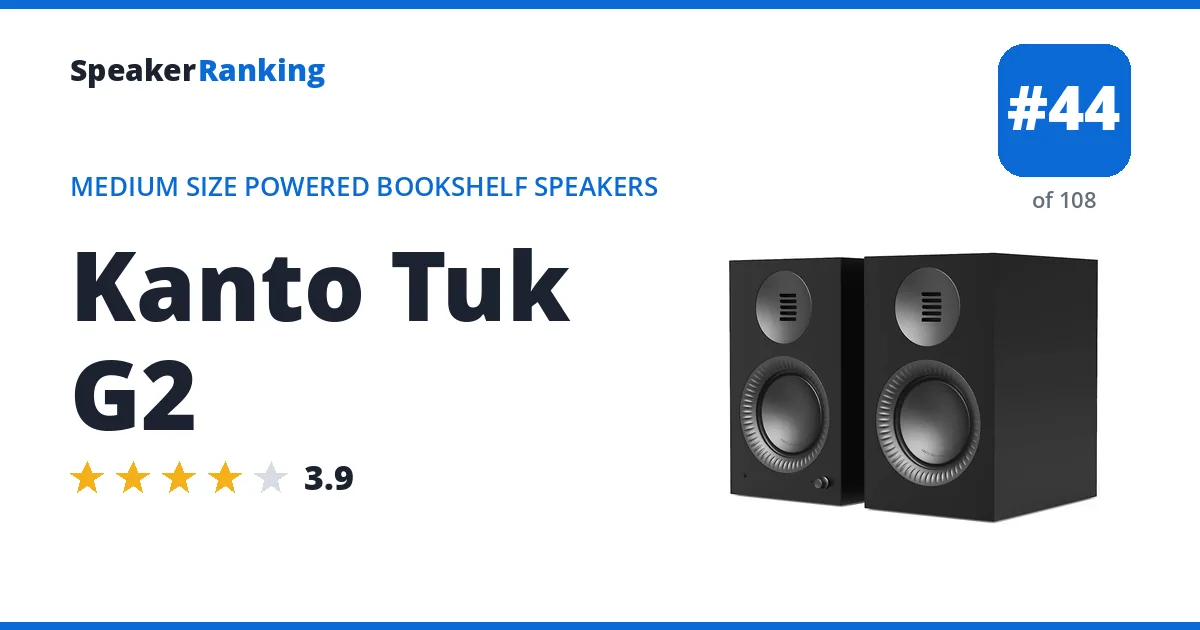
Same family: the Kanto YU4 G2 (smaller bookshelf, ranked lower, estimated 3.6/5), the Kanto YU6 G2 (smaller bookshelf, estimated 3.9/5) and the Kanto TUK Grand G2 (larger bookshelf, estimated 3.9/5). See every Kanto YU and Tuk generation.
Pros: Bass reaches about 52Hz at -3dB and 42Hz at -10dB in Erin’s measurements, legitimate extension from a 5.25-inch woofer. The predicted in-room response is fairly even from the upper bass through the treble, which lifts its preference score to about 4.6 on its own and 6.7 with an ideal subwoofer. Connections cover most desk and living room sources: optical, two RCA inputs, USB-C from a computer and Bluetooth 5.4 with aptX Adaptive, plus a subwoofer output with an 80Hz low-pass, a remote and a USB charging port. Measured bass extension of 52Hz (-3dB).
Cons: On-axis response is uneven, with elevated upper bass around 80 to 100Hz, a forward midrange near 800Hz to 1.5kHz and further ripples through the treble. Horizontal dispersion widens abruptly around 2 to 2.5kHz before narrowing again, and the vertical listening window is narrow, so keep the AMT tweeter near ear height. Compression grows at 96dB and becomes severe near 102dB, with distortion rising sharply at high levels, so it sounds best as a nearfield or small room speaker at moderate volume.
Full Kanto Tuk G2 review and specifications →
| Released | Aug 2026 (2 months ago) |
|---|---|
| AES Input | No |
| Amplifier Power | 130W Class D total (Manufacturer specified) |
| Aux Input | No |
| Bass Extension (-10dB) | 42Hz (measured, Erin’s Audio Corner) |
| Bass Extension (-3dB) | 52Hz (measured, Erin’s Audio Corner) |
| Bluetooth | Yes |
| Bluetooth Codecs | aptX Adaptive, SBC |
| Bluetooth Version | 5.4 |
| Coaxial Input | No |
| DSP | Yes |
| Dimensions | 7.2”W x 12”H x 10”D (183 x 305 x 254 mm) |
| Drivers | 5.25-inch aluminum woofer + AMT folded ribbon tweeter (each), bass reflex |
| Frequency Response | 50Hz-22kHz (Manufacturer specified) |
| HDMI Input | No |
| Headphone Output | No |
| Inputs | Optical, 2x RCA, USB-C, Bluetooth |
| Measurement Source | Erin’s Audio Corner |
| Optical Input | Yes |
| Outputs | Subwoofer RCA (80Hz low-pass), USB-A charging (5V/2A) |
| RCA Input | Yes |
| Spinorama Preference Score | 4.61 (calculated from Erin’s Audio Corner CEA2034 data) |
| Spinorama Preference Score with Perfect Sub | 6.73 (calculated from Erin’s Audio Corner CEA2034 data) |
| Subwoofer Output | Yes |
| TRS Input | No |
| USB Input | Yes |
| Weight | 12.3 lbs (5.6 kg) (active), 11.5 lbs (5.2 kg) (passive) |
| XLR Input | No |
- Links
- Reviews, Comparisons and Sound Samples
- Head-to-Head Comparisons
Large Size Powered Bookshelf Speakers
 Ranked #73 of 119 in Large Size Powered Bookshelf Speakers - JBL 4329P: $4,500 per pair Discontinued eBay
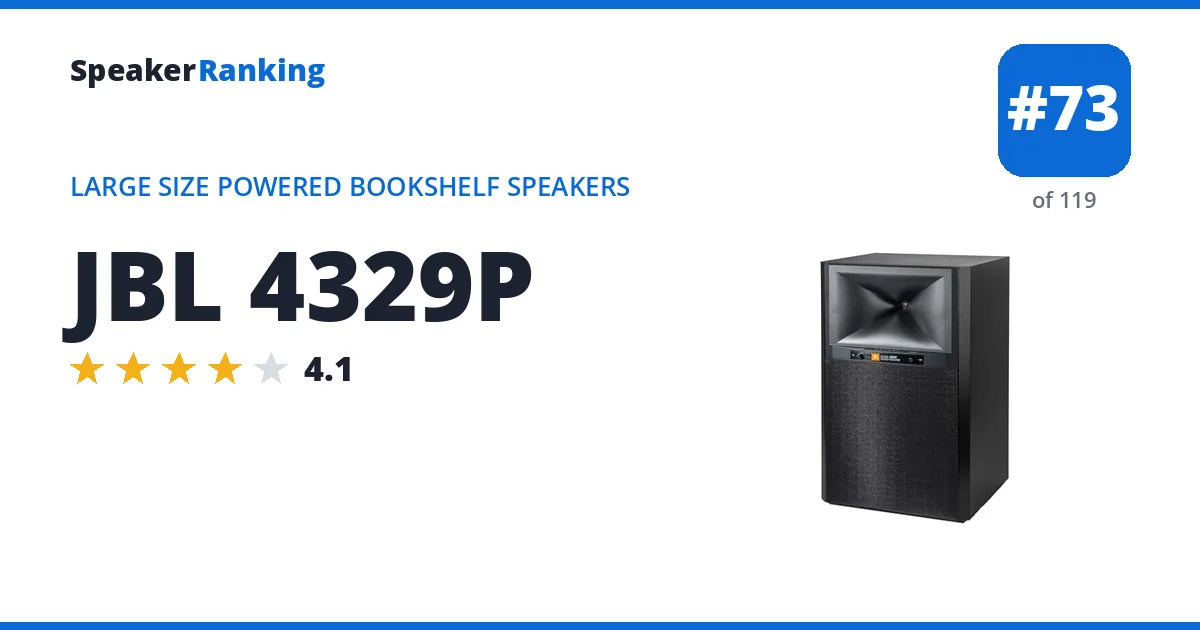
Same family: the JBL 4305P (smaller bookshelf, ranked higher, rated 4.4/5).
Pros: Measured -3dB extension of 32.2Hz provides deeper native bass than the smaller JBL 4305P. Integrated amplification and streaming make it convenient for a full-range living-room system, and its larger format is useful when scale matters. Measured bass extension of 31Hz (-3dB), with a measured sensitivity of 102.2dB.
Cons: The measured 4.5dB response span from 300Hz to 5kHz includes a notable midrange dip, so it is not as neutral as its size and price might suggest. Its 6.72 ideal-subwoofer score trails the JBL 4305P. There is no HDMI connection for the simplest TV hookup. Discontinued.
Full JBL 4329P review and specifications →
| Released | 2023 (3 years ago) |
|---|---|
| AES Input | No |
| Amplifier Power | 300W RMS per speaker (600W total system power) |
| Aux Input | Yes |
| Bass Extension (-10dB) | 27Hz (measured, Erin’s Audio Corner) |
| Bass Extension (-3dB) | 31Hz (measured, Erin’s Audio Corner) |
| Bluetooth | Yes |
| Bluetooth Codecs | SBC, aptX Adaptive |
| Bluetooth Version | 5.3 |
| Coaxial Input | No |
| Dimensions | 20.3”H x 12.6”W x 12.7”D |
| Drivers | 8” midwoofer, 1” compression driver with JBL High-Definition Imaging horn |
| Frequency Response | 30Hz - 20kHz (anechoic, manufacturer specified) |
| HDMI Input | No |
| Inputs | USB, Optical, Bluetooth, Analog, 3.5mm, AirPlay 2 |
| Optical Input | Yes |
| RCA Input | No |
| Sensitivity | 102.2dB (measured at 0.3V/1m, Erin’s Audio Corner) |
| Spinorama Preference Score | 5.40 |
| Spinorama Preference Score with Perfect Sub | 6.72 |
| TRS Input | No |
| USB Input | Yes |
| Weight | 34.4 lbs (15.6 kg) (primary), 34.4 lbs (15.6 kg) (secondary) |
| Woofer Cabinet | ported |
| XLR Input | No |
- Links
- Reviews, Comparisons and Sound Samples
- Head-to-Head Comparisons
 Ranked #100 of 119 in Large Size Powered Bookshelf Speakers - Kanto TUK Grand G2: $999.99 per pair Worldwide Stereo $999.99 eBay
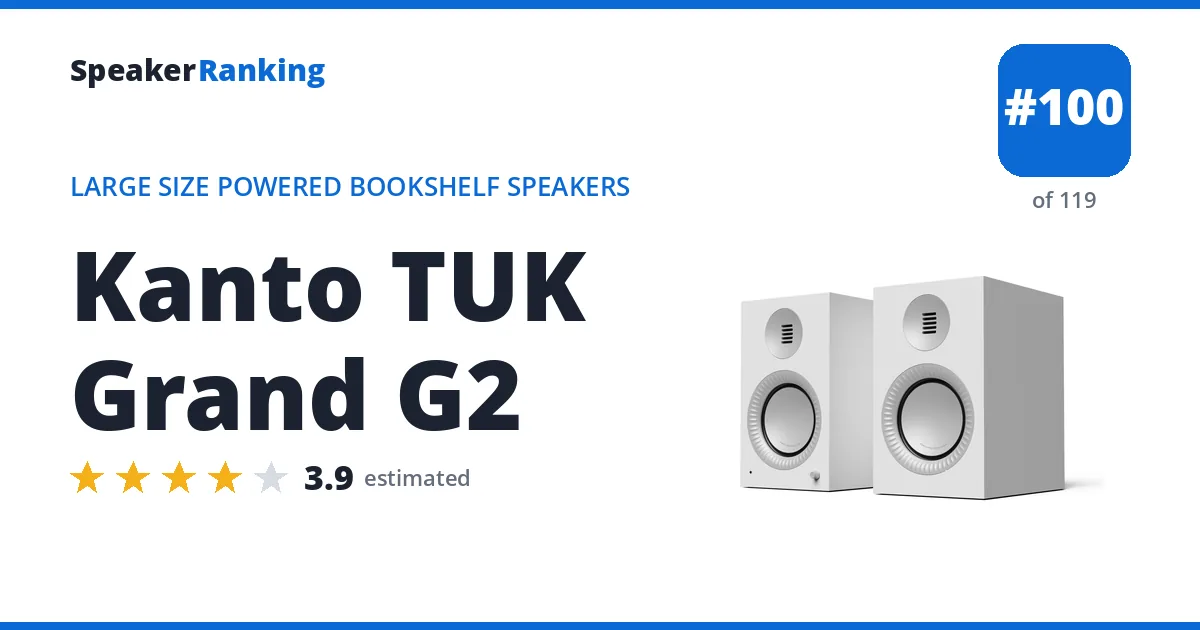
Same family: the Kanto YU4 G2 (smaller bookshelf, estimated 3.6/5), the Kanto YU6 G2 (smaller bookshelf, ranked higher, estimated 3.9/5) and the Kanto Tuk G2 (smaller bookshelf, rated 3.9/5). See every Kanto YU and Tuk generation.
Pros: A bigger Kanto Tuk G2 with a 6” Aircomb aluminum woofer and an AMT tweeter driven by 160W RMS, rated to 40Hz. Bluetooth 5.4, optical, USB-C, RCA with a phono preamp and a subwoofer output make it a complete desktop or shelf system.
Cons: No independent measurements yet, so its tonal balance and directivity can’t be compared with ranked speakers. Its larger cabinet needs more desk space than the Tuk G2, and a passive version without amplification is sold separately.
Full Kanto TUK Grand G2 review and specifications →
| Released | 2026 (this year) |
|---|---|
| Amplifier Power | 160W RMS (320W peak) |
| Bluetooth | Yes |
| Bluetooth Codecs | SBC, AAC, aptX Adaptive |
| Dimensions | 13.8”H x 8.6”W x 11.6”D (351 x 218 x 295 mm) |
| Drivers | 1x 28mm x 35mm AMT tweeter, 1x 6” Aircomb aluminum woofer |
| Frequency Response | 40Hz - 22kHz (manufacturer specified) |
| Impedance | 4 ohms nominal (passive version) |
| Weight | 17.2 lbs (7.8 kg) (active) |
- Links
- Reviews, Comparisons and Sound Samples
- No independent measurement review is linked for this model; it is ranked from hands-on listening and comparison against similarly priced speakers.
- Head-to-Head Comparisons
Headphones
Over-Ear Headphones
 Ranked #25 of 455 in Over-Ear Headphones - Edifier Stax Spirit S3: $514.55 Wireless Amazon $514.55 eBay
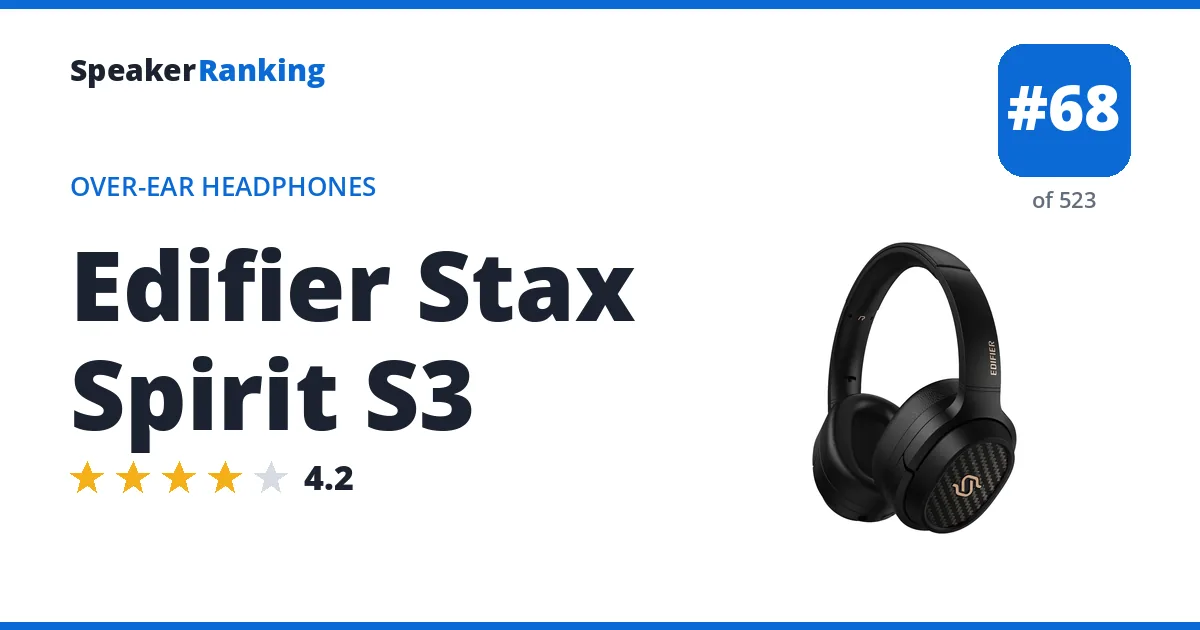
Pros: This is a rare wireless planar magnetic headphone, with Bluetooth 5.2, aptX Adaptive and aptX HD support, a built in microphone and a claimed 80 hours of battery life. The median of six hobbyist measurements on squig.link yields a preference score of 89 with a gently warm tilt, and bass holds to within about 2 dB of target at 30 Hz. The closed back keeps sound in, making it usable in offices and on transit.
Cons: Those measurements show a 6.8 dB dip near 6.9 kHz and the 6 to 10 kHz band sits about 3 dB low, so cymbals and sibilance come across dulled and less detailed. There is no active noise cancelling, and at 329 grams it is on the heavy side for a wireless headphone.
Full Edifier Stax Spirit S3 review and specifications →
| Released | Jun 2022 (4 years ago) |
|---|---|
| Active Noise Cancelling | No |
| Back | Closed |
| Battery Life | 80 hours (Manufacturer specified) |
| Bluetooth Codecs | SBC, aptX, aptX HD, aptX Adaptive |
| Bluetooth Version | 5.2 |
| Built-in Microphone | Yes |
| Connection | Wireless and wired |
| Deviation From Target | 1.62 dB standard deviation |
| Driver Type | Planar magnetic |
| Drivers | 1 x 89x70mm planar magnetic |
| Form Factor | Over-ear |
| Frequency Response | 20Hz - 40kHz (Manufacturer specified) |
| Harman Preference Score | 89 (median of 6 squig.link measurements, calibrated to AutoEQ) |
| Impedance | 24 ohms |
| Sensitivity | 94 dB SPL(A) |
| Sub-bass Extension | Within 6 dB of target down to 20 Hz (-1.9 dB at 30 Hz) |
| Tonal Tilt | -0.20 (negative is warmer, positive brighter) |
| Weight | 0.7 lbs (329 g) |
EQ Presets
Neutral target
Set a preamp of -1.3 dB, then add these filters in any parametric equalizer (Wavelet, Equalizer APO, Peace, or a player with parametric EQ). Calculated by Speaker Ranking from the median of 6 squig.link measurements, in the filter layout AutoEQ uses. Predicted Neutral match with this EQ: 91 out of 100, up from 71.
| Filter | Frequency | Gain | Q |
|---|---|---|---|
| Low shelf | 105 Hz | -3.8 dB | 0.70 |
| High shelf | 10,000 Hz | -5.5 dB | 0.70 |
| Peak | 133 Hz | -1.9 dB | 1.07 |
| Peak | 470 Hz | +1.4 dB | 2.12 |
| Peak | 2,712 Hz | -2.7 dB | 2.42 |
| Peak | 6,985 Hz | +2.0 dB | 1.99 |
Studio flat target
Set a preamp of -2.1 dB, then add these filters in any parametric equalizer (Wavelet, Equalizer APO, Peace, or a player with parametric EQ). Calculated by Speaker Ranking from the median of 6 squig.link measurements, in the filter layout AutoEQ uses. Predicted Studio flat match with this EQ: 93 out of 100, up from 44.
| Filter | Frequency | Gain | Q |
|---|---|---|---|
| Low shelf | 105 Hz | -5.7 dB | 0.70 |
| High shelf | 10,000 Hz | +0.7 dB | 0.70 |
| Peak | 166 Hz | -3.6 dB | 0.82 |
| Peak | 1,950 Hz | +1.6 dB | 6.00 |
| Peak | 4,310 Hz | -1.7 dB | 6.00 |
| Peak | 6,734 Hz | +1.4 dB | 0.40 |
Warm target
Set a preamp of -2.2 dB, then add these filters in any parametric equalizer (Wavelet, Equalizer APO, Peace, or a player with parametric EQ). Calculated by Speaker Ranking from the median of 6 squig.link measurements, in the filter layout AutoEQ uses. Predicted Warm match with this EQ: 96 out of 100, up from 88.
| Filter | Frequency | Gain | Q |
|---|---|---|---|
| Low shelf | 105 Hz | +2.1 dB | 0.70 |
| High shelf | 10,000 Hz | -6.0 dB | 0.70 |
| Peak | 2,839 Hz | -3.9 dB | 1.70 |
| Peak | 6,916 Hz | +2.0 dB | 3.52 |
Bass target
Set a preamp of -5.5 dB, then add these filters in any parametric equalizer (Wavelet, Equalizer APO, Peace, or a player with parametric EQ). Calculated by Speaker Ranking from the median of 6 squig.link measurements, in the filter layout AutoEQ uses. Predicted Bass match with this EQ: 92 out of 100, up from 83.
| Filter | Frequency | Gain | Q |
|---|---|---|---|
| Low shelf | 105 Hz | +5.4 dB | 0.70 |
| High shelf | 10,000 Hz | -5.5 dB | 0.70 |
| Peak | 155 Hz | -1.9 dB | 1.55 |
| Peak | 479 Hz | +1.3 dB | 2.12 |
| Peak | 2,711 Hz | -2.7 dB | 2.41 |
| Peak | 6,993 Hz | +2.0 dB | 1.99 |
Bright target
Set a preamp of -5.2 dB, then add these filters in any parametric equalizer (Wavelet, Equalizer APO, Peace, or a player with parametric EQ). Calculated by Speaker Ranking from the median of 6 squig.link measurements, in the filter layout AutoEQ uses. Predicted Bright match with this EQ: 79 out of 100, up from 50.
| Filter | Frequency | Gain | Q |
|---|---|---|---|
| Low shelf | 105 Hz | -3.8 dB | 0.70 |
| High shelf | 10,000 Hz | -2.3 dB | 0.70 |
| Peak | 132 Hz | -1.9 dB | 1.02 |
| Peak | 2,662 Hz | -2.2 dB | 3.03 |
| Peak | 5,724 Hz | +5.4 dB | 2.81 |
- Links
- Reviews, Comparisons and Sound Samples
- Head-to-Head Comparisons
 Ranked #170 of 455 in Over-Ear Headphones - Focal Bathys: $799.00 Wireless Amazon $799.00 eBay
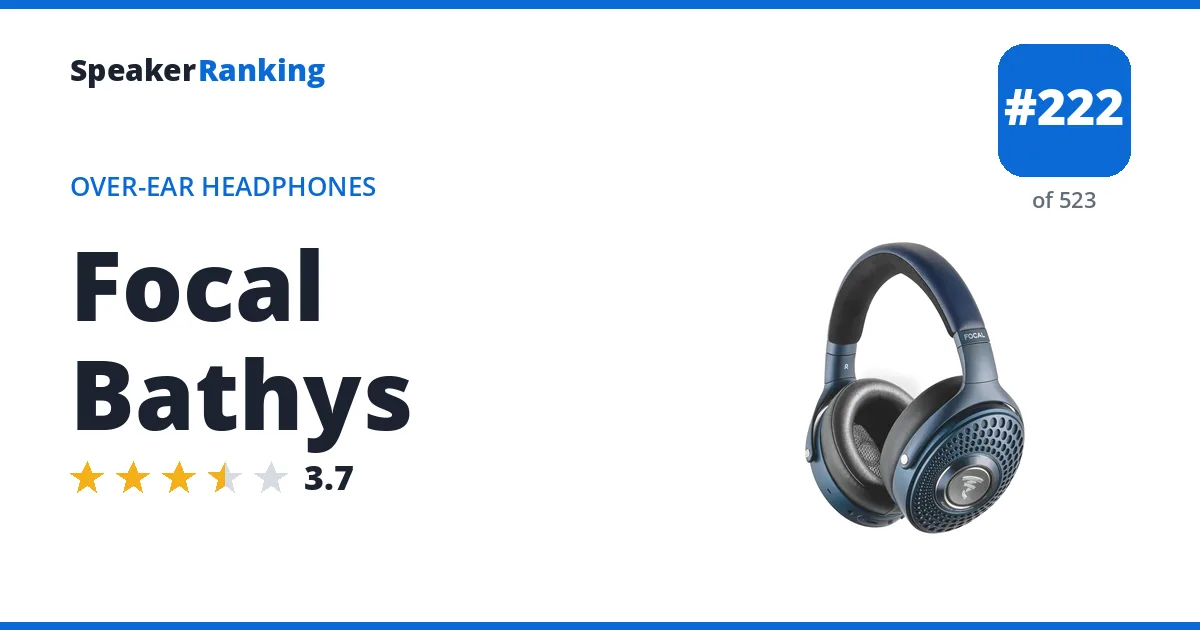
Pros: Bluetooth 5.1 with SBC, AAC, aptX and aptX Adaptive, active noise cancelling and a rated 30 hours of battery make it a full wireless travel headphone, and a wired connection is still available. Bass is slightly boosted, about 1 dB at sub-bass and 2 dB from 60 to 200 Hz, for a warm, punchy low end. The 2.0 dB deviation is smooth, and a 76 preference score is respectable for a wireless model.
Cons: A 6.3 dB dip near 9.4 kHz and mild treble reduction soften cymbals and sibilance. The tilt is on the warm side, so brightness and detail are subdued. The HIFIMAN Audivina holds a higher rating for a lower price, though the Bathys is the one with ANC and a battery.
Full Focal Bathys review and specifications →
| Released | Oct 2022 (4 years ago) |
|---|---|
| Active Noise Cancelling | Yes |
| Back | Closed |
| Battery Life | 30 hours (Manufacturer specified) |
| Bluetooth Codecs | SBC, AAC, aptX, aptX Adaptive |
| Bluetooth Version | 5.1 |
| Built-in Microphone | Yes |
| Connection | Wireless and wired |
| Deviation From Target | 2.04 dB standard deviation |
| Driver Type | Dynamic |
| Drivers | 1 x 40mm dynamic |
| Form Factor | Over-ear |
| Harman Preference Score | 76 (measured by oratory1990, via AutoEQ) |
| Impedance | 80 ohms |
| Sensitivity | 104 dB SPL/mW |
| Sub-bass Extension | Within 6 dB of target down to 20 Hz (-0.1 dB at 30 Hz) |
| Tonal Tilt | -0.84 (negative is warmer, positive brighter) |
| Weight | 0.8 lbs (350 g) |
EQ Presets
Harman target
Set a preamp of -3.9 dB, then add these filters in any parametric equalizer (Wavelet, Equalizer APO, Peace, or a player with parametric EQ). Calculated by AutoEQ from its measured frequency response. Predicted Harman match with this EQ: 100 out of 100, up from 76.
| Filter | Frequency | Gain | Q |
|---|---|---|---|
| Low shelf | 105 Hz | -0.3 dB | 0.70 |
| Peak | 642 Hz | -3.5 dB | 0.24 |
| Peak | 831 Hz | +7.1 dB | 1.99 |
| Peak | 4,157 Hz | +3.6 dB | 1.67 |
| Peak | 2,185 Hz | +4.3 dB | 3.03 |
| High shelf | 10,000 Hz | +0.7 dB | 0.70 |
| Peak | 86 Hz | -0.3 dB | 0.96 |
| Peak | 199 Hz | +0.5 dB | 1.78 |
| Peak | 2,995 Hz | -0.6 dB | 4.09 |
| Peak | 381 Hz | -0.4 dB | 2.53 |
Neutral target
Set a preamp of -3.6 dB, then add these filters in any parametric equalizer (Wavelet, Equalizer APO, Peace, or a player with parametric EQ). Calculated by Speaker Ranking from AutoEQ’s measurement, in the filter layout AutoEQ uses. Predicted Neutral match with this EQ: 97 out of 100, up from 52.
| Filter | Frequency | Gain | Q |
|---|---|---|---|
| Low shelf | 105 Hz | -6.7 dB | 0.70 |
| Peak | 329 Hz | -3.6 dB | 1.02 |
| Peak | 835 Hz | +4.3 dB | 4.25 |
| Peak | 1,303 Hz | -2.2 dB | 3.88 |
| Peak | 2,270 Hz | +2.5 dB | 6.00 |
| Peak | 3,978 Hz | +2.8 dB | 3.19 |
Studio flat target
Set a preamp of -5.1 dB, then add these filters in any parametric equalizer (Wavelet, Equalizer APO, Peace, or a player with parametric EQ). Calculated by Speaker Ranking from AutoEQ’s measurement, in the filter layout AutoEQ uses. Predicted Studio flat match with this EQ: 94 out of 100, up from 18.
| Filter | Frequency | Gain | Q |
|---|---|---|---|
| Low shelf | 105 Hz | -8.6 dB | 0.70 |
| High shelf | 10,000 Hz | +2.0 dB | 0.70 |
| Peak | 126 Hz | -2.1 dB | 1.10 |
| Peak | 350 Hz | -5.2 dB | 0.77 |
| Peak | 817 Hz | +4.7 dB | 3.80 |
| Peak | 1,319 Hz | -2.3 dB | 4.78 |
| Peak | 2,502 Hz | +5.1 dB | 1.85 |
| Peak | 3,898 Hz | +3.1 dB | 6.00 |
Warm target
Set a preamp of -3.9 dB, then add these filters in any parametric equalizer (Wavelet, Equalizer APO, Peace, or a player with parametric EQ). Calculated by Speaker Ranking from AutoEQ’s measurement, in the filter layout AutoEQ uses. Predicted Warm match with this EQ: 99 out of 100, up from 89.
| Filter | Frequency | Gain | Q |
|---|---|---|---|
| Low shelf | 105 Hz | -0.8 dB | 0.70 |
| High shelf | 10,000 Hz | -3.8 dB | 0.70 |
| Peak | 329 Hz | -3.1 dB | 0.75 |
| Peak | 732 Hz | +2.3 dB | 4.50 |
| Peak | 857 Hz | +4.0 dB | 6.00 |
| Peak | 6,949 Hz | -2.6 dB | 2.27 |
Bass target
Set a preamp of -3.7 dB, then add these filters in any parametric equalizer (Wavelet, Equalizer APO, Peace, or a player with parametric EQ). Calculated by Speaker Ranking from AutoEQ’s measurement, in the filter layout AutoEQ uses. Predicted Bass match with this EQ: 98 out of 100, up from 84.
| Filter | Frequency | Gain | Q |
|---|---|---|---|
| Low shelf | 105 Hz | +2.8 dB | 0.70 |
| Peak | 329 Hz | -3.7 dB | 1.07 |
| Peak | 836 Hz | +4.3 dB | 4.35 |
| Peak | 1,303 Hz | -2.2 dB | 3.87 |
| Peak | 2,271 Hz | +2.5 dB | 6.00 |
| Peak | 3,977 Hz | +2.8 dB | 3.22 |
Bright target
Set a preamp of -4.6 dB, then add these filters in any parametric equalizer (Wavelet, Equalizer APO, Peace, or a player with parametric EQ). Calculated by Speaker Ranking from AutoEQ’s measurement, in the filter layout AutoEQ uses. Predicted Bright match with this EQ: 88 out of 100, up from 32.
| Filter | Frequency | Gain | Q |
|---|---|---|---|
| Low shelf | 105 Hz | -6.8 dB | 0.70 |
| High shelf | 10,000 Hz | +1.7 dB | 0.70 |
| Peak | 329 Hz | -3.6 dB | 0.95 |
| Peak | 832 Hz | +4.3 dB | 4.47 |
| Peak | 1,321 Hz | -2.3 dB | 3.63 |
| Peak | 2,262 Hz | +1.8 dB | 6.00 |
| Peak | 4,321 Hz | +4.5 dB | 1.39 |
V-shaped target
Set a preamp of -5.2 dB, then add these filters in any parametric equalizer (Wavelet, Equalizer APO, Peace, or a player with parametric EQ). Calculated by Speaker Ranking from AutoEQ’s measurement, in the filter layout AutoEQ uses. Predicted V-shaped match with this EQ: 86 out of 100, up from 66.
| Filter | Frequency | Gain | Q |
|---|---|---|---|
| Low shelf | 105 Hz | +3.5 dB | 0.70 |
| High shelf | 10,000 Hz | +1.9 dB | 0.70 |
| Peak | 373 Hz | -2.6 dB | 1.04 |
| Peak | 847 Hz | +3.0 dB | 6.00 |
| Peak | 1,313 Hz | -2.6 dB | 4.31 |
| Peak | 2,262 Hz | +2.1 dB | 6.00 |
| Peak | 3,054 Hz | -1.6 dB | 6.00 |
| Peak | 4,321 Hz | +5.1 dB | 1.25 |
- Links
- Reviews, Comparisons and Sound Samples
- Head-to-Head Comparisons
 Ranked #187 of 455 in Over-Ear Headphones - Edifier STAX Spirit S5: $569.99 Wireless Amazon $569.99 eBay
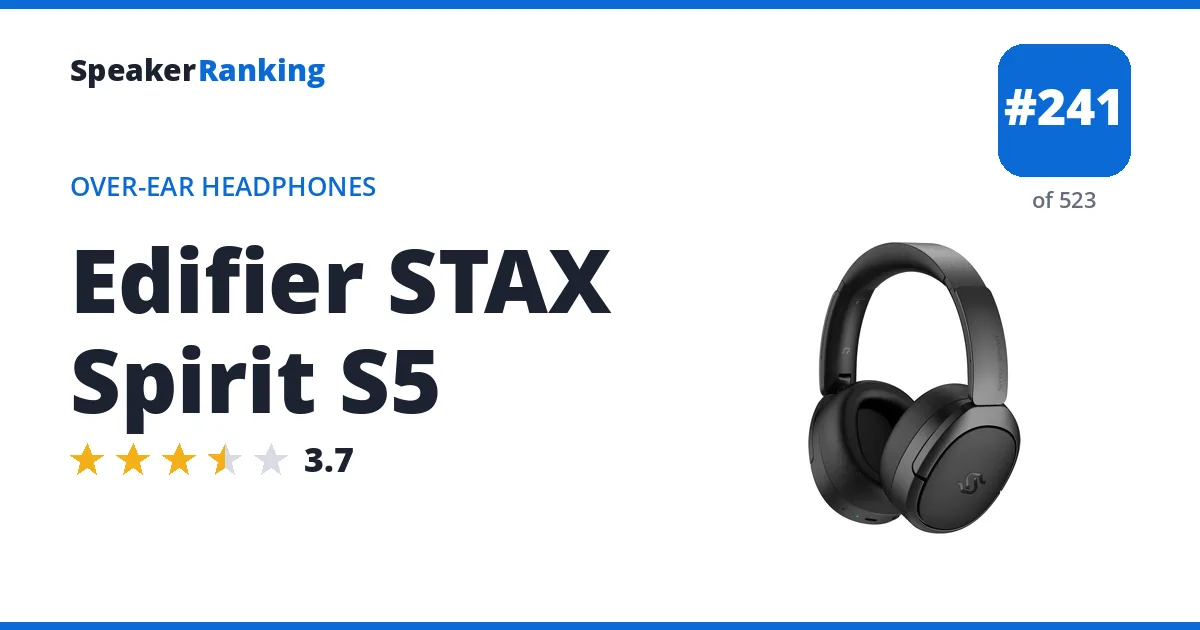
Pros: A planar magnetic headphone that works wirelessly, with an 80 hour rated battery, Bluetooth 5.4 and an unusually broad codec list including LDAC, aptX Lossless, aptX Adaptive and LHDC, plus a wired option. Its preference score of 75 in squig.link hobbyist measurements reflects a fairly even response, with sub-bass right on target and extension held within 6 dB down to 20 Hz. Mid-bass sits about 3 dB above target, giving a punchy, slightly V-shaped presentation that bass fans enjoy.
Cons: There is no active noise cancelling, so the closed back is the only defense against commuter noise. A 7.8 dB peak near 8.7 kHz and air about 3 dB above target can make cymbals and sibilance sound splashy on bright recordings. At 347 g it is on the heavier side for a wireless headphone.
Full Edifier STAX Spirit S5 review and specifications →
| Released | Jul 2024 (2 years ago) |
|---|---|
| Active Noise Cancelling | No |
| Back | Closed |
| Battery Life | 80 hours (Manufacturer specified) |
| Bluetooth Codecs | SBC, AAC, LDAC, aptX, aptX HD, aptX Adaptive, aptX Lossless, LHDC |
| Bluetooth Version | 5.4 |
| Connection | Wireless and wired |
| Deviation From Target | 2.72 dB standard deviation |
| Driver Type | Planar magnetic |
| Form Factor | Over-ear |
| Frequency Response | 10Hz - 40kHz (Manufacturer specified) |
| Harman Preference Score | 75 (median of 2 squig.link measurements, calibrated to AutoEQ) |
| Sub-bass Extension | Within 6 dB of target down to 20 Hz (+1.9 dB at 30 Hz) |
| Tonal Tilt | -0.26 (negative is warmer, positive brighter) |
| Weight | 0.8 lbs (347 g) |
- Links
- Reviews, Comparisons and Sound Samples
 Ranked #252 of 455 in Over-Ear Headphones - Sennheiser ACCENTUM Plus: $129.95 Wireless Amazon $129.95 eBay
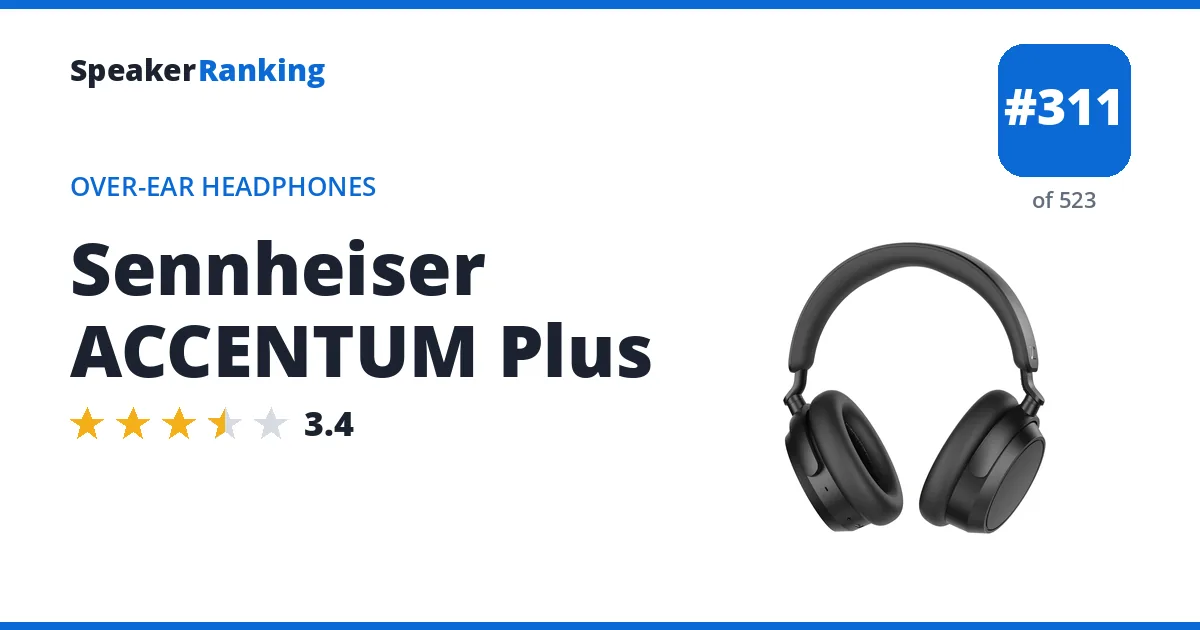
Same family: the Sennheiser ACCENTUM (lower-end model, ranked lower, rated 2.9/5).
Pros: A 50 hour battery, active noise cancelling and a light 227 g body make this an easy all day travel headphone. Bluetooth 5.2 with SBC, AAC, aptX and aptX Adaptive covers most phones, and a built-in microphone handles calls. Bass is strong, with sub-bass about 7.4 dB above target, so electronic and pop tracks have plenty of weight.
Cons: The bass boost runs about 7.4 dB in the sub-bass and 3.8 dB in the upper bass, which can thicken vocals and mask detail. A 4.1 dB peak near 11.4 kHz adds some treble sizzle, and a 6.5 dB dip near 4.4 kHz pulls back vocal clarity. It has no weather rating, and the AKG K361 has a higher rating for less money if wireless is not needed.
Full Sennheiser ACCENTUM Plus review and specifications →
| Released | Feb 2024 (2 years ago) |
|---|---|
| Active Noise Cancelling | Yes |
| Back | Closed |
| Battery Life | 50 hours (Manufacturer specified) |
| Bluetooth Codecs | SBC, AAC, aptX, aptX Adaptive |
| Bluetooth Version | 5.2 |
| Built-in Microphone | Yes |
| Connection | Wireless and wired |
| Deviation From Target | 2.36 dB standard deviation |
| Driver Type | Dynamic |
| Drivers | 1 x 37mm dynamic |
| Form Factor | Over-ear |
| Frequency Response | 10Hz - 22kHz (Manufacturer specified) |
| Harman Preference Score | 68 (measured by oratory1990, via AutoEQ) |
| IP Rating | None |
| Sensitivity | 106 dB SPL |
| Sub-bass Extension | Within 6 dB of target down to 20 Hz (+6.9 dB at 30 Hz) |
| Tonal Tilt | -1.07 (negative is warmer, positive brighter) |
| Weight | 0.5 lbs (227 g) |
EQ Presets
Harman target
Set a preamp of -4.3 dB, then add these filters in any parametric equalizer (Wavelet, Equalizer APO, Peace, or a player with parametric EQ). Calculated by AutoEQ from its measured frequency response. Predicted Harman match with this EQ: 100 out of 100, up from 68.
| Filter | Frequency | Gain | Q |
|---|---|---|---|
| Low shelf | 105 Hz | -6.0 dB | 0.70 |
| Peak | 245 Hz | -1.8 dB | 1.27 |
| Peak | 1,884 Hz | +3.4 dB | 1.83 |
| Peak | 4,135 Hz | +4.7 dB | 4.12 |
| Peak | 2,934 Hz | -3.2 dB | 3.46 |
| High shelf | 10,000 Hz | -4.5 dB | 0.70 |
| Peak | 87 Hz | +2.3 dB | 2.24 |
| Peak | 146 Hz | -1.2 dB | 2.10 |
| Peak | 817 Hz | +0.8 dB | 3.06 |
| Peak | 5,714 Hz | -1.3 dB | 5.18 |
Neutral target
Set a preamp of -5.2 dB, then add these filters in any parametric equalizer (Wavelet, Equalizer APO, Peace, or a player with parametric EQ). Calculated by Speaker Ranking from AutoEQ’s measurement, in the filter layout AutoEQ uses. Predicted Neutral match with this EQ: 100 out of 100, up from 39.
| Filter | Frequency | Gain | Q |
|---|---|---|---|
| Low shelf | 105 Hz | -11.5 dB | 0.70 |
| High shelf | 10,000 Hz | -5.3 dB | 0.70 |
| Peak | 152 Hz | -1.2 dB | 3.34 |
| Peak | 290 Hz | -2.6 dB | 0.69 |
| Peak | 1,860 Hz | +2.6 dB | 3.35 |
| Peak | 2,978 Hz | -3.4 dB | 6.00 |
| Peak | 4,277 Hz | +6.0 dB | 6.00 |
| Peak | 5,795 Hz | -2.6 dB | 6.00 |
Studio flat target
Set a preamp of -6.0 dB, then add these filters in any parametric equalizer (Wavelet, Equalizer APO, Peace, or a player with parametric EQ). Calculated by Speaker Ranking from AutoEQ’s measurement, in the filter layout AutoEQ uses. Predicted Studio flat match with this EQ: 100 out of 100, up from 9.
| Filter | Frequency | Gain | Q |
|---|---|---|---|
| Low shelf | 105 Hz | -11.9 dB | 0.70 |
| High shelf | 10,000 Hz | +1.4 dB | 0.70 |
| Peak | 92 Hz | +1.7 dB | 4.11 |
| Peak | 182 Hz | -4.5 dB | 0.54 |
| Peak | 389 Hz | -1.5 dB | 1.75 |
| Peak | 1,978 Hz | +5.2 dB | 2.98 |
| Peak | 4,167 Hz | +6.0 dB | 4.50 |
| Peak | 5,843 Hz | -3.4 dB | 5.04 |
Warm target
Set a preamp of -1.7 dB, then add these filters in any parametric equalizer (Wavelet, Equalizer APO, Peace, or a player with parametric EQ). Calculated by Speaker Ranking from AutoEQ’s measurement, in the filter layout AutoEQ uses. Predicted Warm match with this EQ: 100 out of 100, up from 80.
| Filter | Frequency | Gain | Q |
|---|---|---|---|
| Low shelf | 105 Hz | -6.7 dB | 0.70 |
| High shelf | 10,000 Hz | -6.0 dB | 0.70 |
| Peak | 24 Hz | -1.5 dB | 1.77 |
| Peak | 85 Hz | +2.2 dB | 3.03 |
| Peak | 220 Hz | -2.6 dB | 1.05 |
| Peak | 389 Hz | -0.9 dB | 2.08 |
| Peak | 1,856 Hz | +2.0 dB | 4.12 |
| Peak | 2,946 Hz | -4.6 dB | 5.68 |
| Peak | 4,277 Hz | +3.3 dB | 6.00 |
| Peak | 6,162 Hz | -4.1 dB | 2.13 |
Bass target
Set a preamp of -5.2 dB, then add these filters in any parametric equalizer (Wavelet, Equalizer APO, Peace, or a player with parametric EQ). Calculated by Speaker Ranking from AutoEQ’s measurement, in the filter layout AutoEQ uses. Predicted Bass match with this EQ: 100 out of 100, up from 83.
| Filter | Frequency | Gain | Q |
|---|---|---|---|
| Low shelf | 105 Hz | -3.1 dB | 0.70 |
| High shelf | 10,000 Hz | -5.3 dB | 0.70 |
| Peak | 24 Hz | -1.4 dB | 1.92 |
| Peak | 83 Hz | +2.3 dB | 2.71 |
| Peak | 220 Hz | -2.9 dB | 1.02 |
| Peak | 389 Hz | -1.0 dB | 1.71 |
| Peak | 1,878 Hz | +2.6 dB | 3.90 |
| Peak | 2,978 Hz | -3.4 dB | 6.00 |
| Peak | 4,277 Hz | +6.0 dB | 6.00 |
| Peak | 5,795 Hz | -2.6 dB | 6.00 |
Bright target
Set a preamp of -6.1 dB, then add these filters in any parametric equalizer (Wavelet, Equalizer APO, Peace, or a player with parametric EQ). Calculated by Speaker Ranking from AutoEQ’s measurement, in the filter layout AutoEQ uses. Predicted Bright match with this EQ: 100 out of 100, up from 22.
| Filter | Frequency | Gain | Q |
|---|---|---|---|
| Low shelf | 105 Hz | -11.6 dB | 0.70 |
| High shelf | 10,000 Hz | -1.5 dB | 0.70 |
| Peak | 152 Hz | -1.2 dB | 3.40 |
| Peak | 290 Hz | -2.7 dB | 0.70 |
| Peak | 1,873 Hz | +2.6 dB | 3.18 |
| Peak | 2,962 Hz | -2.8 dB | 6.00 |
| Peak | 4,380 Hz | +6.0 dB | 3.15 |
| Peak | 7,482 Hz | +2.0 dB | 3.24 |
V-shaped target
Set a preamp of -6.0 dB, then add these filters in any parametric equalizer (Wavelet, Equalizer APO, Peace, or a player with parametric EQ). Calculated by Speaker Ranking from AutoEQ’s measurement, in the filter layout AutoEQ uses. Predicted V-shaped match with this EQ: 88 out of 100, up from 67.
| Filter | Frequency | Gain | Q |
|---|---|---|---|
| Low shelf | 105 Hz | -2.5 dB | 0.70 |
| Peak | 84 Hz | +2.4 dB | 3.43 |
| Peak | 1,902 Hz | +3.0 dB | 4.99 |
| Peak | 2,959 Hz | -2.8 dB | 6.00 |
| Peak | 4,396 Hz | +6.0 dB | 2.58 |
- Links
- Reviews, Comparisons and Sound Samples
- Head-to-Head Comparisons
 Ranked #300 of 455 in Over-Ear Headphones - Bang & Olufsen Beoplay H95: $1,250.00 Wireless Amazon $1,250.00 eBay
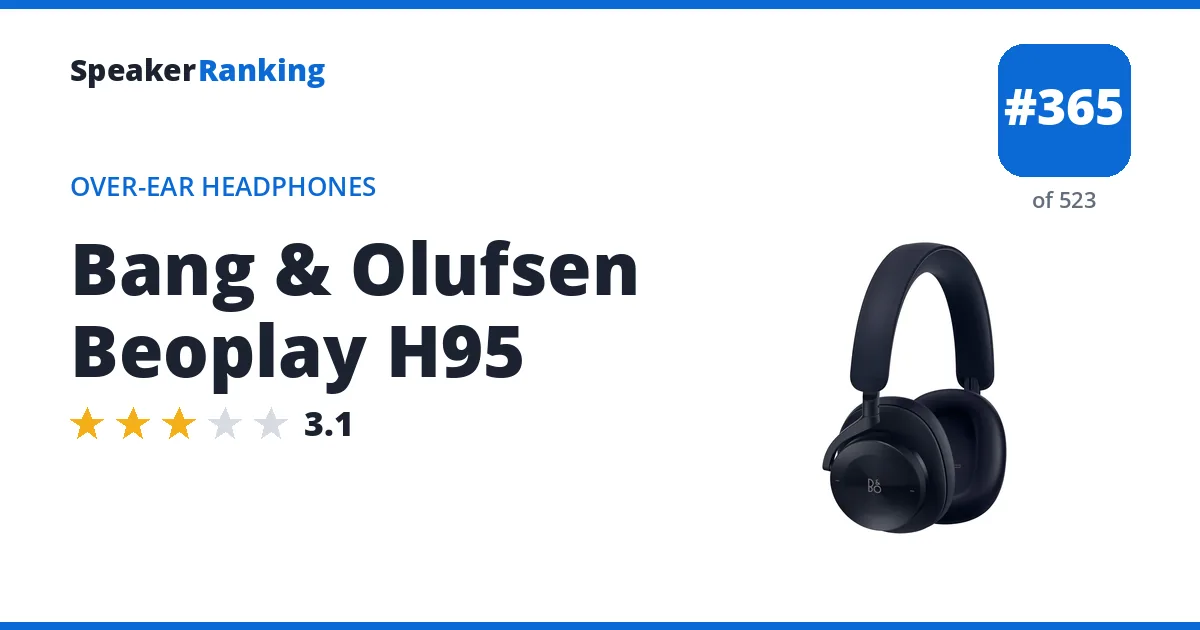
Pros: A full-featured wireless ANC headphone with aptX Adaptive, AAC and SBC, Bluetooth 5.1, a built-in microphone, a wired option and a rated 38 hours of battery (50 without ANC). Sub-bass sits about 6 dB over target and the upper bass about 3 dB over, so low notes have weight and warmth. The midrange stays close to target, within about 2 dB, and the overall curve is fairly smooth for a wireless model.
Cons: Treble is erratic, with a 9.6 dB peak near 11.9 kHz and a 6.7 dB dip near 10 kHz, which makes the top end uneven and slightly hot in places. The bass boost and a 1.9 dB lift in the low mids can make male vocals and bass guitar a little thick. At 323 g and a very high price, it asks a lot for sound that scores only 62 on the Harman preference scale.
Full Bang & Olufsen Beoplay H95 review and specifications →
| Released | Sep 2020 (6 years ago) |
|---|---|
| Active Noise Cancelling | Yes |
| Back | Closed |
| Battery Life | 38 hours (50 without ANC, Manufacturer specified) |
| Bluetooth Codecs | SBC, AAC, aptX Adaptive |
| Bluetooth Version | 5.1 |
| Built-in Microphone | Yes |
| Connection | Wireless and wired |
| Deviation From Target | 2.65 dB standard deviation |
| Driver Type | Dynamic |
| Drivers | 1 x 40mm dynamic |
| Form Factor | Over-ear |
| Frequency Response | 20Hz - 22kHz (Manufacturer specified) |
| Harman Preference Score | 62 (measured by oratory1990, via AutoEQ) |
| Impedance | 12 ohms |
| Sensitivity | 101.5 dB/mW |
| Sub-bass Extension | Within 6 dB of target down to 20 Hz (+5.2 dB at 30 Hz) |
| Tonal Tilt | -1.22 (negative is warmer, positive brighter) |
| Weight | 0.7 lbs (323 g) |
EQ Presets
Harman target
Set a preamp of -3.6 dB, then add these filters in any parametric equalizer (Wavelet, Equalizer APO, Peace, or a player with parametric EQ). Calculated by AutoEQ from its measured frequency response. Predicted Harman match with this EQ: 97 out of 100, up from 62.
| Filter | Frequency | Gain | Q |
|---|---|---|---|
| Low shelf | 105 Hz | -4.5 dB | 0.70 |
| Peak | 252 Hz | -3.8 dB | 1.28 |
| Peak | 2,644 Hz | +2.2 dB | 0.56 |
| Peak | 61 Hz | -2.0 dB | 0.66 |
| Peak | 93 Hz | +5.1 dB | 2.32 |
| High shelf | 10,000 Hz | -8.8 dB | 0.70 |
| Peak | 9,731 Hz | +3.6 dB | 1.42 |
| Peak | 1,253 Hz | -2.3 dB | 2.36 |
| Peak | 842 Hz | +2.1 dB | 3.42 |
| Peak | 1,919 Hz | +2.1 dB | 3.99 |
Neutral target
Set a preamp of -3.2 dB, then add these filters in any parametric equalizer (Wavelet, Equalizer APO, Peace, or a player with parametric EQ). Calculated by Speaker Ranking from AutoEQ’s measurement, in the filter layout AutoEQ uses. Predicted Neutral match with this EQ: 94 out of 100, up from 35.
| Filter | Frequency | Gain | Q |
|---|---|---|---|
| Low shelf | 105 Hz | -11.4 dB | 0.70 |
| High shelf | 10,000 Hz | -6.0 dB | 0.70 |
| Peak | 94 Hz | +3.7 dB | 4.87 |
| Peak | 262 Hz | -4.5 dB | 1.47 |
| Peak | 1,253 Hz | -2.0 dB | 4.66 |
| Peak | 2,000 Hz | +2.3 dB | 5.44 |
| Peak | 3,201 Hz | -2.0 dB | 6.00 |
| Peak | 4,261 Hz | +1.8 dB | 0.49 |
Studio flat target
Set a preamp of -5.8 dB, then add these filters in any parametric equalizer (Wavelet, Equalizer APO, Peace, or a player with parametric EQ). Calculated by Speaker Ranking from AutoEQ’s measurement, in the filter layout AutoEQ uses. Predicted Studio flat match with this EQ: 89 out of 100, up from 4.
| Filter | Frequency | Gain | Q |
|---|---|---|---|
| Low shelf | 105 Hz | -11.9 dB | 0.70 |
| Peak | 93 Hz | +2.5 dB | 6.00 |
| Peak | 258 Hz | -6.3 dB | 1.04 |
| Peak | 2,293 Hz | +5.7 dB | 1.58 |
| Peak | 4,173 Hz | +3.7 dB | 6.00 |
Warm target
Set a preamp of -0.1 dB, then add these filters in any parametric equalizer (Wavelet, Equalizer APO, Peace, or a player with parametric EQ). Calculated by Speaker Ranking from AutoEQ’s measurement, in the filter layout AutoEQ uses. Predicted Warm match with this EQ: 91 out of 100, up from 76.
| Filter | Frequency | Gain | Q |
|---|---|---|---|
| Low shelf | 105 Hz | -5.6 dB | 0.70 |
| High shelf | 10,000 Hz | -6.0 dB | 0.70 |
| Peak | 259 Hz | -4.4 dB | 1.61 |
Bass target
Set a preamp of -3.2 dB, then add these filters in any parametric equalizer (Wavelet, Equalizer APO, Peace, or a player with parametric EQ). Calculated by Speaker Ranking from AutoEQ’s measurement, in the filter layout AutoEQ uses. Predicted Bass match with this EQ: 94 out of 100, up from 75.
| Filter | Frequency | Gain | Q |
|---|---|---|---|
| Low shelf | 105 Hz | -2.0 dB | 0.70 |
| High shelf | 10,000 Hz | -6.0 dB | 0.70 |
| Peak | 92 Hz | +4.1 dB | 4.10 |
| Peak | 261 Hz | -4.7 dB | 1.53 |
| Peak | 1,252 Hz | -2.0 dB | 4.63 |
| Peak | 2,000 Hz | +2.3 dB | 5.43 |
| Peak | 3,201 Hz | -2.0 dB | 6.00 |
| Peak | 4,273 Hz | +1.8 dB | 0.50 |
Bright target
Set a preamp of -4.4 dB, then add these filters in any parametric equalizer (Wavelet, Equalizer APO, Peace, or a player with parametric EQ). Calculated by Speaker Ranking from AutoEQ’s measurement, in the filter layout AutoEQ uses. Predicted Bright match with this EQ: 86 out of 100, up from 17.
| Filter | Frequency | Gain | Q |
|---|---|---|---|
| Low shelf | 105 Hz | -11.5 dB | 0.70 |
| High shelf | 10,000 Hz | -3.4 dB | 0.70 |
| Peak | 94 Hz | +3.7 dB | 4.74 |
| Peak | 265 Hz | -4.5 dB | 1.39 |
| Peak | 5,016 Hz | +4.4 dB | 0.86 |
V-shaped target
Set a preamp of -4.4 dB, then add these filters in any parametric equalizer (Wavelet, Equalizer APO, Peace, or a player with parametric EQ). Calculated by Speaker Ranking from AutoEQ’s measurement, in the filter layout AutoEQ uses. Predicted V-shaped match with this EQ: 88 out of 100, up from 58.
| Filter | Frequency | Gain | Q |
|---|---|---|---|
| Low shelf | 105 Hz | -1.3 dB | 0.70 |
| High shelf | 10,000 Hz | -2.0 dB | 0.70 |
| Peak | 93 Hz | +4.5 dB | 4.36 |
| Peak | 265 Hz | -3.2 dB | 1.41 |
| Peak | 2,014 Hz | +2.6 dB | 5.42 |
| Peak | 5,345 Hz | +4.4 dB | 0.66 |
- Links
- Reviews, Comparisons and Sound Samples
- Head-to-Head Comparisons
 Ranked #365 of 455 in Over-Ear Headphones - Bowers & Wilkins Px7 S2: $259.95 Wireless Discontinued Amazon $259.95 eBay
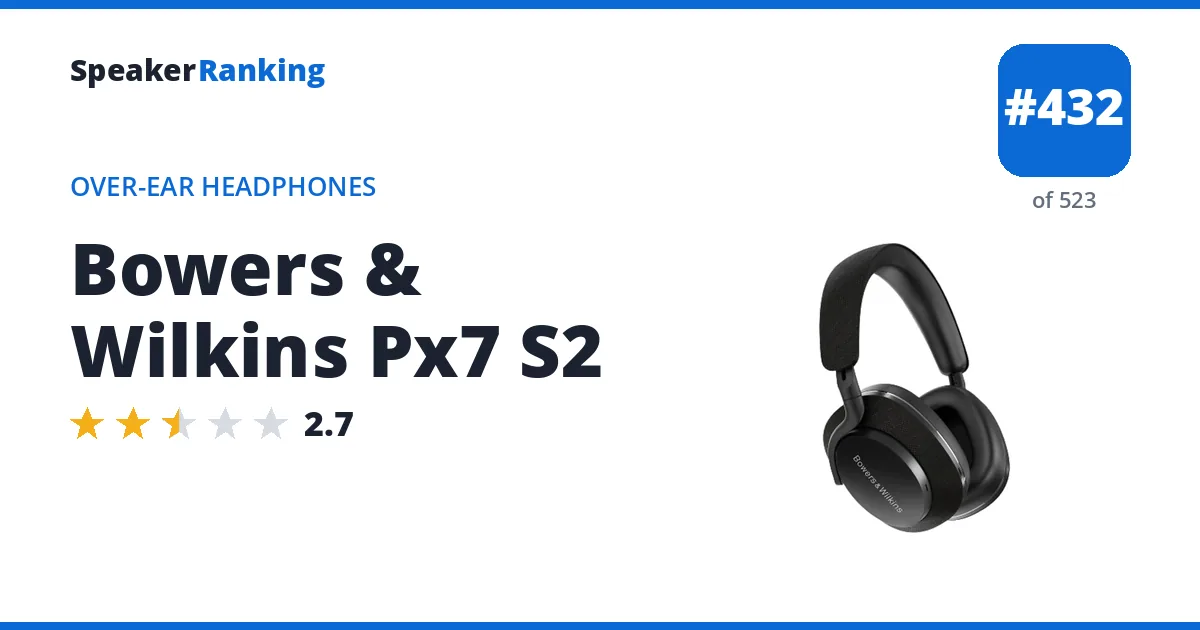
Newer model: the Bowers & Wilkins Px7 S2e, ranked lower, rated 2.7/5, released Sep 2023 (also discontinued). See every Bowers & Wilkins Px7 generation.
Same family: the Bowers & Wilkins Px8 (higher-end model, ranked lower, rated 2.6/5).
Pros: Wireless features are strong, with active noise cancelling, Bluetooth 5.2 and a wide codec list including aptX Adaptive and aptX HD, plus a built-in microphone and about 30 hours of battery life. Sub-bass is about 5 dB above target and bass about 7 dB above, which gives plenty of rumble for bass-heavy music. The midrange from 1 to 6 kHz stays within about 1 dB of target, so voices keep their natural place.
Cons: The bass boost is large enough to overwhelm the low mids on some tracks, and a peak of nearly 7 dB near 8.7 kHz plus treble about 4 dB hot adds a bright, splashy edge to cymbals. It weighs 307 g, on the heavier side for long wear. The Bowers & Wilkins Px7 S2e has an equal rating but a smoother response. Discontinued.
Full Bowers & Wilkins Px7 S2 review and specifications →
| Released | Jun 2022 (4 years ago) |
|---|---|
| Active Noise Cancelling | Yes |
| Back | Closed |
| Battery Life | 30 hours (Manufacturer specified) |
| Bluetooth Codecs | SBC, AAC, aptX, aptX HD, aptX Adaptive |
| Bluetooth Version | 5.2 |
| Built-in Microphone | Yes |
| Connection | Wireless and wired |
| Deviation From Target | 3.30 dB standard deviation |
| Driver Type | Dynamic |
| Drivers | 1 x 40mm dynamic |
| Form Factor | Over-ear |
| Frequency Response | 10Hz - 30kHz (Manufacturer specified) |
| Harman Preference Score | 53 (measured by oratory1990, via AutoEQ) |
| Sub-bass Extension | Within 6 dB of target down to 20 Hz (+5.3 dB at 30 Hz) |
| Tonal Tilt | -1.27 (negative is warmer, positive brighter) |
| Weight | 0.7 lbs (307 g) |
EQ Presets
Harman target
Set a preamp of -4.6 dB, then add these filters in any parametric equalizer (Wavelet, Equalizer APO, Peace, or a player with parametric EQ). Calculated by AutoEQ from its measured frequency response. Predicted Harman match with this EQ: 100 out of 100, up from 53.
| Filter | Frequency | Gain | Q |
|---|---|---|---|
| Low shelf | 105 Hz | -6.1 dB | 0.70 |
| Peak | 173 Hz | -7.1 dB | 0.55 |
| Peak | 2,124 Hz | +4.2 dB | 1.71 |
| Peak | 410 Hz | +4.7 dB | 0.65 |
| Peak | 50 Hz | +5.7 dB | 0.90 |
| High shelf | 10,000 Hz | +0.6 dB | 0.70 |
| Peak | 9,383 Hz | -2.8 dB | 2.33 |
| Peak | 5,503 Hz | +5.0 dB | 3.72 |
| Peak | 3,218 Hz | -2.1 dB | 5.97 |
| Peak | 6,714 Hz | -3.1 dB | 5.99 |
Neutral target
Set a preamp of -2.7 dB, then add these filters in any parametric equalizer (Wavelet, Equalizer APO, Peace, or a player with parametric EQ). Calculated by Speaker Ranking from AutoEQ’s measurement, in the filter layout AutoEQ uses. Predicted Neutral match with this EQ: 100 out of 100, up from 26.
| Filter | Frequency | Gain | Q |
|---|---|---|---|
| Low shelf | 105 Hz | -10.8 dB | 0.70 |
| High shelf | 10,000 Hz | -1.7 dB | 0.70 |
| Peak | 23 Hz | -1.3 dB | 2.48 |
| Peak | 49 Hz | +2.0 dB | 3.71 |
| Peak | 95 Hz | -1.3 dB | 4.30 |
| Peak | 152 Hz | -7.4 dB | 0.95 |
| Peak | 2,199 Hz | +2.8 dB | 3.24 |
| Peak | 3,322 Hz | -2.7 dB | 6.00 |
| Peak | 5,390 Hz | +2.8 dB | 6.00 |
| Peak | 7,513 Hz | -5.7 dB | 5.79 |
Studio flat target
Set a preamp of -5.8 dB, then add these filters in any parametric equalizer (Wavelet, Equalizer APO, Peace, or a player with parametric EQ). Calculated by Speaker Ranking from AutoEQ’s measurement, in the filter layout AutoEQ uses. Predicted Studio flat match with this EQ: 100 out of 100, up from -4.
| Filter | Frequency | Gain | Q |
|---|---|---|---|
| Low shelf | 105 Hz | -11.8 dB | 0.70 |
| High shelf | 10,000 Hz | +2.0 dB | 0.70 |
| Peak | 164 Hz | -9.0 dB | 0.85 |
| Peak | 2,258 Hz | +6.0 dB | 2.64 |
| Peak | 3,321 Hz | -1.7 dB | 6.00 |
| Peak | 5,378 Hz | +2.6 dB | 6.00 |
| Peak | 7,394 Hz | -4.8 dB | 4.82 |
Warm target
Set a preamp of -1.7 dB, then add these filters in any parametric equalizer (Wavelet, Equalizer APO, Peace, or a player with parametric EQ). Calculated by Speaker Ranking from AutoEQ’s measurement, in the filter layout AutoEQ uses. Predicted Warm match with this EQ: 100 out of 100, up from 63.
| Filter | Frequency | Gain | Q |
|---|---|---|---|
| Low shelf | 105 Hz | -5.1 dB | 0.70 |
| High shelf | 10,000 Hz | -5.3 dB | 0.70 |
| Peak | 23 Hz | -1.8 dB | 3.03 |
| Peak | 48 Hz | +2.4 dB | 3.15 |
| Peak | 99 Hz | -1.5 dB | 4.20 |
| Peak | 155 Hz | -7.3 dB | 1.07 |
| Peak | 2,194 Hz | +2.0 dB | 3.87 |
| Peak | 3,311 Hz | -4.2 dB | 5.79 |
| Peak | 5,476 Hz | +2.7 dB | 6.00 |
| Peak | 8,000 Hz | -7.0 dB | 1.78 |
Bass target
Set a preamp of -2.7 dB, then add these filters in any parametric equalizer (Wavelet, Equalizer APO, Peace, or a player with parametric EQ). Calculated by Speaker Ranking from AutoEQ’s measurement, in the filter layout AutoEQ uses. Predicted Bass match with this EQ: 99 out of 100, up from 67.
| Filter | Frequency | Gain | Q |
|---|---|---|---|
| Low shelf | 105 Hz | -1.5 dB | 0.70 |
| High shelf | 10,000 Hz | -1.7 dB | 0.70 |
| Peak | 23 Hz | -1.6 dB | 3.23 |
| Peak | 48 Hz | +2.6 dB | 2.96 |
| Peak | 100 Hz | -1.6 dB | 4.10 |
| Peak | 158 Hz | -7.5 dB | 1.06 |
| Peak | 2,202 Hz | +2.8 dB | 3.27 |
| Peak | 3,322 Hz | -2.7 dB | 6.00 |
| Peak | 5,390 Hz | +2.8 dB | 6.00 |
| Peak | 7,513 Hz | -5.7 dB | 5.77 |
Bright target
Set a preamp of -6.0 dB, then add these filters in any parametric equalizer (Wavelet, Equalizer APO, Peace, or a player with parametric EQ). Calculated by Speaker Ranking from AutoEQ’s measurement, in the filter layout AutoEQ uses. Predicted Bright match with this EQ: 100 out of 100, up from 11.
| Filter | Frequency | Gain | Q |
|---|---|---|---|
| Low shelf | 105 Hz | -10.9 dB | 0.70 |
| High shelf | 10,000 Hz | +1.6 dB | 0.70 |
| Peak | 48 Hz | +2.0 dB | 3.62 |
| Peak | 95 Hz | -1.3 dB | 4.25 |
| Peak | 152 Hz | -7.4 dB | 0.96 |
| Peak | 2,206 Hz | +3.0 dB | 3.51 |
| Peak | 3,220 Hz | -1.9 dB | 6.00 |
| Peak | 5,354 Hz | +6.0 dB | 4.55 |
| Peak | 7,595 Hz | -2.5 dB | 6.00 |
V-shaped target
Set a preamp of -6.1 dB, then add these filters in any parametric equalizer (Wavelet, Equalizer APO, Peace, or a player with parametric EQ). Calculated by Speaker Ranking from AutoEQ’s measurement, in the filter layout AutoEQ uses. Predicted V-shaped match with this EQ: 100 out of 100, up from 58.
| Filter | Frequency | Gain | Q |
|---|---|---|---|
| Low shelf | 105 Hz | -0.9 dB | 0.70 |
| High shelf | 10,000 Hz | +2.0 dB | 0.70 |
| Peak | 48 Hz | +2.5 dB | 3.02 |
| Peak | 152 Hz | -6.3 dB | 1.16 |
| Peak | 2,239 Hz | +3.5 dB | 3.43 |
| Peak | 3,231 Hz | -1.7 dB | 6.00 |
| Peak | 5,371 Hz | +6.0 dB | 3.30 |
- Reviews, Comparisons and Sound Samples
- Head-to-Head Comparisons
 Ranked #366 of 455 in Over-Ear Headphones - Bowers & Wilkins Px7 S2e: $339.10 Wireless Discontinued Amazon $339.10 eBay
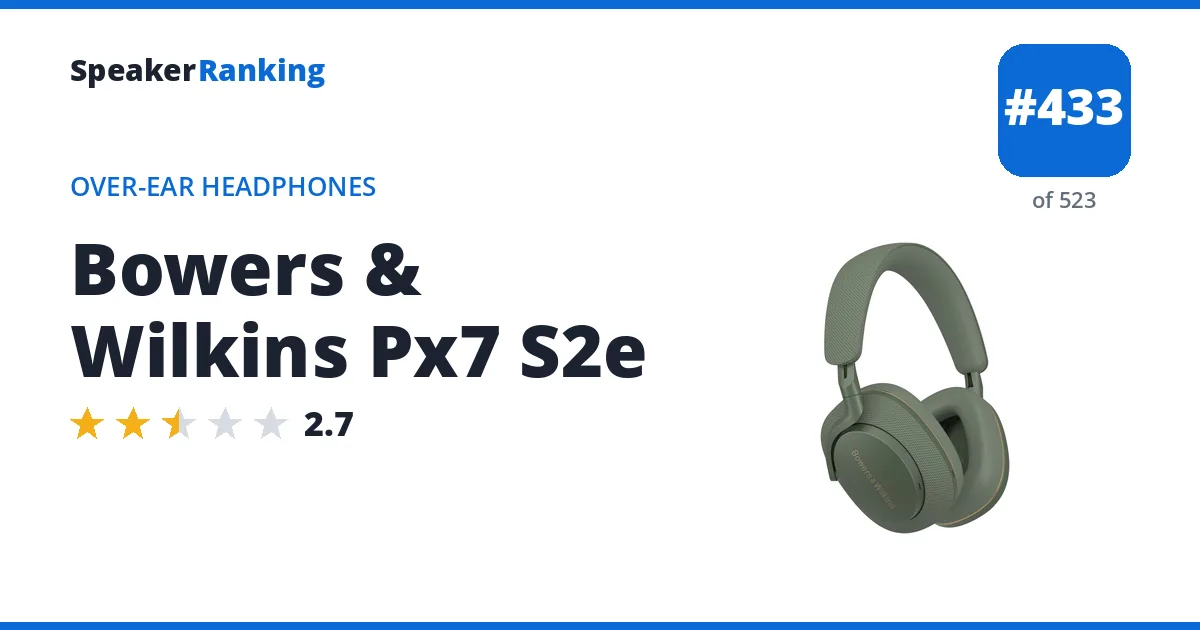
Older model: the Bowers & Wilkins Px7 S2 (ranked higher, rated 2.7/5). See every Bowers & Wilkins Px7 generation.
Pros: Active noise cancelling, Bluetooth 5.2 with SBC, AAC, aptX, aptX HD and aptX Adaptive, a built-in microphone and about 30 hours of battery cover the wireless essentials. The response is smoother than the Bowers & Wilkins Px7 S2, with the largest peak only about 3 dB near 11.9 kHz and treble within 1.5 dB of target. Presence and upper mids sit within about 1 dB of target, so voices sound natural.
Cons: Sub-bass is about 6 dB over target and bass about 5 dB over, so the low end is heavy and can mask the lower midrange, which is itself about 1.6 dB warm. A dip of nearly 7 dB near 9.7 kHz softens cymbals and sibilance. At 307 g it is on the heavier side. Discontinued.
Full Bowers & Wilkins Px7 S2e review and specifications →
| Released | Sep 2023 (3 years ago) |
|---|---|
| Active Noise Cancelling | Yes |
| Back | Closed |
| Battery Life | 30 hours (Manufacturer specified) |
| Bluetooth Codecs | SBC, AAC, aptX, aptX HD, aptX Adaptive |
| Bluetooth Version | 5.2 |
| Built-in Microphone | Yes |
| Connection | Wireless and wired |
| Deviation From Target | 2.90 dB standard deviation |
| Driver Type | Dynamic |
| Drivers | 1 x 40mm dynamic |
| Form Factor | Over-ear |
| Frequency Response | 10Hz - 30kHz (Manufacturer specified) |
| Harman Preference Score | 53 (measured by oratory1990, via AutoEQ) |
| Sub-bass Extension | Within 6 dB of target down to 20 Hz (+6.0 dB at 30 Hz) |
| Tonal Tilt | -1.59 (negative is warmer, positive brighter) |
| Weight | 0.7 lbs (307 g) |
EQ Presets
Harman target
Set a preamp of -4.4 dB, then add these filters in any parametric equalizer (Wavelet, Equalizer APO, Peace, or a player with parametric EQ). Calculated by AutoEQ from its measured frequency response. Predicted Harman match with this EQ: 100 out of 100, up from 53.
| Filter | Frequency | Gain | Q |
|---|---|---|---|
| Low shelf | 105 Hz | -5.6 dB | 0.70 |
| Peak | 202 Hz | -4.0 dB | 1.14 |
| Peak | 1,938 Hz | +4.6 dB | 1.74 |
| Peak | 473 Hz | +1.7 dB | 1.27 |
| Peak | 980 Hz | -1.6 dB | 1.67 |
| High shelf | 10,000 Hz | -0.1 dB | 0.70 |
| Peak | 43 Hz | +2.4 dB | 3.61 |
| Peak | 8,012 Hz | +2.1 dB | 2.17 |
| Peak | 3,528 Hz | +1.6 dB | 3.57 |
| Peak | 2,918 Hz | -2.0 dB | 5.25 |
Neutral target
Set a preamp of -4.0 dB, then add these filters in any parametric equalizer (Wavelet, Equalizer APO, Peace, or a player with parametric EQ). Calculated by Speaker Ranking from AutoEQ’s measurement, in the filter layout AutoEQ uses. Predicted Neutral match with this EQ: 97 out of 100, up from 24.
| Filter | Frequency | Gain | Q |
|---|---|---|---|
| Low shelf | 105 Hz | -11.2 dB | 0.70 |
| High shelf | 10,000 Hz | -1.3 dB | 0.70 |
| Peak | 186 Hz | -4.4 dB | 0.92 |
| Peak | 960 Hz | -1.8 dB | 3.26 |
| Peak | 1,958 Hz | +4.1 dB | 3.32 |
Studio flat target
Set a preamp of -6.0 dB, then add these filters in any parametric equalizer (Wavelet, Equalizer APO, Peace, or a player with parametric EQ). Calculated by Speaker Ranking from AutoEQ’s measurement, in the filter layout AutoEQ uses. Predicted Studio flat match with this EQ: 89 out of 100, up from -9.
| Filter | Frequency | Gain | Q |
|---|---|---|---|
| Low shelf | 105 Hz | -12.0 dB | 0.70 |
| High shelf | 10,000 Hz | +2.0 dB | 0.70 |
| Peak | 198 Hz | -6.1 dB | 0.72 |
| Peak | 964 Hz | -2.3 dB | 3.03 |
| Peak | 2,150 Hz | +6.0 dB | 1.88 |
| Peak | 3,492 Hz | +1.6 dB | 6.00 |
Warm target
Set a preamp of -3.2 dB, then add these filters in any parametric equalizer (Wavelet, Equalizer APO, Peace, or a player with parametric EQ). Calculated by Speaker Ranking from AutoEQ’s measurement, in the filter layout AutoEQ uses. Predicted Warm match with this EQ: 100 out of 100, up from 69.
| Filter | Frequency | Gain | Q |
|---|---|---|---|
| Low shelf | 105 Hz | -6.0 dB | 0.70 |
| High shelf | 10,000 Hz | -4.9 dB | 0.70 |
| Peak | 23 Hz | -3.1 dB | 3.12 |
| Peak | 43 Hz | +2.5 dB | 4.73 |
| Peak | 190 Hz | -4.5 dB | 1.24 |
| Peak | 1,907 Hz | +3.4 dB | 4.77 |
| Peak | 5,352 Hz | -1.9 dB | 0.95 |
Bass target
Set a preamp of -4.0 dB, then add these filters in any parametric equalizer (Wavelet, Equalizer APO, Peace, or a player with parametric EQ). Calculated by Speaker Ranking from AutoEQ’s measurement, in the filter layout AutoEQ uses. Predicted Bass match with this EQ: 98 out of 100, up from 70.
| Filter | Frequency | Gain | Q |
|---|---|---|---|
| Low shelf | 105 Hz | -2.5 dB | 0.70 |
| High shelf | 10,000 Hz | -1.3 dB | 0.70 |
| Peak | 23 Hz | -2.8 dB | 3.23 |
| Peak | 43 Hz | +2.7 dB | 4.11 |
| Peak | 194 Hz | -4.8 dB | 1.25 |
| Peak | 950 Hz | -1.9 dB | 3.01 |
| Peak | 1,960 Hz | +4.1 dB | 3.39 |
Bright target
Set a preamp of -4.0 dB, then add these filters in any parametric equalizer (Wavelet, Equalizer APO, Peace, or a player with parametric EQ). Calculated by Speaker Ranking from AutoEQ’s measurement, in the filter layout AutoEQ uses. Predicted Bright match with this EQ: 90 out of 100, up from 5.
| Filter | Frequency | Gain | Q |
|---|---|---|---|
| Low shelf | 105 Hz | -11.2 dB | 0.70 |
| High shelf | 10,000 Hz | +1.8 dB | 0.70 |
| Peak | 70 Hz | -1.2 dB | 3.42 |
| Peak | 186 Hz | -4.4 dB | 0.91 |
| Peak | 999 Hz | -2.6 dB | 2.53 |
| Peak | 1,896 Hz | +1.8 dB | 6.00 |
| Peak | 2,293 Hz | +2.5 dB | 0.76 |
| Peak | 5,445 Hz | +2.6 dB | 2.38 |
V-shaped target
Set a preamp of -4.4 dB, then add these filters in any parametric equalizer (Wavelet, Equalizer APO, Peace, or a player with parametric EQ). Calculated by Speaker Ranking from AutoEQ’s measurement, in the filter layout AutoEQ uses. Predicted V-shaped match with this EQ: 88 out of 100, up from 51.
| Filter | Frequency | Gain | Q |
|---|---|---|---|
| Low shelf | 105 Hz | -1.8 dB | 0.70 |
| High shelf | 10,000 Hz | +2.0 dB | 0.70 |
| Peak | 23 Hz | -2.9 dB | 3.20 |
| Peak | 43 Hz | +2.6 dB | 4.30 |
| Peak | 193 Hz | -3.4 dB | 1.49 |
| Peak | 972 Hz | -2.7 dB | 2.62 |
| Peak | 1,957 Hz | +3.3 dB | 5.31 |
| Peak | 2,933 Hz | -1.9 dB | 6.00 |
| Peak | 4,419 Hz | +3.2 dB | 0.60 |
- Reviews, Comparisons and Sound Samples
- Head-to-Head Comparisons
 Ranked #384 of 455 in Over-Ear Headphones - Bowers & Wilkins Px8: $469.99 Wireless Amazon $469.99 eBay
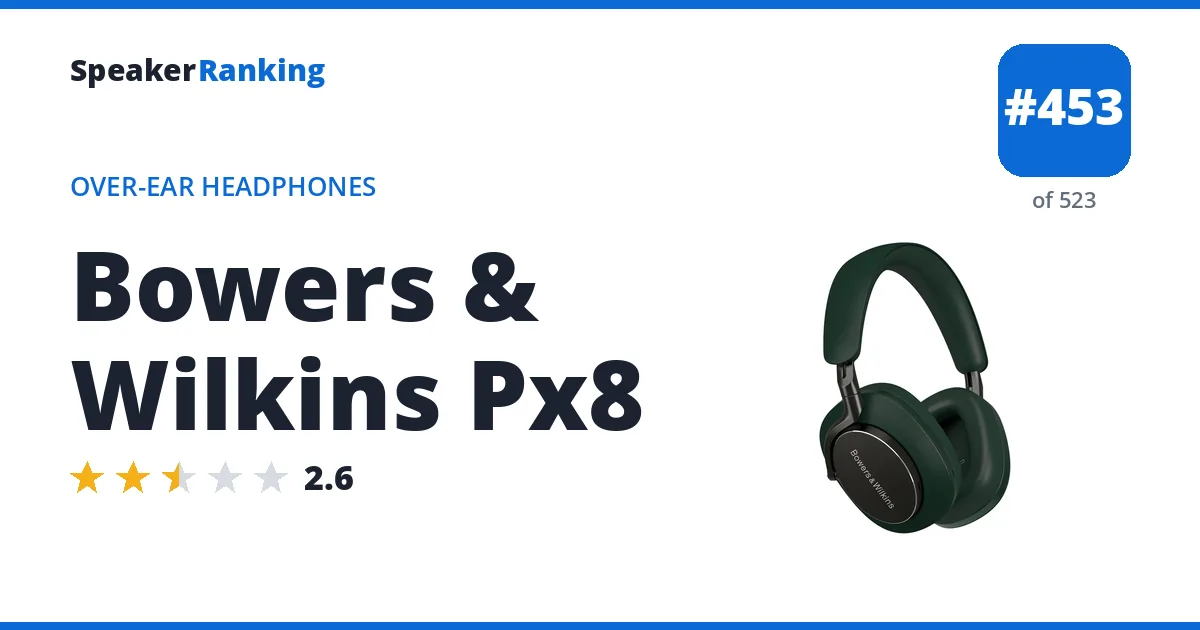
Same family: the Bowers & Wilkins Px7 S2 (lower-end model, ranked higher, rated 2.7/5). See every Bowers & Wilkins Px7 generation.
Pros: Active noise cancelling and a manufacturer rated 30 hours of battery suit travel and commuting, and it also works over a cable. Bluetooth 5.2 with AAC, aptX HD and aptX Adaptive covers high quality streaming on both iPhone and Android. Bass about 5.8 dB above target in oratory1990’s measurement suits listeners who prefer a big, warm low end.
Cons: The bass boost spills into the low mids and upper mids sit 1.7 dB under target, so vocals sound thick and recessed, for a preference score of 50. A 5.2 dB dip near 6.5 kHz softens detail. The Bowers & Wilkins Px7 S2e rates slightly higher for less money.
Full Bowers & Wilkins Px8 review and specifications →
| Released | 2022 (4 years ago) |
|---|---|
| Active Noise Cancelling | Yes |
| Battery Life | 30 hours (Manufacturer specified) |
| Bluetooth Codecs | SBC, AAC, aptX, aptX HD, aptX Adaptive |
| Bluetooth Version | 5.2 |
| Built-in Microphone | Yes |
| Connection | Wireless and wired |
| Deviation From Target | 3.14 dB standard deviation |
| Driver Type | Dynamic |
| Drivers | 1 x 40mm dynamic (carbon cone) |
| Form Factor | Over-ear |
| Harman Preference Score | 50 (measured by oratory1990, via AutoEQ) |
| Sub-bass Extension | Within 6 dB of target down to 20 Hz (+3.9 dB at 30 Hz) |
| Tonal Tilt | -1.61 (negative is warmer, positive brighter) |
| Weight | 0.7 lbs (320 g) |
EQ Presets
Harman target
Set a preamp of -4.7 dB, then add these filters in any parametric equalizer (Wavelet, Equalizer APO, Peace, or a player with parametric EQ). Calculated by AutoEQ from its measured frequency response. Predicted Harman match with this EQ: 100 out of 100, up from 50.
| Filter | Frequency | Gain | Q |
|---|---|---|---|
| Low shelf | 105 Hz | -3.9 dB | 0.70 |
| Peak | 259 Hz | -6.2 dB | 0.18 |
| Peak | 1,994 Hz | +5.3 dB | 0.55 |
| Peak | 425 Hz | +6.3 dB | 1.08 |
| Peak | 53 Hz | +4.7 dB | 1.09 |
| High shelf | 10,000 Hz | +0.5 dB | 0.70 |
| Peak | 6,260 Hz | +3.6 dB | 5.24 |
| Peak | 4,355 Hz | -2.7 dB | 4.52 |
| Peak | 9,862 Hz | +1.0 dB | 2.38 |
| Peak | 1,013 Hz | -0.5 dB | 3.11 |
Neutral target
Set a preamp of -3.3 dB, then add these filters in any parametric equalizer (Wavelet, Equalizer APO, Peace, or a player with parametric EQ). Calculated by Speaker Ranking from AutoEQ’s measurement, in the filter layout AutoEQ uses. Predicted Neutral match with this EQ: 100 out of 100, up from 22.
| Filter | Frequency | Gain | Q |
|---|---|---|---|
| Low shelf | 105 Hz | -10.1 dB | 0.70 |
| Peak | 87 Hz | -2.0 dB | 6.00 |
| Peak | 164 Hz | -5.7 dB | 0.91 |
| Peak | 410 Hz | +1.4 dB | 3.40 |
| Peak | 907 Hz | -2.0 dB | 3.73 |
| Peak | 1,669 Hz | +1.5 dB | 4.07 |
| Peak | 2,498 Hz | +3.2 dB | 1.41 |
| Peak | 4,364 Hz | -2.2 dB | 6.00 |
| Peak | 6,133 Hz | +2.6 dB | 6.00 |
Studio flat target
Set a preamp of -6.1 dB, then add these filters in any parametric equalizer (Wavelet, Equalizer APO, Peace, or a player with parametric EQ). Calculated by Speaker Ranking from AutoEQ’s measurement, in the filter layout AutoEQ uses. Predicted Studio flat match with this EQ: 100 out of 100, up from -10.
| Filter | Frequency | Gain | Q |
|---|---|---|---|
| Low shelf | 105 Hz | -11.6 dB | 0.70 |
| High shelf | 10,000 Hz | +2.0 dB | 0.70 |
| Peak | 53 Hz | +1.5 dB | 3.40 |
| Peak | 90 Hz | -1.4 dB | 6.00 |
| Peak | 169 Hz | -7.4 dB | 0.79 |
| Peak | 899 Hz | -2.4 dB | 2.81 |
| Peak | 1,762 Hz | +1.7 dB | 4.26 |
| Peak | 2,403 Hz | +6.0 dB | 1.44 |
| Peak | 4,463 Hz | -2.2 dB | 6.00 |
| Peak | 6,154 Hz | +2.2 dB | 5.78 |
Warm target
Set a preamp of -0.1 dB, then add these filters in any parametric equalizer (Wavelet, Equalizer APO, Peace, or a player with parametric EQ). Calculated by Speaker Ranking from AutoEQ’s measurement, in the filter layout AutoEQ uses. Predicted Warm match with this EQ: 98 out of 100, up from 64.
| Filter | Frequency | Gain | Q |
|---|---|---|---|
| Low shelf | 105 Hz | -4.1 dB | 0.70 |
| High shelf | 10,000 Hz | -3.5 dB | 0.70 |
| Peak | 164 Hz | -5.7 dB | 1.01 |
| Peak | 4,470 Hz | -3.3 dB | 6.00 |
Bass target
Set a preamp of -3.3 dB, then add these filters in any parametric equalizer (Wavelet, Equalizer APO, Peace, or a player with parametric EQ). Calculated by Speaker Ranking from AutoEQ’s measurement, in the filter layout AutoEQ uses. Predicted Bass match with this EQ: 100 out of 100, up from 64.
| Filter | Frequency | Gain | Q |
|---|---|---|---|
| Low shelf | 105 Hz | -0.6 dB | 0.70 |
| Peak | 49 Hz | +1.9 dB | 3.25 |
| Peak | 88 Hz | -1.9 dB | 5.16 |
| Peak | 166 Hz | -5.9 dB | 1.02 |
| Peak | 902 Hz | -2.0 dB | 3.54 |
| Peak | 1,669 Hz | +1.5 dB | 4.07 |
| Peak | 2,498 Hz | +3.2 dB | 1.44 |
| Peak | 4,366 Hz | -2.1 dB | 6.00 |
| Peak | 6,133 Hz | +2.6 dB | 6.00 |
Bright target
Set a preamp of -3.5 dB, then add these filters in any parametric equalizer (Wavelet, Equalizer APO, Peace, or a player with parametric EQ). Calculated by Speaker Ranking from AutoEQ’s measurement, in the filter layout AutoEQ uses. Predicted Bright match with this EQ: 100 out of 100, up from 4.
| Filter | Frequency | Gain | Q |
|---|---|---|---|
| Low shelf | 105 Hz | -10.1 dB | 0.70 |
| High shelf | 10,000 Hz | +1.7 dB | 0.70 |
| Peak | 87 Hz | -1.8 dB | 6.00 |
| Peak | 164 Hz | -5.7 dB | 0.85 |
| Peak | 910 Hz | -2.2 dB | 3.71 |
| Peak | 1,975 Hz | +1.8 dB | 2.08 |
| Peak | 5,345 Hz | +3.2 dB | 0.42 |
V-shaped target
Set a preamp of -4.2 dB, then add these filters in any parametric equalizer (Wavelet, Equalizer APO, Peace, or a player with parametric EQ). Calculated by Speaker Ranking from AutoEQ’s measurement, in the filter layout AutoEQ uses. Predicted V-shaped match with this EQ: 93 out of 100, up from 48.
| Filter | Frequency | Gain | Q |
|---|---|---|---|
| High shelf | 10,000 Hz | +2.0 dB | 0.70 |
| Peak | 50 Hz | +1.8 dB | 2.68 |
| Peak | 88 Hz | -1.8 dB | 6.00 |
| Peak | 164 Hz | -4.6 dB | 1.08 |
| Peak | 403 Hz | +1.7 dB | 3.34 |
| Peak | 919 Hz | -2.8 dB | 3.33 |
| Peak | 2,498 Hz | +1.8 dB | 2.16 |
| Peak | 5,345 Hz | +3.6 dB | 0.41 |
| Peak | 7,323 Hz | -2.1 dB | 5.12 |
- Links
- Reviews, Comparisons and Sound Samples
- Head-to-Head Comparisons
 Ranked #399 of 455 in Over-Ear Headphones - Sennheiser Momentum 4 Wireless: $213.83 Wireless Amazon $213.83 eBay
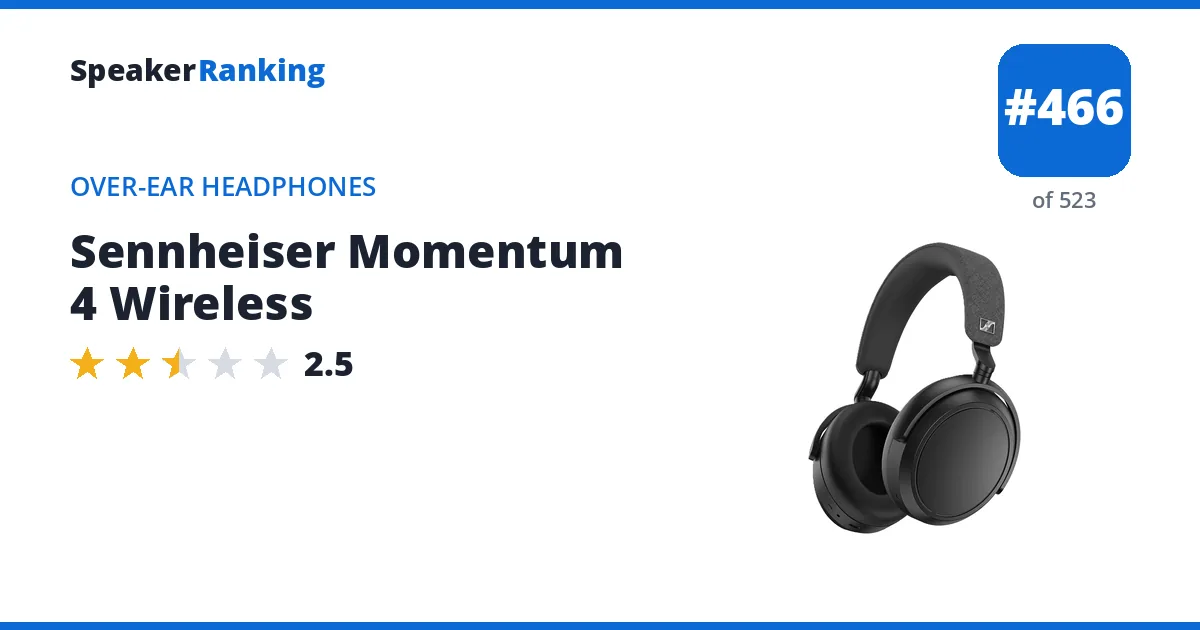
Older models: the Sennheiser Momentum 3 Wireless (ranked higher, rated 3.5/5) and the Sennheiser Momentum 2.0 Wireless (ranked lower, rated 1/5). See every Sennheiser Momentum generation.
Pros: Feature set is strong: active noise cancelling, Bluetooth 5.2 with SBC, AAC, aptX and aptX Adaptive, and a rated 60 hours of battery. It also plays wired and has a built-in microphone. The deep bass lift, about 9 dB in the sub-bass and 6 dB in the bass, suits listeners who like a warm, bass-heavy sound.
Cons: That bass boost overshoots the Harman target by a clear margin and adds about 2 dB in the low mids, which can make vocals and bass guitar thick. A 4.7 dB dip near 2.4 kHz followed by a 3.5 dB peak near 6.8 kHz makes the upper midrange uneven. Its preference score of 47 trails the Beats Studio3 Wireless, which is rated higher.
Full Sennheiser Momentum 4 Wireless review and specifications →
| Released | Aug 2022 (4 years ago) |
|---|---|
| Active Noise Cancelling | Yes |
| Back | Closed |
| Battery Life | 60 hours (Manufacturer specified) |
| Bluetooth Codecs | SBC, AAC, aptX, aptX Adaptive |
| Bluetooth Version | 5.2 |
| Built-in Microphone | Yes |
| Connection | Wireless and wired |
| Deviation From Target | 3.31 dB standard deviation |
| Driver Type | Dynamic |
| Drivers | 1 x 42mm dynamic |
| Form Factor | Over-ear |
| Frequency Response | 6Hz - 22kHz (Manufacturer specified) |
| Harman Preference Score | 47 (measured by oratory1990, via AutoEQ) |
| IP Rating | None |
| Sensitivity | 106 dB SPL (1 kHz / 0 dB FS) |
| Sub-bass Extension | Within 6 dB of target down to 20 Hz (+8.2 dB at 30 Hz) |
| Tonal Tilt | -1.68 (negative is warmer, positive brighter) |
| Weight | 0.6 lbs (293 g) |
EQ Presets
Harman target
Set a preamp of -6.4 dB, then add these filters in any parametric equalizer (Wavelet, Equalizer APO, Peace, or a player with parametric EQ). Calculated by AutoEQ from its measured frequency response. Predicted Harman match with this EQ: 100 out of 100, up from 47.
| Filter | Frequency | Gain | Q |
|---|---|---|---|
| Low shelf | 105 Hz | -7.4 dB | 0.70 |
| Peak | 195 Hz | -3.6 dB | 1.22 |
| Peak | 2,393 Hz | +6.1 dB | 1.81 |
| Peak | 1,726 Hz | +1.6 dB | 1.71 |
| Peak | 2,893 Hz | -3.2 dB | 5.94 |
| High shelf | 10,000 Hz | +0.5 dB | 0.70 |
| Peak | 63 Hz | +1.7 dB | 2.86 |
| Peak | 652 Hz | +1.2 dB | 2.25 |
| Peak | 952 Hz | -1.0 dB | 3.69 |
| Peak | 316 Hz | -0.9 dB | 3.46 |
Neutral target
Set a preamp of -5.1 dB, then add these filters in any parametric equalizer (Wavelet, Equalizer APO, Peace, or a player with parametric EQ). Calculated by Speaker Ranking from AutoEQ’s measurement, in the filter layout AutoEQ uses. Predicted Neutral match with this EQ: 99 out of 100, up from 18.
| Filter | Frequency | Gain | Q |
|---|---|---|---|
| Low shelf | 105 Hz | -11.9 dB | 0.70 |
| High shelf | 10,000 Hz | -1.3 dB | 0.70 |
| Peak | 180 Hz | -4.9 dB | 0.65 |
| Peak | 2,166 Hz | +5.3 dB | 2.92 |
| Peak | 6,196 Hz | -1.9 dB | 1.22 |
Studio flat target
Set a preamp of -6.3 dB, then add these filters in any parametric equalizer (Wavelet, Equalizer APO, Peace, or a player with parametric EQ). Calculated by Speaker Ranking from AutoEQ’s measurement, in the filter layout AutoEQ uses. Predicted Studio flat match with this EQ: 90 out of 100, up from -16.
| Filter | Frequency | Gain | Q |
|---|---|---|---|
| Low shelf | 105 Hz | -12.0 dB | 0.70 |
| High shelf | 10,000 Hz | +2.0 dB | 0.70 |
| Peak | 182 Hz | -7.1 dB | 0.63 |
| Peak | 966 Hz | -2.1 dB | 3.96 |
| Peak | 2,152 Hz | +6.0 dB | 1.82 |
| Peak | 2,617 Hz | +2.2 dB | 4.96 |
| Peak | 6,122 Hz | -2.4 dB | 2.10 |
Warm target
Set a preamp of -4.1 dB, then add these filters in any parametric equalizer (Wavelet, Equalizer APO, Peace, or a player with parametric EQ). Calculated by Speaker Ranking from AutoEQ’s measurement, in the filter layout AutoEQ uses. Predicted Warm match with this EQ: 100 out of 100, up from 60.
| Filter | Frequency | Gain | Q |
|---|---|---|---|
| Low shelf | 105 Hz | -8.4 dB | 0.70 |
| High shelf | 10,000 Hz | -5.0 dB | 0.70 |
| Peak | 194 Hz | -4.8 dB | 0.96 |
| Peak | 2,150 Hz | +4.6 dB | 3.19 |
| Peak | 3,354 Hz | -1.0 dB | 1.94 |
| Peak | 6,198 Hz | -4.3 dB | 1.51 |
Bass target
Set a preamp of -5.2 dB, then add these filters in any parametric equalizer (Wavelet, Equalizer APO, Peace, or a player with parametric EQ). Calculated by Speaker Ranking from AutoEQ’s measurement, in the filter layout AutoEQ uses. Predicted Bass match with this EQ: 100 out of 100, up from 63.
| Filter | Frequency | Gain | Q |
|---|---|---|---|
| Low shelf | 105 Hz | -4.8 dB | 0.70 |
| High shelf | 10,000 Hz | -1.3 dB | 0.70 |
| Peak | 64 Hz | +2.0 dB | 2.94 |
| Peak | 194 Hz | -5.1 dB | 0.97 |
| Peak | 956 Hz | -1.8 dB | 4.56 |
| Peak | 2,173 Hz | +5.3 dB | 3.02 |
| Peak | 6,204 Hz | -1.9 dB | 1.21 |
Bright target
Set a preamp of -5.5 dB, then add these filters in any parametric equalizer (Wavelet, Equalizer APO, Peace, or a player with parametric EQ). Calculated by Speaker Ranking from AutoEQ’s measurement, in the filter layout AutoEQ uses. Predicted Bright match with this EQ: 96 out of 100, up from 1.
| Filter | Frequency | Gain | Q |
|---|---|---|---|
| Low shelf | 105 Hz | -11.9 dB | 0.70 |
| High shelf | 10,000 Hz | +1.1 dB | 0.70 |
| Peak | 184 Hz | -4.8 dB | 0.59 |
| Peak | 2,256 Hz | +5.4 dB | 2.33 |
| Peak | 6,734 Hz | +1.5 dB | 1.13 |
V-shaped target
Set a preamp of -5.9 dB, then add these filters in any parametric equalizer (Wavelet, Equalizer APO, Peace, or a player with parametric EQ). Calculated by Speaker Ranking from AutoEQ’s measurement, in the filter layout AutoEQ uses. Predicted V-shaped match with this EQ: 92 out of 100, up from 48.
| Filter | Frequency | Gain | Q |
|---|---|---|---|
| Low shelf | 105 Hz | -4.2 dB | 0.70 |
| High shelf | 10,000 Hz | +1.6 dB | 0.70 |
| Peak | 65 Hz | +2.0 dB | 2.71 |
| Peak | 194 Hz | -3.7 dB | 1.01 |
| Peak | 966 Hz | -2.5 dB | 3.21 |
| Peak | 2,303 Hz | +5.8 dB | 2.07 |
| Peak | 6,034 Hz | +2.3 dB | 1.89 |
- Links
- Reviews, Comparisons and Sound Samples
- Head-to-Head Comparisons
- Sennheiser Momentum 4 Wireless vs AKG K271 MKII
- Sennheiser Momentum 4 Wireless vs KLH Ultimate One
- Sennheiser Momentum 4 Wireless vs Audio-Technica ATH-AD900X
- Sennheiser Momentum 4 Wireless vs Sony WH-1000XM6
- Sennheiser Momentum 4 Wireless vs Bowers & Wilkins Px8
- Sennheiser Momentum 4 Wireless vs Jabra Evolve 40
- Sennheiser Momentum 4 Wireless vs Sony WH-1000XM5
- Sennheiser Momentum 4 Wireless vs Audio-Technica ATH-A990Z
 Ranked #427 of 455 in Over-Ear Headphones - Bowers & Wilkins Px7 S3: $429.00 Wireless Amazon $429.00 eBay
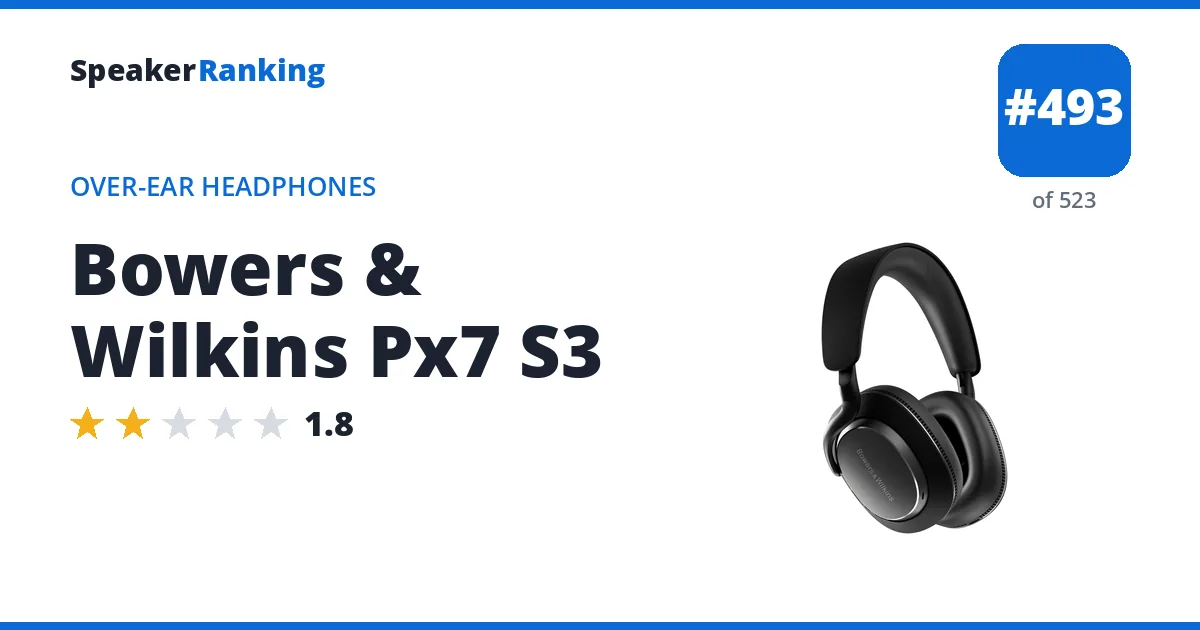
Pros: It brings active noise cancelling, a claimed 30 hours of battery life and Bluetooth 5.3 with an unusually wide codec list, including aptX Adaptive, aptX HD and aptX Lossless alongside AAC. A wired connection is also supported. For listeners who want heavy, elevated bass, its strong low end fits a bassy taste.
Cons: In two hobbyist measurements on squig.link it scores only 30.7 for Harman preference with a 4.23 dB deviation, one of the least accurate responses in its class. Bass runs about 8.3 dB and sub-bass about 7.7 dB over target, which muddies the low end, while an 11.5 dB peak near 8.7 kHz next to a 6 dB dip near 5.4 kHz makes cymbals and sibilance sound hot and uneven. It rates below the Sony WH-1000XM6 and SteelSeries Arctis Nova Pro Wireless, which also offer noise cancelling at a similar price.
Full Bowers & Wilkins Px7 S3 review and specifications →
| Active Noise Cancelling | Yes |
|---|---|
| Back | Closed |
| Battery Life | 30 hours (Manufacturer specified) |
| Bluetooth Codecs | SBC, AAC, aptX, aptX HD, aptX Adaptive, aptX Lossless |
| Bluetooth Version | 5.3 |
| Built-in Microphone | Yes |
| Connection | Wireless and wired |
| Deviation From Target | 4.23 dB standard deviation |
| Driver Type | Dynamic |
| Drivers | 1 x 40mm dynamic |
| Form Factor | Over-ear |
| Frequency Response | 10Hz - 30kHz (Manufacturer specified) |
| Harman Preference Score | 31 (median of 2 squig.link measurements, calibrated to AutoEQ) |
| IP Rating | None |
| Sub-bass Extension | Within 6 dB of target down to 20 Hz (+5.6 dB at 30 Hz) |
| Tonal Tilt | -2.01 (negative is warmer, positive brighter) |
| Weight | 0.7 lbs (300 g) |
- Links
- Reviews, Comparisons and Sound Samples
In-Ear Headphones
 Ranked #53 of 1002 in In-Ear Headphones - Moondrop Voyager: $149.99 Wireless Linsoul $149.99 eBay
Pros: These wireless earbuds track the Harman target unusually closely, with a preference score of 82.1 and only 1.2 dB of deviation in hobbyist measurements, and bass through the upper mids stays within half a decibel of target. Sub-bass holds almost flat to 20 Hz, so bass lines are deep and clean without boom. Bluetooth 5.2 with aptX Adaptive, aptX HD, LHDC, AAC and SBC covers both Android and iPhone, and battery life is rated at 12 hours.
Cons: The 3 to 10 kHz range sits about 2.5 to 2.7 dB below target with a 4.8 dB dip near 9.7 kHz, which softens cymbals and detail slightly. The Juzear 81T and Simgot EA500LM both rate higher at a similar price for listeners who do not need wireless.
Full Moondrop Voyager review and specifications →
| Back | Closed |
|---|---|
| Battery Life | 12 hours (Manufacturer specified) |
| Bluetooth Codecs | SBC, AAC, aptX, aptX HD, aptX Adaptive, LHDC |
| Bluetooth Version | 5.2 |
| Connection | Wireless |
| Deviation From Target | 1.20 dB standard deviation |
| Driver Type | Dynamic |
| Drivers | 1 x 10mm dynamic |
| Form Factor | In-ear |
| Frequency Response | 20Hz - 20kHz (Manufacturer specified) |
| Harman Preference Score | 82 (median of 2 squig.link measurements, calibrated to AutoEQ) |
| Sub-bass Extension | Within 6 dB of target down to 20 Hz (-0.4 dB at 30 Hz) |
| Tonal Tilt | -0.37 (negative is warmer, positive brighter) |
- Reviews, Comparisons and Sound Samples
 Ranked #313 of 1002 in In-Ear Headphones - SoundPEATS Air4 Pro Wireless Discontinued eBay
Pros: Budget noise cancelling earbuds that measure close to the Harman target (score 75), with aptX Lossless support.
Cons: Discontinued, and treble sits about 2.6 dB below target, so it can sound a little dull.
Full SoundPEATS Air4 Pro review and specifications →
| Released | 2023 (3 years ago) |
|---|---|
| Active Noise Cancelling | Yes |
| Back | Closed |
| Battery Life | 6.5 hours (26 hours with case) |
| Bluetooth Codecs | SBC, AAC, aptX Adaptive, aptX Lossless |
| Bluetooth Version | 5.3 |
| Connection | Wireless |
| Deviation From Target | 1.85 dB standard deviation |
| Driver Type | Dynamic |
| Drivers | 1 x 13mm dynamic |
| Form Factor | In-ear |
| Harman Preference Score | 75 (median of 7 squig.link measurements, calibrated to AutoEQ) |
| Sub-bass Extension | Within 6 dB of target down to 20 Hz (-0.4 dB at 30 Hz) |
| Tonal Tilt | -0.16 (negative is warmer, positive brighter) |
EQ Presets
Harman target
Set a preamp of -5.7 dB, then add these filters in any parametric equalizer (Wavelet, Equalizer APO, Peace, or a player with parametric EQ). Calculated by Speaker Ranking from the median of 8 squig.link measurements, in the filter layout AutoEQ uses. Predicted Harman match with this EQ: 85 out of 100, up from 75.
| Filter | Frequency | Gain | Q |
|---|---|---|---|
| Low shelf | 105 Hz | +0.6 dB | 0.70 |
| High shelf | 10,000 Hz | +1.3 dB | 0.70 |
| Peak | 124 Hz | +4.1 dB | 1.97 |
| Peak | 5,192 Hz | +5.6 dB | 2.16 |
Neutral target
Set a preamp of -5.7 dB, then add these filters in any parametric equalizer (Wavelet, Equalizer APO, Peace, or a player with parametric EQ). Calculated by Speaker Ranking from the median of 8 squig.link measurements, in the filter layout AutoEQ uses. Predicted Neutral match with this EQ: 87 out of 100, up from 46.
| Filter | Frequency | Gain | Q |
|---|---|---|---|
| Low shelf | 105 Hz | -7.9 dB | 0.70 |
| High shelf | 10,000 Hz | +1.3 dB | 0.70 |
| Peak | 127 Hz | +4.0 dB | 2.20 |
| Peak | 5,191 Hz | +5.6 dB | 2.15 |
Studio flat target
Set a preamp of -3.6 dB, then add these filters in any parametric equalizer (Wavelet, Equalizer APO, Peace, or a player with parametric EQ). Calculated by Speaker Ranking from the median of 8 squig.link measurements, in the filter layout AutoEQ uses. Predicted Studio flat match with this EQ: 87 out of 100, up from 29.
| Filter | Frequency | Gain | Q |
|---|---|---|---|
| Low shelf | 105 Hz | -10.5 dB | 0.70 |
| High shelf | 10,000 Hz | +2.0 dB | 0.70 |
| Peak | 118 Hz | +2.6 dB | 2.33 |
| Peak | 266 Hz | -2.5 dB | 2.24 |
| Peak | 427 Hz | -1.4 dB | 3.60 |
| Peak | 781 Hz | +1.4 dB | 4.78 |
| Peak | 1,313 Hz | -1.9 dB | 3.84 |
| Peak | 2,386 Hz | +2.4 dB | 5.77 |
| Peak | 5,016 Hz | +3.2 dB | 0.66 |
| Peak | 7,484 Hz | -2.2 dB | 6.00 |
Warm target
Set a preamp of -4.6 dB, then add these filters in any parametric equalizer (Wavelet, Equalizer APO, Peace, or a player with parametric EQ). Calculated by Speaker Ranking from the median of 8 squig.link measurements, in the filter layout AutoEQ uses. Predicted Warm match with this EQ: 90 out of 100, up from 78.
| Filter | Frequency | Gain | Q |
|---|---|---|---|
| Low shelf | 105 Hz | +0.9 dB | 0.70 |
| High shelf | 10,000 Hz | -0.6 dB | 0.70 |
| Peak | 125 Hz | +4.2 dB | 1.89 |
| Peak | 254 Hz | -1.2 dB | 3.42 |
| Peak | 774 Hz | +2.0 dB | 5.40 |
| Peak | 1,358 Hz | -1.7 dB | 3.12 |
| Peak | 2,941 Hz | -1.3 dB | 6.00 |
| Peak | 5,375 Hz | +3.8 dB | 3.79 |
| Peak | 7,653 Hz | -3.1 dB | 6.00 |
Bass target
Set a preamp of -5.8 dB, then add these filters in any parametric equalizer (Wavelet, Equalizer APO, Peace, or a player with parametric EQ). Calculated by Speaker Ranking from the median of 8 squig.link measurements, in the filter layout AutoEQ uses. Predicted Bass match with this EQ: 87 out of 100, up from 67.
| Filter | Frequency | Gain | Q |
|---|---|---|---|
| Low shelf | 105 Hz | +4.4 dB | 0.70 |
| High shelf | 10,000 Hz | +1.3 dB | 0.70 |
| Peak | 122 Hz | +4.1 dB | 1.88 |
| Peak | 5,192 Hz | +5.6 dB | 2.16 |
Bright target
Set a preamp of -6.1 dB, then add these filters in any parametric equalizer (Wavelet, Equalizer APO, Peace, or a player with parametric EQ). Calculated by Speaker Ranking from the median of 8 squig.link measurements, in the filter layout AutoEQ uses. Predicted Bright match with this EQ: 80 out of 100, up from 34.
| Filter | Frequency | Gain | Q |
|---|---|---|---|
| Low shelf | 105 Hz | -7.9 dB | 0.70 |
| High shelf | 10,000 Hz | +2.0 dB | 0.70 |
| Peak | 127 Hz | +3.9 dB | 2.25 |
| Peak | 4,841 Hz | +6.0 dB | 1.50 |
V-shaped target
Set a preamp of -6.5 dB, then add these filters in any parametric equalizer (Wavelet, Equalizer APO, Peace, or a player with parametric EQ). Calculated by Speaker Ranking from the median of 8 squig.link measurements, in the filter layout AutoEQ uses. Predicted V-shaped match with this EQ: 77 out of 100, up from 62.
| Filter | Frequency | Gain | Q |
|---|---|---|---|
| Low shelf | 105 Hz | +5.1 dB | 0.70 |
| High shelf | 10,000 Hz | +2.0 dB | 0.70 |
| Peak | 132 Hz | +4.8 dB | 1.47 |
| Peak | 4,709 Hz | +6.0 dB | 1.33 |
- Reviews, Comparisons and Sound Samples
 Ranked #346 of 1002 in In-Ear Headphones - Edifier Stax Spirit S10: $199.99 TWS Amazon $199.99 eBay
Pros: The median of 3 hobbyist measurements gives it a solid Harman preference score of 74 with a 2.19 dB spread, and its mids sit within about 0.5 dB of target, so vocals and instruments sound natural. It uses 1 x 12mm planar magnetic.
Cons: Presence sits about 4 dB low with a 7.4 dB dip near 10.0 kHz, so vocals and instruments lose some bite. A 7.4 dB peak near 7.9 kHz can make cymbals and sibilance sound sharp. Sub-bass is 3.1 dB short at 30 Hz, so deep bass lacks rumble.
Full Edifier Stax Spirit S10 review and specifications →
| Released | Sep 2024 (2 years ago) |
|---|---|
| Active Noise Cancelling | Yes |
| Back | Closed |
| Battery Life | Up to 28 hours with case (Manufacturer specified) |
| Bluetooth Codecs | SBC, AAC, aptX, aptX Adaptive, aptX Lossless, LDAC, LHDC 5.0 |
| Bluetooth Version | 5.4 |
| Built-in Microphone | Yes |
| Connection | True wireless |
| Deviation From Target | 2.19 dB standard deviation |
| Driver Type | Planar magnetic |
| Drivers | 1 x 12mm planar magnetic |
| Form Factor | In-ear |
| Harman Preference Score | 74 (median of 3 squig.link measurements, calibrated to AutoEQ) |
| IP Rating | IP54 |
| Sub-bass Extension | Within 6 dB of target down to 20 Hz (-3.1 dB at 30 Hz) |
| Tonal Tilt | -0.06 (negative is warmer, positive brighter) |
EQ Presets
Harman target
Set a preamp of -5.3 dB, then add these filters in any parametric equalizer (Wavelet, Equalizer APO, Peace, or a player with parametric EQ). Calculated by Speaker Ranking from the median of 3 squig.link measurements, in the filter layout AutoEQ uses. Predicted Harman match with this EQ: 82 out of 100, up from 74.
| Filter | Frequency | Gain | Q |
|---|---|---|---|
| Low shelf | 105 Hz | +2.5 dB | 0.70 |
| High shelf | 10,000 Hz | -6.0 dB | 0.70 |
| Peak | 23 Hz | +1.7 dB | 2.01 |
| Peak | 109 Hz | -1.6 dB | 0.95 |
| Peak | 1,858 Hz | -1.7 dB | 2.98 |
| Peak | 3,746 Hz | +5.3 dB | 1.23 |
| Peak | 5,887 Hz | +3.5 dB | 6.00 |
Neutral target
Set a preamp of -5.3 dB, then add these filters in any parametric equalizer (Wavelet, Equalizer APO, Peace, or a player with parametric EQ). Calculated by Speaker Ranking from the median of 3 squig.link measurements, in the filter layout AutoEQ uses. Predicted Neutral match with this EQ: 84 out of 100, up from 47.
| Filter | Frequency | Gain | Q |
|---|---|---|---|
| Low shelf | 105 Hz | -6.0 dB | 0.70 |
| High shelf | 10,000 Hz | -6.0 dB | 0.70 |
| Peak | 101 Hz | -1.8 dB | 0.78 |
| Peak | 1,877 Hz | -1.8 dB | 3.40 |
| Peak | 3,748 Hz | +5.3 dB | 1.23 |
| Peak | 5,887 Hz | +3.5 dB | 6.00 |
Studio flat target
Set a preamp of -6.2 dB, then add these filters in any parametric equalizer (Wavelet, Equalizer APO, Peace, or a player with parametric EQ). Calculated by Speaker Ranking from the median of 3 squig.link measurements, in the filter layout AutoEQ uses. Predicted Studio flat match with this EQ: 82 out of 100, up from 29.
| Filter | Frequency | Gain | Q |
|---|---|---|---|
| Low shelf | 105 Hz | -8.6 dB | 0.70 |
| High shelf | 10,000 Hz | -3.9 dB | 0.70 |
| Peak | 152 Hz | -3.0 dB | 0.63 |
| Peak | 1,883 Hz | -1.4 dB | 4.61 |
| Peak | 2,600 Hz | +1.6 dB | 6.00 |
| Peak | 3,219 Hz | +6.0 dB | 1.49 |
| Peak | 4,660 Hz | -2.2 dB | 6.00 |
| Peak | 5,932 Hz | +3.2 dB | 6.00 |
Warm target
Set a preamp of -5.2 dB, then add these filters in any parametric equalizer (Wavelet, Equalizer APO, Peace, or a player with parametric EQ). Calculated by Speaker Ranking from the median of 3 squig.link measurements, in the filter layout AutoEQ uses. Predicted Warm match with this EQ: 88 out of 100, up from 75.
| Filter | Frequency | Gain | Q |
|---|---|---|---|
| Low shelf | 105 Hz | +2.7 dB | 0.70 |
| High shelf | 10,000 Hz | -6.0 dB | 0.70 |
| Peak | 23 Hz | +1.8 dB | 2.04 |
| Peak | 103 Hz | -1.5 dB | 1.19 |
| Peak | 592 Hz | +1.0 dB | 2.66 |
| Peak | 1,896 Hz | -1.7 dB | 4.75 |
| Peak | 3,385 Hz | +5.2 dB | 3.11 |
| Peak | 5,834 Hz | +3.1 dB | 6.00 |
| Peak | 7,610 Hz | -3.3 dB | 6.00 |
Bass target
Set a preamp of -5.7 dB, then add these filters in any parametric equalizer (Wavelet, Equalizer APO, Peace, or a player with parametric EQ). Calculated by Speaker Ranking from the median of 3 squig.link measurements, in the filter layout AutoEQ uses. Predicted Bass match with this EQ: 82 out of 100, up from 63.
| Filter | Frequency | Gain | Q |
|---|---|---|---|
| Low shelf | 105 Hz | +5.6 dB | 0.70 |
| High shelf | 10,000 Hz | -6.0 dB | 0.70 |
| Peak | 1,858 Hz | -1.7 dB | 2.98 |
| Peak | 3,746 Hz | +5.3 dB | 1.23 |
| Peak | 5,887 Hz | +3.5 dB | 6.00 |
Bright target
Set a preamp of -6.3 dB, then add these filters in any parametric equalizer (Wavelet, Equalizer APO, Peace, or a player with parametric EQ). Calculated by Speaker Ranking from the median of 3 squig.link measurements, in the filter layout AutoEQ uses. Predicted Bright match with this EQ: 79 out of 100, up from 36.
| Filter | Frequency | Gain | Q |
|---|---|---|---|
| Low shelf | 105 Hz | -6.1 dB | 0.70 |
| High shelf | 10,000 Hz | -6.0 dB | 0.70 |
| Peak | 23 Hz | +1.3 dB | 2.42 |
| Peak | 103 Hz | -1.8 dB | 0.79 |
| Peak | 1,708 Hz | -1.5 dB | 1.75 |
| Peak | 3,187 Hz | +2.9 dB | 4.60 |
| Peak | 5,345 Hz | +5.7 dB | 0.67 |
| Peak | 6,760 Hz | -2.5 dB | 6.00 |
V-shaped target
Set a preamp of -6.2 dB, then add these filters in any parametric equalizer (Wavelet, Equalizer APO, Peace, or a player with parametric EQ). Calculated by Speaker Ranking from the median of 3 squig.link measurements, in the filter layout AutoEQ uses. Predicted V-shaped match with this EQ: 78 out of 100, up from 61.
| Filter | Frequency | Gain | Q |
|---|---|---|---|
| Low shelf | 105 Hz | +5.8 dB | 0.70 |
| High shelf | 10,000 Hz | -5.4 dB | 0.70 |
| Peak | 321 Hz | +0.7 dB | 0.58 |
| Peak | 1,118 Hz | -1.4 dB | 5.17 |
| Peak | 1,708 Hz | -1.5 dB | 1.69 |
| Peak | 3,076 Hz | +2.9 dB | 4.39 |
| Peak | 5,345 Hz | +5.8 dB | 0.63 |
| Peak | 6,834 Hz | -2.8 dB | 5.57 |
- Links
- Reviews, Comparisons and Sound Samples
- Head-to-Head Comparisons
 Ranked #608 of 1002 in In-Ear Headphones - Sennheiser Momentum True Wireless 3: $110.05 TWS Discontinued Amazon $110.05 eBay
Newer model: the Sennheiser MOMENTUM True Wireless 4, ranked lower, rated 3.3/5, released Feb 2024. It adds LC3.
Older model: the Sennheiser Momentum True Wireless 2 (ranked lower, rated 1.6/5). See every Sennheiser Momentum True Wireless generation.
Pros: Active noise cancelling, Bluetooth 5.2 and aptX Adaptive support (alongside SBC, AAC and aptX) add real convenience, and battery life is 7 hours per charge with up to 28 hours using the case. At 5.8 g per earbud with an IPX4 rating, it handles workouts and light rain. Oratory1990’s measurement shows bass and sub-bass within 1 dB of target, giving a clean, warm foundation that suits warm and bassy tastes.
Cons: Presence between 3 and 6 kHz is 6.9 dB under target with a 7.6 dB dip near 4.4 kHz, so vocals, snare and guitar edges sound distant and veiled. Air above 10 kHz runs 5.4 dB hot, with a peak of 4.9 dB near 10.5 kHz, which adds a hissy edge on top of the recessed mids. The preference score of 66 and deviation of 2.59 dB confirm the response sits well off the target. The KZ PR1 is rated higher at a similar cost, though it lacks wireless and ANC. Discontinued.
Full Sennheiser Momentum True Wireless 3 review and specifications →
| Released | Apr 2022 (4 years ago) |
|---|---|
| Active Noise Cancelling | Yes |
| Back | Closed |
| Battery Life | 7 hours (28 with case, Manufacturer specified) |
| Bluetooth Codecs | SBC, AAC, aptX, aptX Adaptive |
| Bluetooth Version | 5.2 |
| Built-in Microphone | Yes |
| Connection | True wireless |
| Deviation From Target | 2.59 dB standard deviation |
| Driver Type | Dynamic |
| Drivers | 1 x 7mm dynamic |
| Form Factor | In-ear |
| Frequency Response | 5Hz - 21kHz (Manufacturer specified) |
| Harman Preference Score | 66 (measured by oratory1990, via AutoEQ) |
| IP Rating | IPX4 |
| Sensitivity | 107 dB SPL (1 kHz / 1 mW) |
| Sub-bass Extension | Within 6 dB of target down to 20 Hz (+0.3 dB at 30 Hz) |
| Tonal Tilt | -0.85 (negative is warmer, positive brighter) |
| Weight | 0 lbs (5.8 g) per earbud |
EQ Presets
Harman target
Set a preamp of -5.3 dB, then add these filters in any parametric equalizer (Wavelet, Equalizer APO, Peace, or a player with parametric EQ). Calculated by AutoEQ from its measured frequency response. Predicted Harman match with this EQ: 90 out of 100, up from 66.
| Filter | Frequency | Gain | Q |
|---|---|---|---|
| Low shelf | 105 Hz | -2.6 dB | 0.70 |
| Peak | 4,231 Hz | +5.9 dB | 1.39 |
| Peak | 209 Hz | -2.2 dB | 0.78 |
| Peak | 1,433 Hz | -2.6 dB | 1.99 |
| Peak | 69 Hz | +1.5 dB | 1.35 |
| High shelf | 10,000 Hz | -5.4 dB | 0.70 |
| Peak | 5,556 Hz | +1.7 dB | 5.29 |
| Peak | 759 Hz | +0.5 dB | 2.36 |
| Peak | 335 Hz | -0.4 dB | 3.16 |
| Peak | 4,230 Hz | -0.6 dB | 5.10 |
Neutral target
Set a preamp of -6.2 dB, then add these filters in any parametric equalizer (Wavelet, Equalizer APO, Peace, or a player with parametric EQ). Calculated by Speaker Ranking from AutoEQ’s measurement, in the filter layout AutoEQ uses. Predicted Neutral match with this EQ: 92 out of 100, up from 29.
| Filter | Frequency | Gain | Q |
|---|---|---|---|
| Low shelf | 105 Hz | -8.8 dB | 0.70 |
| High shelf | 10,000 Hz | -4.1 dB | 0.70 |
| Peak | 31 Hz | -0.5 dB | 0.40 |
| Peak | 239 Hz | -1.5 dB | 0.92 |
| Peak | 726 Hz | +0.8 dB | 1.97 |
| Peak | 1,392 Hz | -2.1 dB | 2.71 |
| Peak | 3,180 Hz | +2.4 dB | 3.41 |
| Peak | 5,016 Hz | +6.0 dB | 0.76 |
| Peak | 6,696 Hz | -2.5 dB | 6.00 |
Studio flat target
Set a preamp of -6.4 dB, then add these filters in any parametric equalizer (Wavelet, Equalizer APO, Peace, or a player with parametric EQ). Calculated by Speaker Ranking from AutoEQ’s measurement, in the filter layout AutoEQ uses. Predicted Studio flat match with this EQ: 89 out of 100, up from 10.
| Filter | Frequency | Gain | Q |
|---|---|---|---|
| Low shelf | 105 Hz | -11.3 dB | 0.70 |
| High shelf | 10,000 Hz | +0.8 dB | 0.70 |
| Peak | 194 Hz | -3.0 dB | 0.58 |
| Peak | 1,468 Hz | -2.7 dB | 2.41 |
| Peak | 2,954 Hz | +6.0 dB | 0.97 |
| Peak | 5,078 Hz | +3.7 dB | 2.83 |
Warm target
Set a preamp of -5.9 dB, then add these filters in any parametric equalizer (Wavelet, Equalizer APO, Peace, or a player with parametric EQ). Calculated by Speaker Ranking from AutoEQ’s measurement, in the filter layout AutoEQ uses. Predicted Warm match with this EQ: 92 out of 100, up from 75.
| Filter | Frequency | Gain | Q |
|---|---|---|---|
| High shelf | 10,000 Hz | -6.0 dB | 0.70 |
| Peak | 239 Hz | -1.3 dB | 1.36 |
| Peak | 1,437 Hz | -2.1 dB | 3.24 |
| Peak | 4,204 Hz | +6.0 dB | 1.26 |
Bass target
Set a preamp of -6.2 dB, then add these filters in any parametric equalizer (Wavelet, Equalizer APO, Peace, or a player with parametric EQ). Calculated by Speaker Ranking from AutoEQ’s measurement, in the filter layout AutoEQ uses. Predicted Bass match with this EQ: 93 out of 100, up from 69.
| Filter | Frequency | Gain | Q |
|---|---|---|---|
| Low shelf | 105 Hz | +3.6 dB | 0.70 |
| High shelf | 10,000 Hz | -4.1 dB | 0.70 |
| Peak | 239 Hz | -1.6 dB | 1.18 |
| Peak | 757 Hz | +0.7 dB | 2.46 |
| Peak | 1,391 Hz | -2.1 dB | 2.70 |
| Peak | 3,181 Hz | +2.4 dB | 3.41 |
| Peak | 5,016 Hz | +6.0 dB | 0.76 |
| Peak | 6,695 Hz | -2.5 dB | 6.00 |
Bright target
Set a preamp of -6.4 dB, then add these filters in any parametric equalizer (Wavelet, Equalizer APO, Peace, or a player with parametric EQ). Calculated by Speaker Ranking from AutoEQ’s measurement, in the filter layout AutoEQ uses. Predicted Bright match with this EQ: 82 out of 100, up from 17.
| Filter | Frequency | Gain | Q |
|---|---|---|---|
| Low shelf | 105 Hz | -8.8 dB | 0.70 |
| High shelf | 10,000 Hz | -0.4 dB | 0.70 |
| Peak | 30 Hz | -0.5 dB | 0.40 |
| Peak | 239 Hz | -1.5 dB | 0.86 |
| Peak | 723 Hz | +0.7 dB | 1.88 |
| Peak | 1,390 Hz | -2.3 dB | 2.55 |
| Peak | 3,106 Hz | +2.7 dB | 3.12 |
| Peak | 5,345 Hz | +5.7 dB | 0.61 |
| Peak | 6,987 Hz | -3.7 dB | 5.38 |
V-shaped target
Set a preamp of -6.6 dB, then add these filters in any parametric equalizer (Wavelet, Equalizer APO, Peace, or a player with parametric EQ). Calculated by Speaker Ranking from AutoEQ’s measurement, in the filter layout AutoEQ uses. Predicted V-shaped match with this EQ: 77 out of 100, up from 58.
| Filter | Frequency | Gain | Q |
|---|---|---|---|
| Low shelf | 105 Hz | +4.2 dB | 0.70 |
| High shelf | 10,000 Hz | +0.9 dB | 0.70 |
| Peak | 1,422 Hz | -2.9 dB | 1.95 |
| Peak | 3,148 Hz | +6.0 dB | 0.96 |
| Peak | 5,392 Hz | +3.9 dB | 3.25 |
- Reviews, Comparisons and Sound Samples
- Head-to-Head Comparisons
- Sennheiser Momentum True Wireless 3 vs iBasso IT01S
- Sennheiser Momentum True Wireless 3 vs FiiO FH3
- Sennheiser Momentum True Wireless 3 vs Sennheiser Momentum True Wireless 5
- Sennheiser Momentum True Wireless 3 vs Sennheiser Momentum True Wireless 2
- Sennheiser Momentum True Wireless 3 vs Sennheiser Momentum True Wireless
 Ranked #632 of 1002 in In-Ear Headphones - Sennheiser MOMENTUM True Wireless 4: $250.13 TWS Amazon $250.13 eBay
Older models: the Sennheiser Momentum True Wireless 3 (ranked higher, rated 3.4/5) and the Sennheiser Momentum True Wireless 2 (ranked lower, rated 1.6/5). See every Sennheiser Momentum True Wireless generation.
Pros: This true wireless set adds active noise cancelling, Bluetooth 5.4 and a codec list that runs from SBC and AAC up to aptX Lossless and LC3. Battery life is 7.5 hours per charge and 30 hours with the case, and IP54 resistance covers sweat and light rain. Oratory1990’s measurement shows bass about 0.6 dB above target, so low end is full without being overdone.
Cons: Presence from 3 to 6 kHz is about 6.9 dB under target, with an 8.2 dB dip near 5.7 kHz, so voices and guitars sound recessed. Air above 10 kHz runs 5 dB hot with a peak of 4.2 dB near 10.6 kHz, which can add a thin, sparkly edge. The Tin HiFi P1 Max has a higher rating, for a lower price.
Full Sennheiser MOMENTUM True Wireless 4 review and specifications →
| Released | Feb 2024 (2 years ago) |
|---|---|
| Active Noise Cancelling | Yes |
| Back | Closed |
| Battery Life | 7.5 hours (30 with case, Manufacturer specified) |
| Bluetooth Codecs | SBC, AAC, aptX, aptX Adaptive, aptX Lossless, LC3 |
| Bluetooth Version | 5.4 |
| Built-in Microphone | Yes |
| Connection | True wireless |
| Deviation From Target | 2.63 dB standard deviation |
| Driver Type | Dynamic |
| Drivers | 1 x 7mm dynamic |
| Form Factor | In-ear |
| Harman Preference Score | 65 (measured by oratory1990, via AutoEQ) |
| IP Rating | IP54 |
| Sub-bass Extension | Within 6 dB of target down to 20 Hz (-1.4 dB at 30 Hz) |
| Tonal Tilt | -0.74 (negative is warmer, positive brighter) |
| Weight | 0 lbs (6.2 g) per earbud |
EQ Presets
Harman target
Set a preamp of -6.5 dB, then add these filters in any parametric equalizer (Wavelet, Equalizer APO, Peace, or a player with parametric EQ). Calculated by AutoEQ from its measured frequency response. Predicted Harman match with this EQ: 91 out of 100, up from 65.
| Filter | Frequency | Gain | Q |
|---|---|---|---|
| Low shelf | 105 Hz | -0.1 dB | 0.70 |
| Peak | 5,605 Hz | +5.8 dB | 2.82 |
| Peak | 123 Hz | -2.8 dB | 0.23 |
| Peak | 3,977 Hz | +3.9 dB | 2.27 |
| Peak | 70 Hz | +2.1 dB | 0.97 |
| High shelf | 10,000 Hz | -5.2 dB | 0.70 |
| Peak | 1,511 Hz | -1.3 dB | 1.73 |
| Peak | 877 Hz | +0.8 dB | 2.46 |
| Peak | 7,841 Hz | +2.1 dB | 5.59 |
| Peak | 3,002 Hz | +0.7 dB | 3.65 |
Neutral target
Set a preamp of -6.2 dB, then add these filters in any parametric equalizer (Wavelet, Equalizer APO, Peace, or a player with parametric EQ). Calculated by Speaker Ranking from AutoEQ’s measurement, in the filter layout AutoEQ uses. Predicted Neutral match with this EQ: 91 out of 100, up from 32.
| Filter | Frequency | Gain | Q |
|---|---|---|---|
| Low shelf | 105 Hz | -7.7 dB | 0.70 |
| High shelf | 10,000 Hz | -4.0 dB | 0.70 |
| Peak | 198 Hz | -1.7 dB | 0.44 |
| Peak | 1,544 Hz | -1.0 dB | 3.36 |
| Peak | 3,482 Hz | +2.0 dB | 2.86 |
| Peak | 5,345 Hz | +6.0 dB | 0.73 |
| Peak | 6,798 Hz | -3.0 dB | 6.00 |
Studio flat target
Set a preamp of -6.5 dB, then add these filters in any parametric equalizer (Wavelet, Equalizer APO, Peace, or a player with parametric EQ). Calculated by Speaker Ranking from AutoEQ’s measurement, in the filter layout AutoEQ uses. Predicted Studio flat match with this EQ: 91 out of 100, up from 13.
| Filter | Frequency | Gain | Q |
|---|---|---|---|
| Low shelf | 105 Hz | -10.3 dB | 0.70 |
| High shelf | 10,000 Hz | +1.0 dB | 0.70 |
| Peak | 206 Hz | -3.5 dB | 0.54 |
| Peak | 1,543 Hz | -1.5 dB | 3.04 |
| Peak | 3,354 Hz | +6.0 dB | 0.88 |
| Peak | 5,443 Hz | +3.2 dB | 3.71 |
Warm target
Set a preamp of -5.8 dB, then add these filters in any parametric equalizer (Wavelet, Equalizer APO, Peace, or a player with parametric EQ). Calculated by Speaker Ranking from AutoEQ’s measurement, in the filter layout AutoEQ uses. Predicted Warm match with this EQ: 90 out of 100, up from 75.
| Filter | Frequency | Gain | Q |
|---|---|---|---|
| Low shelf | 105 Hz | +1.0 dB | 0.70 |
| High shelf | 10,000 Hz | -6.0 dB | 0.70 |
| Peak | 5,016 Hz | +6.0 dB | 1.15 |
Bass target
Set a preamp of -6.1 dB, then add these filters in any parametric equalizer (Wavelet, Equalizer APO, Peace, or a player with parametric EQ). Calculated by Speaker Ranking from AutoEQ’s measurement, in the filter layout AutoEQ uses. Predicted Bass match with this EQ: 91 out of 100, up from 66.
| Filter | Frequency | Gain | Q |
|---|---|---|---|
| Low shelf | 105 Hz | +4.6 dB | 0.70 |
| High shelf | 10,000 Hz | -4.0 dB | 0.70 |
| Peak | 237 Hz | -1.8 dB | 0.69 |
| Peak | 1,531 Hz | -1.1 dB | 3.07 |
| Peak | 3,487 Hz | +2.0 dB | 2.93 |
| Peak | 5,345 Hz | +6.0 dB | 0.74 |
| Peak | 6,797 Hz | -3.0 dB | 6.00 |
Bright target
Set a preamp of -6.3 dB, then add these filters in any parametric equalizer (Wavelet, Equalizer APO, Peace, or a player with parametric EQ). Calculated by Speaker Ranking from AutoEQ’s measurement, in the filter layout AutoEQ uses. Predicted Bright match with this EQ: 78 out of 100, up from 20.
| Filter | Frequency | Gain | Q |
|---|---|---|---|
| Low shelf | 105 Hz | -7.8 dB | 0.70 |
| Peak | 216 Hz | -1.7 dB | 0.40 |
| Peak | 848 Hz | +0.8 dB | 3.64 |
| Peak | 1,728 Hz | -1.3 dB | 2.06 |
| Peak | 3,573 Hz | +6.0 dB | 0.99 |
| Peak | 5,540 Hz | +3.3 dB | 4.32 |
V-shaped target
Set a preamp of -6.3 dB, then add these filters in any parametric equalizer (Wavelet, Equalizer APO, Peace, or a player with parametric EQ). Calculated by Speaker Ranking from AutoEQ’s measurement, in the filter layout AutoEQ uses. Predicted V-shaped match with this EQ: 73 out of 100, up from 54.
| Filter | Frequency | Gain | Q |
|---|---|---|---|
| Low shelf | 105 Hz | +5.2 dB | 0.70 |
| High shelf | 10,000 Hz | +1.0 dB | 0.70 |
| Peak | 1,400 Hz | -1.4 dB | 1.39 |
| Peak | 3,573 Hz | +6.0 dB | 0.94 |
| Peak | 5,525 Hz | +3.1 dB | 4.54 |
- Links
- Reviews, Comparisons and Sound Samples
- Head-to-Head Comparisons
 Ranked #654 of 1002 in In-Ear Headphones - Creative Aurvana Ace 2: $90.30 TWS Amazon $90.30 eBay
Pros: True wireless earbuds with ANC, IPX5 water resistance and an unusually wide codec list, including aptX Lossless, aptX Adaptive, AAC and LC3, so they get the best connection from most Android phones. Each bud weighs only 4.7 g, and the 30 Hz sub-bass sits right on target for listeners who want warm, bassy playback.
Cons: Squig.link hobbyist measurements put its preference score at 65, with bass and low mids running about 2 dB thick while an 8.9 dB peak near 7.9 kHz makes cymbals and sibilance sharp and splashy. Air above 10 kHz then falls 2.3 dB short with a 6.6 dB dip near 11.9 kHz, so treble sounds both edgy and closed in. Battery life is a modest 6 hours per charge, 24 with the case.
Full Creative Aurvana Ace 2 review and specifications →
| Released | Dec 2023 (2 years ago) |
|---|---|
| Active Noise Cancelling | Yes |
| Back | Closed |
| Battery Life | 6 hours (24 with case, Manufacturer specified) |
| Bluetooth Codecs | SBC, AAC, aptX, aptX Adaptive, aptX Lossless, LC3 |
| Bluetooth Version | 5.3 |
| Built-in Microphone | Yes |
| Connection | True wireless |
| Deviation From Target | 2.44 dB standard deviation |
| Driver Type | Hybrid (1 dynamic + 1 xMEMS solid-state) |
| Drivers | 1 x 10mm dynamic + 1 x xMEMS solid-state |
| Form Factor | In-ear |
| Frequency Response | 5Hz - 40kHz (Manufacturer specified) |
| Harman Preference Score | 65 (median of 7 squig.link measurements, calibrated to AutoEQ) |
| IP Rating | IPX5 |
| Sub-bass Extension | Within 6 dB of target down to 20 Hz (+0.3 dB at 30 Hz) |
| Tonal Tilt | -0.70 (negative is warmer, positive brighter) |
| Weight | 0 lbs (4.7 g) per earbud |
EQ Presets
Harman target
Set a preamp of -3.4 dB, then add these filters in any parametric equalizer (Wavelet, Equalizer APO, Peace, or a player with parametric EQ). Calculated by Speaker Ranking from the median of 8 squig.link measurements, in the filter layout AutoEQ uses. Predicted Harman match with this EQ: 88 out of 100, up from 65.
| Filter | Frequency | Gain | Q |
|---|---|---|---|
| Low shelf | 105 Hz | -1.5 dB | 0.70 |
| High shelf | 10,000 Hz | -1.8 dB | 0.70 |
| Peak | 27 Hz | -0.7 dB | 2.71 |
| Peak | 65 Hz | +1.2 dB | 3.01 |
| Peak | 248 Hz | -4.5 dB | 0.89 |
| Peak | 491 Hz | -0.8 dB | 2.61 |
| Peak | 1,864 Hz | +1.3 dB | 3.85 |
| Peak | 3,219 Hz | +3.3 dB | 1.06 |
| Peak | 5,983 Hz | +1.3 dB | 6.00 |
| Peak | 7,551 Hz | -4.2 dB | 6.00 |
Neutral target
Set a preamp of -3.4 dB, then add these filters in any parametric equalizer (Wavelet, Equalizer APO, Peace, or a player with parametric EQ). Calculated by Speaker Ranking from the median of 8 squig.link measurements, in the filter layout AutoEQ uses. Predicted Neutral match with this EQ: 88 out of 100, up from 31.
| Filter | Frequency | Gain | Q |
|---|---|---|---|
| Low shelf | 105 Hz | -10.0 dB | 0.70 |
| High shelf | 10,000 Hz | -1.8 dB | 0.70 |
| Peak | 27 Hz | -1.2 dB | 1.99 |
| Peak | 242 Hz | -4.4 dB | 0.82 |
| Peak | 1,860 Hz | +1.3 dB | 3.78 |
| Peak | 3,219 Hz | +3.3 dB | 1.05 |
| Peak | 5,985 Hz | +1.3 dB | 6.00 |
| Peak | 7,550 Hz | -4.2 dB | 6.00 |
Studio flat target
Set a preamp of -5.6 dB, then add these filters in any parametric equalizer (Wavelet, Equalizer APO, Peace, or a player with parametric EQ). Calculated by Speaker Ranking from the median of 8 squig.link measurements, in the filter layout AutoEQ uses. Predicted Studio flat match with this EQ: 84 out of 100, up from 11.
| Filter | Frequency | Gain | Q |
|---|---|---|---|
| Low shelf | 105 Hz | -11.6 dB | 0.70 |
| High shelf | 10,000 Hz | +2.0 dB | 0.70 |
| Peak | 219 Hz | -6.1 dB | 0.73 |
| Peak | 450 Hz | -1.0 dB | 2.60 |
| Peak | 1,864 Hz | +1.4 dB | 3.08 |
| Peak | 2,836 Hz | +5.5 dB | 1.48 |
| Peak | 4,854 Hz | -1.6 dB | 6.00 |
| Peak | 7,545 Hz | -3.7 dB | 3.40 |
Warm target
Set a preamp of -1.9 dB, then add these filters in any parametric equalizer (Wavelet, Equalizer APO, Peace, or a player with parametric EQ). Calculated by Speaker Ranking from the median of 8 squig.link measurements, in the filter layout AutoEQ uses. Predicted Warm match with this EQ: 89 out of 100, up from 74.
| Filter | Frequency | Gain | Q |
|---|---|---|---|
| Low shelf | 105 Hz | -1.3 dB | 0.70 |
| High shelf | 10,000 Hz | -4.5 dB | 0.70 |
| Peak | 65 Hz | +1.2 dB | 2.88 |
| Peak | 247 Hz | -4.3 dB | 0.92 |
| Peak | 1,842 Hz | +1.1 dB | 3.21 |
| Peak | 3,021 Hz | +1.7 dB | 1.06 |
| Peak | 4,862 Hz | -1.9 dB | 6.00 |
| Peak | 7,504 Hz | -6.3 dB | 5.85 |
Bass target
Set a preamp of -3.4 dB, then add these filters in any parametric equalizer (Wavelet, Equalizer APO, Peace, or a player with parametric EQ). Calculated by Speaker Ranking from the median of 8 squig.link measurements, in the filter layout AutoEQ uses. Predicted Bass match with this EQ: 89 out of 100, up from 67.
| Filter | Frequency | Gain | Q |
|---|---|---|---|
| Low shelf | 105 Hz | +2.3 dB | 0.70 |
| High shelf | 10,000 Hz | -1.8 dB | 0.70 |
| Peak | 64 Hz | +1.3 dB | 2.59 |
| Peak | 250 Hz | -4.5 dB | 0.91 |
| Peak | 493 Hz | -0.8 dB | 2.58 |
| Peak | 1,865 Hz | +1.3 dB | 3.88 |
| Peak | 3,219 Hz | +3.3 dB | 1.06 |
| Peak | 5,982 Hz | +1.3 dB | 6.00 |
| Peak | 7,551 Hz | -4.2 dB | 6.00 |
Bright target
Set a preamp of -4.7 dB, then add these filters in any parametric equalizer (Wavelet, Equalizer APO, Peace, or a player with parametric EQ). Calculated by Speaker Ranking from the median of 8 squig.link measurements, in the filter layout AutoEQ uses. Predicted Bright match with this EQ: 88 out of 100, up from 21.
| Filter | Frequency | Gain | Q |
|---|---|---|---|
| Low shelf | 105 Hz | -10.1 dB | 0.70 |
| High shelf | 10,000 Hz | +0.6 dB | 0.70 |
| Peak | 26 Hz | -1.2 dB | 2.20 |
| Peak | 252 Hz | -4.4 dB | 0.72 |
| Peak | 3,219 Hz | +1.3 dB | 1.15 |
| Peak | 5,345 Hz | +4.0 dB | 0.50 |
| Peak | 7,510 Hz | -4.0 dB | 6.00 |
V-shaped target
Set a preamp of -5.3 dB, then add these filters in any parametric equalizer (Wavelet, Equalizer APO, Peace, or a player with parametric EQ). Calculated by Speaker Ranking from the median of 8 squig.link measurements, in the filter layout AutoEQ uses. Predicted V-shaped match with this EQ: 85 out of 100, up from 61.
| Filter | Frequency | Gain | Q |
|---|---|---|---|
| Low shelf | 105 Hz | +2.9 dB | 0.70 |
| High shelf | 10,000 Hz | +1.4 dB | 0.70 |
| Peak | 68 Hz | +1.4 dB | 1.94 |
| Peak | 266 Hz | -3.1 dB | 0.83 |
| Peak | 3,219 Hz | +1.5 dB | 1.55 |
| Peak | 5,345 Hz | +4.6 dB | 0.49 |
| Peak | 7,394 Hz | -3.2 dB | 4.80 |
- Links
- Reviews, Comparisons and Sound Samples
- Head-to-Head Comparisons
 Ranked #771 of 1002 in In-Ear Headphones - Noble Audio FoKus Pro: $349 Wireless Discontinued eBay
Pros: True wireless earbuds with a hybrid dynamic and dual armature design and aptX Adaptive, and about 6 dB of extra bass for listeners who want a fuller low end.
Cons: Discontinued and replaced by the FoKus Mystique. Treble sits about 2.4 dB above target, which can sound sharp at higher volume, and the Harman score of 59 is modest for the price.
Full Noble Audio FoKus Pro review and specifications →
| Released | 2021 (5 years ago) |
|---|---|
| Back | Closed |
| Battery Life | About 7.5 hours (50% volume) |
| Bluetooth Codecs | SBC, AAC, aptX, aptX Adaptive |
| Connection | Wireless |
| Deviation From Target | 2.93 dB standard deviation |
| Driver Type | Hybrid |
| Drivers | 1 x 8.2mm dynamic + 2 x balanced armature |
| Form Factor | In-ear |
| Harman Preference Score | 59 (measured by HypetheSonics, via AutoEQ) |
| Sub-bass Extension | Within 6 dB of target down to 20 Hz (+5.8 dB at 30 Hz) |
| Tonal Tilt | -1.01 (negative is warmer, positive brighter) |
EQ Presets
Harman target
Set a preamp of -3.2 dB, then add these filters in any parametric equalizer (Wavelet, Equalizer APO, Peace, or a player with parametric EQ). Calculated by AutoEQ from its measured frequency response. Predicted Harman match with this EQ: 87 out of 100, up from 59.
| Filter | Frequency | Gain | Q |
|---|---|---|---|
| Low shelf | 105 Hz | -6.7 dB | 0.70 |
| Peak | 780 Hz | +3.6 dB | 0.56 |
| Peak | 183 Hz | -3.6 dB | 0.65 |
| Peak | 8,011 Hz | -2.8 dB | 3.35 |
| Peak | 63 Hz | +3.5 dB | 0.75 |
| High shelf | 10,000 Hz | -0.9 dB | 0.70 |
| Peak | 3,258 Hz | +2.2 dB | 3.50 |
| Peak | 5,895 Hz | +2.3 dB | 5.94 |
| Peak | 4,660 Hz | -1.5 dB | 3.76 |
| Peak | 2,258 Hz | -1.0 dB | 3.63 |
Neutral target
Set a preamp of -0.1 dB, then add these filters in any parametric equalizer (Wavelet, Equalizer APO, Peace, or a player with parametric EQ). Calculated by Speaker Ranking from AutoEQ’s measurement, in the filter layout AutoEQ uses. Predicted Neutral match with this EQ: 81 out of 100, up from 17.
| Filter | Frequency | Gain | Q |
|---|---|---|---|
| Low shelf | 105 Hz | -12.0 dB | 0.70 |
| High shelf | 10,000 Hz | -2.8 dB | 0.70 |
| Peak | 174 Hz | -5.3 dB | 0.65 |
| Peak | 7,635 Hz | -6.6 dB | 4.28 |
Studio flat target
Set a preamp of -3.5 dB, then add these filters in any parametric equalizer (Wavelet, Equalizer APO, Peace, or a player with parametric EQ). Calculated by Speaker Ranking from AutoEQ’s measurement, in the filter layout AutoEQ uses. Predicted Studio flat match with this EQ: 72 out of 100, up from -2.
| Filter | Frequency | Gain | Q |
|---|---|---|---|
| Low shelf | 105 Hz | -12.0 dB | 0.70 |
| High shelf | 10,000 Hz | +2.0 dB | 0.70 |
| Peak | 167 Hz | -7.8 dB | 0.73 |
| Peak | 837 Hz | +1.4 dB | 2.26 |
| Peak | 2,978 Hz | +3.7 dB | 3.64 |
| Peak | 4,762 Hz | -3.0 dB | 5.57 |
| Peak | 7,687 Hz | -6.5 dB | 2.54 |
Warm target
Set a preamp of -1.4 dB, then add these filters in any parametric equalizer (Wavelet, Equalizer APO, Peace, or a player with parametric EQ). Calculated by Speaker Ranking from AutoEQ’s measurement, in the filter layout AutoEQ uses. Predicted Warm match with this EQ: 92 out of 100, up from 61.
| Filter | Frequency | Gain | Q |
|---|---|---|---|
| Low shelf | 105 Hz | -6.0 dB | 0.70 |
| High shelf | 10,000 Hz | -6.0 dB | 0.70 |
| Peak | 192 Hz | -5.0 dB | 0.91 |
| Peak | 819 Hz | +1.7 dB | 2.38 |
| Peak | 2,207 Hz | -1.8 dB | 3.53 |
| Peak | 4,574 Hz | -1.9 dB | 5.76 |
| Peak | 6,056 Hz | +2.1 dB | 6.00 |
| Peak | 8,000 Hz | -7.4 dB | 1.29 |
Bass target
Set a preamp of -0.1 dB, then add these filters in any parametric equalizer (Wavelet, Equalizer APO, Peace, or a player with parametric EQ). Calculated by Speaker Ranking from AutoEQ’s measurement, in the filter layout AutoEQ uses. Predicted Bass match with this EQ: 88 out of 100, up from 73.
| Filter | Frequency | Gain | Q |
|---|---|---|---|
| Low shelf | 105 Hz | -2.5 dB | 0.70 |
| High shelf | 10,000 Hz | -2.8 dB | 0.70 |
| Peak | 198 Hz | -5.2 dB | 0.92 |
| Peak | 7,637 Hz | -6.6 dB | 4.26 |
Bright target
Set a preamp of -3.5 dB, then add these filters in any parametric equalizer (Wavelet, Equalizer APO, Peace, or a player with parametric EQ). Calculated by Speaker Ranking from AutoEQ’s measurement, in the filter layout AutoEQ uses. Predicted Bright match with this EQ: 84 out of 100, up from 10.
| Filter | Frequency | Gain | Q |
|---|---|---|---|
| Low shelf | 105 Hz | -12.0 dB | 0.70 |
| High shelf | 10,000 Hz | +0.7 dB | 0.70 |
| Peak | 87 Hz | -1.3 dB | 3.66 |
| Peak | 174 Hz | -5.4 dB | 0.65 |
| Peak | 783 Hz | +1.5 dB | 2.29 |
| Peak | 2,157 Hz | -1.1 dB | 3.82 |
| Peak | 3,394 Hz | +2.9 dB | 3.86 |
| Peak | 5,774 Hz | +3.8 dB | 6.00 |
| Peak | 7,669 Hz | -3.7 dB | 6.00 |
V-shaped target
Set a preamp of -3.4 dB, then add these filters in any parametric equalizer (Wavelet, Equalizer APO, Peace, or a player with parametric EQ). Calculated by Speaker Ranking from AutoEQ’s measurement, in the filter layout AutoEQ uses. Predicted V-shaped match with this EQ: 90 out of 100, up from 72.
| Filter | Frequency | Gain | Q |
|---|---|---|---|
| Low shelf | 105 Hz | -1.8 dB | 0.70 |
| High shelf | 10,000 Hz | +1.3 dB | 0.70 |
| Peak | 195 Hz | -3.8 dB | 0.97 |
| Peak | 3,267 Hz | +2.7 dB | 5.03 |
| Peak | 5,345 Hz | +2.6 dB | 1.32 |
| Peak | 7,650 Hz | -3.4 dB | 6.00 |
- Reviews, Comparisons and Sound Samples
 Ranked #853 of 1002 in In-Ear Headphones - Sennheiser CX Plus True Wireless: $170.95 TWS Amazon $170.95 eBay
Pros: Supports aptX and aptX Adaptive along with AAC and SBC, so it streams well from Qualcomm based Android phones. Active noise cancelling, IPX4 splash resistance and 8 hours per charge (24 with the case) cover everyday use. Bass runs about 3 dB above target from 60 to 200 Hz in hobbyist measurements on squig.link, which appeals to listeners who want a bassy profile.
Cons: An 11.4 dB treble peak near 10.2 kHz makes cymbals and sibilance sharp and fatiguing, while a 6.6 dB shortfall from 3 to 6 kHz hollows out vocals. The response is very uneven at a 3.9 dB standard deviation, and the 1MORE Penta Driver matches its rating for less money.
Full Sennheiser CX Plus True Wireless review and specifications →
| Released | Sep 2021 (5 years ago) |
|---|---|
| Active Noise Cancelling | Yes |
| Back | Closed |
| Battery Life | 8 hours (24 with case, Manufacturer specified) |
| Bluetooth Codecs | SBC, AAC, aptX, aptX Adaptive |
| Bluetooth Version | 5.2 |
| Built-in Microphone | Yes |
| Connection | True wireless |
| Deviation From Target | 3.86 dB standard deviation |
| Driver Type | Dynamic |
| Drivers | 1 x 7mm dynamic |
| Form Factor | In-ear |
| Frequency Response | 5Hz - 21kHz (Manufacturer specified) |
| Harman Preference Score | 51 (median of 1 squig.link measurements, calibrated to AutoEQ) |
| IP Rating | IPX4 |
| Sub-bass Extension | Within 6 dB of target down to 20 Hz (-2.6 dB at 30 Hz) |
| Tonal Tilt | -0.76 (negative is warmer, positive brighter) |
| Weight | 0 lbs (6 g) per earbud |
- Links
- Reviews, Comparisons and Sound Samples
- Head-to-Head Comparisons
Headphone Amps and DACs
DAC and Headphone Amp Combos
 Ranked #7 of 59 in DAC and Headphone Amp Combos - Topping DX5 II: $299.00 Amazon $299.00 eBay
Older model: the Topping DX5 (ranked higher, rated 4.9/5). See every Topping DX5 generation.
Pros: Audio Science Review measured a SINAD of 122 dB, so its noise and distortion are inaudible. A rated 6.4 W into 32 ohms and 990 mW into 300 ohms is enough for nearly any headphone, through 6.35 mm, 4.4 mm and 4 pin XLR outputs. It adds a 10 band parametric EQ, Bluetooth with LDAC and aptX Adaptive, and RCA and XLR line outputs, matching the rating of the SMSL DO400 for less.
Cons: The Topping DX1 II shares its rating for well under half the price and still delivers about 1 W into 32 ohms, which is plenty for most headphones. Its full size chassis takes more desk space than compact all in ones.
Full Topping DX5 II review and specifications →
| Released | Jun 2025 (1 year ago) |
|---|---|
| Balanced Output | Yes (4.4 mm, 4-pin XLR, XLR line out) |
| Bluetooth Codecs | SBC, AAC, aptX, aptX HD, aptX Adaptive, LDAC |
| DAC Chip | 2 x ES9039Q2M |
| Device Type | DAC and headphone amp |
| Dimensions | 7.5” x 1.7” x 6.1” (190 x 44 x 155 mm) |
| Equalizer | Yes (10-band parametric) |
| Headphone Outputs | 6.35 mm, 4.4 mm balanced, 4-pin XLR balanced |
| Inputs | USB, optical, coaxial, Bluetooth |
| Output Power (300 ohms) | 990 mW (manufacturer rated, balanced) |
| Output Power (32 ohms) | 6,400 mW (manufacturer rated, balanced) |
| Outputs | RCA, XLR |
| SINAD | 122 dB (measured by Audio Science Review) |
| Volume Control | Hardware knob |
| Weight | 2.1 lbs (945 g) |
- Links
- Reviews, Comparisons and Sound Samples
- Head-to-Head Comparisons
 Ranked #11 of 59 in DAC and Headphone Amp Combos - Topping G5: $299.00 Amazon $299.00 eBay
Pros: Audio Science Review measured a SINAD of 120 dB, so its noise and distortion are inaudible. A rated 1,200 mW into 32 ohms is unusual for a battery unit and handles most planars, with 3.5 mm and 4.4 mm balanced outputs. It runs about 9 hours on USB, 10 on Bluetooth with LDAC and aptX Adaptive, and 25 as an analog amp, and weighs 265 g.
Cons: Its 175 mW into 300 ohms limits headroom with high-impedance headphones. The Topping DX1 II rates the same and measures slightly cleaner for much less, though it is not portable. At 140 mm long and 18 mm thick, it suits a bag better than a pocket.
Full Topping G5 review and specifications →
| Released | Aug 2022 (4 years ago) |
|---|---|
| Balanced Output | Yes (4.4 mm) |
| Battery Life | 9 hours (USB), 10 hours (Bluetooth), 25 hours (analog) |
| Bluetooth Codecs | SBC, AAC, aptX, aptX LL, aptX HD, aptX Adaptive, LDAC |
| DAC Chip | ES9068AS |
| Device Type | DAC and headphone amp |
| Dimensions | 2.8” x 5.5” x 0.7” (70 x 140 x 18 mm) |
| Headphone Outputs | 3.5 mm, 4.4 mm |
| Inputs | USB-C, Bluetooth, 3.5 mm analog |
| Output Power (300 ohms) | 175 mW (manufacturer rated) |
| Output Power (32 ohms) | 1,200 mW (manufacturer rated) |
| SINAD | 120 dB (measured by Audio Science Review) |
| Volume Control | Hardware knob |
| Weight | 0.6 lbs (265 g) |
- Links
- Reviews, Comparisons and Sound Samples
- Head-to-Head Comparisons
 Ranked #57 of 59 in DAC and Headphone Amp Combos - xDuoo DM-01: $279.00 Amazon $279.00 eBay
Pros: It supports a long list of Bluetooth codecs, including LDAC, aptX Adaptive and LC3, alongside USB-C. A rated 1.5 W into 32 ohms is enough power on paper for most planar magnetic headphones.
Cons: Audio Science Review measured just 38 dB SINAD, a severe and audible level of noise and distortion. There is only a single unbalanced 6.35 mm output, and the Loxjie D30 rates far higher and measures transparent for much less.
Full xDuoo DM-01 review and specifications →
| Released | Mar 2025 (1 year ago) |
|---|---|
| Balanced Output | No |
| Bluetooth Codecs | SBC, AAC, aptX, aptX HD, aptX Adaptive, LDAC, LC3 |
| DAC Chip | CS43131 |
| Device Type | DAC and headphone amp |
| Dimensions | 6.9” x 3.4” x 2.4” (175 x 86 x 60 mm) |
| Headphone Outputs | 6.35 mm |
| Inputs | USB-C, Bluetooth |
| Output Power (32 ohms) | 1,500 mW (manufacturer rated) |
| Outputs | AUX line out |
| SINAD | 38 dB (measured by Audio Science Review) |
| Weight | 1.6 lbs (730 g) |
- Reviews, Comparisons and Sound Samples
- Head-to-Head Comparisons
DACs
 Ranked #2 of 59 in DACs - Topping D900: $1,799.00 Amazon $1,799.00 eBay
Pros: Audio Science Review measured 122 dB SINAD, so its noise and distortion are transparent. It has a huge input set, including USB, two optical, two coaxial, AES, I2S and Bluetooth with LDAC and aptX Adaptive, plus a volume knob, 10 band parametric EQ and an XLR preamp output for powered speakers.
Cons: The Topping D50 III matches its rating with slightly higher measured SINAD for a small fraction of the price. Outputs are XLR only with no RCA, and at 2,520 g it is a large unit.
Full Topping D900 review and specifications →
| Released | Jun 2025 (1 year ago) |
|---|---|
| Balanced Output | Yes (XLR line out) |
| Bluetooth Codecs | SBC, AAC, aptX, aptX HD, aptX Adaptive, LDAC |
| DAC Chip | Discrete PSRM 1-bit module |
| Device Type | DAC |
| Dimensions | 13” x 2.2” x 8.3” (330 x 57 x 210 mm) |
| Equalizer | Yes (10-band parametric) |
| Inputs | USB-B, USB-C, optical x2, coaxial x2, AES, I2S, Bluetooth |
| Outputs | XLR (line out), XLR (preamp out) |
| SINAD | 122 dB (measured by Audio Science Review) |
| Volume Control | Hardware knob |
| Weight | 5.6 lbs (2,520 g) |
- Links
- Reviews, Comparisons and Sound Samples
- Head-to-Head Comparisons
 Ranked #8 of 59 in DACs - Topping D70 Pro SABRE: $599.00 Amazon $599.00 eBay
Pros: Audio Science Review measured a SINAD of 123 dB, among the cleanest results available, so its noise and distortion are inaudible. It feeds powered speakers or an amp via RCA or balanced XLR, with a volume knob for direct control. Inputs include USB, optical, coaxial, AES and Bluetooth with LDAC, aptX Adaptive, aptX HD and AAC, and it costs less than the SMSL RAW Pro-DAC1 with the same SINAD.
Cons: The SMSL D-6S rates the same for far less, so the extra cost mostly buys inputs and features rather than audible gains. At 222 mm wide and 1,050 g, it needs a full-size spot on the desk or rack.
Full Topping D70 Pro SABRE review and specifications →
| Released | May 2023 (3 years ago) |
|---|---|
| Balanced Output | Yes (XLR line out) |
| Bluetooth Codecs | SBC, AAC, aptX, aptX HD, aptX Adaptive, LDAC |
| DAC Chip | ES9039SPRO |
| Device Type | DAC |
| Dimensions | 8.7” x 1.9” x 6.9” (222 x 48 x 176 mm) |
| Inputs | USB, optical, coaxial, AES, Bluetooth |
| Outputs | RCA, XLR |
| SINAD | 123 dB (measured by Audio Science Review) |
| Volume Control | Hardware knob |
| Weight | 2.3 lbs (1,050 g) |
- Links
- Reviews, Comparisons and Sound Samples
- Head-to-Head Comparisons
- Topping D70 Pro SABRE vs SMSL VMV D1se2
- Topping D70 Pro SABRE vs Gustard X18
- Topping D70 Pro SABRE vs SMSL RAW Pro-DAC1
- Topping D70 Pro SABRE vs SMSL D400 Pro
- Topping D70 Pro SABRE vs SMSL DO200 Pro
- Topping D70 Pro SABRE vs SMSL DO200 MKII
- Topping D70 Pro SABRE vs SMSL M400
- Topping D70 Pro SABRE vs SMSL SU-9n
 Ranked #9 of 59 in DACs - Topping D90 III Sabre: $899.00 Amazon $899.00 eBay
Pros: Audio Science Review measured a SINAD of 123 dB, so its noise and distortion are inaudible. It accepts USB, optical, coaxial, AES, I2S and Bluetooth with LDAC and aptX Adaptive, and drives an amp or powered speakers over RCA or balanced XLR. A volume knob and Bluetooth remote let it work as a preamp.
Cons: The Topping D70 Pro SABRE matches both its rating and its 123 dB SINAD for much less, and the SMSL D-6S matches its rating for a fraction of the price. It has no headphone output.
Full Topping D90 III Sabre review and specifications →
| Released | Dec 2023 (2 years ago) |
|---|---|
| Balanced Output | Yes (XLR line out) |
| Bluetooth Codecs | SBC, AAC, aptX HD, aptX Adaptive, LDAC |
| DAC Chip | 2 x ES9039SPRO |
| Device Type | DAC |
| Dimensions | 8.7” x 1.8” x 6.3” (220 x 45 x 160 mm) |
| Inputs | USB, optical, coaxial, AES, I2S, Bluetooth |
| Outputs | RCA, XLR |
| SINAD | 123 dB (measured by Audio Science Review) |
| Volume Control | Hardware knob and Bluetooth remote |
- Links
- Reviews, Comparisons and Sound Samples
- Head-to-Head Comparisons
- Topping D90 III Sabre vs Gustard X18
- Topping D90 III Sabre vs SMSL VMV D1se2
- Topping D90 III Sabre vs SMSL D400 Pro
- Topping D90 III Sabre vs SMSL RAW Pro-DAC1
- Topping D90 III Sabre vs SMSL SU-10
- Topping D90 III Sabre vs Topping D900
- Topping D90 III Sabre vs SMSL M400
- Topping D90 III Sabre vs SMSL VMV D2R
- See all 10 comparisons
 Ranked #13 of 59 in DACs - SMSL DL200: $189.99 Discontinued eBay
Pros: Audio Science Review measured a SINAD of 122 dB, so noise and distortion are inaudible and it is fully transparent. It doubles as a headphone amp with 6.35 mm and 4.4 mm balanced jacks rated at 1,500 mW into 32 ohms, enough for most planar magnetic headphones. Inputs cover USB-C, optical, coaxial and Bluetooth 5.1 with LDAC, aptX Adaptive, aptX HD and AAC, feeding RCA and balanced line outputs.
Cons: At over 1.3 kg and more than 22 cm wide, it takes up real desk space. The SMSL SU-10 and SMSL D400ES rate the same with slightly higher SINAD, so the built in headphone amp is the main reason to pick this one. Discontinued.
Full SMSL DL200 review and specifications →
| Released | Nov 2023 (2 years ago) |
|---|---|
| Balanced Output | Yes (4.4 mm) |
| Bluetooth Codecs | LDAC, aptX HD, aptX Adaptive, AAC, SBC |
| DAC Chip | ESS ES9039Q2M |
| Device Type | DAC |
| Dimensions | 8.7” x 1.2” x 8.1” (221.9 x 31 x 206.7 mm) |
| Headphone Outputs | 6.35 mm, 4.4 mm balanced |
| Inputs | USB-C, optical, coaxial, Bluetooth 5.1 |
| Output Power (32 ohms) | 1,500 mW (manufacturer rated) |
| Outputs | RCA, 6.35 mm TRS balanced line out |
| SINAD | 122 dB (measured by Audio Science Review) |
| Weight | 3.1 lbs (1.39 kg) |
- Reviews, Comparisons and Sound Samples
 Ranked #35 of 59 in DACs - Topping Centaurus: $869.00 Amazon $869.00 eBay
Pros: Audio Science Review measured a SINAD of 113 dB, clean for nearly all listening and very good for an R2R design. It has a 10 band parametric EQ built in and accepts USB, optical, coaxial, AES, I2S and Bluetooth with LDAC and aptX Adaptive, with RCA and balanced XLR outputs.
Cons: Its 113 dB SINAD trails most DACs in its group, and the SMSL SU-2 matches its rating and measured cleaner at 123 dB for a small fraction of the price. The Topping D70 Pro SABRE rates higher for less. Volume is set with buttons rather than a knob.
Full Topping Centaurus review and specifications →
| Released | Dec 2024 (1 year ago) |
|---|---|
| Balanced Output | Yes (XLR line out) |
| Bluetooth Codecs | SBC, AAC, aptX, aptX HD, aptX Adaptive, LDAC |
| DAC Chip | Discrete 8-channel R2R |
| Device Type | DAC |
| Dimensions | 8.7” x 1.8” x 6.3” (222 x 45 x 160 mm) |
| Equalizer | Yes (10-band parametric) |
| Inputs | USB, optical, coaxial, AES, I2S, Bluetooth |
| Outputs | RCA, XLR |
| SINAD | 113 dB (measured by Audio Science Review) |
| Volume Control | Digital (buttons) |
| Weight | 2.5 lbs (1,130 g) |
- Links
- Reviews, Comparisons and Sound Samples
- Head-to-Head Comparisons