Short answer: the Klipsch RP-600M II. It ranks #74 of 130 bookshelf speakers by sound quality at $449.99; the Philharmonic BMR Monitor ranks #76 and costs $2200, so there is little reason to consider the other one.
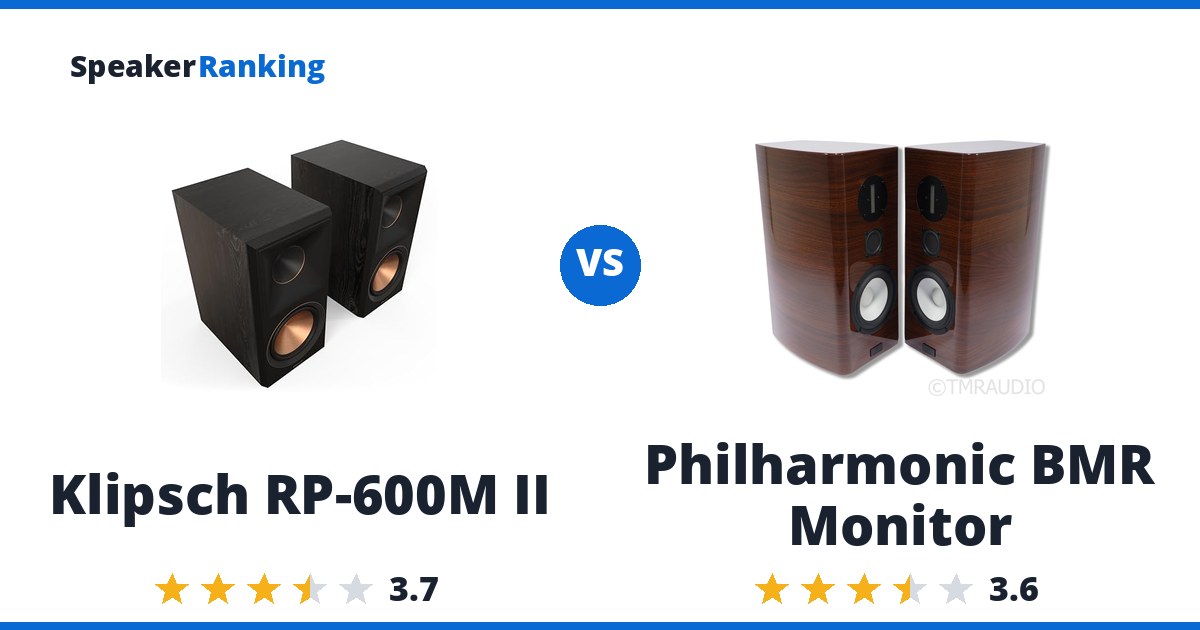
What the Klipsch RP-600M II offers: Redesigned waveguide extends flush to the baffle edge, reducing diffraction compared to the original RP-600M. Roughly 10-20° wider horizontal radiation than the original, giving more soundstage envelopment while retaining precise imaging. A major step up in overall tonal neutrality compared to the original RP-600M, largely eliminating that model’s midrange resonance issues. Unusually, sounds better with the grille on - the grille smooths out the elevated treble rather than degrading the sound, a rare trait among speakers the reviewer has tested. More refined back-panel hardware, including anodized binding posts and jumper cables for optional bi-amping. Responds well to EQ correction (verified using measurement software and a miniDSP), letting the on-axis response be made genuinely linear. Watch for: On-axis, the treble runs notably hot - even hotter than the original RP-600M in some respects - and needs about 20° of toe-out or the grille installed to sound balanced. Horizontal dispersion is very slightly less linear across angles than the original RP-600M, a minor trade-off for the wider overall radiation pattern. Klipsch’s marketed sensitivity (about 94.5dB) is, like the original, a half-space rating roughly 9dB above the anechoic reality (closer to 85-86dB). In-room bass rolls off around 60Hz in practice, and a 120Hz boost paired with a midrange scoop gives kick drums their “tambour” without real low-end weight - a subwoofer is still recommended. Vertical listening tolerance is limited to about ±10° from the tweeter axis. Toeing the speaker out for better on-axis tonality (rather than using the grille) introduces slightly more diffuse imaging from added sidewall reflections.
What the Philharmonic BMR Monitor offers: Three-way design combining a 6” SB Acoustics mid-woofer, a 2.5” Tectonic balanced-mode radiator (BMR) for the midrange, and a ribbon tweeter - premium component choices relative to the asking price. A clear improvement over the V1: the earlier version’s overly hot, plateauing treble has been resolved, leaving a genuinely good in-room response outside of one specific area. Extremely wide horizontal radiation of about ±70-80°, creating an enveloping, wide soundstage that illuminates the sidewalls. Well-built, attractive cabinet. Midrange and tweeter show no stress or elevated distortion even at higher output - all the compression and distortion issues trace back to the mid-woofer alone. Watch for: A 1-2dB bump around 2-3kHz creates a “glare” on vocals, guitars, and strings that the reviewer noticed consistently across many tracks. The extremely wide radiation trades off against imaging precision - instrument placement became noticeably more diffuse and harder to pinpoint in a narrower, more reflective room, though it improved substantially in a larger, more open room with less sidewall interaction. A suspected resonance around 500Hz shows up as an imbalance in sound power and horizontal directivity measurements, loosely correlating with a vague sense of resonance the reviewer heard subjectively. Moderate sensitivity (about 84.1dB anechoic) and a mid-woofer that runs out of steam under real stress - distortion exceeds 3% even at 100Hz at 96dB, and the reviewer notes SB Acoustics’ published excursion specs tend to overstate real-world linear excursion by nearly 2x. Significant compression appears at 102dB: the woofer audibly unloads around 120Hz, and the ribbon tweeter also compresses heavily at high output - not well suited to very loud two-channel listening (above about 90dB at 4 meters). In-room bass rolls off around 50Hz, so a subwoofer is recommended for most music. Benefits noticeably from a few bands of EQ if available.
Buy the Klipsch RP-600M II. It ranks higher for sound quality than the Philharmonic BMR Monitor and costs less, so there is no real case for the other one.
Still deciding? The full Passive Home rankings cover every ranked option.
Specifications Side By Side
| Klipsch RP-600M II | Philharmonic BMR Monitor | |
|---|---|---|
| Price | $449.99 per pair | $2200 per pair |
| Ranked | #74 of 130 in Large Size Bookshelf Speakers | #76 of 130 in Large Size Bookshelf Speakers |
| Bass Extension (-10dB) | 41Hz (measured, Erin's Audio Corner) | 32Hz (measured, Erin's Audio Corner) |
| Bass Extension (-3dB) | 70Hz (measured, Erin's Audio Corner) | 47Hz (measured, Erin's Audio Corner) |
| Dimensions | 15.7"H x 8"W x 12.5"D (398.8 x 203.2 x 317.5 mm) | 20"H x 8"W x 12.5"D (508 x 203.2 x 317.5 mm) |
| Impedance | 8 ohms nominal (3.5 ohms minimum above 80Hz, measured by Erin's Audio Corner) | 4 ohms nominal (3 ohms minimum above 80Hz, measured by Erin's Audio Corner) |
| Sensitivity | 86dB (measured, Erin's Audio Corner) | 84dB (measured, Erin's Audio Corner) |
| Drivers | 6.5" Cerametallic cone woofer, 1" titanium LTS vented tweeter with Tractrix horn | 6" Ceramic woofer, Balanced Mode Radiator 2.5" midrange, RAAL 64-10X OEM tweeter |
| Weight | 13 lbs (5.9 kg) each | 32 lbs (14.5 kg) each |
| Woofer Cabinet | ported | ported, rear |
| Spinorama Preference Score | 4.75 | - |
| Spinorama Preference Score with Perfect Sub | 6.88 | - |
Related Speaker Comparisons
More top alternatives to Klipsch RP-600M II:
- Klipsch RP-600M II vs KEF Reference 1 Meta
- Klipsch RP-600M II vs GR-Research NX-Studio
- Klipsch RP-600M II vs March Audio Sointuva AWG
- Klipsch RP-600M II vs AsciLab C6B
- Klipsch RP-600M II vs Audio First Cadentia 3
Prices on this page were last checked September 14, 2026 at 1:47 AM UTC. Product prices and availability are accurate as of that date/time and are subject to change; the price and availability shown on Amazon at the time of purchase will apply to the purchase of this product.
As an eBay Partner, we may be compensated if you make a purchase.
The Two Speakers In Full
 Klipsch RP-600M II: $449.99 per pair Amazon eBay
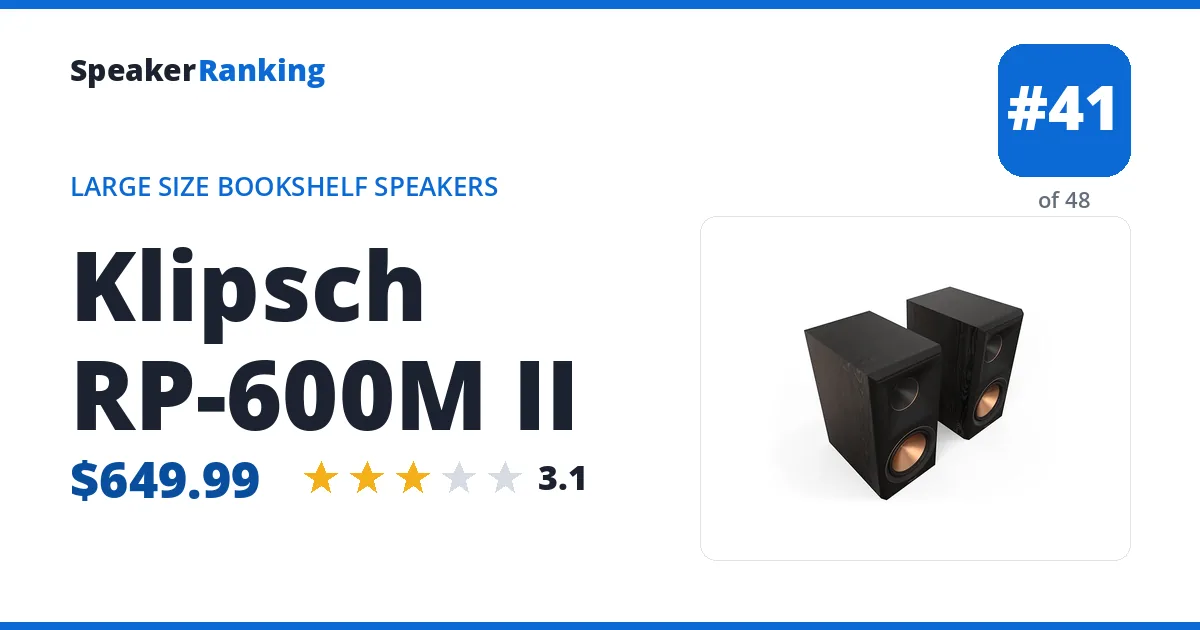
Pros: Redesigned waveguide extends flush to the baffle edge, reducing diffraction compared to the original RP-600M. Roughly 10-20° wider horizontal radiation than the original, giving more soundstage envelopment while retaining precise imaging. A major step up in overall tonal neutrality compared to the original RP-600M, largely eliminating that model’s midrange resonance issues. Unusually, sounds better with the grille on - the grille smooths out the elevated treble rather than degrading the sound, a rare trait among speakers the reviewer has tested. More refined back-panel hardware, including anodized binding posts and jumper cables for optional bi-amping. Responds well to EQ correction (verified using measurement software and a miniDSP), letting the on-axis response be made genuinely linear. Measured bass extension of 70Hz (-3dB), with a measured sensitivity of 86dB.
Cons: On-axis, the treble runs notably hot - even hotter than the original RP-600M in some respects - and needs about 20° of toe-out or the grille installed to sound balanced. Horizontal dispersion is very slightly less linear across angles than the original RP-600M, a minor trade-off for the wider overall radiation pattern. Klipsch’s marketed sensitivity (about 94.5dB) is, like the original, a half-space rating roughly 9dB above the anechoic reality (closer to 85-86dB). In-room bass rolls off around 60Hz in practice, and a 120Hz boost paired with a midrange scoop gives kick drums their “tambour” without real low-end weight - a subwoofer is still recommended. Vertical listening tolerance is limited to about ±10° from the tweeter axis. Toeing the speaker out for better on-axis tonality (rather than using the grille) introduces slightly more diffuse imaging from added sidewall reflections.
Full Klipsch RP-600M II review and specifications →
| Bass Extension (-10dB) | 41Hz (measured, Erin's Audio Corner) |
|---|---|
| Bass Extension (-3dB) | 70Hz (measured, Erin's Audio Corner) |
| Dimensions | 15.7"H x 8"W x 12.5"D (398.8 x 203.2 x 317.5 mm) |
| Drivers | 6.5" Cerametallic cone woofer, 1" titanium LTS vented tweeter with Tractrix horn |
| Impedance | 8 ohms nominal (3.5 ohms minimum above 80Hz, measured by Erin's Audio Corner) |
| Sensitivity | 86dB (measured, Erin's Audio Corner) |
| Spinorama Preference Score | 4.75 |
| Spinorama Preference Score with Perfect Sub | 6.88 |
| Weight | 13 lbs (5.9 kg) each |
| Woofer Cabinet | ported |
- Links
- Reviews, Comparisons and Sound Samples
- Erin’s Audio Corner: The Truth about Klipsch’s “NEW” Sound. RP-600M Update. More from Erin’s Audio Corner →
- Erin’s Audio Corner Website Klipsch RP-600M II
- GR-Research: We Bought The "NEW" RP-600M II Is KLIPSCH Listening?! More from GR-Research →
- Erin’s Audio Corner: 5 AWESOME SPEAKERS Under $1000 You Won’t Regret
- Erin’s Audio Corner Measurements (spinorama.org)
- Head-to-Head Comparisons
- Klipsch RP-600M II vs Dynaudio Emit 20
- Klipsch RP-600M II vs JBL Studio 630
- Klipsch RP-600M II vs Behringer B2030P
- Klipsch RP-600M II vs Ascend CBM-170 SE2
- Klipsch RP-600M II vs Infinity Reference R162
- Klipsch RP-600M II vs GR-Research X-LS Encore
- Klipsch RP-600M II vs Infinity IL10
- Klipsch RP-600M II vs Buchardt S400 MKII
- See all 72 comparisons
 Philharmonic BMR Monitor: $2200 per pair Philharmonicaudio eBay
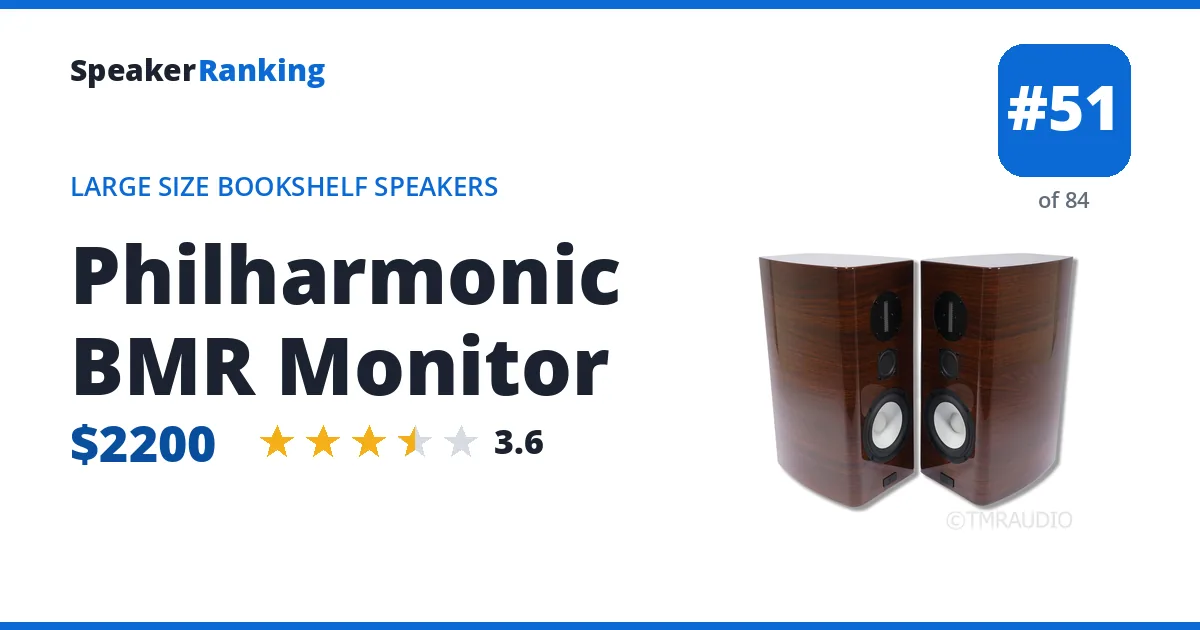
Pros: Three-way design combining a 6” SB Acoustics mid-woofer, a 2.5” Tectonic balanced-mode radiator (BMR) for the midrange, and a ribbon tweeter - premium component choices relative to the asking price. A clear improvement over the V1: the earlier version’s overly hot, plateauing treble has been resolved, leaving a genuinely good in-room response outside of one specific area. Extremely wide horizontal radiation of about ±70-80°, creating an enveloping, wide soundstage that illuminates the sidewalls. Well-built, attractive cabinet. Midrange and tweeter show no stress or elevated distortion even at higher output - all the compression and distortion issues trace back to the mid-woofer alone. Measured bass extension of 47Hz (-3dB), with a measured sensitivity of 84dB.
Cons: A 1-2dB bump around 2-3kHz creates a “glare” on vocals, guitars, and strings that the reviewer noticed consistently across many tracks. The extremely wide radiation trades off against imaging precision - instrument placement became noticeably more diffuse and harder to pinpoint in a narrower, more reflective room, though it improved substantially in a larger, more open room with less sidewall interaction. A suspected resonance around 500Hz shows up as an imbalance in sound power and horizontal directivity measurements, loosely correlating with a vague sense of resonance the reviewer heard subjectively. Moderate sensitivity (about 84.1dB anechoic) and a mid-woofer that runs out of steam under real stress - distortion exceeds 3% even at 100Hz at 96dB, and the reviewer notes SB Acoustics’ published excursion specs tend to overstate real-world linear excursion by nearly 2x. Significant compression appears at 102dB: the woofer audibly unloads around 120Hz, and the ribbon tweeter also compresses heavily at high output - not well suited to very loud two-channel listening (above about 90dB at 4 meters). In-room bass rolls off around 50Hz, so a subwoofer is recommended for most music. Benefits noticeably from a few bands of EQ if available.
Full Philharmonic BMR Monitor review and specifications →
| Bass Extension (-10dB) | 32Hz (measured, Erin's Audio Corner) |
|---|---|
| Bass Extension (-3dB) | 47Hz (measured, Erin's Audio Corner) |
| Dimensions | 20"H x 8"W x 12.5"D (508 x 203.2 x 317.5 mm) |
| Drivers | 6" Ceramic woofer, Balanced Mode Radiator 2.5" midrange, RAAL 64-10X OEM tweeter |
| Impedance | 4 ohms nominal (3 ohms minimum above 80Hz, measured by Erin's Audio Corner) |
| Sensitivity | 84dB (measured, Erin's Audio Corner) |
| Weight | 32 lbs (14.5 kg) each |
| Woofer Cabinet | ported, rear |
- Links
- Reviews, Comparisons and Sound Samples
- Head-to-Head Comparisons