Short answer: the Kanto ORA4. It ranks #12 of 47 powered bookshelf speakers by sound quality, rated 3.8/5, at $449.99. The Edifier M90 ranks #23, rated 3.3/5, at $369.99, $80 cheaper, not enough of a saving to outweigh the sound-quality gap.
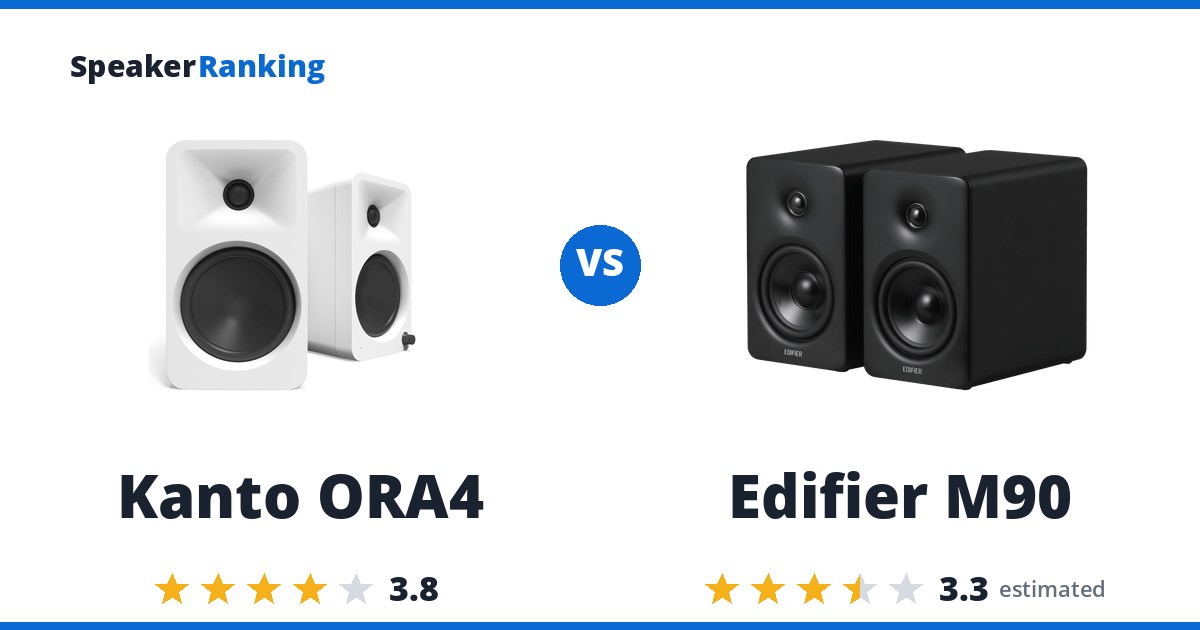
The Kanto ORA4 is the better-sounding option. Compact powered desktop speakers with 4-inch aluminum-cone woofers and 3/4-inch silk-dome tweeters in waveguides, bi-amplified with 70W RMS in total. Watch for: Its score here is our estimate: spinorama.org hasn’t published numeric data for it yet, so we traced Erin’s Audio Corner’s published charts, which put its preference score with an ideal subwoofer at roughly 6.9, level with the better small powered speakers but short of the best.
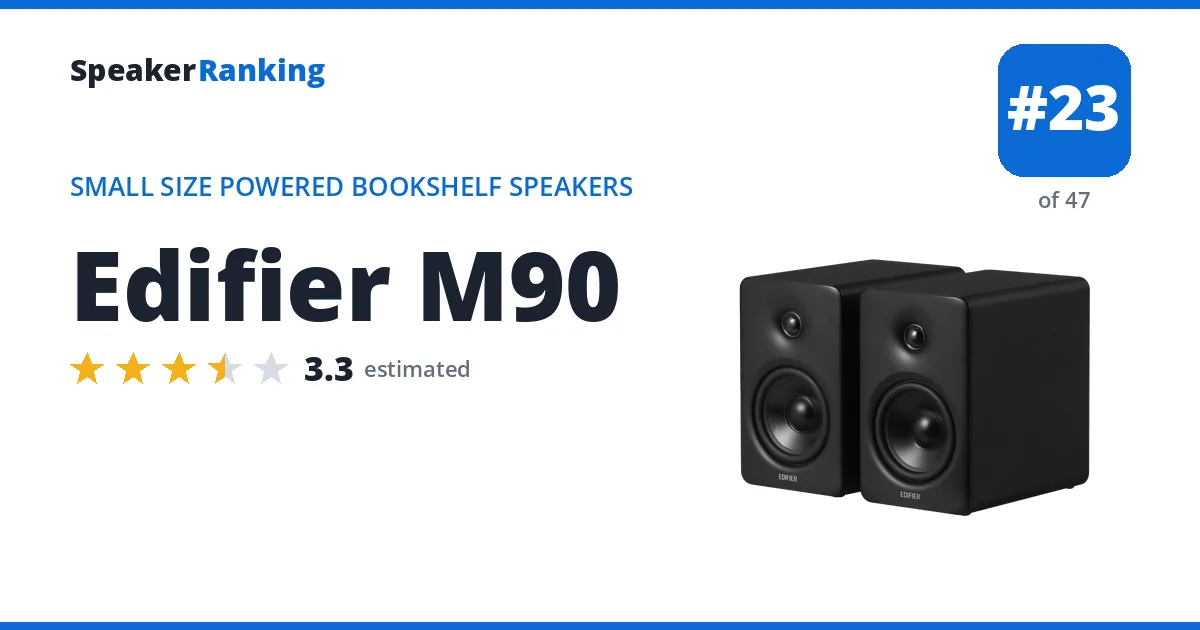
What the Edifier M90 does well: A bi-amped two-way pair with a 4” long-throw aluminum mid-bass driver and a 1” silk dome tweeter per side, driven by 100W RMS in total (35W to each woofer, 15W to each tweeter). It supports LDAC Bluetooth, which the Kanto ORA4 lacks. It keeps a wired aux input, which the Kanto ORA4 lacks. The catch: No independent anechoic or Spinorama measurements have been published yet, so its tonal balance and directivity can’t be compared with ranked speakers.
Buy the Kanto ORA4. It is rated higher for sound quality, and saving $80 with the Edifier M90 does not make up for the sound-quality gap.
About the ratings: the Edifier M90’s rating is estimated from measured siblings and predecessors rather than its own measurements, with a likely range of 3.1 to 3.5, so this verdict could change once it is measured.
Still deciding? The full Powered Home rankings cover every ranked option.
Specifications Side By Side
| Kanto ORA4 | Edifier M90 | |
|---|---|---|
| Price | $449.99 per pair | $369.99 per pair |
| Ranked | #12 of 47 in Small Size Powered Bookshelf Speakers | #23 of 47 in Small Size Powered Bookshelf Speakers Estimated |
| Weight | 4.4 lbs (2 kg) | 13.3 lbs (6.05 kg) |
| Dimensions | 8.3”H x 4.7”W x 6.7”D (211 x 120 x 170 mm) | 8.3”H x 5.2”W x 8.9”D (212 x 133 x 225 mm) |
| Amplifier Power | 70W RMS total (140W peak) per pair | 100W RMS total (2x 35W woofer, 2x 15W tweeter) |
| Drivers | 3/4” silk dome tweeter, 4” aluminum cone woofer | 4” aluminum woofer, 1” silk dome tweeter |
| Frequency Response | 60Hz - 22kHz (Manufacturer specified) | 50Hz - 40kHz (Manufacturer specified) |
| Inputs | RCA, USB-C, Bluetooth | HDMI eARC, Optical, USB-C, Aux, Bluetooth |
| RCA Input | Yes | No |
| USB Input | Yes (USB-C) | Yes |
| Optical Input | No | Yes |
| Coaxial Input | No | No |
| HDMI Input | No | Yes (eARC) |
| XLR Input | No | No |
| Aux Input | No | Yes |
| Bluetooth | Yes | Yes |
| Bluetooth Version | 5.0 | 6.0 |
| Bluetooth Codecs | SBC | SBC, LDAC |
| Subwoofer Output | Yes (automatic 80Hz crossover) | Yes |
| Bass Extension (-3dB) | 54Hz (measured, Erin’s Audio Corner charts) | - |
| Bass Extension (-10dB) | 43Hz (measured, Erin’s Audio Corner charts) | - |
| AES Input | - | No |
| App | - | Yes (Edifier ConneX) |
| EQ | - | Yes |
| TRS Input | - | No |
Related Speaker Comparisons
How Kanto ORA4 compares with other leading options:
- Kanto ORA4 vs ADAM Audio D3v
- Kanto ORA4 vs Edifier M60
- Airpulse A60 vs Kanto ORA4
- Kanto ORA4 vs Kanto ORA
- Kanto ORA4 vs Kanto YU4
Prices on this page were last checked October 14, 2026 at 2:38 PM UTC. Product prices and availability are accurate as of that date/time and are subject to change; the price and availability shown on Amazon at the time of purchase will apply to the purchase of this product.
As an eBay Partner, we may be compensated if you make a purchase.
The Two Speakers In Full
 Kanto ORA4: $449.99 per pair Amazon $449.99 eBay

Same family: the Kanto ORA (smaller bookshelf, ranked lower, rated 3.7/5).
Pros: Compact powered desktop speakers with 4-inch aluminum-cone woofers and 3/4-inch silk-dome tweeters in waveguides, bi-amplified with 70W RMS in total. Erin’s Audio Corner’s Klippel measurements show a well-behaved design for the size: the listening window stays within about a 4.5dB span from 300Hz to 5kHz and tracks the on-axis response closely, and the predicted in-room response is smooth. Bass goes deeper than most desktop speakers, to about 54Hz at -3dB and 43Hz at -10dB, and a subwoofer output with an automatic 80Hz crossover makes adding one easy. Inputs cover RCA, USB-C audio and Bluetooth 5.0. Measured bass extension of 54Hz (-3dB).
Cons: Its score here is our estimate: spinorama.org hasn’t published numeric data for it yet, so we traced Erin’s Audio Corner’s published charts, which put its preference score with an ideal subwoofer at roughly 6.9, level with the better small powered speakers but short of the best. Treble sits slightly above the midrange, and there is no optical input. Kanto’s own rating stops at 60Hz, so a subwoofer still helps for deep bass at higher volumes.
Full Kanto ORA4 review and specifications →
| Released | Apr 2024 (2 years ago) |
|---|---|
| Amplifier Power | 70W RMS total (140W peak) per pair |
| Aux Input | No |
| Bass Extension (-10dB) | 43Hz (measured, Erin’s Audio Corner charts) |
| Bass Extension (-3dB) | 54Hz (measured, Erin’s Audio Corner charts) |
| Bluetooth | Yes |
| Bluetooth Codecs | SBC |
| Bluetooth Version | 5.0 |
| Coaxial Input | No |
| Dimensions | 8.3”H x 4.7”W x 6.7”D (211 x 120 x 170 mm) |
| Drivers | 3/4” silk dome tweeter, 4” aluminum cone woofer |
| Frequency Response | 60Hz - 22kHz (Manufacturer specified) |
| HDMI Input | No |
| Inputs | RCA, USB-C, Bluetooth |
| Optical Input | No |
| RCA Input | Yes |
| Subwoofer Output | Yes (automatic 80Hz crossover) |
| USB Input | Yes (USB-C) |
| Weight | 4.4 lbs (2 kg) |
| XLR Input | No |
- Links
- Reviews, Comparisons and Sound Samples
- Head-to-Head Comparisons
 Edifier M90: $369.99 per pair Amazon $369.99 eBay
Same family: the Edifier M60 (smaller bookshelf, ranked higher, rated 4/5).
Pros: A bi-amped two-way pair with a 4” long-throw aluminum mid-bass driver and a 1” silk dome tweeter per side, driven by 100W RMS in total (35W to each woofer, 15W to each tweeter). The most connected Edifier desktop pair yet: HDMI eARC with TV remote control over CEC, optical, USB-C, aux and Bluetooth 6.0 with LDAC, plus a subwoofer output for a 2.1 setup. Three sound presets on the included 2.4GHz remote and custom EQ in the Edifier ConneX app. Edifier rates the response down to 50Hz, against 55Hz for the smaller Edifier M60.
Cons: No independent anechoic or Spinorama measurements have been published yet, so its tonal balance and directivity can’t be compared with ranked speakers. The only measurement so far is an in-room reading at the listening position (Pragmatic Audio), which showed bass reaching about 50 to 60Hz with a DSP limiter controlling the roll-off. A 4” woofer still needs a subwoofer for deep bass. It costs close to twice as much as the Edifier M60, and TechRadar found its output falls short of some rivals at the price.
Full Edifier M90 review and specifications →
| Released | 2026 (this year) |
|---|---|
| AES Input | No |
| Amplifier Power | 100W RMS total (2x 35W woofer, 2x 15W tweeter) |
| App | Yes (Edifier ConneX) |
| Aux Input | Yes |
| Bluetooth | Yes |
| Bluetooth Codecs | SBC, LDAC |
| Bluetooth Version | 6.0 |
| Coaxial Input | No |
| Dimensions | 8.3”H x 5.2”W x 8.9”D (212 x 133 x 225 mm) |
| Drivers | 4” aluminum woofer, 1” silk dome tweeter |
| EQ | Yes |
| Frequency Response | 50Hz - 40kHz (Manufacturer specified) |
| HDMI Input | Yes (eARC) |
| Inputs | HDMI eARC, Optical, USB-C, Aux, Bluetooth |
| Optical Input | Yes |
| RCA Input | No |
| Subwoofer Output | Yes |
| TRS Input | No |
| USB Input | Yes |
| Weight | 13.3 lbs (6.05 kg) |
| XLR Input | No |
- Links
- Reviews, Comparisons and Sound Samples
- Head-to-Head Comparisons