Short answer: the JBL 4367 if you want full-range bass without a sub, the Revel Concerta2 F35 if the room is smaller. The F35 is a two-and-a-half-way, four-driver tower with a 1” aluminum dome tweeter on a waveguide and dual 5.25” mid-bass drivers, but its F3 of 61Hz and F10 of 39Hz mean a subwoofer is needed for real bass extension. The 4367’s 15” front-ported woofer and horn-loaded compression driver cost about $16,500 per pair.
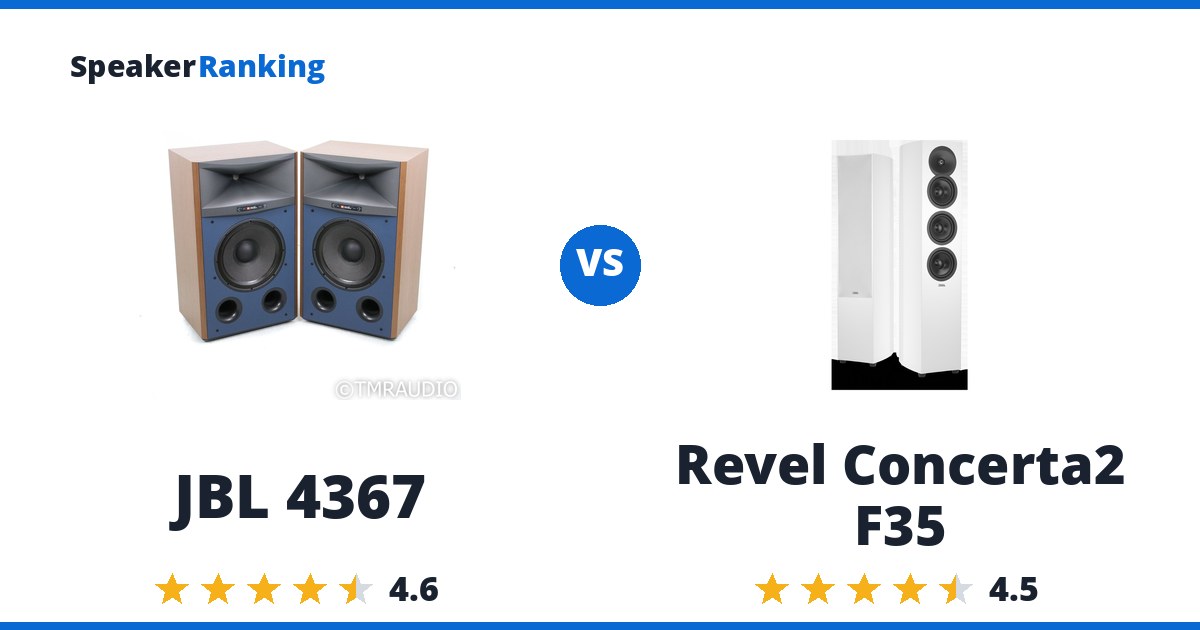
Buy the Revel Concerta2 F35 if you want one new; the JBL 4367 is discontinued, so only look for it used.
Looking for alternatives? See the complete Passive Home rankings.
Specifications Side By Side
| JBL 4367 | Revel Concerta2 F35 | |
|---|---|---|
| Price | $16,500 per pair Discontinued | $900 per pair |
| Ranked | #11 of 74 in Large Size Floorstanding Speakers | #19 of 74 in Large Size Floorstanding Speakers |
| Bass Extension (-10dB) | 31Hz (measured, Erin’s Audio Corner) | 50Hz (measured, Erin’s Audio Corner) |
| Bass Extension (-3dB) | 43Hz (measured, Erin’s Audio Corner) | 70Hz (measured, Erin’s Audio Corner) |
| Dimensions | 37.2”H x 22.2”W x 16.8”D (944.9 x 563.9 x 426.7 mm) | 40.3”H x 8.4”W x 12.2”D (1023.6 x 213.4 x 309.9 mm) |
| Impedance | 4 ohms nominal (5.3 ohms minimum above 80Hz, measured by Erin’s Audio Corner) | 6 ohms nominal (3.8 ohms minimum, measured by Erin’s Audio Corner) |
| Sensitivity | 92.5dB (measured average, Erin’s Audio Corner) | 89.4dB (measured, Erin’s Audio Corner; 90dB manufacturer specified) |
| Drivers | 15” (380mm) 2216Nd-1 Dual Differential Drive® woofer, 3” (75mm) D2430K dual compression tweeter | 3x 5.25” deep anodized aluminum cone woofers, 1” Aluminum Tweeter |
| Weight | 119 lbs (54 kg) each | 41 lbs (18.6 kg) each |
| Woofer Cabinet | ported, front | ported, rear |
| Spinorama Preference Score | 5.07 | 5.35 |
| Spinorama Preference Score with Perfect Sub | 6.88 | 7.30 |
| DIY Kit | No | No |
Related Speaker Comparisons
More top alternatives to JBL 4367:
- KEF Blade Two Meta vs JBL 4367
- MoFi SourcePoint V10 Master Edition vs JBL 4367
- JBL 4367 vs MoFi SourcePoint 888
- Revel F328Be vs JBL 4367
- Radiant Acoustics Clarity 66 vs JBL 4367
Prices on this page were last checked October 2, 2026 at 10:18 PM UTC. Product prices and availability are accurate as of that date/time and are subject to change; the price and availability shown on Amazon at the time of purchase will apply to the purchase of this product.
As an eBay Partner, we may be compensated if you make a purchase.
The Two Speakers In Full
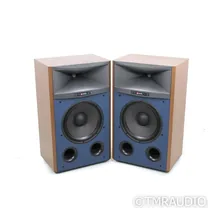 JBL 4367: $16,500 per pair Discontinued eBay
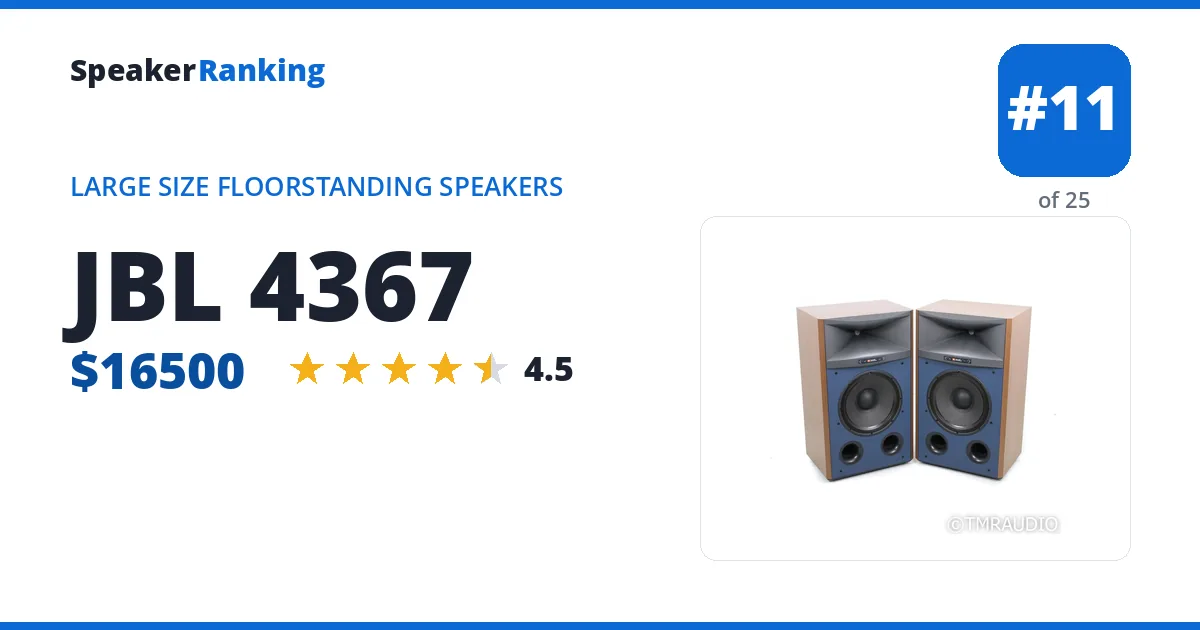
Newer model: the JBL 4369. It’s likely to perform similarly, though we don’t have measurements to confirm that yet.
Pros: Three-way design pairing a 15” front-ported woofer with a compression driver on a controlled-dispersion horn/waveguide, crossed over at 700Hz. On-axis frequency response is nearly dead flat, holding within about ±1.5dB, with the listening window tracking it closely except right at the crossover. Distortion stays below 1% THD across the entire audible band at both 86dB and 96dB. Compression/dynamic-range linearity is exceptional: within about a quarter of a dB from 76dB to 102dB, among the best the reviewer has measured. High sensitivity (about 92.6dB average) eases the amplifier match despite the speaker’s size. Minimal rear radiation thanks to the 15” woofer’s directivity and front-firing ports: rear energy runs about 20dB down from the primary wavefront, giving it a near-cardioid radiation pattern. Well-controlled horn directivity keeps the soundstage from noticeably shifting in width across the 700Hz crossover region. A natural high-frequency rolloff above about 7-8kHz gives it an easy, non-fatiguing character for extended listening sessions. Measured bass extension of 43Hz (-3dB), with a measured sensitivity of 92.5dB.
Cons: At roughly $16500/pair, this is a major investment: the reviewer recommends buying from a dealer with a liberal return policy. Vertical response shows dips beyond about ±10-20°, with a larger null further out: an inherent trade-off of mating a 15” woofer to a horn compression driver at a 700Hz crossover, since crossing lower would hurt power handling and dynamic range. Horizontal directivity isn’t perfectly consistent with frequency: narrow (about ±20°) through 200-800Hz, briefly widening to near ±50° above the crossover, then narrowing again at high frequency. An unusual, non-constant pattern. The high-frequency rolloff that gives it an easy-listening character also reduces the sense of air and space in the soundstage when listening from off-center seats. Massive and heavy (about 120 lbs, roughly 36-37” tall): needs to be raised on a stand to bring the horn to ear level, and isn’t something one person easily moves alone. Only modest EQ adjustment is available on the speaker itself (about ±1-2dB bass/treble trim). Discontinued.
Full JBL 4367 review and specifications →
| Bass Extension (-10dB) | 31Hz (measured, Erin’s Audio Corner) |
|---|---|
| Bass Extension (-3dB) | 43Hz (measured, Erin’s Audio Corner) |
| DIY Kit | No |
| Dimensions | 37.2”H x 22.2”W x 16.8”D (944.9 x 563.9 x 426.7 mm) |
| Drivers | 15” (380mm) 2216Nd-1 Dual Differential Drive® woofer, 3” (75mm) D2430K dual compression tweeter |
| Impedance | 4 ohms nominal (5.3 ohms minimum above 80Hz, measured by Erin’s Audio Corner) |
| Sensitivity | 92.5dB (measured average, Erin’s Audio Corner) |
| Spinorama Preference Score | 5.07 |
| Spinorama Preference Score with Perfect Sub | 6.88 |
| Weight | 119 lbs (54 kg) each |
| Woofer Cabinet | ported, front |
- Links
- Reviews, Comparisons and Sound Samples
- Head-to-Head Comparisons
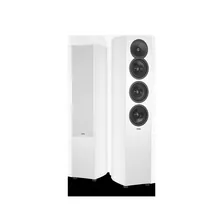 Revel Concerta2 F35: $900 per pair Crutchfield eBay
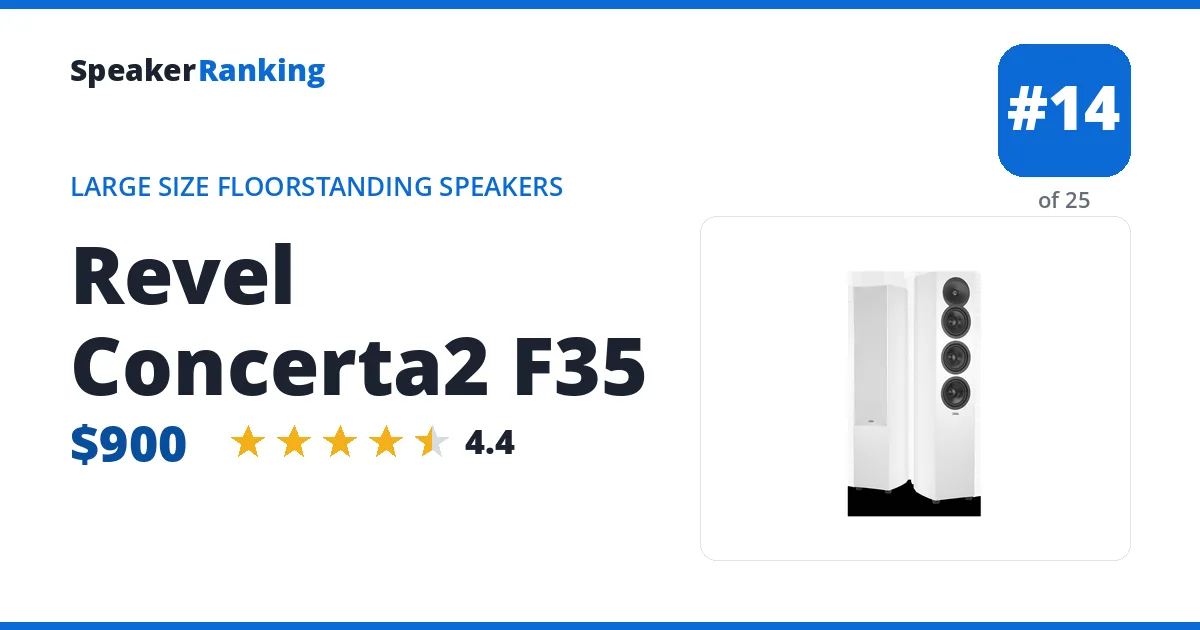
Pros: Two-and-a-half-way, four-driver design: a 1” aluminum dome tweeter on a waveguide, a 5.25” mid-range, and dual 5.25” mid-bass drivers in a rear-ported cabinet. Measured sensitivity of 89.4dB closely matches the 90dB spec, and distortion looks good at both 86dB and 96dB, holding up well even with a high-pass filter applied. At its sale price of $900/pair, down from full retail, the reviewer calls it a “no-brainer,” undercutting comparable budget floorstanders like the ELAC DF63. Frequency response and directivity mismatches are largely EQ-able, since most of what shows up in measurements traces to physical tweeter/mid-range separation rather than a fundamental flaw. Compression is fairly well controlled for the price: about 1dB of loss around 100Hz under long-term compression, described as “par for the course” at this cost. Measured bass extension of 70Hz (-3dB), with a measured sensitivity of 89.4dB.
Cons: F3 of 61Hz and F10 of 39Hz mean a subwoofer is needed for real bass extension. A dip in the lower midrange/2-3kHz region reduces attack and detail, and a peak around 5kHz adds some edge and sibilance in the lower treble. A peak in off-axis energy around 3kHz reflects off sidewalls at roughly 60-70° off-axis and arrives louder than the direct sound: this specific issue can’t be fixed with EQ (boosting the direct sound would boost the stronger reflection too) and would need acoustic absorption to properly address, though the reviewer considers it a minor, optional fix at this price. A couple of minor resonances appear in the impedance plot, including one around 300Hz that may partly explain a subtle sense of vocal warmth noticed in listening, though it’s more likely room-related. Minimum impedance around 3.8 ohms. Short-term compression testing shows some increased distortion in the tweeter and higher-frequency compression at loud output.
Full Revel Concerta2 F35 review and specifications →
| Bass Extension (-10dB) | 50Hz (measured, Erin’s Audio Corner) |
|---|---|
| Bass Extension (-3dB) | 70Hz (measured, Erin’s Audio Corner) |
| DIY Kit | No |
| Dimensions | 40.3”H x 8.4”W x 12.2”D (1023.6 x 213.4 x 309.9 mm) |
| Drivers | 3x 5.25” deep anodized aluminum cone woofers, 1” Aluminum Tweeter |
| Impedance | 6 ohms nominal (3.8 ohms minimum, measured by Erin’s Audio Corner) |
| Sensitivity | 89.4dB (measured, Erin’s Audio Corner; 90dB manufacturer specified) |
| Spinorama Preference Score | 5.35 |
| Spinorama Preference Score with Perfect Sub | 7.30 |
| Weight | 41 lbs (18.6 kg) each |
| Woofer Cabinet | ported, rear |
- Links
- Reviews, Comparisons and Sound Samples
- Audio Science Review Revel Concerta2 F35 More from Audio Science Review →
- Erin’s Audio Corner: Revel F35 Review: Great Sound, Lower Price! More from Erin’s Audio Corner →
- Erin’s Audio Review Website Revel Concerta2 F35
- Audio Science Review Measurements (spinorama.org)
- Erin’s Audio Corner: You’ve Never Seen a Review Like This. Revel F35 Review (Part 1).
- Head-to-Head Comparisons
- Revel Concerta2 F35 vs Revel F206
- Revel Concerta2 F35 vs Perlisten S7t
- Revel Concerta2 F35 vs Revel F228Be
- Revel Concerta2 F35 vs Revel F208
- Revel Concerta2 F35 vs KEF R5
- Revel Concerta2 F35 vs Focal Chora 816
- Revel Concerta2 F35 vs JBL HDI-3800
- Revel Concerta2 F35 vs KEF R11 Meta
- See all 56 comparisons