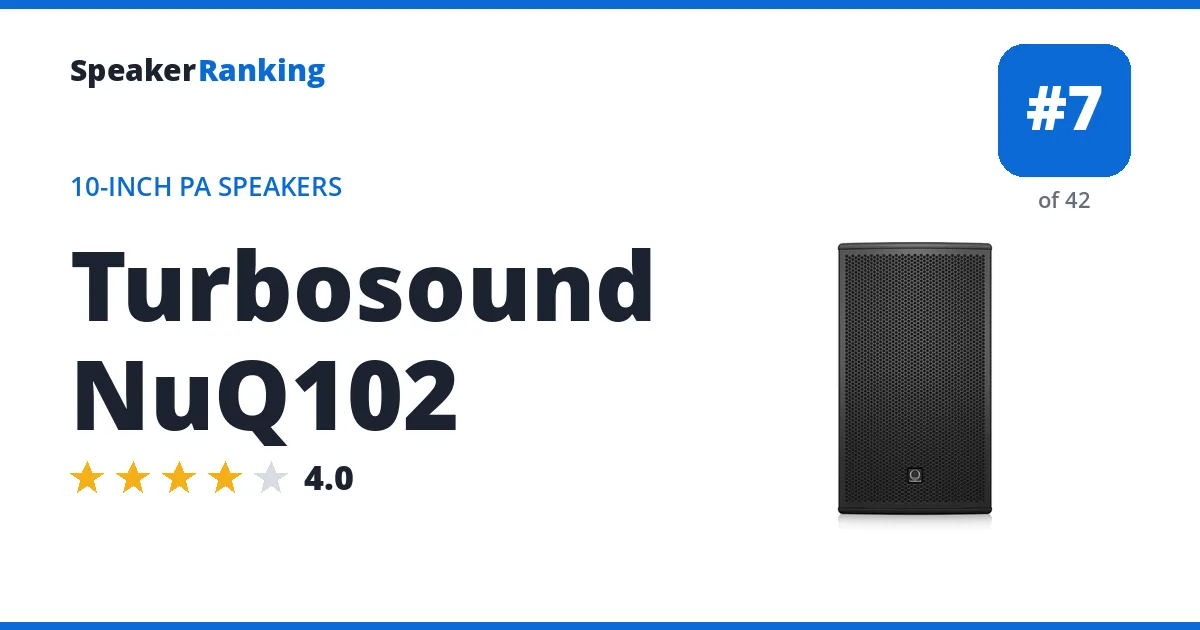
The Turbosound NuQ102 is rated 4/5 for sound quality, #7 of 42 10-Inch PA Speakers. See all PA & Live Sound rankings for every top pick.
Prices on this page were last checked October 24, 2026 at 4:42 PM UTC. Product prices and availability are accurate as of that date/time and are subject to change; the price and availability shown on Amazon at the time of purchase will apply to the purchase of this product.
As an eBay Partner, we may be compensated if you make a purchase.
Brand: Turbosound
#7 Turbosound NuQ102: $530 Passive Discontinued eBay
Same family: the Turbosound NuQ62 (smaller model, rated 3.6/5), the Turbosound NuQ82 (smaller model, rated 4.1/5), the Turbosound NuQ122 (larger model, rated 3.5/5) and the Turbosound NuQ152 (larger model, rated 3.7/5).
Pros: A passive coaxial 10 inch PA speaker with wide, even coverage and good sound for installers who choose their own amplifier. Low-quality vendor data still shows a 5.5 ideal-subwoofer preference score with 63Hz measured extension. The coaxial point-source design gives symmetric 100° x 60° coverage, and being passive keeps amplification and DSP choices flexible for installers. Measured bass extension of 69Hz (-3dB).
Cons: Being passive, it needs an external amplifier and crossover to work at all, and its 124dB peak claim trails every active speaker in this ranking. Discontinued.
Is the Turbosound NuQ102 right for you?
Buy it if
- you can use EQ: our neutral preset raises its predicted score by about 1.1.
Skip it if
- you want to buy it new: it is discontinued.
| AES Input | No |
|---|---|
| Amplifier Power | Passive/bi-amp speaker; use external amplification within the 300W continuous / 1,200W peak handling rating |
| Aux Input | No |
| Bass Extension (-3dB) | 69Hz (measured, vendor Spinorama data) |
| Bluetooth | No |
| Cabinet Material | 12mm birch plywood |
| Coaxial Input | No |
| Configuration | Passive 2-way coaxial PA speaker |
| Coverage | 100° x 60° |
| DSP | Yes, Klark Teknik DSP with dynamic EQ, limiting, position compensation, user EQ and subwoofer integration; LCD/rotary control plus USB for PC remote control |
| Dimensions | 20.7”H x 12.5”W x 10.2”D (525 x 318 x 258 mm) |
| Drivers | 10” coaxial woofer, compression driver |
| Frequency Response | 55Hz - 18kHz (±3dB, manufacturer specified); 50Hz - 20kHz (-10dB) |
| Guitar Input | No |
| HDMI Input | No |
| Inputs | Two Neutrik speakON NL4 connectors |
| Maximum SPL | 124dB peak (manufacturer specified) |
| Microphone Input | No |
| Optical Input | No |
| Passive | Yes |
| Power Handling | 300W continuous / 1,200W peak (IEC, manufacturer specified) |
| RCA Input | No |
| Rigging | Eight M10, three M8 and four M6 fly points |
| Spinorama Preference Score | 2.72 |
| Spinorama Preference Score with Perfect Sub | 5.47 |
| TRS Input | No |
| USB Input | No |
| Weight | 28 lbs (12.7 kg) |
| XLR Input | No |
- Links
- Reviews, Comparisons and Sound Samples
Frequency Response
How the Turbosound NuQ102 measures across the audible range. A flatter listening window (the sound arriving straight at you) is more neutral: peaks sound forward or harsh, dips sound recessed. The estimated in-room response adds what a typical room does, and there a gentle, even tilt down toward the treble is ideal. Both curves are shifted so their 300 Hz to 3 kHz average sits at 0 dB.
Measurement data: spinorama.org, measured by the manufacturer.
EQ for a Neutral Response
Flattens the measured listening window from the Turbosound NuQ102's own bass extension up to 16 kHz. Set a preamp of -3.1 dB, then add these filters to any parametric equalizer in the signal path: the speaker's app or DSP if it has parametric EQ, a miniDSP, Equalizer APO or Wavelet. Boosts are kept to 3 dB, and EQ cannot fix how evenly the speaker spreads sound off-axis, which is why some speakers gain more than others. Predicted preference score with this EQ: 3.7, up from 2.7 (6.5 with an ideal subwoofer, up from 5.5). Calculated by Speaker Ranking from the spinorama measurements above.
| Filter | Frequency | Gain | Q |
|---|---|---|---|
| Peak | 163 Hz | -4.2 dB | 0.89 |
| Peak | 426 Hz | -2.0 dB | 3.10 |
| Peak | 1,259 Hz | -2.5 dB | 4.00 |
| Peak | 2,582 Hz | +3.0 dB | 1.25 |
| Peak | 5,167 Hz | +1.1 dB | 2.10 |
| Peak | 7,219 Hz | -1.8 dB | 4.00 |
| Peak | 12,491 Hz | -3.0 dB | 2.25 |