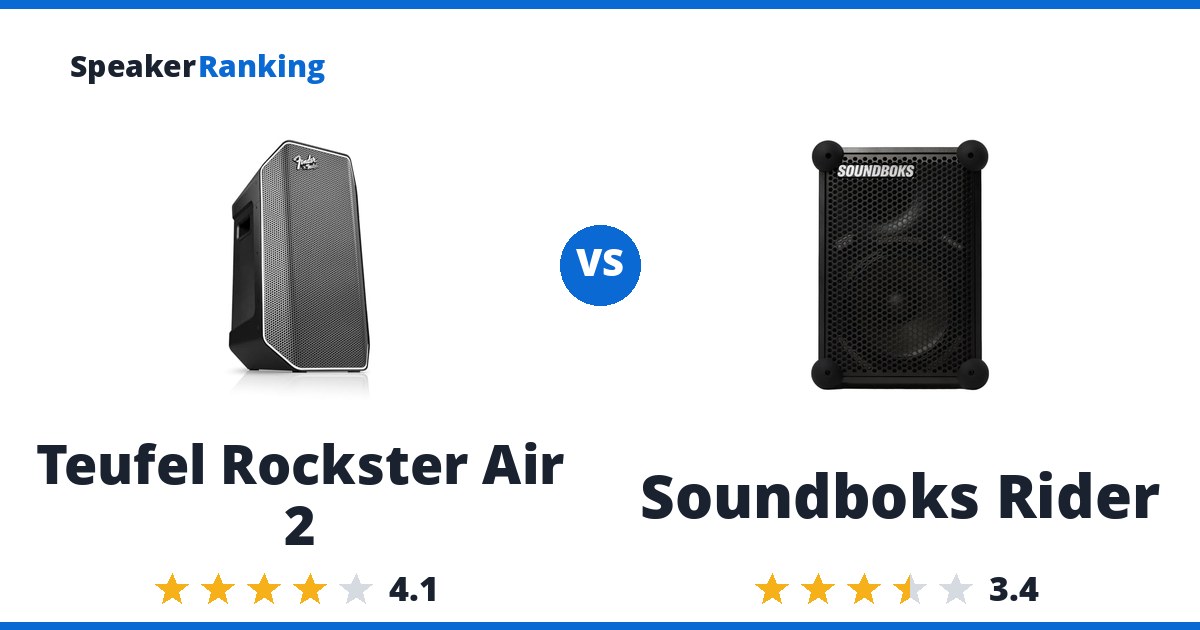
These sit in different size classes, so this is not a straight ranking comparison. The Teufel Rockster Air 2 ranks #5 of 14 battery-powered PA speakers by sound quality at $499.99; the Soundboks Rider ranks #26 of 43 party speakers by sound quality at $599.
The case for the Teufel Rockster Air 2: More consistent off-axis sound than the JBL Partybox 130, thanks to its single horn-loaded compression driver. Watch for: Bass isn’t as deep as the JBL Partybox 130’s boosted bass, though the JBL’s is boomy rather than truly deep.
What the Soundboks Rider does well: At 6.5 kg it is the lightest Soundboks yet, with a carry handle, IP66 dust and water protection, and the same swappable 100Wh battery as the Mix and Soundboks 4, rated for 35 hours at mid volume and 8 hours at maximum. The catch: Its sealed 8in woofer runs out of real bass at high volume: Xander measured the -6 dB point rising to roughly 75 to 85 Hz at maximum, with 40 Hz some 20 dB down, and M1M heard the bass pulled back toward the upper bass above mid volume.
Buy the Teufel Rockster Air 2 at $499.99 if you want a battery-powered PA speaker. Buy the Soundboks Rider at $599 if you want a party speaker instead.
Battery life favors the Teufel Rockster Air 2: rated for 58 hours against 35 hours for the Soundboks Rider.
There is a real gap in water resistance: the Soundboks Rider at IP66 (powerful water jets) against the Teufel Rockster Air 2, which has no water resistance.
Looking for alternatives? See the complete PA & Live Sound rankings and Portable Bluetooth rankings.
Specifications Side By Side
| Teufel Rockster Air 2 | Soundboks Rider | |
|---|---|---|
| Price | $499.99 | $599.00 |
| Ranked | #5 of 14 in Battery-Powered PA Speakers | #26 of 43 in Party Size Portable Bluetooth Speakers |
| App | No | Yes (Soundboks) |
| Aux Input | Yes | Yes |
| Battery Life | 58 hours (Manufacturer specified) | 35 hours (Manufacturer specified) |
| Bluetooth Codecs | SBC, AAC, aptX, aptX HD | - |
| Bluetooth Version | 5.0 | - |
| Dimensions | 12.7” x 23.2” x 13.5” (323 x 589 x 343 mm) | - |
| EQ | No | Yes (6-band EQ + Bass+, Indoor and Outdoor profiles) |
| IP Rating | None | IP66 |
| Inputs | XLR microphone, 6.3mm instrument, 3.5mm stereo, Bluetooth | - |
| Party Mode | Yes (Party Link Stereo, 2 speakers; XLR chaining up to 10) | No (no TeamUp) |
| Power Bank | Yes (USB-C) | - |
| Power Input | AC Power cord | USB-C (65W fast charging) |
| Stereo | Yes | No |
| Omnidirectional | No | No |
| TWS | Yes | No |
| USB Playback | No | - |
| Weight | 31.2 lbs (14.15 kg) | 14.3 lbs (6.5 kg) |
| Amplifier Power | 80W RMS | 92W RMS (72W woofer + 20W tweeter) |
| Drivers | 2-way: 1x 10” paper woofer, 1x 1” polypropylene tweeter | 8” woofer (sealed), 1.2” dome tweeter in horn |
| Digital Aux Input | No | No |
| Frequency Response | 47Hz - 22kHz (Manufacturer specified) | 40Hz - 20kHz (Manufacturer specified) |
| Microphone Input | Yes (XLR) | - |
| Guitar Input | Yes | - |
| XLR Input | Yes | - |
| Maximum SPL | 103dB RMS / 115dB peak @ 1m (Manufacturer specified) | 113.2dB(C) (measured by M1M Tech Channel) |
| Configuration | Battery-powered 2-way active PA | - |
| Rigging | 35mm pole mount | - |
| Coverage | 80° H x 40° V | - |
| DSP | No | - |
| Bluetooth | Yes | - |
| Cabinet Material | Plastic and MDF | - |
| Removable Battery | - | Yes |
| Strap | - | No |
Related Speaker Comparisons
How Teufel Rockster Air 2 compares with other leading options:
- Teufel Rockster Air 2 vs Electro-Voice Everse 12
- Teufel Rockster Air 2 vs Electrotec Stage One
- Teufel Rockster Air 2 vs Electro-Voice Everse 8
- Teufel Rockster Neo vs Teufel Rockster Air 2
- Teufel Rockster Air 2 vs Bose S1 Pro+
Prices on this page were last checked September 26, 2026 at 11:14 PM UTC. Product prices and availability are accurate as of that date/time and are subject to change; the price and availability shown on Amazon at the time of purchase will apply to the purchase of this product.
As an eBay Partner, we may be compensated if you make a purchase.
The Two Speakers In Full
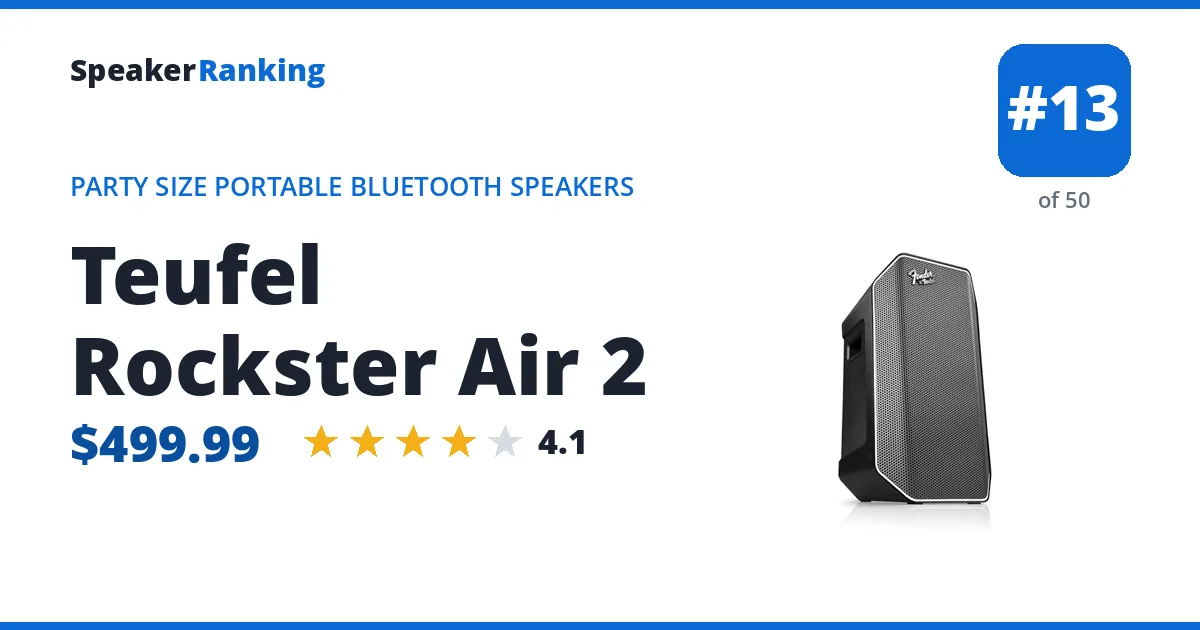
 Teufel Rockster Air 2: $499.99 Amazon eBay
Older model: the Teufel Rockster Air (ranked lower, rated 3.4/5).
Pros: More consistent off-axis sound than the JBL Partybox 130, thanks to its single horn-loaded compression driver. Projects sound more evenly to the sides, unlike the JBL’s narrower front-firing dispersion. Cleaner instrument separation at high volume than the JBL Partybox 130, which turns anemic and loses bass at max volume despite its bass boost.
Cons: Bass isn’t as deep as the JBL Partybox 130’s boosted bass, though the JBL’s is boomy rather than truly deep. Bass and treble aren’t perfectly controlled at maximum volume - can sound hollow or too bright unless turned down from default. Not meaningfully louder than its 3-year-old predecessor, and the reviewer found the overall tuning a bit worse.
Full Teufel Rockster Air 2 review and specifications →
| Amplifier Power | 80W RMS |
|---|---|
| App | No |
| Aux Input | Yes |
| Battery Life | 58 hours (Manufacturer specified) |
| Bluetooth | Yes |
| Bluetooth Codecs | SBC, AAC, aptX, aptX HD |
| Bluetooth Version | 5.0 |
| Cabinet Material | Plastic and MDF |
| Configuration | Battery-powered 2-way active PA |
| Coverage | 80° H x 40° V |
| DSP | No |
| Digital Aux Input | No |
| Dimensions | 12.7” x 23.2” x 13.5” (323 x 589 x 343 mm) |
| Drivers | 2-way: 1x 10” paper woofer, 1x 1” polypropylene tweeter |
| EQ | No |
| Frequency Response | 47Hz - 22kHz (Manufacturer specified) |
| Guitar Input | Yes |
| IP Rating | None |
| Inputs | XLR microphone, 6.3mm instrument, 3.5mm stereo, Bluetooth |
| Maximum SPL | 103dB RMS / 115dB peak @ 1m (Manufacturer specified) |
| Microphone Input | Yes (XLR) |
| Omnidirectional | No |
| Party Mode | Yes (Party Link Stereo, 2 speakers; XLR chaining up to 10) |
| Power Bank | Yes (USB-C) |
| Power Input | AC Power cord |
| Rigging | 35mm pole mount |
| Stereo | Yes |
| TWS | Yes |
| USB Playback | No |
| Weight | 31.2 lbs (14.15 kg) |
| XLR Input | Yes |
- Links
- Reviews, Comparisons and Sound Samples
- Head-to-Head Comparisons
- Teufel Rockster Air 2 vs Teufel Rockster Neo
- Teufel Rockster Air 2 vs Bose S1 Pro+
- Teufel Rockster Air 2 vs Electro-Voice Everse 8
- Teufel Rockster Air 2 vs Mackie Thump Go
- Teufel Rockster Air 2 vs Electrotec Stage One
- Teufel Rockster Air 2 vs Soundboks 4
- Teufel Rockster Air 2 vs Electro-Voice Everse 12
- Teufel Rockster Air 2 vs Teufel Rockster Air
- See all 32 comparisons
 Soundboks Rider: $599.00 Amazon eBay
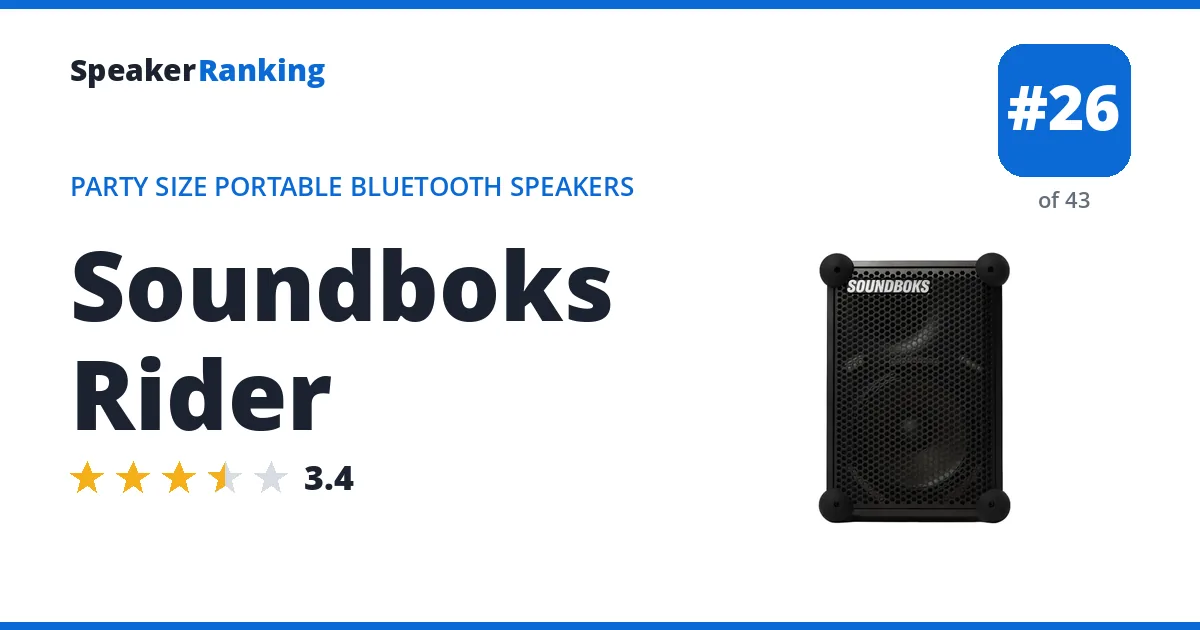
Pros: At 6.5 kg it is the lightest Soundboks yet, with a carry handle, IP66 dust and water protection, and the same swappable 100Wh battery as the Mix and Soundboks 4, rated for 35 hours at mid volume and 8 hours at maximum. Xander’s measurements found its flat profile genuinely flat, with distortion around 0.2 percent at moderate volume and below 2 percent from 500 Hz to 10 kHz even at full output, and the Indoor profile reaching down to 40 Hz at moderate volume. Both Xander and M1M Tech Channel preferred its punchy, controlled kick bass to the larger Soundboks Mix, and the app adds a six-band EQ with saveable presets.
Cons: Its sealed 8in woofer runs out of real bass at high volume: Xander measured the -6 dB point rising to roughly 75 to 85 Hz at maximum, with 40 Hz some 20 dB down, and M1M heard the bass pulled back toward the upper bass above mid volume. It measured 107 dB(C) outdoors for Xander and 113.2 dB(C) for M1M, about 3 dB below the Soundboks Mix and well short of the claimed 118 dB. There is no TeamUp, so it cannot link with other Soundboks speakers, the strap and charger are sold separately, and Xander found the grille causes dispersion artifacts around 5 kHz and judged the price too high for what it delivers.
Full Soundboks Rider review and specifications →
| Amplifier Power | 92W RMS (72W woofer + 20W tweeter) |
|---|---|
| App | Yes (Soundboks) |
| Aux Input | Yes |
| Battery Life | 35 hours (Manufacturer specified) |
| Digital Aux Input | No |
| Drivers | 8” woofer (sealed), 1.2” dome tweeter in horn |
| EQ | Yes (6-band EQ + Bass+, Indoor and Outdoor profiles) |
| Frequency Response | 40Hz - 20kHz (Manufacturer specified) |
| IP Rating | IP66 |
| Maximum SPL | 113.2dB(C) (measured by M1M Tech Channel) |
| Omnidirectional | No |
| Party Mode | No (no TeamUp) |
| Power Input | USB-C (65W fast charging) |
| Removable Battery | Yes |
| Stereo | No |
| Strap | No |
| TWS | No |
| Weight | 14.3 lbs (6.5 kg) |
- Links
- Reviews, Comparisons and Sound Samples
- Head-to-Head Comparisons
- Soundboks Rider vs Ultimate Ears Hyperboom
- Soundboks Rider vs Soundboks Mix
- Soundboks Rider vs Klipsch Gig XXL
- Soundboks Rider vs Soundcore Rave 3S
- Soundboks Rider vs Onn Large Party gen 2
- Soundboks Rider vs Sony SRS-XV500
- Soundboks Rider vs Zealot PT21
- Soundboks Rider vs JBL Partybox 110
- See all 27 comparisons