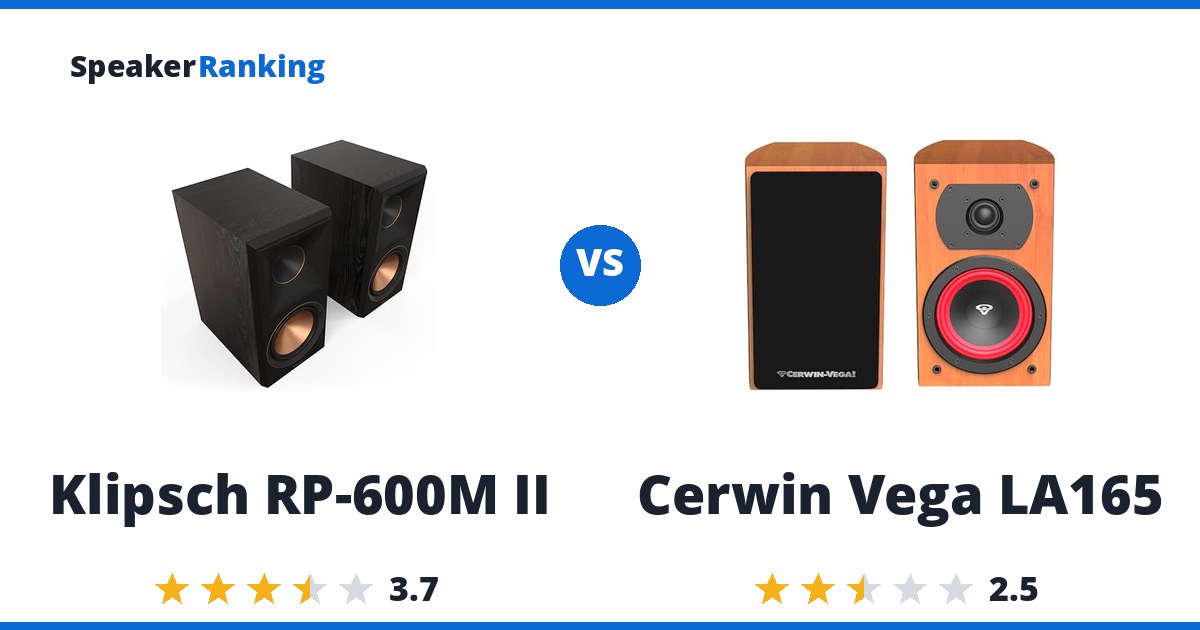
Short answer: the Klipsch RP-600M II on measured sound quality, the Cerwin Vega LA165 on price. The Klipsch RP-600M II ranks #74 of 130 bookshelf speakers at $449.99. The Cerwin Vega LA165 ranks #116 at $269.99, $180 cheaper.
What the Klipsch RP-600M II offers: Redesigned waveguide extends flush to the baffle edge, reducing diffraction compared to the original RP-600M. Roughly 10-20° wider horizontal radiation than the original, giving more soundstage envelopment while retaining precise imaging. A major step up in overall tonal neutrality compared to the original RP-600M, largely eliminating that model’s midrange resonance issues. Unusually, sounds better with the grille on - the grille smooths out the elevated treble rather than degrading the sound, a rare trait among speakers the reviewer has tested. More refined back-panel hardware, including anodized binding posts and jumper cables for optional bi-amping. Responds well to EQ correction (verified using measurement software and a miniDSP), letting the on-axis response be made genuinely linear. Watch for: On-axis, the treble runs notably hot - even hotter than the original RP-600M in some respects - and needs about 20° of toe-out or the grille installed to sound balanced. Horizontal dispersion is very slightly less linear across angles than the original RP-600M, a minor trade-off for the wider overall radiation pattern. Klipsch’s marketed sensitivity (about 94.5dB) is, like the original, a half-space rating roughly 9dB above the anechoic reality (closer to 85-86dB). In-room bass rolls off around 60Hz in practice, and a 120Hz boost paired with a midrange scoop gives kick drums their “tambour” without real low-end weight - a subwoofer is still recommended. Vertical listening tolerance is limited to about ±10° from the tweeter axis. Toeing the speaker out for better on-axis tonality (rather than using the grille) introduces slightly more diffuse imaging from added sidewall reflections.
What the Cerwin Vega LA165 offers: Passive bookshelf design with decent internal cabinet damping/batting material for the price. Delivers noticeable mid-bass punch around 100-120Hz, giving a sense of kick and impact that fans of the brand’s traditionally punchy sound may appreciate. Horizontal radiation of about ±60-70° lands in the reviewer’s preferred range for soundstage width. Reasonably priced at around $270/pair. Watch for: Overall tonal balance is far from neutral: a 2-3dB cut through the vocal fundamental range gives a hollow midrange, while a dip around 2-4kHz removes attack, snap, and clarity from snares and other transient sounds. An elevated upper treble region adds a sibilant, edgy quality (though not as extreme as some pricier speakers with similar issues). The manufacturer’s quoted 33Hz-20kHz frequency response is essentially meaningless without a tolerance bound - actual measured extension is closer to an F3 of 67Hz and F10 of 47Hz, roughly 19dB down at the claimed 33Hz. Measured sensitivity (about 86.2dB) runs several dB below the manufacturer’s 90dB spec regardless of which impedance figure is used to convert it. Significant modal ringing in the midwoofer cone, confirmed by testing the driver in isolation, ties directly to elevated distortion and resonances around 700Hz-1kHz from a cone-edge/surround mismatch. Multitone distortion crosses the reviewer’s 3% threshold at 96dB, adding graininess through the midrange and upper-mid. Unusual compression behavior shows the treble actually gaining level (rather than compressing) under both long-term and instantaneous testing - an atypical and not particularly desirable trait. Directly compared to the similarly-priced Polk XT20, which the reviewer considers clearly superior in linearity, distortion, and bass extension.
Buy the Klipsch RP-600M II if sound quality matters more than the price. Buy the Cerwin Vega LA165 if the price matters more than sound quality.
The Cerwin Vega LA165 is not a sound-quality pick. It sits near the bottom of the 130 bookshelf speakers; there are better options higher up.
Want more options? Browse the full Passive Home rankings.
Specifications Side By Side
| Klipsch RP-600M II | Cerwin Vega LA165 | |
|---|---|---|
| Price | $449.99 per pair | $269.99 per pair |
| Ranked | #74 of 130 in Large Size Bookshelf Speakers | #116 of 130 in Large Size Bookshelf Speakers |
| Bass Extension (-10dB) | 41Hz (measured, Erin's Audio Corner) | 47Hz (measured, Erin's Audio Corner) |
| Bass Extension (-3dB) | 70Hz (measured, Erin's Audio Corner) | 66.7Hz (measured, Erin's Audio Corner) |
| Dimensions | 15.7"H x 8"W x 12.5"D (398.8 x 203.2 x 317.5 mm) | 13.7"H x 8"W x 12.4"D (348.0 x 203.2 x 315.0 mm) |
| Impedance | 8 ohms nominal (3.5 ohms minimum above 80Hz, measured by Erin's Audio Corner) | 4 ohms nominal |
| Sensitivity | 86dB (measured, Erin's Audio Corner) | 86.2dB (2.83V/1m, measured by Erin's Audio Corner) |
| Drivers | 6.5" Cerametallic cone woofer, 1" titanium LTS vented tweeter with Tractrix horn | 1" tweeter + 6.5" woofer |
| Weight | 13 lbs (5.9 kg) each | 26.5 lbs (12 kg) |
| Woofer Cabinet | ported | ported, rear |
| Spinorama Preference Score | 4.75 | 2.16 |
| Spinorama Preference Score with Perfect Sub | 6.88 | 4.63 |
Related Speaker Comparisons
More top alternatives to Klipsch RP-600M II:
- Klipsch RP-600M II vs KEF Reference 1 Meta
- Klipsch RP-600M II vs GR-Research NX-Studio
- Klipsch RP-600M II vs March Audio Sointuva AWG
- Klipsch RP-600M II vs AsciLab C6B
- Klipsch RP-600M II vs Audio First Cadentia 3
Prices on this page were last checked September 14, 2026 at 1:47 AM UTC. Product prices and availability are accurate as of that date/time and are subject to change; the price and availability shown on Amazon at the time of purchase will apply to the purchase of this product.
As an eBay Partner, we may be compensated if you make a purchase.
The Two Speakers In Full
 Klipsch RP-600M II: $449.99 per pair Amazon eBay
Pros: Redesigned waveguide extends flush to the baffle edge, reducing diffraction compared to the original RP-600M. Roughly 10-20° wider horizontal radiation than the original, giving more soundstage envelopment while retaining precise imaging. A major step up in overall tonal neutrality compared to the original RP-600M, largely eliminating that model’s midrange resonance issues. Unusually, sounds better with the grille on - the grille smooths out the elevated treble rather than degrading the sound, a rare trait among speakers the reviewer has tested. More refined back-panel hardware, including anodized binding posts and jumper cables for optional bi-amping. Responds well to EQ correction (verified using measurement software and a miniDSP), letting the on-axis response be made genuinely linear. Measured bass extension of 70Hz (-3dB), with a measured sensitivity of 86dB.
Cons: On-axis, the treble runs notably hot - even hotter than the original RP-600M in some respects - and needs about 20° of toe-out or the grille installed to sound balanced. Horizontal dispersion is very slightly less linear across angles than the original RP-600M, a minor trade-off for the wider overall radiation pattern. Klipsch’s marketed sensitivity (about 94.5dB) is, like the original, a half-space rating roughly 9dB above the anechoic reality (closer to 85-86dB). In-room bass rolls off around 60Hz in practice, and a 120Hz boost paired with a midrange scoop gives kick drums their “tambour” without real low-end weight - a subwoofer is still recommended. Vertical listening tolerance is limited to about ±10° from the tweeter axis. Toeing the speaker out for better on-axis tonality (rather than using the grille) introduces slightly more diffuse imaging from added sidewall reflections.
Full Klipsch RP-600M II review and specifications →
| Bass Extension (-10dB) | 41Hz (measured, Erin's Audio Corner) |
|---|---|
| Bass Extension (-3dB) | 70Hz (measured, Erin's Audio Corner) |
| Dimensions | 15.7"H x 8"W x 12.5"D (398.8 x 203.2 x 317.5 mm) |
| Drivers | 6.5" Cerametallic cone woofer, 1" titanium LTS vented tweeter with Tractrix horn |
| Impedance | 8 ohms nominal (3.5 ohms minimum above 80Hz, measured by Erin's Audio Corner) |
| Sensitivity | 86dB (measured, Erin's Audio Corner) |
| Spinorama Preference Score | 4.75 |
| Spinorama Preference Score with Perfect Sub | 6.88 |
| Weight | 13 lbs (5.9 kg) each |
| Woofer Cabinet | ported |
- Links
- Reviews, Comparisons and Sound Samples
- Erin’s Audio Corner: The Truth about Klipsch’s “NEW” Sound. RP-600M Update. More from Erin’s Audio Corner →
- Erin’s Audio Corner Website Klipsch RP-600M II
- GR-Research: We Bought The "NEW" RP-600M II Is KLIPSCH Listening?! More from GR-Research →
- Erin’s Audio Corner: 5 AWESOME SPEAKERS Under $1000 You Won’t Regret
- Erin’s Audio Corner Measurements (spinorama.org)
- Head-to-Head Comparisons
- Klipsch RP-600M II vs Dynaudio Emit 20
- Klipsch RP-600M II vs Philharmonic BMR Monitor
- Klipsch RP-600M II vs JBL Studio 630
- Klipsch RP-600M II vs Behringer B2030P
- Klipsch RP-600M II vs Ascend CBM-170 SE2
- Klipsch RP-600M II vs Infinity Reference R162
- Klipsch RP-600M II vs GR-Research X-LS Encore
- Klipsch RP-600M II vs Infinity IL10
- See all 72 comparisons
 Cerwin Vega LA165: $269.99 per pair Amazon eBay
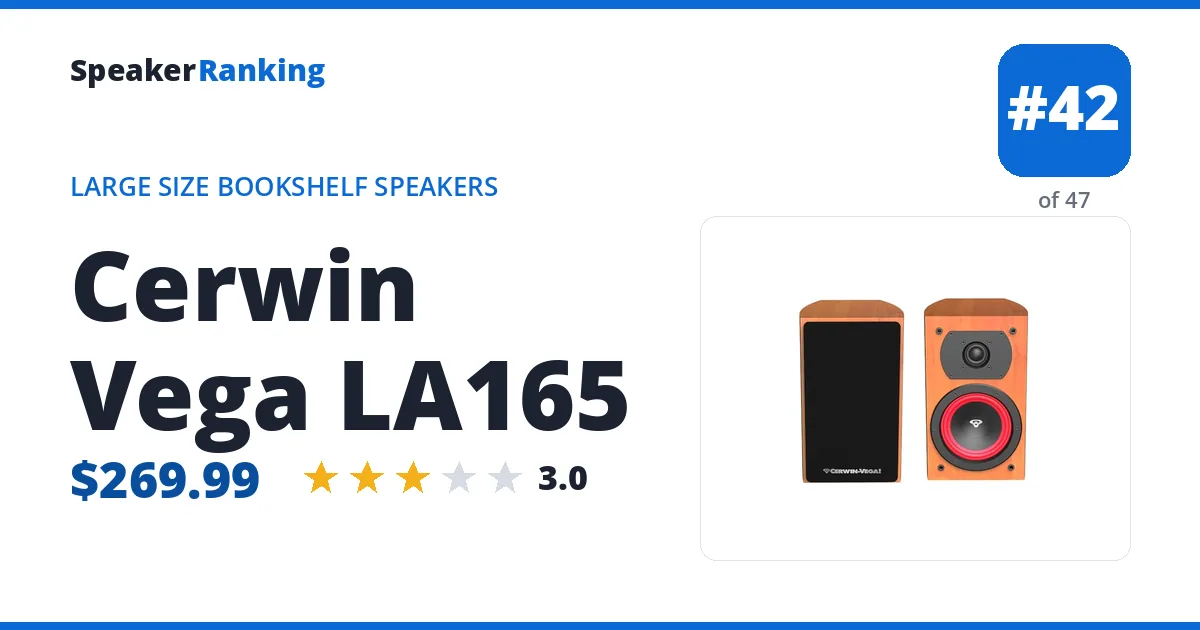
Pros: Passive bookshelf design with decent internal cabinet damping/batting material for the price. Delivers noticeable mid-bass punch around 100-120Hz, giving a sense of kick and impact that fans of the brand’s traditionally punchy sound may appreciate. Horizontal radiation of about ±60-70° lands in the reviewer’s preferred range for soundstage width. Reasonably priced at around $270/pair. Measured bass extension of 66.7Hz (-3dB), with a measured sensitivity of 86.2dB.
Cons: Overall tonal balance is far from neutral: a 2-3dB cut through the vocal fundamental range gives a hollow midrange, while a dip around 2-4kHz removes attack, snap, and clarity from snares and other transient sounds. An elevated upper treble region adds a sibilant, edgy quality (though not as extreme as some pricier speakers with similar issues). The manufacturer’s quoted 33Hz-20kHz frequency response is essentially meaningless without a tolerance bound - actual measured extension is closer to an F3 of 67Hz and F10 of 47Hz, roughly 19dB down at the claimed 33Hz. Measured sensitivity (about 86.2dB) runs several dB below the manufacturer’s 90dB spec regardless of which impedance figure is used to convert it. Significant modal ringing in the midwoofer cone, confirmed by testing the driver in isolation, ties directly to elevated distortion and resonances around 700Hz-1kHz from a cone-edge/surround mismatch. Multitone distortion crosses the reviewer’s 3% threshold at 96dB, adding graininess through the midrange and upper-mid. Unusual compression behavior shows the treble actually gaining level (rather than compressing) under both long-term and instantaneous testing - an atypical and not particularly desirable trait. Directly compared to the similarly-priced Polk XT20, which the reviewer considers clearly superior in linearity, distortion, and bass extension.
Full Cerwin Vega LA165 review and specifications →
| Bass Extension (-10dB) | 47Hz (measured, Erin's Audio Corner) |
|---|---|
| Bass Extension (-3dB) | 66.7Hz (measured, Erin's Audio Corner) |
| Dimensions | 13.7"H x 8"W x 12.4"D (348.0 x 203.2 x 315.0 mm) |
| Drivers | 1" tweeter + 6.5" woofer |
| Impedance | 4 ohms nominal |
| Sensitivity | 86.2dB (2.83V/1m, measured by Erin's Audio Corner) |
| Spinorama Preference Score | 2.16 |
| Spinorama Preference Score with Perfect Sub | 4.63 |
| Weight | 26.5 lbs (12 kg) |
| Woofer Cabinet | ported, rear |
- Links
- Reviews, Comparisons and Sound Samples
- Head-to-Head Comparisons