Short answer: the KEF LS60. It ranks #2 of 15 powered floorstanding speakers by sound quality (rated 4.8/5); the GGNTKT M3 ranks #3 (rated 4.7/5).
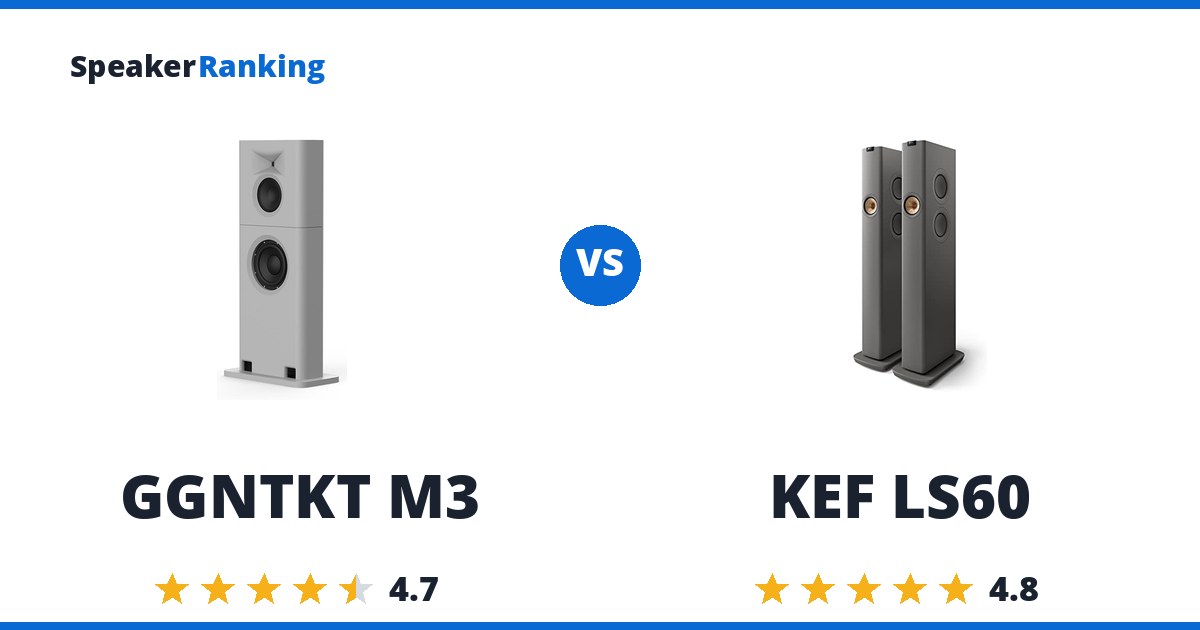
The case for the GGNTKT M3: Huge active floorstanding speakers with exceptionally even, accurate sound and cardioid bass that copes well near a wall. Watch for: Measured -3dB extension of 35.5Hz is useful but does not match the deepest-reaching towers here.
The KEF LS60 is the more accurate choice. Wireless floorstanding speakers with extremely accurate sound and bass deep enough to skip a subwoofer. Its measured preference score, a predictor of how neutral it sounds, is 7.26 against 6.61 for the GGNTKT M3. The catch: A diffraction dip around 9kHz can soften cymbal shimmer when aimed directly at the listener; 10-20 degrees of toe-out helps.
Buy the KEF LS60. It is rated higher for sound quality than the GGNTKT M3.
Want more options? Browse the full Powered Home rankings.

Huge active floorstanding speakers with exceptionally even, accurate sound and cardioid bass that copes well near a wall.

Wireless floorstanding speakers with extremely accurate sound and bass deep enough to skip a subwoofer.
Prices on this page were last checked October 23, 2026 at 8:27 AM UTC. Product prices and availability are accurate as of that date/time and are subject to change; the price and availability shown on Amazon at the time of purchase will apply to the purchase of this product.
As an eBay Partner, we may be compensated if you make a purchase.
Specifications Side By Side
| GGNTKT M3 | KEF LS60 | |
|---|---|---|
| Price | €29,950 per pair | $5,999.99 per pair |
| Ranked | #3 of 15 in Large Size Powered Floorstanding Speakers | #2 of 15 in Large Size Powered Floorstanding Speakers |
| Enclosure | 4-way bass reflex, cardioid-loaded bass (opposed front/rear woofers) | - |
| Drivers | 56mm ring-diaphragm compression tweeter, 210mm (8”) paper-fiber midrange, 2x 260mm (10”) long-throw subwoofers | 4 x 135 mm (5.25 in.) Uni-Core Force Cancelling Driver: woofers, 100 mm (4in.) aluminium cone midrange, 19 mm (0.75 in.) vented aluminium dome with Metamaterial Absorption Technology tweeter |
| Dimensions | 50.6”H x 19.6”W x 7.8”D (1286 x 499 x 199 mm) | 42.9”H x 8.3”W x 15.5”D (1089.7 x 210.8 x 393.7 mm) |
| Weight | approx. 154.3 lbs (70 kg) each | 69 lbs (31.3 kg) each |
| Amplifier Power | approx. 1000W total (PASCAL Class-D UMAC modules) | 700W (500W LF Class D + 100W MF Class D + 100W HF Class AB) |
| Frequency Response | 29Hz-20kHz (-3dB), 24Hz-22kHz (-6dB) | 31Hz - 24kHz (±3dB) (Manufacturer specified) |
| Coverage | 140 deg horizontal x 100 deg vertical (constant directivity waveguide) | - |
| Warranty | 2 years, extendable to 3 with product registration | - |
| Country | Germany | - |
| Spinorama Preference Score | 6.61 | 7.26 |
| Spinorama Preference Score with Perfect Sub | 8.59 | 7.91 |
| Inputs | XLR (balanced analog), XLR AES/EBU (digital), USB (calibration/control only, not an audio input) | Wifi, Optical, Digital coaxial, RCA, HDMI eARC, Ethernet |
| XLR Input | Yes | No |
| RCA Input | No | Yes |
| TRS Input | No | No |
| Optical Input | No | Yes |
| Coaxial Input | No | Yes |
| USB Input | No | No |
| HDMI Input | No | Yes |
| AES Input | Yes | No |
| Aux Input | No | No |
| Bluetooth | No | Yes |
| Bass Extension (-10dB) | - | <20Hz (measured, Erin’s Audio Corner) |
| Bass Extension (-3dB) | - | 23Hz (measured, Erin’s Audio Corner) |
| App | - | Yes (KEF Connect) |
| Bluetooth Version | - | 5.0 |
| Bluetooth Codecs | - | SBC, AAC |
| DSP | - | Yes (Music Integrity Engine) |
| EQ | - | Yes (Normal and Expert modes, room adaptation) |
| Outputs | - | Subwoofer RCA |
| Streaming Services | - | Yes (AirPlay 2, Chromecast, Roon Ready, Spotify Connect, Tidal Connect, Amazon Music, Qobuz, Deezer) |
| Wi-Fi | - | Yes (dual-band) |
| Sensitivity | - | 97.7dB (measured at 0.3V/1m, Erin’s Audio Corner) |
| Maximum SPL | - | 111dB @ 1m (pink noise) (manufacturer specified) |
| Subwoofer Output | - | Yes |
Frequency Response Compared
Both speakers’ spinorama measurements, overlaid. A flatter line is more neutral: peaks sound forward or harsh, dips sound recessed. Each curve is shifted so its average from 300 Hz to 3 kHz sits at 0 dB, so loudness differences between the two are removed and only the shape is compared. The two were measured by different sources, so small differences, especially in the bass, can come from the measurement setup rather than the speakers.
Measurement data: GGNTKT M3 (measured by the manufacturer) and KEF LS60 (measured by Erin’s Audio Corner), via spinorama.org.
Related Speaker Comparisons
More worthwhile head-to-heads for KEF LS60: