Short answer: the GGNTKT M3. It ranks #2 of 8 powered floorstanding speakers by sound quality (rated 4.7/5); the Grimm Audio LS1c + SB1 ranks #7 (rated 4.4/5).
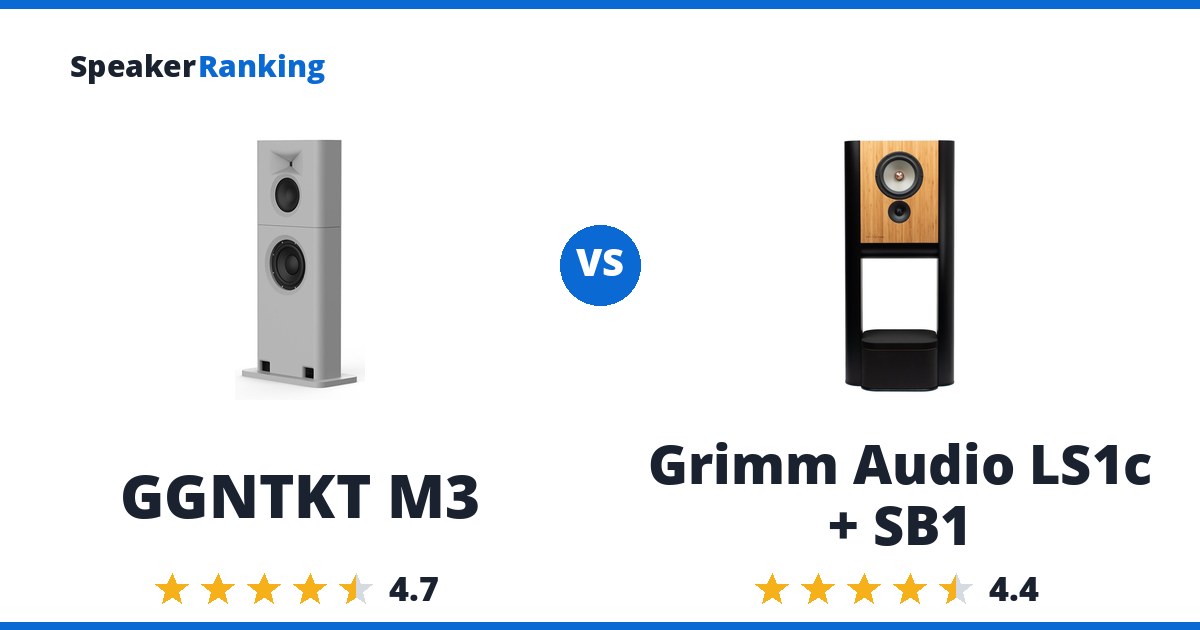
Why pick the GGNTKT M3: The manufacturer measurement shows a very tight 0.5dB response span from 300Hz to 5kHz and a 8.59 ideal-subwoofer preference score, supporting exceptionally even midrange balance. The tradeoff: Measured -3dB extension of 35.5Hz is useful but does not match the deepest-reaching towers here.
What the Grimm Audio LS1c + SB1 does well: Independently measured by Audio Science Review as a complete system with its SB1 subwoofers, with 0.83 listening-window smoothness and 0.38dB average on-axis deviation. The catch: The standard preference score is only 5.73, rising to 7.54 with an ideal subwoofer, because spinorama puts the system’s -6dB point at 45.4Hz despite the subwoofers.
Buy the GGNTKT M3. It is rated higher for sound quality than the Grimm Audio LS1c + SB1.
Looking for alternatives? See the complete Powered Home rankings.
Specifications Side By Side
| GGNTKT M3 | Grimm Audio LS1c + SB1 | |
|---|---|---|
| Price | $32,350 per pair | $43,440 per pair |
| Ranked | #2 of 8 in Large Size Powered Floorstanding Speakers | #7 of 8 in Large Size Powered Floorstanding Speakers |
| Enclosure | 4-way bass reflex, cardioid-loaded bass (opposed front/rear woofers) | Active 2-way monitor on stand with integrated SB1 sealed subwoofer (3-way system) |
| Drivers | 56mm ring-diaphragm compression tweeter, 210mm (8”) paper-fiber midrange, 2x 260mm (10”) long-throw subwoofers | TPCD carbon composite tweeter (Seas); 8” Seas midrange-woofer; 10” up-firing SB1 subwoofer |
| Dimensions | 50.6”H x 19.6”W x 7.8”D (1286 x 499 x 199 mm) | 45.3”H x 20.5”W x 6.3”D (1150 x 521 x 160 mm) |
| Weight | approx. 154.3 lbs (70 kg) each | 119 lbs (54 kg) each with SB1 |
| Amplifier Power | approx. 1000W total (PASCAL Class-D UMAC modules) | 240W woofer and 100W tweeter per speaker (Hypex NCore); 400W per SB1 subwoofer |
| Frequency Response | 29Hz-20kHz (-3dB), 24Hz-22kHz (-6dB) | 20Hz-27kHz +0.5/-3dB with SB1 (manufacturer) |
| Coverage | 140 deg horizontal x 100 deg vertical (constant directivity waveguide) | - |
| Warranty | 2 years, extendable to 3 with product registration | - |
| Country | Germany | Made in the Netherlands |
| Spinorama Preference Score | 6.61 | 5.73 |
| Spinorama Preference Score with Perfect Sub | 8.59 | 7.54 |
| Inputs | XLR (balanced analog), XLR AES/EBU (digital), USB (calibration/control only, not an audio input) | Analog XLR, 3x AES/EBU, USB |
| XLR Input | Yes | Yes |
| RCA Input | No | No |
| TRS Input | No | - |
| Optical Input | No | No |
| Coaxial Input | No | No |
| USB Input | No | Yes |
| HDMI Input | No | No |
| AES Input | Yes | Yes |
| Aux Input | No | - |
| Bass Extension (-10dB) | - | approximately 28.9Hz (measured, spinorama.org ASR data) |
| Maximum SPL | - | 105dB (measured by ASR) |
| Bluetooth | - | No |
Related Speaker Comparisons
More worthwhile head-to-heads for GGNTKT M3:
- GGNTKT M3 vs KEF LS60
- Aalto Speakers Aalto 9 vs GGNTKT M3
- Pitt & Giblin Superwax vs GGNTKT M3
- Aalto Speakers Aalto 9 vs Grimm Audio LS1c + SB1
- Pitt & Giblin Superwax vs Grimm Audio LS1c + SB1
Prices on this page were last checked September 26, 2026 at 11:14 PM UTC. Product prices and availability are accurate as of that date/time and are subject to change; the price and availability shown on Amazon at the time of purchase will apply to the purchase of this product.
As an eBay Partner, we may be compensated if you make a purchase.
The Two Speakers In Full
 GGNTKT M3: $32,350 per pair GGNTKT eBay
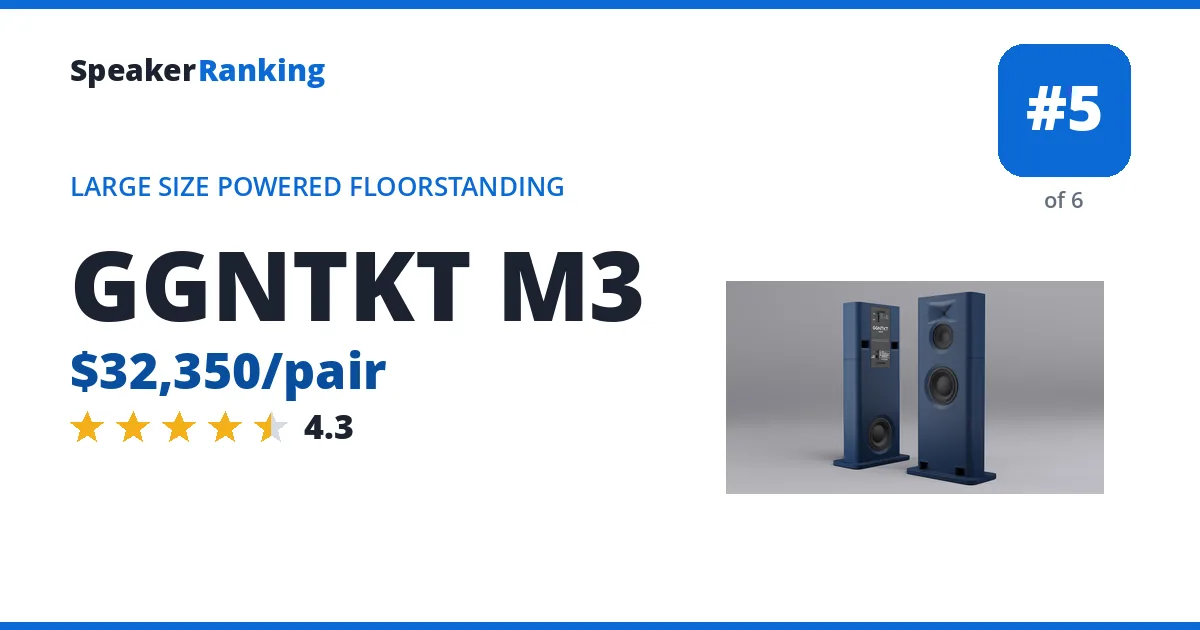
Pros: The manufacturer measurement shows a very tight 0.5dB response span from 300Hz to 5kHz and a 8.59 ideal-subwoofer preference score, supporting exceptionally even midrange balance. Cardioid radiation reduces rearward bass and low-midrange energy, helping with near-wall placement. A dedicated midrange, wide waveguide and DSP-controlled four-way architecture suit a large listening area without relying on a narrow on-axis sweet spot.
Cons: Measured -3dB extension of 35.5Hz is useful but does not match the deepest-reaching towers here. Cardioid operation reduces some boundary interaction rather than eliminating room modes. The broad, heavy cabinets and professional system setup demand space and planning; maximum-output claims should not be confused with equally low distortion at every frequency.
Full GGNTKT M3 review and specifications →
| AES Input | Yes |
|---|---|
| Amplifier Power | approx. 1000W total (PASCAL Class-D UMAC modules) |
| Aux Input | No |
| Coaxial Input | No |
| Country | Germany |
| Coverage | 140 deg horizontal x 100 deg vertical (constant directivity waveguide) |
| Dimensions | 50.6”H x 19.6”W x 7.8”D (1286 x 499 x 199 mm) |
| Drivers | 56mm ring-diaphragm compression tweeter, 210mm (8”) paper-fiber midrange, 2x 260mm (10”) long-throw subwoofers |
| Enclosure | 4-way bass reflex, cardioid-loaded bass (opposed front/rear woofers) |
| Frequency Response | 29Hz-20kHz (-3dB), 24Hz-22kHz (-6dB) |
| HDMI Input | No |
| Inputs | XLR (balanced analog), XLR AES/EBU (digital), USB (calibration/control only, not an audio input) |
| Optical Input | No |
| RCA Input | No |
| Spinorama Preference Score | 6.61 |
| Spinorama Preference Score with Perfect Sub | 8.59 |
| TRS Input | No |
| USB Input | No |
| Warranty | 2 years, extendable to 3 with product registration |
| Weight | approx. 154.3 lbs (70 kg) each |
| XLR Input | Yes |
- Links
- Reviews, Comparisons and Sound Samples
- Head-to-Head Comparisons
 Grimm Audio LS1c + SB1: $43,440 per pair The Listening Room eBay
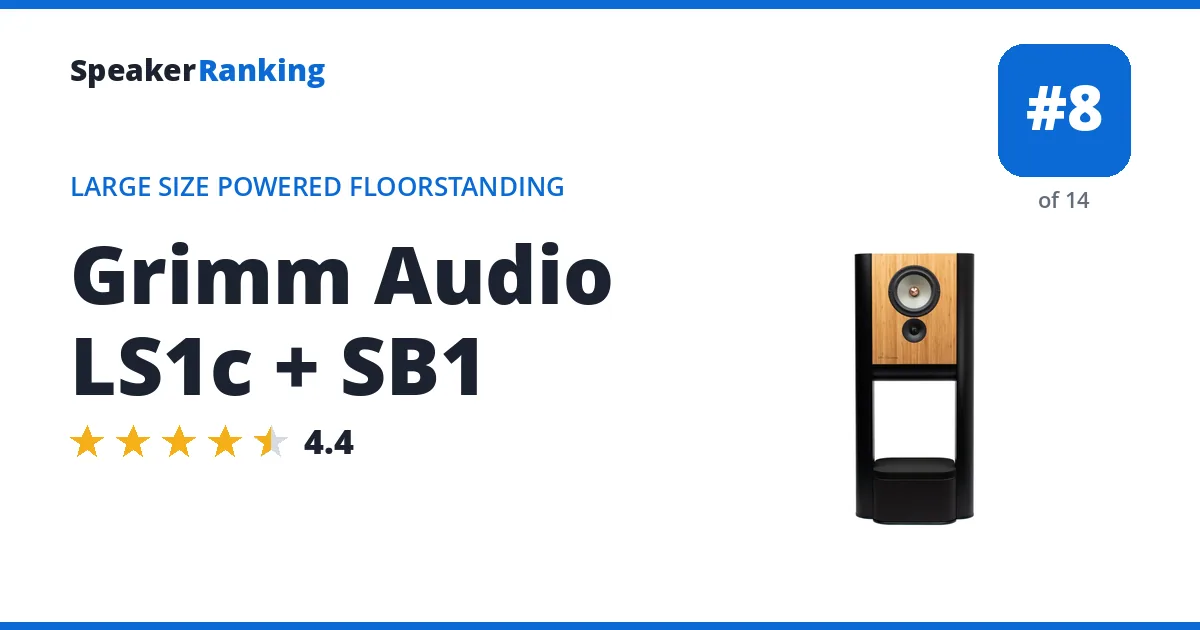
Pros: Independently measured by Audio Science Review as a complete system with its SB1 subwoofers, with 0.83 listening-window smoothness and 0.38dB average on-axis deviation. ASR found the widest horizontal dispersion it had measured, very clean decay and distortion that stays low at 86 and 96dB. The -10dB point sits near 28.9Hz, and the SB1’s motional feedback controls the 10-inch woofer. It is a complete active system with Hypex NCore amplification, DSP crossovers and analog, AES/EBU and USB inputs. Measured bass extension of 28.9Hz (-10dB).
Cons: The standard preference score is only 5.73, rising to 7.54 with an ideal subwoofer, because spinorama puts the system’s -6dB point at 45.4Hz despite the subwoofers. At $28850 per pair with the SB1s, it costs far more than active systems that score higher. ASR measured a maximum of about 105dB, modest output for the price. Custom finishes add weeks to the dealer lead time.
Full Grimm Audio LS1c + SB1 review and specifications →
| AES Input | Yes |
|---|---|
| Amplifier Power | 240W woofer and 100W tweeter per speaker (Hypex NCore); 400W per SB1 subwoofer |
| Bass Extension (-10dB) | approximately 28.9Hz (measured, spinorama.org ASR data) |
| Bluetooth | No |
| Coaxial Input | No |
| Country | Made in the Netherlands |
| Dimensions | 45.3”H x 20.5”W x 6.3”D (1150 x 521 x 160 mm) |
| Drivers | TPCD carbon composite tweeter (Seas); 8” Seas midrange-woofer; 10” up-firing SB1 subwoofer |
| Enclosure | Active 2-way monitor on stand with integrated SB1 sealed subwoofer (3-way system) |
| Frequency Response | 20Hz-27kHz +0.5/-3dB with SB1 (manufacturer) |
| HDMI Input | No |
| Inputs | Analog XLR, 3x AES/EBU, USB |
| Maximum SPL | 105dB (measured by ASR) |
| Optical Input | No |
| RCA Input | No |
| Spinorama Preference Score | 5.73 |
| Spinorama Preference Score with Perfect Sub | 7.54 |
| USB Input | Yes |
| Weight | 119 lbs (54 kg) each with SB1 |
| XLR Input | Yes |
- Links
- Reviews, Comparisons and Sound Samples
- Head-to-Head Comparisons