Short answer: these Yamaha DXR15mkIII and Yamaha DBR15 alternatives share a brand and size class, but their coverage, driver architecture, cabinet format, processing, and output priorities can make them fit very different jobs.
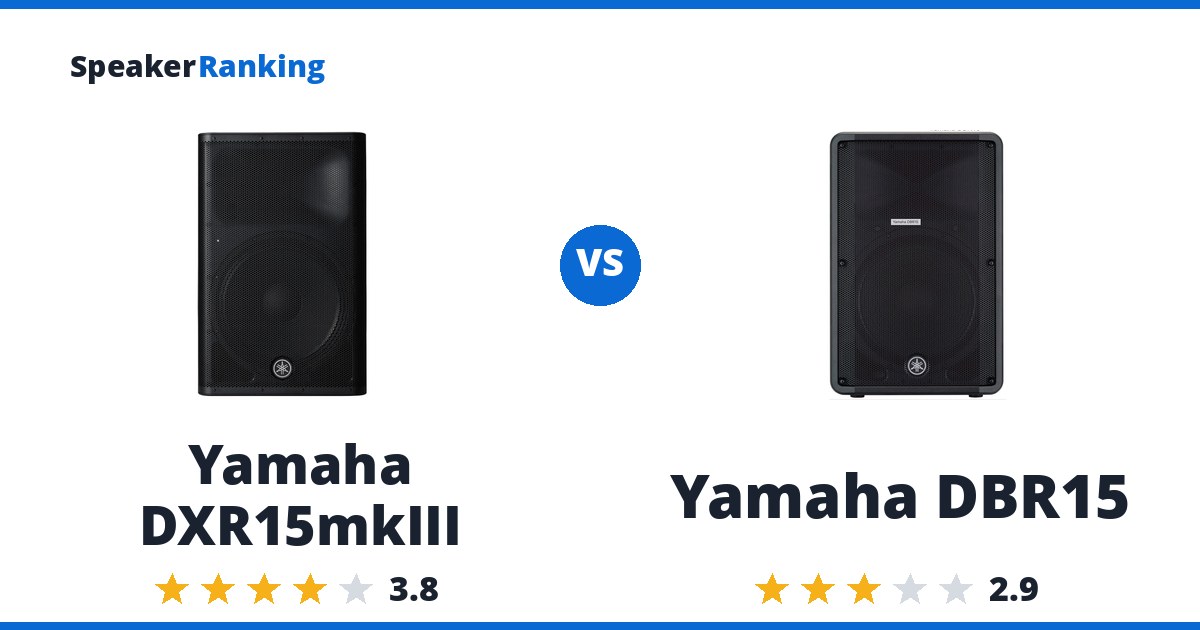
Why choose the Yamaha DXR15mkIII. The third-generation DXR15 raises claimed output to 134dB with 2000W amplification, app-based control and Yamaha’s newest onboard DSP, while its 90° x 60° pattern matches the well-regarded DXR12mkIII.
Why choose the Yamaha DBR15. Yamaha’s most portable 15-inch powered speaker carries the same DSP and amplification platform as the DXR and DZR series, with a built-in 2-channel mixer accepting XLR, 1/4-inch, RCA and 3.5mm sources.
What to weigh before buying. The low-quality local data is truncated and cannot produce a preference score, so its tonal advantage over the proven DXR15mkII is unconfirmed. Wireless connectivity is for remote control, not audio streaming. Medium-quality vendor data shows a 2.87 ideal-subwoofer preference score, one of the weaker results in this ranking and well below the DBR12’s own measured result, so a subwoofer partner matters more here than with most alternatives.
Buy the Yamaha DXR15mkIII when its stated coverage, output, processing, and deployment format best match the job.
Buy the Yamaha DBR15 when its stated strengths are the better match for the room and the rest of the PA.
Still deciding? The full PA & Live Sound rankings cover every ranked option.

A powered 15 inch PA speaker with loud output, app control and Yamaha’s latest onboard DSP.

A light, affordable 15 inch powered PA speaker with a built in two channel mixer for mics, instruments and line sources.
Prices on this page were last checked October 23, 2026 at 8:27 AM UTC. Product prices and availability are accurate as of that date/time and are subject to change; the price and availability shown on Amazon at the time of purchase will apply to the purchase of this product.
As an eBay Partner, we may be compensated if you make a purchase.
Specifications Side By Side
| Yamaha DXR15mkIII | Yamaha DBR15 | |
|---|---|---|
| Price | $1,099.99 | $559.99 |
| Ranked | #20 of 76 in 15-Inch PA Speakers | #65 of 76 in 15-Inch PA Speakers |
| Passive | No | No |
| Configuration | Active 2-way bass-reflex PA speaker | Active 2-way bass-reflex PA speaker |
| Drivers | 15” woofer, 1” throat/1.75” diaphragm compression driver | 15” woofer, 1.4” compression driver |
| Frequency Response | 46Hz - 20kHz (-10dB, manufacturer specified) | 50Hz - 20kHz (-10dB, manufacturer specified) |
| Dimensions | 27.5”H x 17.6”W x 15”D (699 x 447 x 380 mm) | 27.6”H x 17.9”W x 14.9”D (700 x 455 x 378 mm) |
| Coverage | 90° x 60° | 90° x 60° (constant directivity horn) |
| Maximum SPL | 134dB peak (manufacturer specified) | 132dB peak (manufacturer specified) |
| Inputs | 2 x XLR/TRS combo; XLR thru and DSP outputs | 2 x XLR/TRS combo and stereo RCA; XLR output |
| Amplifier Power | 2000W peak / 1000W RMS (1700W LF + 300W HF peak) | 1000W dynamic / 465W continuous (800W LF + 200W HF dynamic) |
| Crossover Frequency | 1800Hz (FIR-X) | - |
| Cabinet Material | PP plastic | Plastic |
| Rigging | 3 x M10 points plus U-bracket points; 35mm dual-angle pole mount | 3 x M8 points; 35mm pole mount |
| Bass Extension (-3dB) | 54.5Hz (measured, vendor Spinorama data) | 53Hz (measured, vendor Spinorama data) |
| DSP | Yes, FIR-X tuning, Drive Motion Calibration and D-Remote | Yes |
| Bluetooth | Yes | No |
| Bluetooth Version | 5.0 | - |
| Weight | 46.3 lbs (21 kg) | 42.5 lbs (19.3 kg) |
| XLR Input | Yes | Yes |
| RCA Input | No | Yes |
| TRS Input | Yes | Yes |
| Optical Input | No | No |
| Coaxial Input | No | No |
| USB Input | No | No |
| HDMI Input | No | No |
| AES Input | No | No |
| Aux Input | No | No |
| Microphone Input | No | No |
| Guitar Input | No | No |
| Spinorama Preference Score | - | 0.49 |
| Spinorama Preference Score with Perfect Sub | - | 2.87 |
Frequency Response Compared
Both speakers’ spinorama measurements, overlaid. A flatter line is more neutral: peaks sound forward or harsh, dips sound recessed. Each curve is shifted so its average from 300 Hz to 3 kHz sits at 0 dB, so loudness differences between the two are removed and only the shape is compared.
Measurement data: Yamaha DXR15mkIII (measured by the manufacturer) and Yamaha DBR15 (measured by the manufacturer), via spinorama.org.
Related Speaker Comparisons
More worthwhile head-to-heads for Yamaha DXR15mkIII: