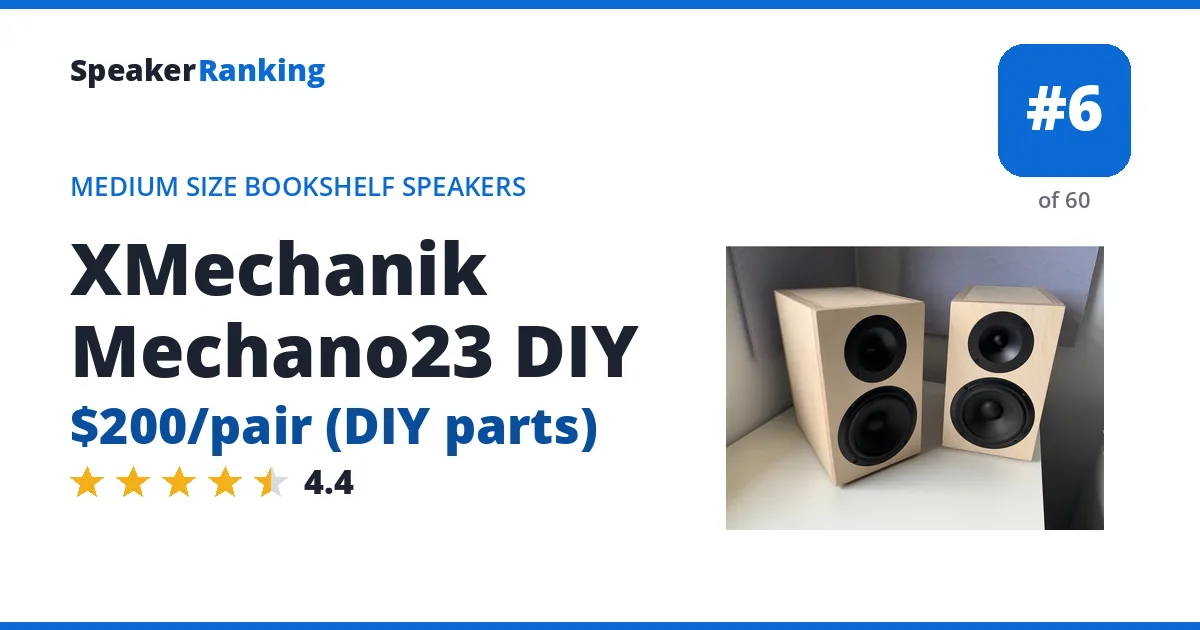
Short answer: the XMechanik Mechano23 DIY. It ranks #6 of 101 bookshelf speakers by sound quality (rated 4.4/5) at $200 and is still sold new; the Q Acoustics 3020i ranks #80 (rated 2.4/5) and is discontinued, so it is only an option used.
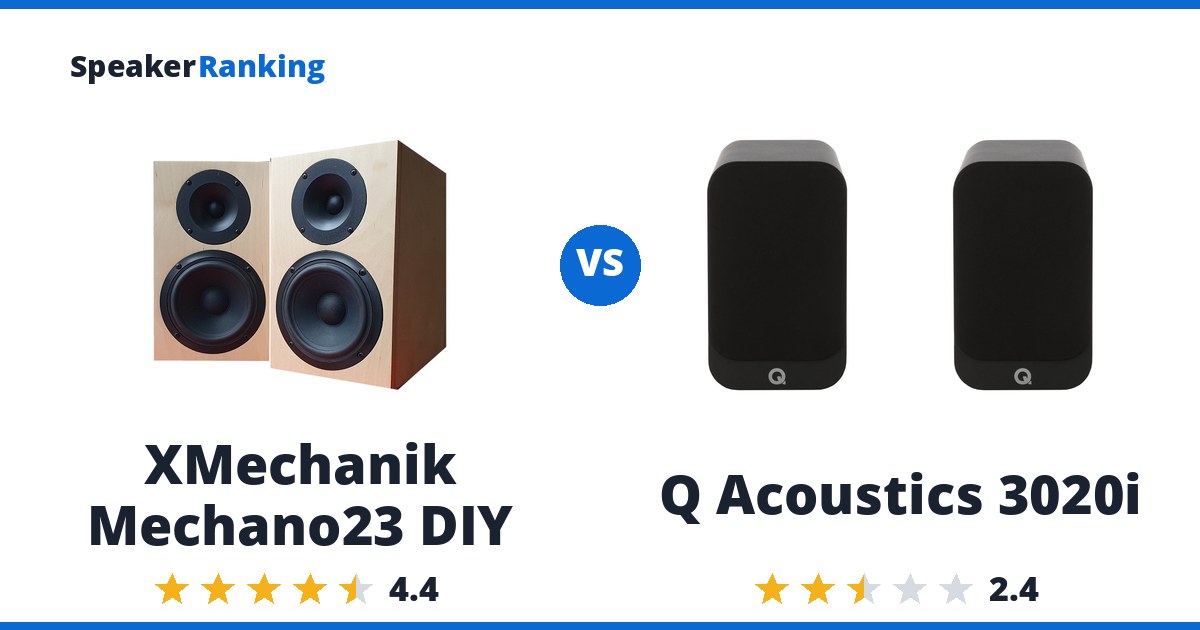
The XMechanik Mechano23 DIY is the more accurate pick. The bass alignment is unusually well damped, with a measured Q of 0.336, among the lowest of any speaker in this catalog, so the -3dB point at 77.6Hz rolls off cleanly instead of building into a resonant bump the way many small ported designs do. Its measured preference score, a predictor of how neutral it sounds, is 5.42 against 3.86 for the Q Acoustics 3020i. The catch: This is a true DIY project.
What the Q Acoustics 3020i does well: UK-designed (Finkteam) with attractive styling, including recessed binding posts and custom connectors. The tradeoff: On-axis response shows a rising upper-frequency trend and a dip in the 2-4kHz crossover region alongside two resonance-related dips; a significant resonance appears at 366Hz in the waterfall plot.
Buy the XMechanik Mechano23 DIY. It is rated higher for sound quality, and the Q Acoustics 3020i is discontinued, so it is only available used.
Looking for alternatives? See the complete Passive Home rankings.
Specifications Side By Side
| XMechanik Mechano23 DIY | Q Acoustics 3020i | |
|---|---|---|
| Price | $200 per pair DIY parts | $314.99 per pair Discontinued |
| Ranked | #6 of 101 in Medium Size Bookshelf Speakers | #80 of 101 in Medium Size Bookshelf Speakers |
| Enclosure | ported | - |
| Drivers | Scan-Speak Discovery H2606/9200 1” horn loaded textile dome tweeter, SB Acoustics SB13PFCR25-4 5” fiber cone woofer | 125mm (5”) bass driver, 22mm (0.9”) tweeter |
| Dimensions | 11.4”H x 6.9”W x 10.4”D (290 x 174 x 263 mm) | 10.9”H x 6.7”W x 11.1”D (278 x 170 x 282 mm) |
| Sensitivity | 85.1dB @ 2.83V/1m (measured, Audio Science Review) | 86dB (2.83V/1m, manufacturer specified) |
| Bass Extension (-3dB) | 77.6Hz (measured, Audio Science Review) | 82.0Hz (measured, Audio Science Review) |
| Bass Extension (-10dB) | 42.4Hz (measured, Audio Science Review) | 49.8Hz (measured, Audio Science Review) |
| Port Tuning | Approximately 45Hz | - |
| Cabinet Material | 18mm Baltic birch plywood | - |
| Country | Design origin: United States (ASR forum); assembled by buyer | - |
| Spinorama Preference Score | 5.42 | 3.86 |
| Spinorama Preference Score with Perfect Sub | 7.88 | 6.38 |
| Impedance | 4.1 ohms nominal (measured, ASR) | 6 ohms nominal, 4 ohms minimum |
| DIY Kit | Yes | No |
| Weight | - | 10.6 lbs (4.8 kg) each |
| Crossover Frequency | - | 2.4kHz |
| Woofer Cabinet | - | ported, reflex |
Related Speaker Comparisons
How XMechanik Mechano23 DIY compares with other leading options:
- XMechanik Mechano23 DIY vs Audio First Fidelia
- XMechanik Mechano23 DIY vs Philharmonic Ceramic Mini
- Ascend Sierra 1 v2 vs XMechanik Mechano23 DIY
- KEF LS50 Meta vs XMechanik Mechano23 DIY
- Ascend Acoustics HTM-200SE2 vs XMechanik Mechano23 DIY
Prices on this page were last checked October 4, 2026 at 9:58 PM UTC. Product prices and availability are accurate as of that date/time and are subject to change; the price and availability shown on Amazon at the time of purchase will apply to the purchase of this product.
As an eBay Partner, we may be compensated if you make a purchase.
The Two Speakers In Full
 XMechanik Mechano23 DIY: $200 per pair DIY parts Madisound (Tweeter) Madisound (Woofer) eBay
Pros: The bass alignment is unusually well damped, with a measured Q of 0.336, among the lowest of any speaker in this catalog, so the -3dB point at 77.6Hz rolls off cleanly instead of building into a resonant bump the way many small ported designs do. On axis deviation measures a tight 0.195dB average, and Audio Science Review’s independent Klippel NFS review called the predicted in room response nearly perfect, with directivity matching that beats some commercial designs costing many times more, all from about $200 in parts. Measured bass extension of 77.6Hz (-3dB), with a measured sensitivity of 85.1dB.
Cons: This is a true DIY project. There is no assembled unit to buy, drivers come from Madisound, the crossover kit comes separately from EZ Speaker Solutions, and the birch plywood cabinet has to be built and finished by hand. Listening window smoothness measures a moderate 0.47 and the sound power directivity index has more variation (standard deviation 4.02) than the tightest speakers in this catalog, so off axis energy isn’t quite as evenly controlled as the excellent on axis figures suggest.
Full XMechanik Mechano23 DIY review and specifications →
| Bass Extension (-10dB) | 42.4Hz (measured, Audio Science Review) |
|---|---|
| Bass Extension (-3dB) | 77.6Hz (measured, Audio Science Review) |
| Cabinet Material | 18mm Baltic birch plywood |
| Country | Design origin: United States (ASR forum); assembled by buyer |
| DIY Kit | Yes |
| Dimensions | 11.4”H x 6.9”W x 10.4”D (290 x 174 x 263 mm) |
| Drivers | Scan-Speak Discovery H2606/9200 1” horn loaded textile dome tweeter, SB Acoustics SB13PFCR25-4 5” fiber cone woofer |
| Enclosure | ported |
| Impedance | 4.1 ohms nominal (measured, ASR) |
| Port Tuning | Approximately 45Hz |
| Sensitivity | 85.1dB @ 2.83V/1m (measured, Audio Science Review) |
| Spinorama Preference Score | 5.42 |
| Spinorama Preference Score with Perfect Sub | 7.88 |
- Links
- Reviews, Comparisons and Sound Samples
- Head-to-Head Comparisons
- XMechanik Mechano23 DIY vs Ascend Acoustics HTM-200SE2
- XMechanik Mechano23 DIY vs Arendal 1961 Monitor
- XMechanik Mechano23 DIY vs KEF LS50 Meta
- XMechanik Mechano23 DIY vs Ascend Sierra 1 v2
- XMechanik Mechano23 DIY vs Philharmonic Ceramic Mini
- XMechanik Mechano23 DIY vs Ascend Acoustics Luna V2 Mini-Monitor Titan
- XMechanik Mechano23 DIY vs Aalto Speakers Aalto 1 EVO
- XMechanik Mechano23 DIY vs Audio First Fidelia
- See all 24 comparisons
 Q Acoustics 3020i: $314.99 per pair Discontinued eBay
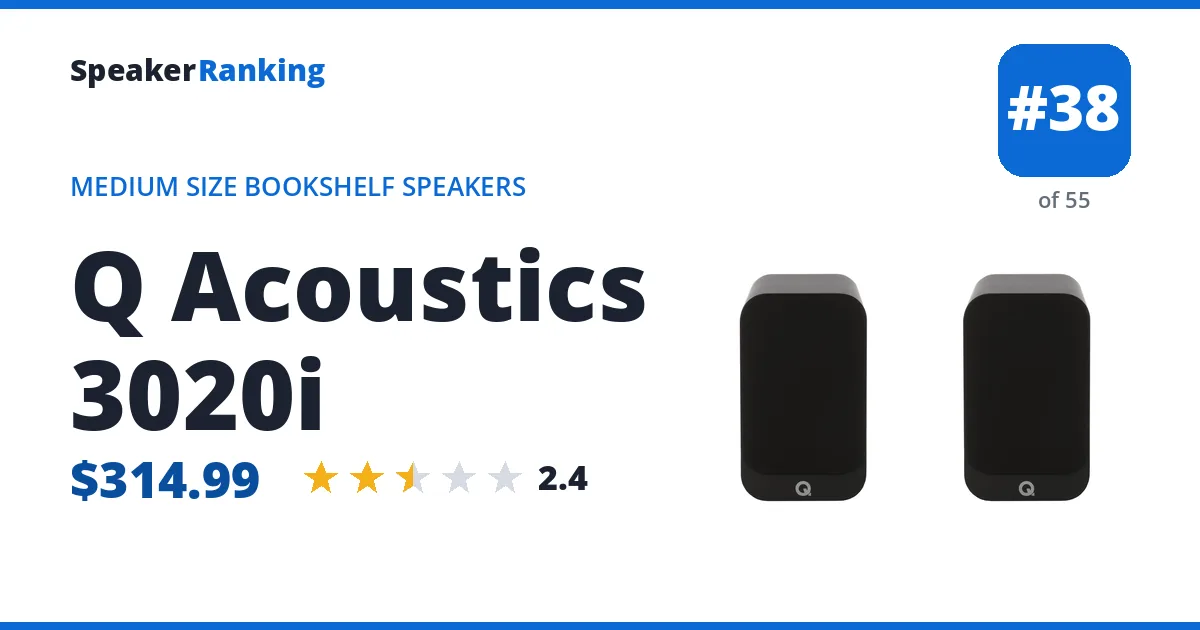
Newer model: the Q Acoustics 3020c, ranked higher, estimated 2.6/5.
Pros: UK-designed (Finkteam) with attractive styling, including recessed binding posts and custom connectors. Vertical directivity is good enough that the tweeter doesn’t need to be exactly at ear level. With EQ correction, especially high-frequency shelving and a sub-40Hz high-pass filter, Amir found performance “improves substantially.”. Measured bass extension of 82.0Hz (-3dB).
Cons: On-axis response shows a rising upper-frequency trend and a dip in the 2-4kHz crossover region alongside two resonance-related dips; a significant resonance appears at 366Hz in the waterfall plot. Horizontal directivity is narrow and uneven due to a woofer/tweeter beamwidth mismatch. Amir cautions the speaker is “merely a distortion generator” if played too low, and its low impedance demands a quality amplifier. Without EQ, Amir “can’t recommend the Q Acoustics 3020i.”. Discontinued; Q Acoustics now sells the 3030i and 3010c in its place.
Full Q Acoustics 3020i review and specifications →
| Bass Extension (-10dB) | 49.8Hz (measured, Audio Science Review) |
|---|---|
| Bass Extension (-3dB) | 82.0Hz (measured, Audio Science Review) |
| Crossover Frequency | 2.4kHz |
| DIY Kit | No |
| Dimensions | 10.9”H x 6.7”W x 11.1”D (278 x 170 x 282 mm) |
| Drivers | 125mm (5”) bass driver, 22mm (0.9”) tweeter |
| Impedance | 6 ohms nominal, 4 ohms minimum |
| Sensitivity | 86dB (2.83V/1m, manufacturer specified) |
| Spinorama Preference Score | 3.86 |
| Spinorama Preference Score with Perfect Sub | 6.38 |
| Weight | 10.6 lbs (4.8 kg) each |
| Woofer Cabinet | ported, reflex |
- Reviews, Comparisons and Sound Samples
- Head-to-Head Comparisons
- Q Acoustics 3020i vs KEF Q100
- Q Acoustics 3020i vs ELAC Uni-Fi 2.0 UB52
- Q Acoustics 3020i vs Micca RB42
- Q Acoustics 3020i vs JBL Stage A120
- Q Acoustics 3020i vs Q Acoustics 5020
- Q Acoustics 3020i vs JBL L52 Classic
- Q Acoustics 3020i vs JBL Stage A130
- Q Acoustics 3020i vs Fluance Signature HFS
- See all 35 comparisons