Short answer: the Sound Rhyme SR10. It ranks #961 of 1369 in-ear headphones by sound quality, rated 3.3/5, at $99; the Shure SE215 ranks #1019, rated 3.1/5, and costs $109, which makes this an easy call rather than a real tradeoff.
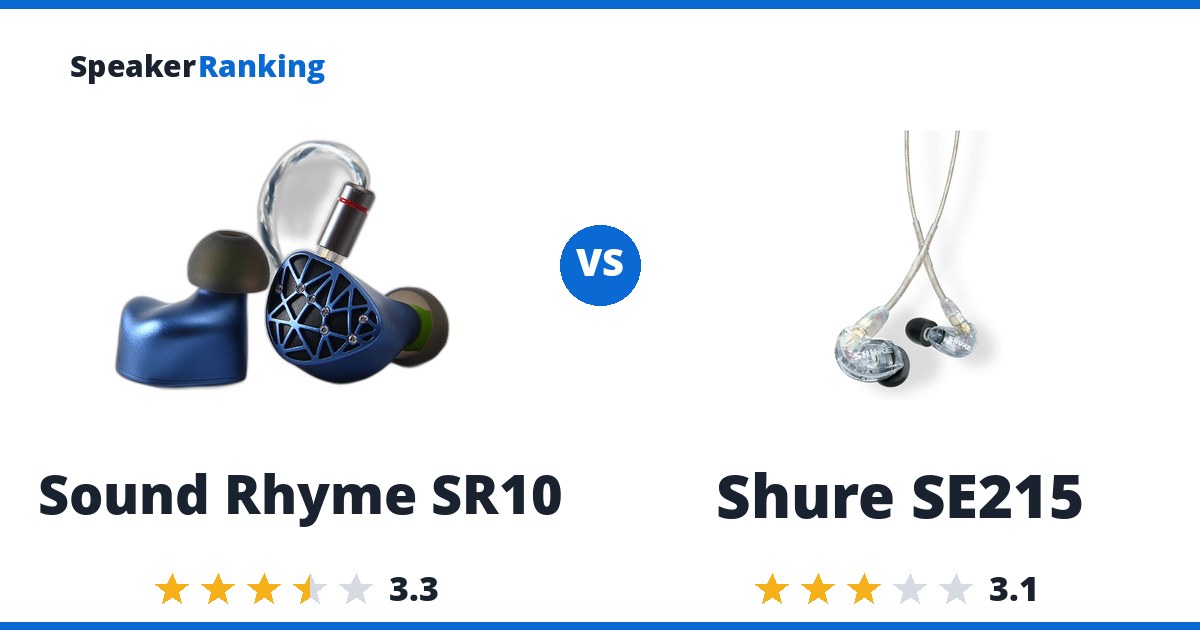
What the Sound Rhyme SR10 does well: A published AutoEQ preset corrects its response toward the Harman target, so a few minutes of EQ setup closes most of the gap. The catch: Treble about 3 dB below target from 3 to 10 kHz, which can sound dull or veiled next to brighter headphones.
What the Shure SE215 does well: Bass from 60 to 200 Hz is lifted by about 4.2 dB with low mids up 2.2 dB, giving a warm, full sound that suits rock, pop and hip hop. The catch: Treble from 6 to 10 kHz is about 3 dB low with a 5.9 dB dip near 6.7 kHz, and the top octave is down 2.7 dB, so cymbals and air sound dull.
Buy the Sound Rhyme SR10. It is rated higher for sound quality than the Shure SE215 and costs less, so it is the default pick unless a specific strength of the other one matters more to you.
Looking for alternatives? See the complete Headphones rankings.

A published AutoEQ preset corrects its response toward the Harman target, so a few minutes of EQ setup closes most of the gap.
Penon Audio eBay
Bass from 60 to 200 Hz is lifted by about 4.2 dB with low mids up 2.2 dB, giving a warm, full sound that suits rock, pop and hip hop.
Amazon $109.00 eBayPrices on this page were last checked October 17, 2026 at 6:04 PM UTC. Product prices and availability are accurate as of that date/time and are subject to change; the price and availability shown on Amazon at the time of purchase will apply to the purchase of this product.
As an eBay Partner, we may be compensated if you make a purchase.
Specifications Side By Side
| Sound Rhyme SR10 | Shure SE215 | |
|---|---|---|
| Price | 99.00 | $109.00 |
| Ranked | #961 of 1369 in In-Ear Headphones | #1019 of 1369 in In-Ear Headphones |
| Form Factor | In-ear | In-ear |
| Back | Closed | Closed |
| Harman Preference Score | 65 (median of 3 squig.link measurements, calibrated to AutoEQ) | 63 (measured by oratory1990, via AutoEQ) |
| Deviation From Target | 2.39 dB standard deviation | 2.78 dB standard deviation |
| Tonal Tilt | -1.03 (negative is warmer, positive brighter) | -0.78 (negative is warmer, positive brighter) |
| Sub-bass Extension | Within 6 dB of target down to 20 Hz (+1.0 dB at 30 Hz) | Within 6 dB of target down to 20 Hz (-1.0 dB at 30 Hz) |
| Driver Type | Tribrid | Dynamic |
| Drivers | 10 drivers (2 dynamic drivers + 4 balanced armatures + 4 micro planar drivers) | 1 x dynamic |
| Impedance | 18 ohms | 17 ohms |
| Sensitivity | 115 dB | 107 dB SPL/mW |
| Frequency Response | 10Hz - 40kHz | 22Hz - 17.5kHz (Manufacturer specified) |
| Connection | Wired | Wired |
Frequency Response Compared
Both headphones’ measurements overlaid on the Harman target. Above the target sounds louder in that range, below it quieter. Each curve is the median of several independent measurements, shifted so its 500 Hz to 2 kHz average sits at 0 dB, so only the tuning is compared.
Measurement data: the Sound Rhyme SR10 from atechreviews, flare and sl0the; the Shure SE215 from aden, ducbloke, ekaudio, superreview, suporsalad and yoshiultra, all via squig.link.
Related Headphone Comparisons
More worthwhile head-to-heads for Sound Rhyme SR10: