Short answer: the XMechanik Mechano23 DIY. It ranks #6 of 87 bookshelf speakers by sound quality at $48; the Polk Audio XT15 ranks #29 and costs $159.99, so there is not much of a tradeoff to weigh.
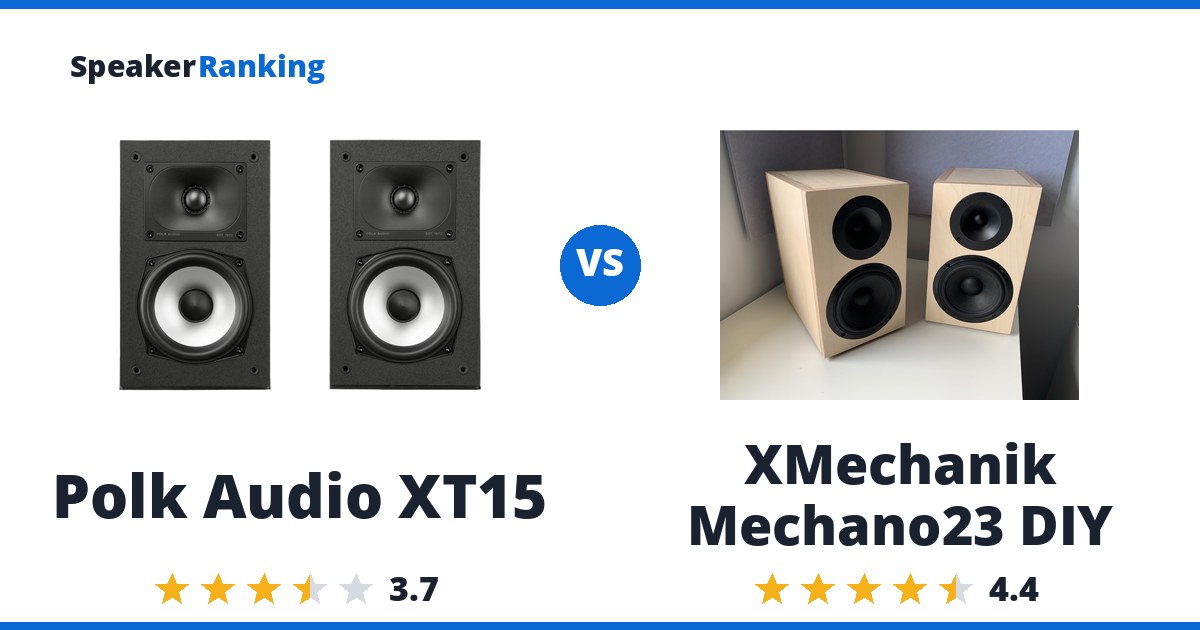
What the Polk Audio XT15 offers: Very low $179/pair entry price for a Hi-Res Audio Certified 2-way design that’s Dolby Atmos and DTS:X compatible, and works with either 4- or 8-ohm amplifier outputs so it drops into almost any AVR without matching concerns. Directivity spread is reasonably even for the price (directivity_spdi_stddev 3.60). Watch for: Bass rolls off earlier than most of this batch at 77.6Hz (-3dB) / 54.2Hz (-10dB). On-axis deviation is the roughest measured figure here (aad_on_axis 0.449), and listening-window smoothness (0.303) trails the pricier options in this group. Modest 86dB sensitivity wants a reasonably powered amp channel. The 5.25” bi-laminate paper woofer is Polk’s entry-tier driver, not the polypropylene/Turbine cones used in its pricier Signature Elite/Reserve lines.
What the XMechanik Mechano23 DIY offers: The bass alignment is unusually well damped, with a measured Q of 0.336, among the lowest of any speaker in this catalog, so the -3dB point at 77.6Hz rolls off cleanly instead of building into a resonant bump the way many small ported designs do. On axis deviation measures a tight 0.195dB average, and Audio Science Review’s independent Klippel NFS review called the predicted in room response nearly perfect, with directivity matching that beats some commercial designs costing many times more, all from about $200 in parts. Watch for: This is a true DIY project. There is no assembled unit to buy, drivers come from Madisound, the crossover kit comes separately from EZ Speaker Solutions, and the birch plywood cabinet has to be built and finished by hand. Listening window smoothness measures a moderate 0.47 and the sound power directivity index has more variation (standard deviation 4.02) than the tightest speakers in this catalog, so off axis energy isn’t quite as evenly controlled as the excellent on axis figures suggest.
Buy the XMechanik Mechano23 DIY. It ranks higher for sound quality than the Polk Audio XT15 and costs less, which settles it without a real tradeoff to make.
Looking for alternatives? See the complete Passive Home rankings.
Specifications Side By Side
| Polk Audio XT15 | XMechanik Mechano23 DIY | |
|---|---|---|
| Price | $159.99 per pair | $200 per pair DIY parts |
| Ranked | #29 of 87 in Medium Size Bookshelf Speakers | #6 of 87 in Medium Size Bookshelf Speakers |
| Bass Extension (-10dB) | 54.2Hz (measured, spinorama.org) | 42.4Hz (measured, Audio Science Review) |
| Bass Extension (-3dB) | 77.6Hz (measured, spinorama.org) | 77.6Hz (measured, Audio Science Review) |
| Dimensions | 16.51 x 18.24cm (6.5 x 7.18 in), 4.08kg (9 lb) each | 11.4"H x 6.9"W x 10.4"D (290 x 174 x 263 mm) |
| Impedance | 4/8-ohm compatible | - |
| Sensitivity | 86dB (1W/1m) | 85.1dB @ 2.83V/1m (measured, Audio Science Review) |
| Drivers | 1" Terylene dome tweeter, 5.25" bi-laminate paper woofer | Scan-Speak Discovery H2606/9200 1" horn loaded textile dome tweeter, SB Acoustics SB13PFCR25-4 5" fiber cone woofer |
| Weight | 9 lbs (4.08 kg) each | - |
| Woofer Cabinet | Ported | - |
| Spinorama Preference Score | 3.65 | 4.70 |
| Spinorama Preference Score with Perfect Sub | 6.40 | 7.16 |
| Enclosure | - | ported |
| Port Tuning | - | Approximately 45Hz |
| Cabinet Material | - | 18mm Baltic birch plywood |
| Country | - | Design origin: United States (ASR forum); assembled by buyer |
Related Speaker Comparisons
More worthwhile head-to-heads for XMechanik Mechano23 DIY:
- XMechanik Mechano23 DIY vs Audio First Fidelia
- XMechanik Mechano23 DIY vs Philharmonic Ceramic Mini
- Ascend Sierra 1 v2 vs XMechanik Mechano23 DIY
- KEF LS50 Meta vs XMechanik Mechano23 DIY
- Ascend Acoustics HTM-200SE2 vs XMechanik Mechano23 DIY
Prices on this page were last checked September 16, 2026 at 12:41 AM UTC. Product prices and availability are accurate as of that date/time and are subject to change; the price and availability shown on Amazon at the time of purchase will apply to the purchase of this product.
As an eBay Partner, we may be compensated if you make a purchase.
The Two Speakers In Full
 Polk Audio XT15: $159.99 per pair Amazon B&H Photo Video Crutchfield eBay
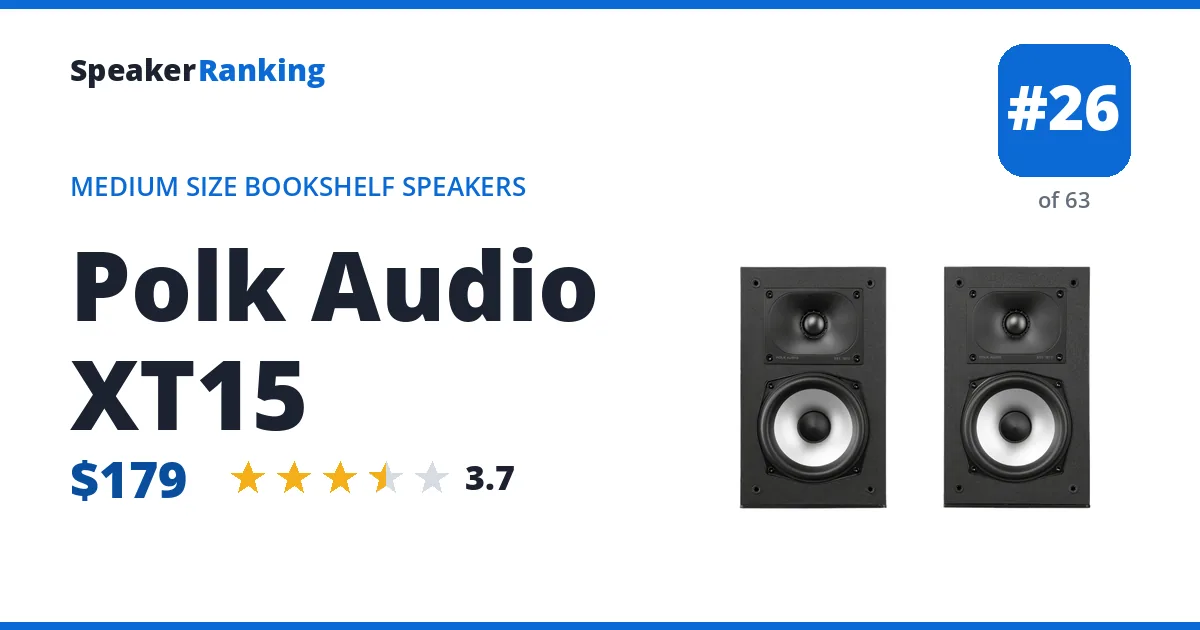
Pros: Very low $179/pair entry price for a Hi-Res Audio Certified 2-way design that’s Dolby Atmos and DTS:X compatible, and works with either 4- or 8-ohm amplifier outputs so it drops into almost any AVR without matching concerns. Directivity spread is reasonably even for the price (directivity_spdi_stddev 3.60). Measured bass extension of 77.6Hz (-3dB).
Cons: Bass rolls off earlier than most of this batch at 77.6Hz (-3dB) / 54.2Hz (-10dB). On-axis deviation is the roughest measured figure here (aad_on_axis 0.449), and listening-window smoothness (0.303) trails the pricier options in this group. Modest 86dB sensitivity wants a reasonably powered amp channel. The 5.25” bi-laminate paper woofer is Polk’s entry-tier driver, not the polypropylene/Turbine cones used in its pricier Signature Elite/Reserve lines.
Full Polk Audio XT15 review and specifications →
| Bass Extension (-10dB) | 54.2Hz (measured, spinorama.org) |
|---|---|
| Bass Extension (-3dB) | 77.6Hz (measured, spinorama.org) |
| Dimensions | 16.51 x 18.24cm (6.5 x 7.18 in), 4.08kg (9 lb) each |
| Drivers | 1" Terylene dome tweeter, 5.25" bi-laminate paper woofer |
| Impedance | 4/8-ohm compatible |
| Sensitivity | 86dB (1W/1m) |
| Spinorama Preference Score | 3.65 |
| Spinorama Preference Score with Perfect Sub | 6.40 |
| Weight | 9 lbs (4.08 kg) each |
| Woofer Cabinet | Ported |
- Links
- Reviews, Comparisons and Sound Samples
- Head-to-Head Comparisons
- Polk Audio XT15 vs Wharfedale Diamond 220
- Polk Audio XT15 vs KEF Q150
- Polk Audio XT15 vs JBL Stage 250B
- Polk Audio XT15 vs Neumi Silk 4
- Polk Audio XT15 vs Boston Acoustics A25
- Polk Audio XT15 vs Radiant Acoustics Clarity 4.2
- Polk Audio XT15 vs Wharfedale Diamond 12.1
- Polk Audio XT15 vs Wharfedale Super Denton
- See all 41 comparisons
 XMechanik Mechano23 DIY: $200 per pair DIY parts Madisound (Tweeter) Madisound (Woofer) eBay
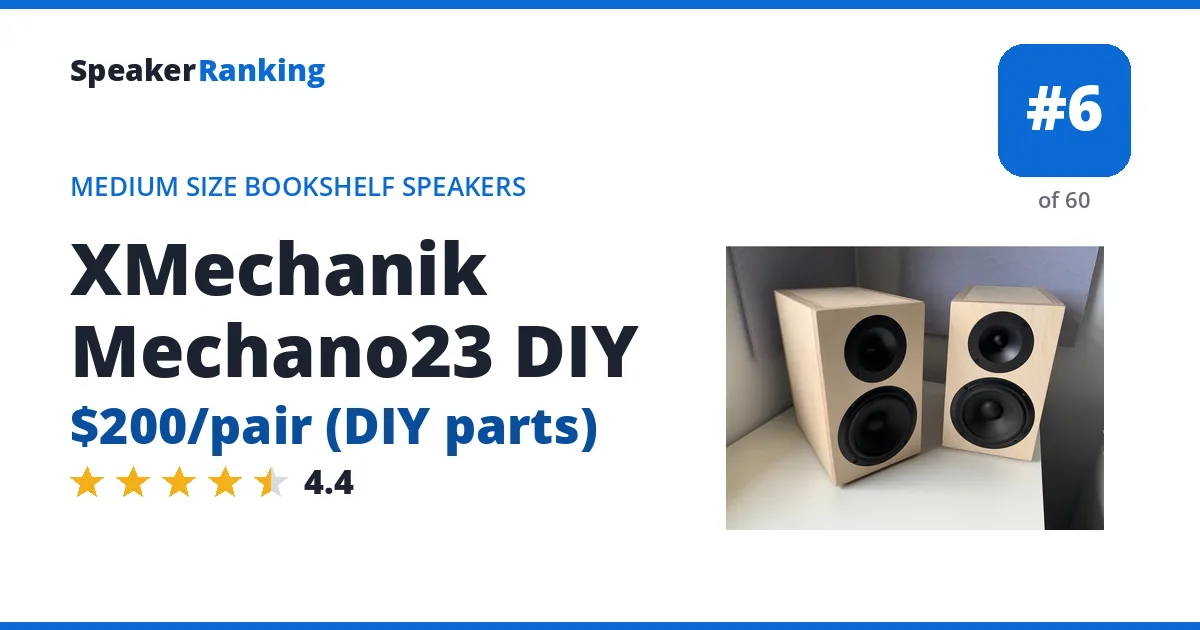
Pros: The bass alignment is unusually well damped, with a measured Q of 0.336, among the lowest of any speaker in this catalog, so the -3dB point at 77.6Hz rolls off cleanly instead of building into a resonant bump the way many small ported designs do. On axis deviation measures a tight 0.195dB average, and Audio Science Review’s independent Klippel NFS review called the predicted in room response nearly perfect, with directivity matching that beats some commercial designs costing many times more, all from about $200 in parts. Measured bass extension of 77.6Hz (-3dB), with a measured sensitivity of 85.1dB.
Cons: This is a true DIY project. There is no assembled unit to buy, drivers come from Madisound, the crossover kit comes separately from EZ Speaker Solutions, and the birch plywood cabinet has to be built and finished by hand. Listening window smoothness measures a moderate 0.47 and the sound power directivity index has more variation (standard deviation 4.02) than the tightest speakers in this catalog, so off axis energy isn’t quite as evenly controlled as the excellent on axis figures suggest.
Full XMechanik Mechano23 DIY review and specifications →
| Bass Extension (-10dB) | 42.4Hz (measured, Audio Science Review) |
|---|---|
| Bass Extension (-3dB) | 77.6Hz (measured, Audio Science Review) |
| Cabinet Material | 18mm Baltic birch plywood |
| Country | Design origin: United States (ASR forum); assembled by buyer |
| Dimensions | 11.4"H x 6.9"W x 10.4"D (290 x 174 x 263 mm) |
| Drivers | Scan-Speak Discovery H2606/9200 1" horn loaded textile dome tweeter, SB Acoustics SB13PFCR25-4 5" fiber cone woofer |
| Enclosure | ported |
| Port Tuning | Approximately 45Hz |
| Sensitivity | 85.1dB @ 2.83V/1m (measured, Audio Science Review) |
| Spinorama Preference Score | 4.70 |
| Spinorama Preference Score with Perfect Sub | 7.16 |
- Links
- Reviews, Comparisons and Sound Samples
- Head-to-Head Comparisons
- XMechanik Mechano23 DIY vs Ascend Acoustics HTM-200SE2
- XMechanik Mechano23 DIY vs Arendal 1961 Monitor
- XMechanik Mechano23 DIY vs KEF LS50 Meta
- XMechanik Mechano23 DIY vs Ascend Sierra 1 v2
- XMechanik Mechano23 DIY vs Philharmonic Ceramic Mini
- XMechanik Mechano23 DIY vs Ascend Acoustics Luna V2 Mini-Monitor Titan
- XMechanik Mechano23 DIY vs Aalto Speakers Aalto 1 EVO
- XMechanik Mechano23 DIY vs Audio First Fidelia
- See all 20 comparisons