Short answer: the Ex Machina Pulsar MKII, if you are buying new. The Focal Twin6 Be measures as well as it (#104 vs #105 of 119 powered bookshelf speakers, 3.8/5 vs 3.8/5) but is discontinued, so only consider it used; the Ex Machina Pulsar MKII is still sold new at $11,700. The Focal Twin6 Be’s replacement, the Focal ST6 Twin6, is rated 3.8/5 at $4,598.
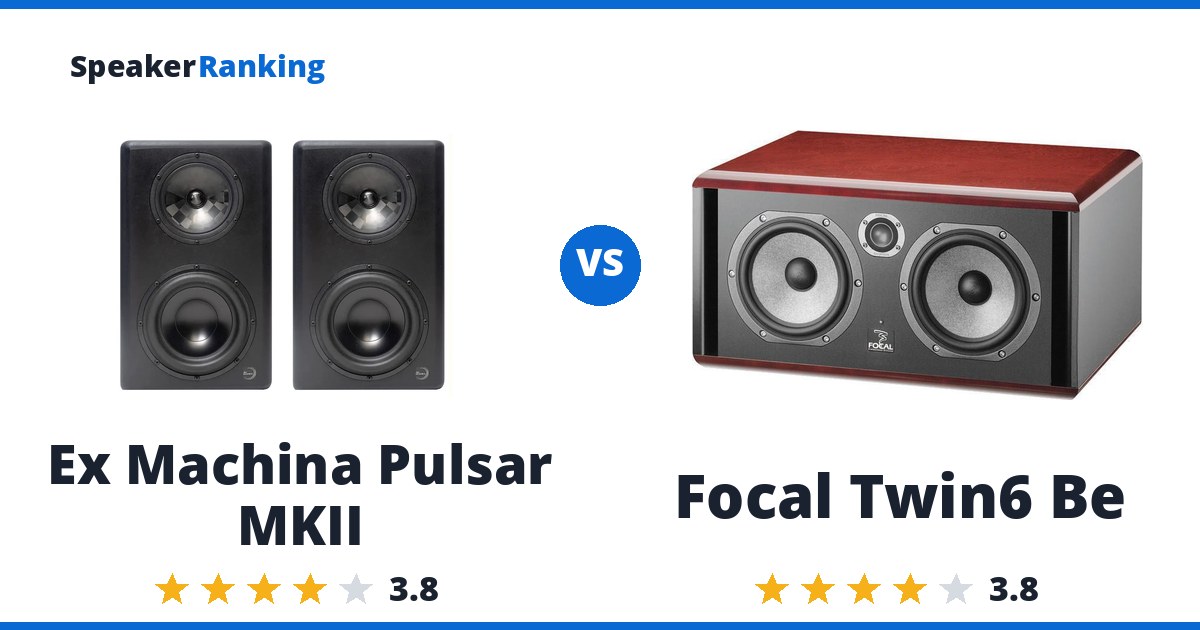
The Ex Machina Pulsar MKII is the more accurate pick. A high end active three way studio monitor with deep bass that can skip a subwoofer and digital and analog inputs. Its measured preference score, a predictor of how neutral it sounds, is 5.04 against 4.04 for the Focal Twin6 Be. Watch for: Its 6.16 ideal-subwoofer score and uneven listening-window response do not support a top accuracy ranking.
What the Focal Twin6 Be does well: A dual woofer studio monitor with a beryllium tweeter and plenty of output for dedicated mixing rooms. The tradeoff: The horizontal measurement scores 6.06 with an ideal subwoofer and spans 2.9dB from 300Hz to 5kHz.
Buy the Ex Machina Pulsar MKII if you want one new; the Focal Twin6 Be is discontinued, so only look for it used.
Still deciding? The full Powered Home rankings cover every ranked option.

A high end active three way studio monitor with deep bass that can skip a subwoofer and digital and analog inputs.

A dual woofer studio monitor with a beryllium tweeter and plenty of output for dedicated mixing rooms.
Prices on this page were last checked October 23, 2026 at 8:27 AM UTC. Product prices and availability are accurate as of that date/time and are subject to change; the price and availability shown on Amazon at the time of purchase will apply to the purchase of this product.
As an eBay Partner, we may be compensated if you make a purchase.
Specifications Side By Side
| Ex Machina Pulsar MKII | Focal Twin6 Be | |
|---|---|---|
| Price | $11,700 per pair | $3,990 per pair Discontinued |
| Ranked | #105 of 119 in Large Size Powered Bookshelf Speakers | #104 of 119 in Large Size Powered Bookshelf Speakers |
| Enclosure | Powered sealed 3-way | - |
| Drivers | 9-inch SEAS woofer, 7-inch coaxial midrange/tweeter | 1” inverted beryllium tweeter; dual 6.5” W-cone drivers |
| Amplifier Power | 250W LF, 100W MF, 50W HF per speaker | 150W LF + 100W LF/MF + 100W HF |
| Frequency Response | 35Hz-32kHz (+/-1dB) | 40Hz - 40kHz (±3dB) (Manufacturer specified) |
| Maximum SPL | 110dB continuous at 1m | - |
| Coverage | 90 degrees conical | - |
| Inputs | Analog and AES/EBU digital | Balanced XLR with +4dBu/-10dBV sensitivity |
| DSP | SHARC, phase and magnitude correction | - |
| Spinorama Preference Score | 5.04 | 4.04 |
| Spinorama Preference Score with Perfect Sub | 6.16 | 6.06 |
| XLR Input | No | Yes |
| RCA Input | No | No |
| TRS Input | No | No |
| Optical Input | No | No |
| Coaxial Input | No | No |
| USB Input | No | No |
| HDMI Input | No | No |
| AES Input | Yes | No |
| Aux Input | No | No |
| Bluetooth | No | No |
| Dimensions | 19” x 11.4” x 13.6” (483 x 289 x 345 mm) (H x W x D) | 9.8” x 19.7” x 13.4” (250 x 500 x 340 mm) (H x W x D) |
| Weight | 50.7 lbs (23 kg) | 48.5 lbs (22 kg) |
| Bass Extension | - | 40Hz manufacturer specified; Erin measured strong low-frequency linearity |
| Bass Extension (-3dB) | - | 48.3Hz (measured, Erin’s Audio Corner) |
| Bass Extension (-10dB) | - | 39.1Hz (measured, Erin’s Audio Corner) |
Frequency Response Compared
Both speakers’ spinorama measurements, overlaid. A flatter line is more neutral: peaks sound forward or harsh, dips sound recessed. Each curve is shifted so its average from 300 Hz to 3 kHz sits at 0 dB, so loudness differences between the two are removed and only the shape is compared.
Measurement data: Ex Machina Pulsar MKII (measured by Erin’s Audio Corner) and Focal Twin6 Be (measured by Erin’s Audio Corner), via spinorama.org.
Related Speaker Comparisons
More top alternatives to Focal Twin6 Be: