Short answer: the ED150A for a confirmed measured advantage, the DXR15mkIII for the newest features and wider dealer support. These rank #13 and #15 out of 51 15-inch powered PA speakers, priced at $1,990 and $1,099.99.
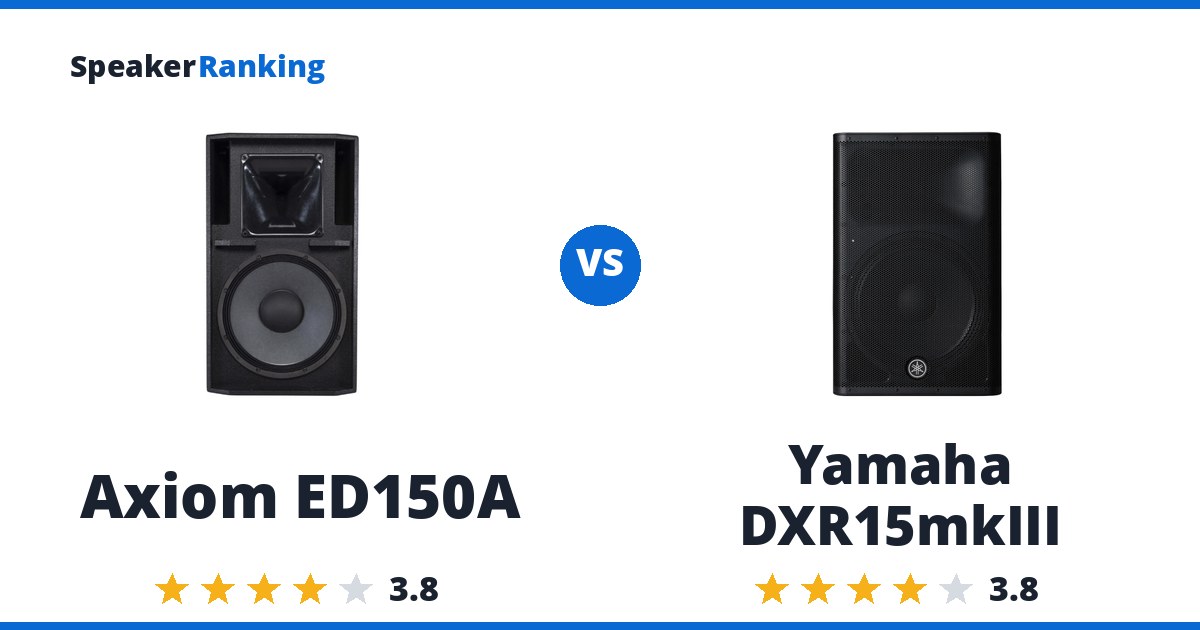
The ED150A carries a confirmed strong measured score. High-quality vendor data returns a 5.36 ideal-subwoofer preference score with 47Hz measured extension, matching the well-regarded ED120A’s asymmetric-coverage design in a 15-inch cabinet, with PRONET control over EtherCON/CANBUS for networked systems. Its own cons note Axiom has a much smaller North American dealer and service network than JBL, Yamaha or QSC, and detailed coverage and weight figures weren’t confirmed in local data.
The DXR15mkIII is the newest-generation Yamaha, but its measured result is unconfirmed. The third-generation DXR15 raises claimed output to 134dB with 2000W amplification, app-based control and Yamaha’s newest onboard DSP, while its 90° x 60° pattern matches the well-regarded DXR12mkIII, and it adds Bluetooth 5.0 audio streaming alongside D-Remote control. Its own cons are candid: the low-quality local data is truncated and can’t produce a preference score, so its tonal advantage over the proven DXR15mkII is unconfirmed.
Buy the ED150A for a confirmed high-quality measured result if PRONET networking fits your system.
Buy the DXR15mkIII for Bluetooth audio streaming, app-based control and Yamaha’s broader service network, accepting that its measured tonal position is unconfirmed.
Still deciding? The full PA & Live Sound rankings cover every ranked option.
Specifications Side By Side
| Axiom ED150A | Yamaha DXR15mkIII | |
|---|---|---|
| Price | $1,990 | $1,099.99 |
| Ranked | #13 of 51 in 15-Inch PA Speakers | #15 of 51 in 15-Inch PA Speakers |
| Configuration | Active 2-way bass-reflex PA speaker | Active 2-way bass-reflex PA speaker |
| Drivers | 15” woofer, compression driver | 15” woofer, 1” throat/1.75” diaphragm compression driver |
| Frequency Response | 50Hz - 17kHz (-6dB, manufacturer specified) | 46Hz - 20kHz (-10dB, manufacturer specified) |
| Dimensions | 30.1”H x 17.7”W x 15.7”D (765 x 450 x 400 mm) | 27.5”H x 17.6”W x 15”D (699 x 447 x 380 mm) |
| Inputs | Neutrik XLR input and link output | 2 x XLR/TRS combo; XLR thru and DSP outputs |
| Amplifier Power | 1,200W continuous (900W LF + 300W HF Class D, manufacturer specified) | 2000W peak / 1000W RMS (1700W LF + 300W HF peak) |
| Cabinet Material | 15mm reinforced phenolic birch plywood | PP plastic |
| Rigging | M10 and M6 fly points; pole-mount socket | 3 x M10 points plus U-bracket points; 35mm dual-angle pole mount |
| Network Control | PRONET control over EtherCON/CANBUS | - |
| Bass Extension (-3dB) | 54.5Hz (measured, vendor Spinorama data) | 54.5Hz (measured, vendor Spinorama data) |
| DSP | Yes | Yes, FIR-X tuning, Drive Motion Calibration and D-Remote |
| Bluetooth | No | Yes |
| Spinorama Preference Score | 3.14 | - |
| Spinorama Preference Score with Perfect Sub | 5.36 | - |
| XLR Input | Yes | Yes |
| RCA Input | No | No |
| TRS Input | No | Yes |
| Optical Input | No | No |
| Coaxial Input | No | No |
| USB Input | No | No |
| HDMI Input | No | No |
| AES Input | No | No |
| Aux Input | No | No |
| Microphone Input | No | No |
| Guitar Input | No | No |
| Maximum SPL | 132dB peak (manufacturer specified) | 134dB peak (manufacturer specified) |
| Coverage | 60-100° horizontal (asymmetric), 60° vertical average | 90° x 60° |
| Weight | 68.3 lbs (31 kg) | 46.3 lbs (21 kg) |
| Crossover Frequency | - | 1800Hz (FIR-X) |
| Bluetooth Version | - | 5.0 |
Related Speaker Comparisons
How Axiom ED150A compares with other leading options:
- LD Systems DDQ15 vs Axiom ED150A
- RCF ART 935-A vs Axiom ED150A
- Coda Audio G715 vs Axiom ED150A
- Yamaha DZR315 vs Axiom ED150A
- Axiom ED150A vs FBT Mitus 115A
Prices on this page were last checked October 7, 2026 at 9:25 PM UTC. Product prices and availability are accurate as of that date/time and are subject to change; the price and availability shown on Amazon at the time of purchase will apply to the purchase of this product.
As an eBay Partner, we may be compensated if you make a purchase.
The Two Speakers In Full
 Axiom ED150A: $1,990 eBay
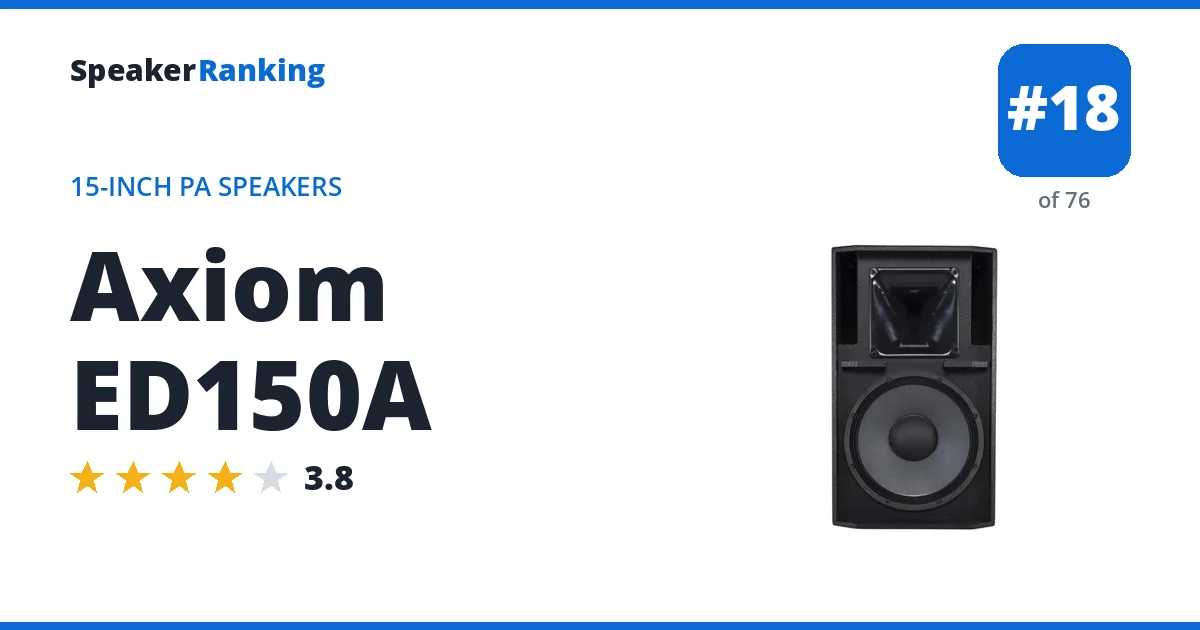
Same family: the Axiom ED60P (smaller model, rated 3.3/5), the Axiom ED80P (smaller model, rated 3.4/5) and the Axiom ED120A (smaller model, rated 4/5).
Pros: High-quality vendor data returns a 5.36 ideal-subwoofer preference score with 47Hz measured extension, matching the well-regarded ED120A’s asymmetric-coverage design in a 15-inch cabinet. Measured bass extension of 54.5Hz (-3dB).
Cons: Axiom has a much smaller North American dealer and service network than JBL, Yamaha or QSC, and detailed coverage/weight figures were not confirmed in local data.
Full Axiom ED150A review and specifications →
| AES Input | No |
|---|---|
| Amplifier Power | 1,200W continuous (900W LF + 300W HF Class D, manufacturer specified) |
| Aux Input | No |
| Bass Extension (-3dB) | 54.5Hz (measured, vendor Spinorama data) |
| Bluetooth | No |
| Cabinet Material | 15mm reinforced phenolic birch plywood |
| Coaxial Input | No |
| Configuration | Active 2-way bass-reflex PA speaker |
| Coverage | 60-100° horizontal (asymmetric), 60° vertical average |
| DSP | Yes |
| Dimensions | 30.1”H x 17.7”W x 15.7”D (765 x 450 x 400 mm) |
| Drivers | 15” woofer, compression driver |
| Frequency Response | 50Hz - 17kHz (-6dB, manufacturer specified) |
| Guitar Input | No |
| HDMI Input | No |
| Inputs | Neutrik XLR input and link output |
| Maximum SPL | 132dB peak (manufacturer specified) |
| Microphone Input | No |
| Network Control | PRONET control over EtherCON/CANBUS |
| Optical Input | No |
| RCA Input | No |
| Rigging | M10 and M6 fly points; pole-mount socket |
| Spinorama Preference Score | 3.14 |
| Spinorama Preference Score with Perfect Sub | 5.36 |
| TRS Input | No |
| USB Input | No |
| Weight | 68.3 lbs (31 kg) |
| XLR Input | Yes |
- Links
- Reviews, Comparisons and Sound Samples
- Head-to-Head Comparisons
 Yamaha DXR15mkIII: $1,099.99 Amazon B&H Photo Video Guitar Center eBay
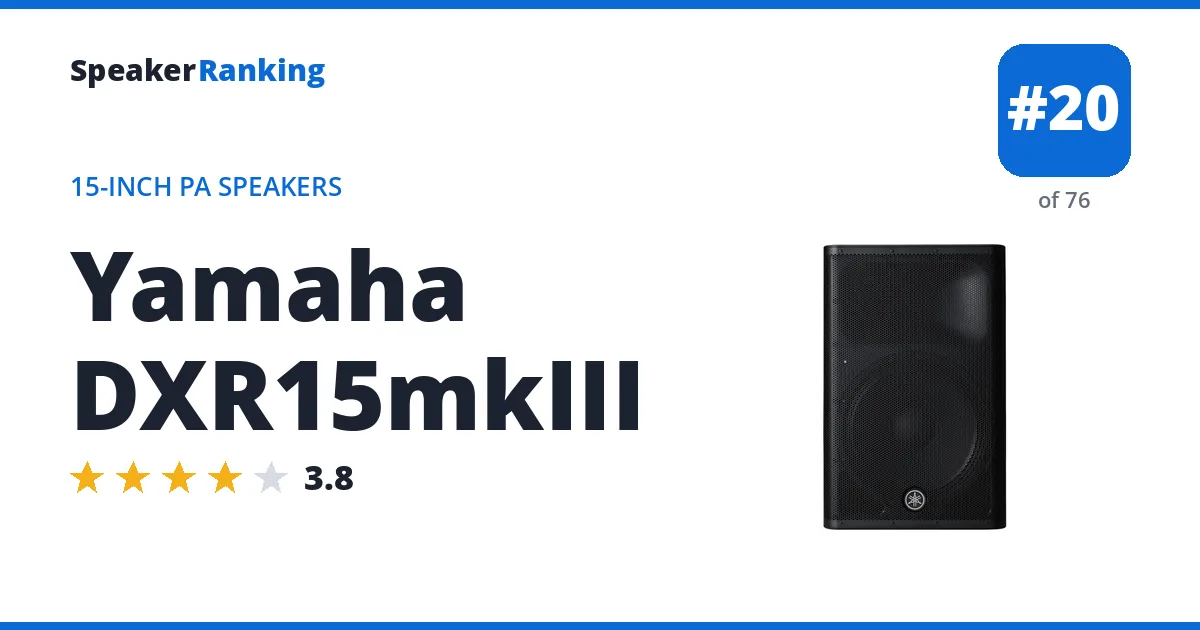
Older model: the Yamaha DXR15mkII (ranked lower, rated 3.7/5).
Pros: The third-generation DXR15 raises claimed output to 134dB with 2000W amplification, app-based control and Yamaha’s newest onboard DSP, while its 90° x 60° pattern matches the well-regarded DXR12mkIII. Measured bass extension of 54.5Hz (-3dB).
Cons: The low-quality local data is truncated and cannot produce a preference score, so its tonal advantage over the proven DXR15mkII is unconfirmed. Wireless connectivity is for remote control, not audio streaming.
Full Yamaha DXR15mkIII review and specifications →
| AES Input | No |
|---|---|
| Amplifier Power | 2000W peak / 1000W RMS (1700W LF + 300W HF peak) |
| Aux Input | No |
| Bass Extension (-3dB) | 54.5Hz (measured, vendor Spinorama data) |
| Bluetooth | Yes |
| Bluetooth Version | 5.0 |
| Cabinet Material | PP plastic |
| Coaxial Input | No |
| Configuration | Active 2-way bass-reflex PA speaker |
| Coverage | 90° x 60° |
| Crossover Frequency | 1800Hz (FIR-X) |
| DSP | Yes, FIR-X tuning, Drive Motion Calibration and D-Remote |
| Dimensions | 27.5”H x 17.6”W x 15”D (699 x 447 x 380 mm) |
| Drivers | 15” woofer, 1” throat/1.75” diaphragm compression driver |
| Frequency Response | 46Hz - 20kHz (-10dB, manufacturer specified) |
| Guitar Input | No |
| HDMI Input | No |
| Inputs | 2 x XLR/TRS combo; XLR thru and DSP outputs |
| Maximum SPL | 134dB peak (manufacturer specified) |
| Microphone Input | No |
| Optical Input | No |
| RCA Input | No |
| Rigging | 3 x M10 points plus U-bracket points; 35mm dual-angle pole mount |
| TRS Input | Yes |
| USB Input | No |
| Weight | 46.3 lbs (21 kg) |
| XLR Input | Yes |
- Links
- Reviews, Comparisons and Sound Samples
- Head-to-Head Comparisons
- Yamaha DXR15mkIII vs Coda Audio G715
- Yamaha DXR15mkIII vs FBT Mitus 115A
- Yamaha DXR15mkIII vs RCF ART 935-A
- Yamaha DXR15mkIII vs Yamaha DXR15mkII
- Yamaha DXR15mkIII vs JBL PRX915
- Yamaha DXR15mkIII vs RCF ART 715-A MK5
- Yamaha DXR15mkIII vs Yamaha DZR15
- Yamaha DXR15mkIII vs RCF NX 915-A
- See all 20 comparisons