Short answer: a tie on sound quality. Both are rated 3.8/5 (#14 and #13 of 38 15-inch pa speakers), so choose on features and fit.
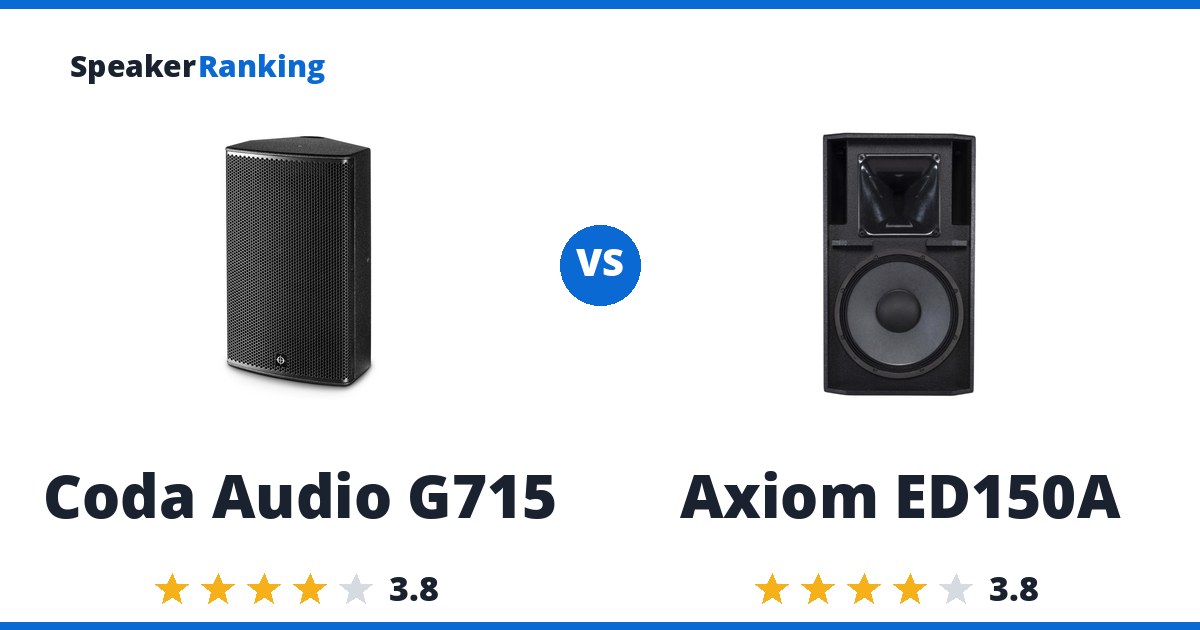
Why pick the Coda Audio G715: High-quality manufacturer measurements give preference scores of 2.86 standalone and 5.88 with an ideal subwoofer, with a tighter 2.9dB reference band than the G515. Watch for: Bass measures 87.5Hz at -3dB and about 56.5Hz at -10dB, less extended than a 15-inch woofer suggests, so it still needs a subwoofer.
What the Axiom ED150A does well: High-quality vendor data returns a 5.36 ideal-subwoofer preference score with 47Hz measured extension, matching the well-regarded ED120A’s asymmetric-coverage design in a 15-inch cabinet. The tradeoff: Axiom has a much smaller North American dealer and service network than JBL, Yamaha or QSC, and detailed coverage/weight figures were not confirmed in local data.
Buy the Coda Audio G715 or the Axiom ED150A on features: they are rated the same for sound quality at close to the same price.
Want more options? Browse the full PA & Live Sound rankings.
Specifications Side By Side
| Coda Audio G715 | Axiom ED150A | |
|---|---|---|
| Price | - | $1,990.00 |
| Ranked | #14 of 38 in 15-Inch PA Speakers | #13 of 38 in 15-Inch PA Speakers |
| Configuration | Passive 3-way PA speaker (passive or bi-amp) | Active 2-way bass-reflex PA speaker |
| Drivers | 15” neodymium woofer (4” voice coil), 1.4” neodymium coaxial mid/high driver | 15” woofer, compression driver |
| Frequency Response | 50Hz - 23kHz (-6dB, manufacturer specified) | 50Hz - 17kHz (-6dB, manufacturer specified) |
| Dimensions | 27.6”H x 16.5”W x 14.6”D (700 x 420 x 370 mm) | 30.1”H x 17.7”W x 15.7”D (765 x 450 x 400 mm) |
| Amplifier Power | Passive speaker; requires external amplification | 1,200W continuous (900W LF + 300W HF Class D, manufacturer specified) |
| Power Handling | 1,000W AES / 4,000W peak | - |
| Maximum SPL | 143dB peak (manufacturer specified) | 132dB peak (manufacturer specified) |
| Coverage | 90° x 60° (rotatable) | 60-100° horizontal (asymmetric), 60° vertical average |
| Sensitivity | 98dB | - |
| Impedance | 8 ohms | - |
| DSP | No (passive) | Yes |
| Weight | 54 lbs (24.5 kg) | 68.3 lbs (31 kg) |
| Bluetooth | No | No |
| XLR Input | No | Yes |
| RCA Input | No | No |
| TRS Input | No | No |
| Optical Input | No | No |
| Coaxial Input | No | No |
| USB Input | No | No |
| HDMI Input | No | No |
| AES Input | No | No |
| Aux Input | No | No |
| Microphone Input | No | No |
| Guitar Input | No | No |
| Bass Extension (-3dB) | 87.5Hz (measured, vendor Spinorama data) | 54.5Hz (measured, vendor Spinorama data) |
| Bass Extension (-10dB) | about 56.5Hz (measured, vendor Spinorama data) | - |
| Spinorama Preference Score | 2.86 | 3.14 |
| Spinorama Preference Score with Perfect Sub | 5.88 | 5.36 |
| Inputs | - | Neutrik XLR input and link output |
| Cabinet Material | - | 15mm reinforced phenolic birch plywood |
| Rigging | - | M10 and M6 fly points; pole-mount socket |
| Network Control | - | PRONET control over EtherCON/CANBUS |
Related Speaker Comparisons
More top alternatives to Axiom ED150A:
- LD Systems DDQ15 vs Axiom ED150A
- RCF ART 935-A vs Axiom ED150A
- Axiom ED150A vs Yamaha DXR15mkIII
- Yamaha DZR315 vs Axiom ED150A
- Axiom ED150A vs FBT Mitus 115A
Prices on this page were last checked September 26, 2026 at 11:14 PM UTC. Product prices and availability are accurate as of that date/time and are subject to change; the price and availability shown on Amazon at the time of purchase will apply to the purchase of this product.
As an eBay Partner, we may be compensated if you make a purchase.
The Two Speakers In Full
 Coda Audio G715 Passive eBay
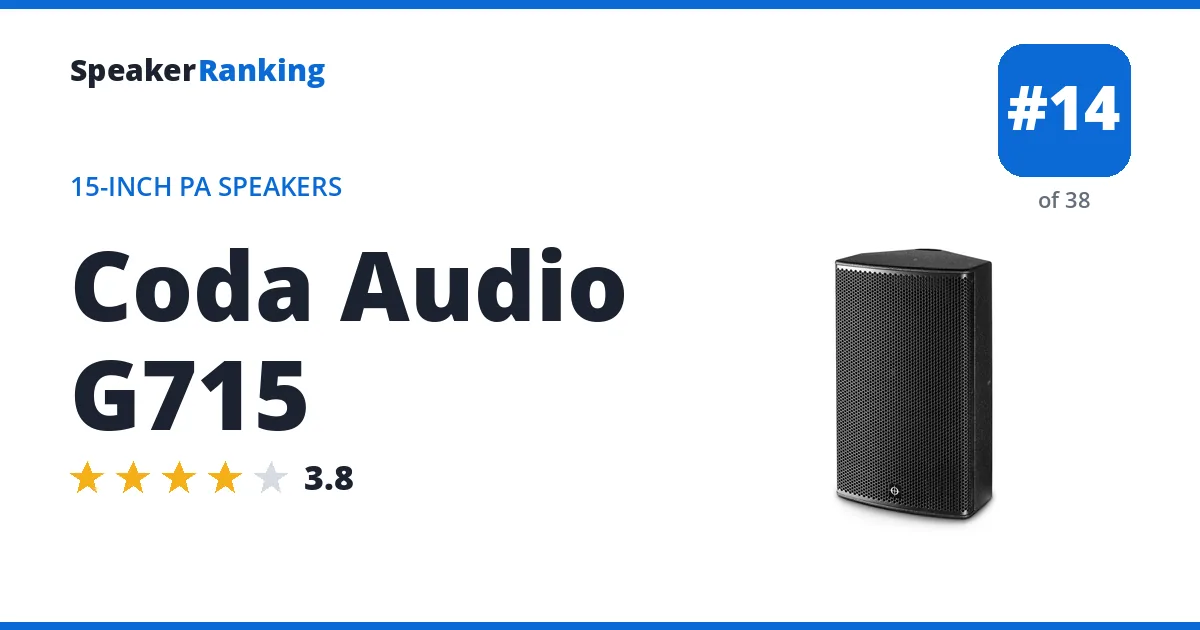
Pros: High-quality manufacturer measurements give preference scores of 2.86 standalone and 5.88 with an ideal subwoofer, with a tighter 2.9dB reference band than the G515. The 3-way design pairs a 15-inch low-distortion woofer with a coaxial 1.4-inch mid/high driver, rated at 98dB sensitivity and a 143dB peak. Passive or bi-amp operation and a rotatable 90° x 60° waveguide suit large venues and touring. Measured bass extension of 87.5Hz (-3dB).
Cons: Bass measures 87.5Hz at -3dB and about 56.5Hz at -10dB, less extended than a 15-inch woofer suggests, so it still needs a subwoofer. A 4.19 directivity-index deviation means off-axis tone varies. It weighs 24.5kg, is passive, and is sold through pro dealers with no published price.
Full Coda Audio G715 review and specifications →
| AES Input | No |
|---|---|
| Amplifier Power | Passive speaker; requires external amplification |
| Aux Input | No |
| Bass Extension (-10dB) | about 56.5Hz (measured, vendor Spinorama data) |
| Bass Extension (-3dB) | 87.5Hz (measured, vendor Spinorama data) |
| Bluetooth | No |
| Coaxial Input | No |
| Configuration | Passive 3-way PA speaker (passive or bi-amp) |
| Coverage | 90° x 60° (rotatable) |
| DSP | No (passive) |
| Dimensions | 27.6”H x 16.5”W x 14.6”D (700 x 420 x 370 mm) |
| Drivers | 15” neodymium woofer (4” voice coil), 1.4” neodymium coaxial mid/high driver |
| Frequency Response | 50Hz - 23kHz (-6dB, manufacturer specified) |
| Guitar Input | No |
| HDMI Input | No |
| Impedance | 8 ohms |
| Maximum SPL | 143dB peak (manufacturer specified) |
| Microphone Input | No |
| Optical Input | No |
| Power Handling | 1,000W AES / 4,000W peak |
| RCA Input | No |
| Sensitivity | 98dB |
| Spinorama Preference Score | 2.86 |
| Spinorama Preference Score with Perfect Sub | 5.88 |
| TRS Input | No |
| USB Input | No |
| Weight | 54 lbs (24.5 kg) |
| XLR Input | No |
- Links
- Reviews, Comparisons and Sound Samples
- Head-to-Head Comparisons
 Axiom ED150A: $1,990.00 eBay
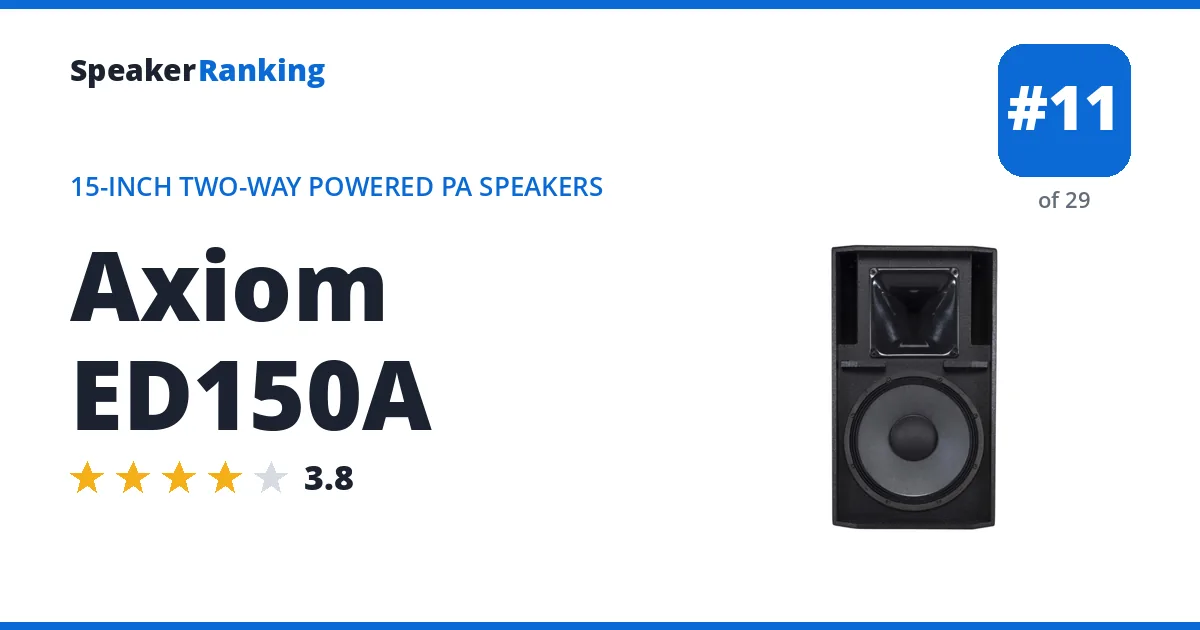
Pros: High-quality vendor data returns a 5.36 ideal-subwoofer preference score with 47Hz measured extension, matching the well-regarded ED120A’s asymmetric-coverage design in a 15-inch cabinet. Measured bass extension of 54.5Hz (-3dB).
Cons: Axiom has a much smaller North American dealer and service network than JBL, Yamaha or QSC, and detailed coverage/weight figures were not confirmed in local data.
Full Axiom ED150A review and specifications →
| AES Input | No |
|---|---|
| Amplifier Power | 1,200W continuous (900W LF + 300W HF Class D, manufacturer specified) |
| Aux Input | No |
| Bass Extension (-3dB) | 54.5Hz (measured, vendor Spinorama data) |
| Bluetooth | No |
| Cabinet Material | 15mm reinforced phenolic birch plywood |
| Coaxial Input | No |
| Configuration | Active 2-way bass-reflex PA speaker |
| Coverage | 60-100° horizontal (asymmetric), 60° vertical average |
| DSP | Yes |
| Dimensions | 30.1”H x 17.7”W x 15.7”D (765 x 450 x 400 mm) |
| Drivers | 15” woofer, compression driver |
| Frequency Response | 50Hz - 17kHz (-6dB, manufacturer specified) |
| Guitar Input | No |
| HDMI Input | No |
| Inputs | Neutrik XLR input and link output |
| Maximum SPL | 132dB peak (manufacturer specified) |
| Microphone Input | No |
| Network Control | PRONET control over EtherCON/CANBUS |
| Optical Input | No |
| RCA Input | No |
| Rigging | M10 and M6 fly points; pole-mount socket |
| Spinorama Preference Score | 3.14 |
| Spinorama Preference Score with Perfect Sub | 5.36 |
| TRS Input | No |
| USB Input | No |
| Weight | 68.3 lbs (31 kg) |
| XLR Input | Yes |
- Links
- Reviews, Comparisons and Sound Samples
- Head-to-Head Comparisons