Short answer: a tie on sound quality. Both are rated 3.4/5 (#859 and #862 of 1291 in-ear headphones) at nearly the same price ($49.90 vs $45), so choose on features and fit.
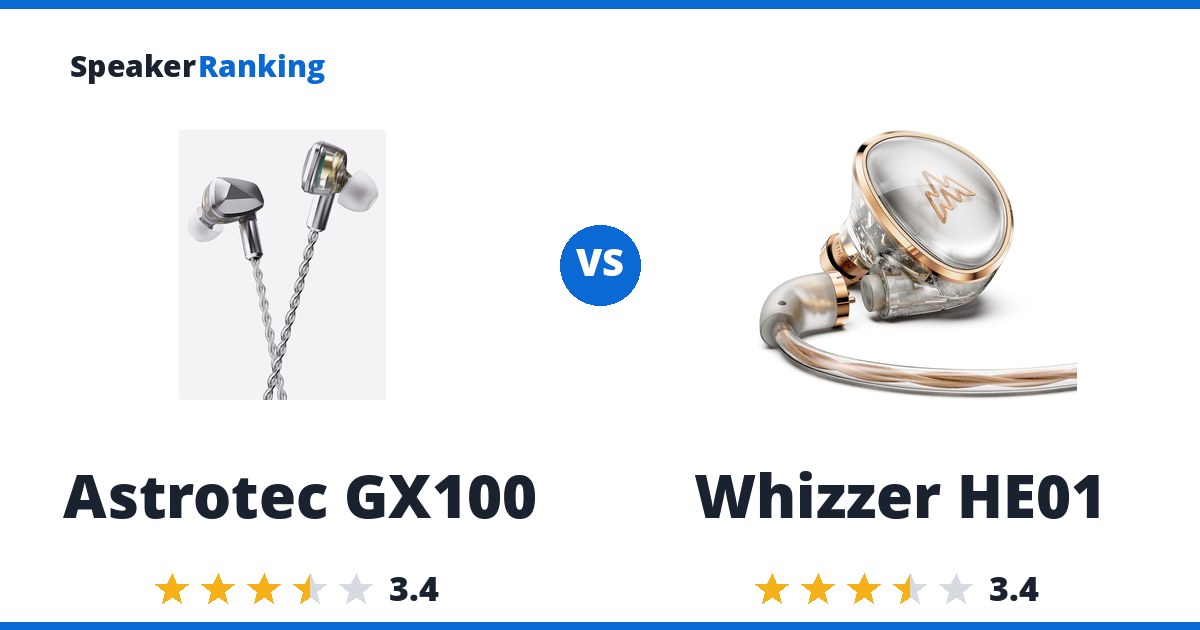
What the Astrotec GX100 does well: A broadly balanced tuning with a preference score of 67 against the Harman target. The tradeoff: Treble about 2 dB above target from 3 to 10 kHz, which can sound sharp or tiring at higher volume.
Why pick the Whizzer HE01: For a budget single dynamic driver earphone it earns a preference score of 66.0 in crinacle’s measurement, with a warm tilt that suits listeners who prefer a relaxed, bass forward sound. The catch: An 8.1 dB dip near 6.4 kHz and a treble band averaging 3.3 dB below target dull cymbals and blunt detail, while a 4.2 dB peak near 11.9 kHz adds an uneven, slightly metallic edge.
Buy the Astrotec GX100 or the Whizzer HE01 on features: they are rated the same for sound quality at close to the same price.
Still deciding? The full Headphones rankings cover every ranked option.

A broadly balanced tuning with a preference score of 67 against the Harman target.
Astrotec $49.90 eBay
For a budget single dynamic driver earphone it earns a preference score of 66.0 in crinacle’s measurement, with a warm tilt that suits listeners who prefer a relaxed, bass forward sound.
Amazon $45.00 eBayPrices on this page were last checked October 16, 2026 at 5:46 PM UTC. Product prices and availability are accurate as of that date/time and are subject to change; the price and availability shown on Amazon at the time of purchase will apply to the purchase of this product.
As an eBay Partner, we may be compensated if you make a purchase.
Specifications Side By Side
| Astrotec GX100 | Whizzer HE01 | |
|---|---|---|
| Price | $49.90 | $45.00 |
| Ranked | #859 of 1291 in In-Ear Headphones | #862 of 1291 in In-Ear Headphones |
| Form Factor | In-ear | In-ear |
| Back | Closed | Closed |
| Harman Preference Score | 67 (median of 4 squig.link measurements, calibrated to AutoEQ) | 66 (measured by crinacle, via AutoEQ) |
| Deviation From Target | 2.39 dB standard deviation | 2.78 dB standard deviation |
| Tonal Tilt | +0.98 (negative is warmer, positive brighter) | -0.49 (negative is warmer, positive brighter) |
| Sub-bass Extension | Within 6 dB of target down to 20 Hz (-4.3 dB at 30 Hz) | Within 6 dB of target down to 20 Hz (-1.9 dB at 30 Hz) |
| Connection | Wired | Wired |
| Driver Type | Hybrid | Dynamic |
| Drivers | 1 DD + 1 PZT (1 x 10mm LCP dynamic driver + 1 x 10.6mm piezoelectric ceramic driver) | - |
| Impedance | 32 ohms | 18 ohms |
| Sensitivity | 108 dB | 112 dB/mW |
| Frequency Response | 5Hz - 40kHz | 15Hz - 40kHz (Manufacturer specified) |
| Built-in Microphone | - | No |
Frequency Response Compared
Both headphones’ measurements overlaid on the Harman target. Above the target sounds louder in that range, below it quieter. Each curve is the median of several independent measurements, shifted so its 500 Hz to 2 kHz average sits at 0 dB, so only the tuning is compared.
Measurement data: the Astrotec GX100 from audioamigo, pw, soundcheck39 and tonedeafmonk; the Whizzer HE01 from aftersound, arn and pw, all via squig.link.
Related Headphone Comparisons
How Astrotec GX100 compares with other leading options: