The Nexus Center DIY ranks #77 out of 134 total Center Channel Speakers for sound quality. See all Passive Home rankings for every top pick.
Brand: Nexus
Prices on this page were last checked October 20, 2026 at 10:35 PM UTC. Product prices and availability are accurate as of that date/time and are subject to change; the price and availability shown on Amazon at the time of purchase will apply to the purchase of this product.
As an eBay Partner, we may be compensated if you make a purchase.
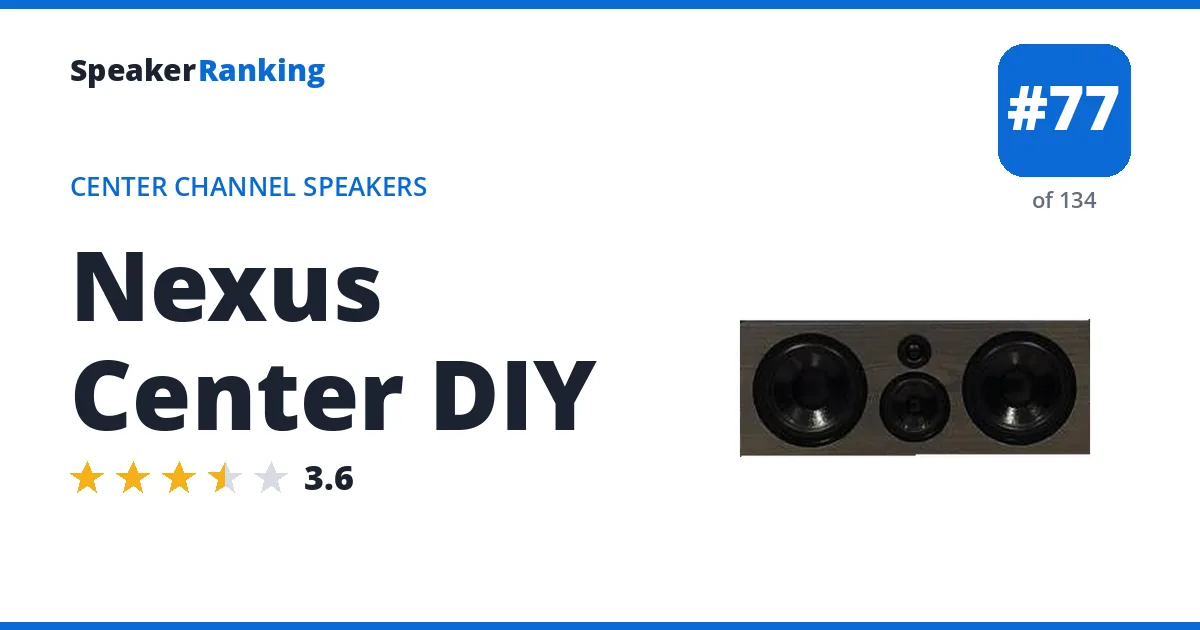
#77 Nexus Center DIY: $350 each eBay
Pros: A true three-way center: a dedicated midrange under the tweeter keeps vertical dispersion wider (about 30 degrees either side) than the Nexus MTM DIY, so dialogue holds up for listeners above or below the speaker. The listening window is the most even in the Nexus family (0.23 deviation), and bass reaches 59.1Hz at -3dB and about 36Hz at -10dB. Preference score 4.96, or 7.29 with an ideal subwoofer. Measured bass extension of 59.1Hz (-3dB).
Cons: It is a design to build yourself, with no finished retail version. The response straight on axis is less even than the listening window (0.49 deviation), and the measurements are low quality.
| Bass Extension (-10dB) | about 36.0Hz (measured, designer data via spinorama.org) |
|---|---|
| Bass Extension (-3dB) | 59.1Hz (measured, designer data via spinorama.org) |
| DIY Kit | Yes |
| Drivers | 2 woofers, 1 midrange and 1 dome tweeter (three-way) |
| Spinorama Preference Score | 4.96 |
| Spinorama Preference Score with Perfect Sub | 7.29 |
- Links
- Reviews, Comparisons and Sound Samples
Frequency Response
How the Nexus Center DIY measures across the audible range. A flatter listening window (the sound arriving straight at you) is more neutral: peaks sound forward or harsh, dips sound recessed. The estimated in-room response adds what a typical room does, and there a gentle, even tilt down toward the treble is ideal. Both curves are shifted so their 300 Hz to 3 kHz average sits at 0 dB.
Measurement data: spinorama.org, measured by an independent reviewer.
EQ for a Neutral Response
No EQ preset: the best simple EQ we can fit to these measurements improves the predicted preference score by less than 0.2. The listening window is already close to flat, and what holds the score back, such as narrow ripple in the response or uneven output off-axis, is not something EQ can fix without making it worse elsewhere.