The Roseselsa Quiet Sea II ranks #1004 out of 1369 total In-Ear Headphones for sound quality. See all Headphones rankings for every top pick.
Brand: Roseselsa
Prices on this page were last checked October 17, 2026 at 6:04 PM UTC. Product prices and availability are accurate as of that date/time and are subject to change; the price and availability shown on Amazon at the time of purchase will apply to the purchase of this product.
As an eBay Partner, we may be compensated if you make a purchase.
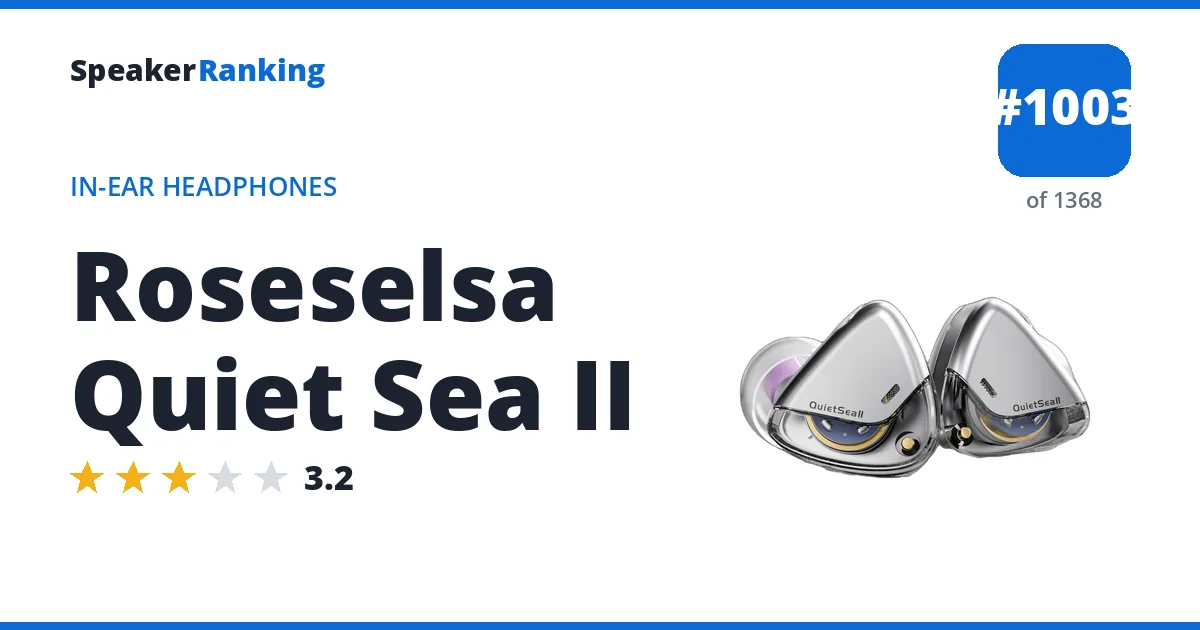
#1004 Roseselsa Quiet Sea II: $62.99 HiFiGo $62.99 eBay
Pros: About 3 dB more bass than the Harman target below 150 Hz, for listeners who want a fuller low end.
Cons: An uneven response, 2.4 dB standard deviation from target.
Is the Roseselsa Quiet Sea II right for you?
Buy it if
- you like extra bass (about +3 dB below 150 Hz versus the target).
- you want sub-bass rumble that reaches down to 20 Hz.
- you are happy to use EQ: our preset lifts its Harman match by about 28 points.
Skip it if
- you want the best value: the higher-rated EPZ G10 costs about $39 less.
| Back | Closed |
|---|---|
| Connection | Wired |
| Deviation From Target | 2.43 dB standard deviation |
| Driver Type | Dynamic |
| Drivers | 1 x 10mm dual-magnetic dual-cavity dynamic driver (PEEK substrate + carbon-copper vacuum-coated dome diaphragm) |
| Form Factor | In-ear |
| Frequency Response | 20Hz - 20kHz |
| Harman Preference Score | 64 (median of 7 squig.link measurements, calibrated to AutoEQ) |
| Impedance | 18 ohms |
| Sensitivity | 106 dB/mW |
| Sub-bass Extension | Within 6 dB of target down to 20 Hz (+1.0 dB at 30 Hz) |
| Tonal Tilt | -0.95 (negative is warmer, positive brighter) |
EQ Presets
Harman target
Set a preamp of -1.6 dB, then add these filters in any parametric equalizer (Wavelet, Equalizer APO, Peace, or a player with parametric EQ). Calculated by Speaker Ranking from the median of 7 squig.link measurements, in the filter layout AutoEQ uses. Predicted Harman match with this EQ: 92 out of 100, up from 64.
| Filter | Frequency | Gain | Q |
|---|---|---|---|
| Low shelf | 105 Hz | -2.4 dB | 0.70 |
| High shelf | 10,000 Hz | -0.4 dB | 0.70 |
| Peak | 188 Hz | -5.4 dB | 0.75 |
| Peak | 5,345 Hz | +1.6 dB | 0.40 |
| Peak | 7,780 Hz | -2.2 dB | 6.00 |
Neutral target
Set a preamp of -1.6 dB, then add these filters in any parametric equalizer (Wavelet, Equalizer APO, Peace, or a player with parametric EQ). Calculated by Speaker Ranking from the median of 7 squig.link measurements, in the filter layout AutoEQ uses. Predicted Neutral match with this EQ: 93 out of 100, up from 26.
| Filter | Frequency | Gain | Q |
|---|---|---|---|
| Low shelf | 105 Hz | -11.0 dB | 0.70 |
| High shelf | 10,000 Hz | -0.4 dB | 0.70 |
| Peak | 180 Hz | -5.2 dB | 0.66 |
| Peak | 791 Hz | +0.8 dB | 3.12 |
| Peak | 5,345 Hz | +1.6 dB | 0.40 |
| Peak | 7,777 Hz | -2.2 dB | 6.00 |
Studio flat target
Set a preamp of -3.9 dB, then add these filters in any parametric equalizer (Wavelet, Equalizer APO, Peace, or a player with parametric EQ). Calculated by Speaker Ranking from the median of 7 squig.link measurements, in the filter layout AutoEQ uses. Predicted Studio flat match with this EQ: 88 out of 100, up from 6.
| Filter | Frequency | Gain | Q |
|---|---|---|---|
| Low shelf | 105 Hz | -12.0 dB | 0.70 |
| High shelf | 10,000 Hz | +2.0 dB | 0.70 |
| Peak | 177 Hz | -7.4 dB | 0.69 |
| Peak | 2,622 Hz | +3.9 dB | 1.51 |
Warm target
Set a preamp of -0.8 dB, then add these filters in any parametric equalizer (Wavelet, Equalizer APO, Peace, or a player with parametric EQ). Calculated by Speaker Ranking from the median of 7 squig.link measurements, in the filter layout AutoEQ uses. Predicted Warm match with this EQ: 93 out of 100, up from 74.
| Filter | Frequency | Gain | Q |
|---|---|---|---|
| Low shelf | 105 Hz | -2.2 dB | 0.70 |
| High shelf | 10,000 Hz | -4.0 dB | 0.70 |
| Peak | 187 Hz | -5.2 dB | 0.76 |
| Peak | 831 Hz | +1.2 dB | 2.21 |
| Peak | 7,670 Hz | -2.8 dB | 6.00 |
Bass target
Set a preamp of -2.2 dB, then add these filters in any parametric equalizer (Wavelet, Equalizer APO, Peace, or a player with parametric EQ). Calculated by Speaker Ranking from the median of 7 squig.link measurements, in the filter layout AutoEQ uses. Predicted Bass match with this EQ: 93 out of 100, up from 71.
| Filter | Frequency | Gain | Q |
|---|---|---|---|
| Low shelf | 105 Hz | +1.3 dB | 0.70 |
| High shelf | 10,000 Hz | -0.4 dB | 0.70 |
| Peak | 25 Hz | +1.0 dB | 0.88 |
| Peak | 193 Hz | -5.4 dB | 0.78 |
| Peak | 5,345 Hz | +1.6 dB | 0.41 |
| Peak | 7,778 Hz | -2.2 dB | 6.00 |
Bright target
Set a preamp of -5.2 dB, then add these filters in any parametric equalizer (Wavelet, Equalizer APO, Peace, or a player with parametric EQ). Calculated by Speaker Ranking from the median of 7 squig.link measurements, in the filter layout AutoEQ uses. Predicted Bright match with this EQ: 90 out of 100, up from 15.
| Filter | Frequency | Gain | Q |
|---|---|---|---|
| Low shelf | 105 Hz | -11.0 dB | 0.70 |
| High shelf | 10,000 Hz | +2.0 dB | 0.70 |
| Peak | 180 Hz | -5.2 dB | 0.64 |
| Peak | 2,201 Hz | +0.6 dB | 0.42 |
| Peak | 5,345 Hz | +4.8 dB | 1.19 |
| Peak | 6,854 Hz | -1.8 dB | 6.00 |
V-shaped target
Set a preamp of -5.4 dB, then add these filters in any parametric equalizer (Wavelet, Equalizer APO, Peace, or a player with parametric EQ). Calculated by Speaker Ranking from the median of 7 squig.link measurements, in the filter layout AutoEQ uses. Predicted V-shaped match with this EQ: 86 out of 100, up from 63.
| Filter | Frequency | Gain | Q |
|---|---|---|---|
| Low shelf | 105 Hz | +2.0 dB | 0.70 |
| High shelf | 10,000 Hz | +2.0 dB | 0.70 |
| Peak | 23 Hz | +0.9 dB | 0.88 |
| Peak | 189 Hz | -4.0 dB | 0.76 |
| Peak | 2,421 Hz | +1.4 dB | 3.18 |
| Peak | 5,016 Hz | +5.3 dB | 1.14 |
| Peak | 6,861 Hz | -1.7 dB | 6.00 |
- Reviews, Comparisons and Sound Samples
Frequency Response
How the Roseselsa Quiet Sea II measures across the audible range, against the Harman in-ear target that most listeners prefer in blind tests. Where the line sits above the target that range sounds louder (more bass, brighter treble), below it quieter. The curve is the median of 7 independent measurements, so one odd sample or rig cannot skew it, and both lines are shifted so their 500 Hz to 2 kHz average sits at 0 dB.
Measurement data: median of 7 measurements from the squig.link databases of atechreviews, bassaudio, csi-zone, eplv, faxepremium, jaytiss and practiphile. Thanks to each of them for publishing their work.
Head-to-Head Comparisons
3 comparisons- Roseselsa Quiet Sea II vs FiiO FW3
- Roseselsa Quiet Sea II vs TRN White Tiger
- Roseselsa Quiet Sea II vs ZiSin 340
No comparisons match that search.