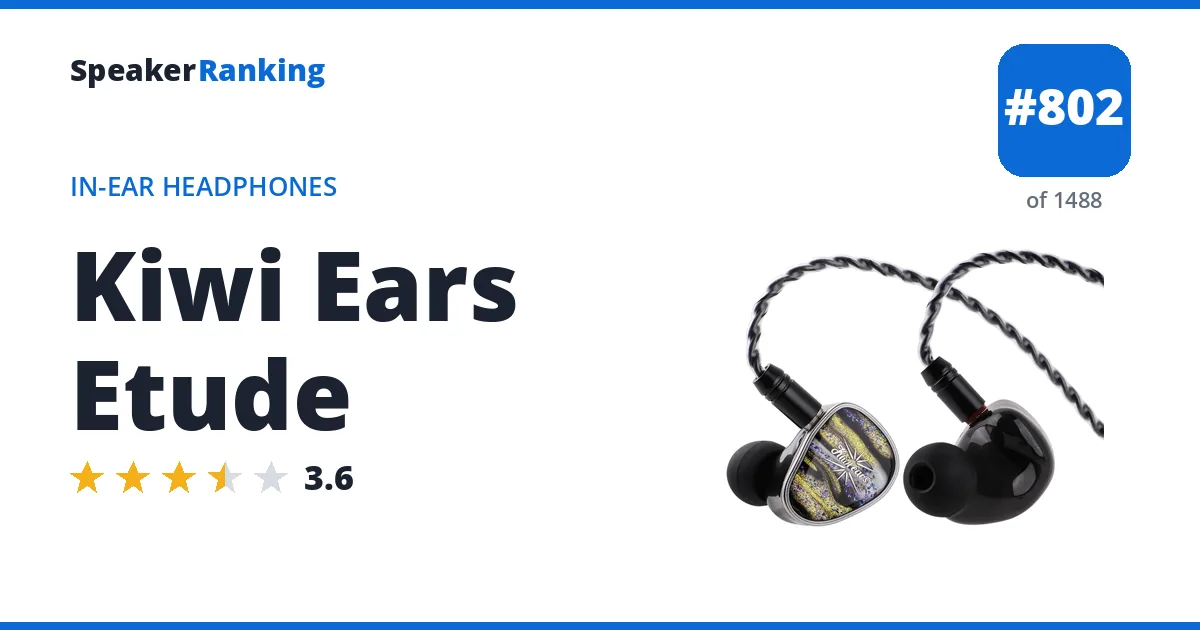
The Kiwi Ears Etude is rated 3.6/5 for sound quality, #802 of 1488 In-Ear Headphones. See all Headphones rankings for every top pick.
Prices on this page were last checked November 25, 2026 at 9:40 PM UTC. Product prices and availability are accurate as of that date/time and are subject to change; the price and availability shown on Amazon at the time of purchase will apply to the purchase of this product.
As an eBay Partner, we may be compensated if you make a purchase.
Brand: Kiwi Ears
#802 Kiwi Ears Etude: $119 Linsoul $119 eBay
Pros: Wired in-ear headphones with one dynamic driver, three balanced armatures and a vibration driver, tuned with full bass and even mids. The median of 17 hobbyist measurements gives it a solid Harman preference score of 69 with a 2.29 dB spread, and its mids sit within about 0.5 dB of target, so vocals and instruments sound natural. Bass sits close to target and holds down to 20 Hz, so low end sounds full without bloat. It uses 1 x 10mm dynamic + 3 x balanced armature + 1 x vibration transducer.
Cons: Presence sits about 4.7 dB low with a 5.8 dB dip near 4.0 kHz, so vocals and instruments lose some bite.
Is the Kiwi Ears Etude right for you?
Buy it if
- your taste runs warm: it scores 81 for that sound.
- you are sensitive to bright or sharp treble (treble sits 4.1 dB below target).
- you want sub-bass rumble that reaches down to 20 Hz.
Skip it if
- you want the best value: the higher-rated QCY HT05 MeloBuds ANC costs about $85 less.
| Released | Apr 2025 (1 year ago) |
|---|---|
| Back | Closed |
| Connection | Wired |
| Deviation From Target | 2.29 dB standard deviation |
| Driver Type | Tribrid |
| Drivers | 1 x 10mm dynamic + 3 x balanced armature + 1 x vibration transducer |
| Form Factor | In-ear |
| Frequency Response | 20Hz - 20kHz (Manufacturer specified) |
| Harman Preference Score | 69 (median of 17 squig.link measurements scored separately, calibrated to AutoEQ) |
| Impedance | 5 ohms |
| Sensitivity | 104 dB/mW |
| Sub-bass Extension | Within 6 dB of target down to 20 Hz (+0.1 dB at 30 Hz) |
| Tonal Tilt | -0.70 (negative is warmer, positive brighter) |
- Links
- Reviews, Comparisons and Sound Samples