The EarAcoustic Genesis Mix9 ranks #134 out of 1476 total In-Ear Headphones for sound quality. See all Headphones rankings for every top pick.
Brand: EarAcoustic
Prices on this page were last checked October 20, 2026 at 10:35 PM UTC. Product prices and availability are accurate as of that date/time and are subject to change; the price and availability shown on Amazon at the time of purchase will apply to the purchase of this product.
As an eBay Partner, we may be compensated if you make a purchase.
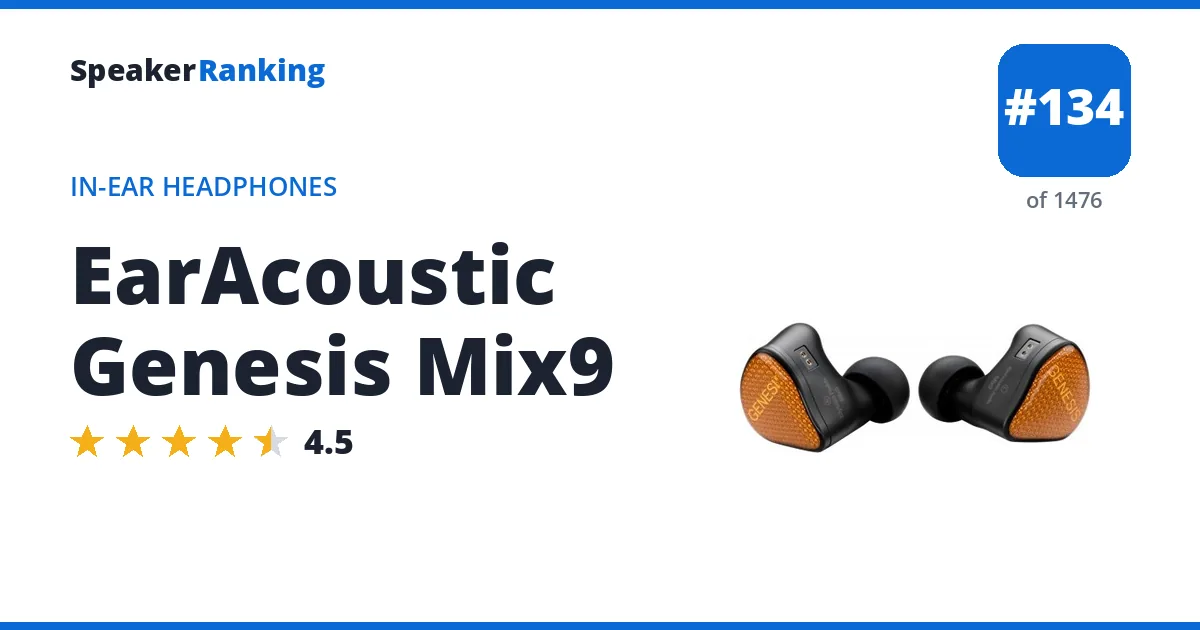
#134 EarAcoustic Genesis Mix9: $420 eBay
Pros: A nine driver hybrid with a dynamic woofer, four balanced armatures and four planar drivers, scoring 80. Bass reaches 20 Hz and the midrange stays within about 1.5 dB of target.
Cons: Presence and treble run 1 to 2 dB low with dips of 5.7 dB near 4 kHz and 5.2 dB near 6.1 kHz, so it can sound a bit polite. It sells mainly in Japan and Europe at about $420, and the score rests on a single measurement.
Is the EarAcoustic Genesis Mix9 right for you?
Buy it if
- you want the tuning most listeners prefer in blind tests out of the box (Harman score 80).
- you are sensitive to bright or sharp treble (treble sits 2.5 dB below target).
Skip it if
- you want the best value: the higher-rated QCY HT05 MeloBuds ANC costs about $386 less.
| Released | Feb 2026 (8 months ago) |
|---|---|
| Back | Closed |
| Connection | Wired |
| Deviation From Target | 1.70 dB standard deviation |
| Driver Type | Tribrid (dynamic + balanced armature + planar magnetic) |
| Drivers | 1 x 8.3mm dynamic + 4 x balanced armature + 4 x planar magnetic |
| Form Factor | In-ear |
| Frequency Response | 20Hz - 20kHz (Manufacturer specified) |
| Harman Preference Score | 80 (1 squig.link measurement, calibrated to AutoEQ) |
| Impedance | 12 ohms |
| Sensitivity | 107 dB |
| Sub-bass Extension | Within 6 dB of target down to 20 Hz (-2.8 dB at 30 Hz) |
| Tonal Tilt | +0.14 (negative is warmer, positive brighter) |
EQ Presets
Harman target
Set a preamp of -5.2 dB, then add these filters in any parametric equalizer (Wavelet, Equalizer APO, Peace, or a player with parametric EQ). Calculated by Speaker Ranking from a single measurement from squig.link, in the filter layout AutoEQ uses. Predicted Harman match with this EQ: 88 out of 100, up from 80.
| Filter | Frequency | Gain | Q |
|---|---|---|---|
| Low shelf | 105 Hz | +2.6 dB | 0.70 |
| High shelf | 10,000 Hz | +1.5 dB | 0.70 |
| Peak | 91 Hz | -1.5 dB | 1.55 |
| Peak | 2,299 Hz | -1.5 dB | 5.34 |
| Peak | 3,939 Hz | +5.1 dB | 3.09 |
| Peak | 5,957 Hz | +3.9 dB | 6.00 |
Neutral target
Set a preamp of -5.2 dB, then add these filters in any parametric equalizer (Wavelet, Equalizer APO, Peace, or a player with parametric EQ). Calculated by Speaker Ranking from a single measurement from squig.link, in the filter layout AutoEQ uses. Predicted Neutral match with this EQ: 89 out of 100, up from 54.
| Filter | Frequency | Gain | Q |
|---|---|---|---|
| Low shelf | 105 Hz | -5.9 dB | 0.70 |
| High shelf | 10,000 Hz | +1.5 dB | 0.70 |
| Peak | 85 Hz | -1.8 dB | 1.23 |
| Peak | 2,300 Hz | -1.5 dB | 5.39 |
| Peak | 3,939 Hz | +5.1 dB | 3.08 |
| Peak | 5,957 Hz | +3.9 dB | 6.00 |
Studio flat target
Set a preamp of -4.9 dB, then add these filters in any parametric equalizer (Wavelet, Equalizer APO, Peace, or a player with parametric EQ). Calculated by Speaker Ranking from a single measurement from squig.link, in the filter layout AutoEQ uses. Predicted Studio flat match with this EQ: 89 out of 100, up from 36.
| Filter | Frequency | Gain | Q |
|---|---|---|---|
| Low shelf | 105 Hz | -8.5 dB | 0.70 |
| High shelf | 10,000 Hz | +2.0 dB | 0.70 |
| Peak | 135 Hz | -2.8 dB | 0.84 |
| Peak | 1,150 Hz | -1.1 dB | 4.41 |
| Peak | 3,440 Hz | +4.7 dB | 1.84 |
| Peak | 4,845 Hz | -2.1 dB | 6.00 |
| Peak | 6,887 Hz | +1.4 dB | 1.49 |
Warm target
Set a preamp of -3.4 dB, then add these filters in any parametric equalizer (Wavelet, Equalizer APO, Peace, or a player with parametric EQ). Calculated by Speaker Ranking from a single measurement from squig.link, in the filter layout AutoEQ uses. Predicted Warm match with this EQ: 84 out of 100, up from 77.
| Filter | Frequency | Gain | Q |
|---|---|---|---|
| Low shelf | 105 Hz | +2.9 dB | 0.70 |
| High shelf | 10,000 Hz | +0.4 dB | 0.70 |
| Peak | 3,937 Hz | +3.6 dB | 6.00 |
Bass target
Set a preamp of -5.7 dB, then add these filters in any parametric equalizer (Wavelet, Equalizer APO, Peace, or a player with parametric EQ). Calculated by Speaker Ranking from a single measurement from squig.link, in the filter layout AutoEQ uses. Predicted Bass match with this EQ: 87 out of 100, up from 65.
| Filter | Frequency | Gain | Q |
|---|---|---|---|
| Low shelf | 105 Hz | +5.6 dB | 0.70 |
| High shelf | 10,000 Hz | +1.5 dB | 0.70 |
| Peak | 2,299 Hz | -1.5 dB | 5.34 |
| Peak | 3,939 Hz | +5.1 dB | 3.10 |
| Peak | 5,957 Hz | +3.9 dB | 6.00 |
Bright target
Set a preamp of -5.6 dB, then add these filters in any parametric equalizer (Wavelet, Equalizer APO, Peace, or a player with parametric EQ). Calculated by Speaker Ranking from a single measurement from squig.link, in the filter layout AutoEQ uses. Predicted Bright match with this EQ: 84 out of 100, up from 42.
| Filter | Frequency | Gain | Q |
|---|---|---|---|
| Low shelf | 105 Hz | -6.0 dB | 0.70 |
| High shelf | 10,000 Hz | +2.0 dB | 0.70 |
| Peak | 86 Hz | -1.7 dB | 1.23 |
| Peak | 321 Hz | +0.7 dB | 1.39 |
| Peak | 1,176 Hz | -1.3 dB | 4.60 |
| Peak | 2,287 Hz | -1.9 dB | 4.05 |
| Peak | 4,321 Hz | +5.4 dB | 1.40 |
| Peak | 5,849 Hz | +2.4 dB | 6.00 |
V-shaped target
Set a preamp of -6.0 dB, then add these filters in any parametric equalizer (Wavelet, Equalizer APO, Peace, or a player with parametric EQ). Calculated by Speaker Ranking from a single measurement from squig.link, in the filter layout AutoEQ uses. Predicted V-shaped match with this EQ: 82 out of 100, up from 62.
| Filter | Frequency | Gain | Q |
|---|---|---|---|
| Low shelf | 105 Hz | +5.8 dB | 0.70 |
| High shelf | 10,000 Hz | +2.0 dB | 0.70 |
| Peak | 288 Hz | +1.8 dB | 1.05 |
| Peak | 1,159 Hz | -1.7 dB | 2.32 |
| Peak | 2,317 Hz | -1.5 dB | 6.00 |
| Peak | 4,321 Hz | +5.8 dB | 1.31 |
| Peak | 5,822 Hz | +2.0 dB | 6.00 |
- Reviews, Comparisons and Sound Samples
Frequency Response
How the EarAcoustic Genesis Mix9 measures across the audible range, against the Harman in-ear target that most listeners prefer in blind tests. Where the line sits above the target that range sounds louder (more bass, brighter treble), below it quieter. The curve is a single measurement, and both lines are shifted so their 500 Hz to 2 kHz average sits at 0 dB.
Measurement data: a single measurement from the squig.link database of aftersound. Thanks to them for publishing their work.