8 ranked speakers have a verified HDMI ARC or eARC input, sending TV audio to the speakers over the same cable that carries picture, with volume control through the TV remote via HDMI-CEC. That’s different from a plain HDMI input without ARC, which some speakers carry for other sources but which can’t receive TV audio this way. eARC adds bandwidth for higher-quality audio formats over the older ARC standard, but check your TV’s own port labeling either way; not every “HDMI” port on a TV supports ARC.
A speaker’s rank here reflects its measured audio performance, not the presence of this input. If you want sound quality weighed specifically against this feature, see our curated best powered speakers for TV picks instead of just every match.
This is every match, grouped by category and sorted by measured sound quality.
The Speakers
Prices on this page were last checked September 22, 2026 at 5:11 AM UTC. Product prices and availability are accurate as of that date/time and are subject to change; the price and availability shown on Amazon at the time of purchase will apply to the purchase of this product.
As an eBay Partner, we may be compensated if you make a purchase.
Portable Bluetooth Speakers
Boombox Size Portable Bluetooth Speakers
 Ranked #10 of 75 in Boombox Size Portable Bluetooth Speakers - Yeahbox Sonic Boom Ultra: $388.00 Amazon eBay
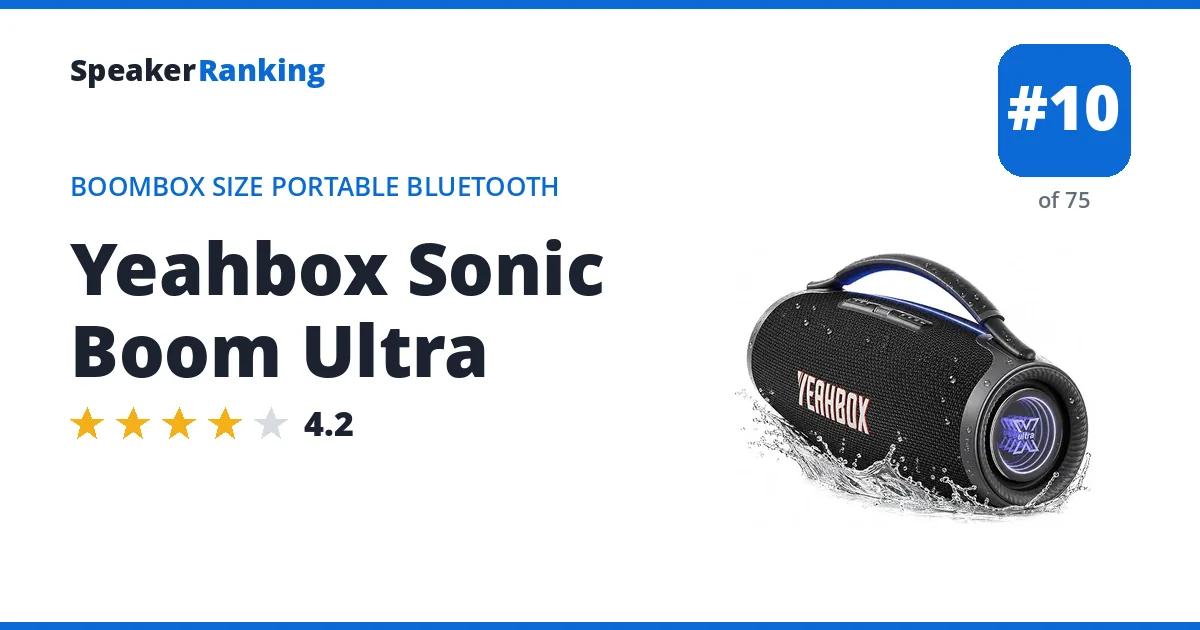
Pros: By far the loudest boombox tested against it, hitting 106-107dB, roughly 3-5dB louder than the JBL Boombox 4, Zealot ZE41, Tribit Stormbox Blast 2, W-King X20, and Hopestar A90/A95. The massive 6x9in racetrack woofer reaches audible bass down to around 30Hz on the Country EQ preset, and a teardown confirmed genuinely robust internals: a thick vented voice coil and a dedicated crossover output per driver. HDMI ARC input/output lets it double as a TV soundbar, a feature none of its direct competitors offer.
Cons: The 500W peak-power rating doesn’t fully hold up: it gets noisy above roughly 80-90% volume, and the midrange isn’t fully refined, sometimes sitting a touch too forward. The custom EQ in the app noticeably reduces bass output compared to the factory presets and doesn’t persist after the speaker powers off. No Auracast, no removable battery, a plastic handle with some flex, and heavy at 11kg (24lb) for $388. Most of the sound-quality coverage comes from enthusiast listening-test comparisons rather than independent measurement.
Full Yeahbox Sonic Boom Ultra review and specifications →
| Amplifier Power | 320W RMS / 500W Peak |
|---|---|
| App | Yes |
| Aux Input | Yes |
| Battery Capacity | 45000mAh (Reviewer estimated) |
| Battery Life | 24 hours (Manufacturer specified) |
| Bluetooth Codecs | SBC (inferred; additional codecs unverified) |
| Bluetooth Version | 6.0 |
| Digital Aux Input | No |
| Dimensions | 23.4" x 9.8" x 12.3" (595 x 248 x 313 mm) |
| Drivers | 6x9in racetrack woofer (200W) + 2x 4.5in midrange (40W each) + 2x tweeters (20W each), true 3-way |
| EQ | Yes (Country, Classic, and custom app EQ; custom settings don't persist after the app closes) |
| IP Rating | IPX6 |
| Inputs | HDMI ARC (in/out, usable as a TV soundbar), AUX in/out, USB drive, microSD, optional wired mic |
| Lights | Yes |
| MicroSD Playback | Yes |
| Omnidirectional | No |
| Party Mode | No (TWS stereo pairing of 2 units only, no Auracast) |
| Power Input | USB-C (60W fast charging) |
| Stereo | Yes |
| TWS | Yes |
| USB Playback | Yes |
| Weight | 24.3 lbs (11 kg) |
- Links
- Reviews, Comparisons and Sound Samples
- Jagist reviews: Yeahbox Sonic Boom Ultra Vs Zealot Ze41!!! Battle Of Big Boys!!! 😜😜😜 More from Jagistreviews →
- Jagist reviews: Yeahbox Sonic Boom Ultra Vs Zealot Ze21!!! Battle Of The Deep Bass 🥳🥳🥳
- Jagist reviews: Yeahbox Sonic Boom Ultra Vs W-king X20!!! Old Vs New!!! 🫨🫨🫨
- Techder Audios: YEAHBOX Sonic Boom Ultra VS JBL Boombox 4 "IT BEATS THE KING!?😈😱" More from techderaudios →
- Jagist reviews: Yeahbox Sonic Boom Ultra Vs Tribit Stormbox Blast 2 Firmware 11!!! Holy Crap!!! 🤩🤩🤩
- Jagist reviews: Yeahbox Sonic Boom Ultra Vs Hopestar A95!!! Battle Of Big Boys!!!! 😘😘😘
- Jagist reviews: Yeahbox Sonic Boom Ultra!!! 💥 Unboxing And Review!!! Absolutely A Beast 💯 🥵🥵🥵
- Techder Audios: YEAHBOX Sonic Boom Ultra - Soundtest "DEEP SUBWOOFER LIKE PERFORMANCE!🔥"
- Audio y Mas: El Woofer Más GRANDE en un Altavoz, Yeahbox Sonic Boom Ultra
- Jagist reviews: Yeahbox Sonic Boom Ultra Bass Test!!! What A Beast!!! 😍😍😍
- brett levesque: Yeahbox sonic boom ultra hertz test
- Jagist reviews: Yeahbox Sonic Boom Ultra Hertz Test!!! How Low Will She Go??? 😛😛😛
- Head-to-Head Comparisons
- Yeahbox Sonic Boom Ultra vs Vifa Copenhagen 2.0
- Yeahbox Sonic Boom Ultra vs Harman Kardon Onyx Studio 8
- Yeahbox Sonic Boom Ultra vs Harman Kardon Onyx Studio 6
- Yeahbox Sonic Boom Ultra vs JBL Partybox Encore Essential
- Yeahbox Sonic Boom Ultra vs Harman Kardon Onyx Studio 7
- Yeahbox Sonic Boom Ultra vs Harman Kardon Onyx Studio 9
- Yeahbox Sonic Boom Ultra vs JBL Partybox Encore
- Yeahbox Sonic Boom Ultra vs JBL Partybox Encore Essential 2
- See all 45 comparisons
Powered Speakers
Medium Size Powered Bookshelf Speakers
 Ranked #12 of 65 in Medium Size Powered Bookshelf Speakers - Klipsch The Fives: $699 per pair Amazon eBay
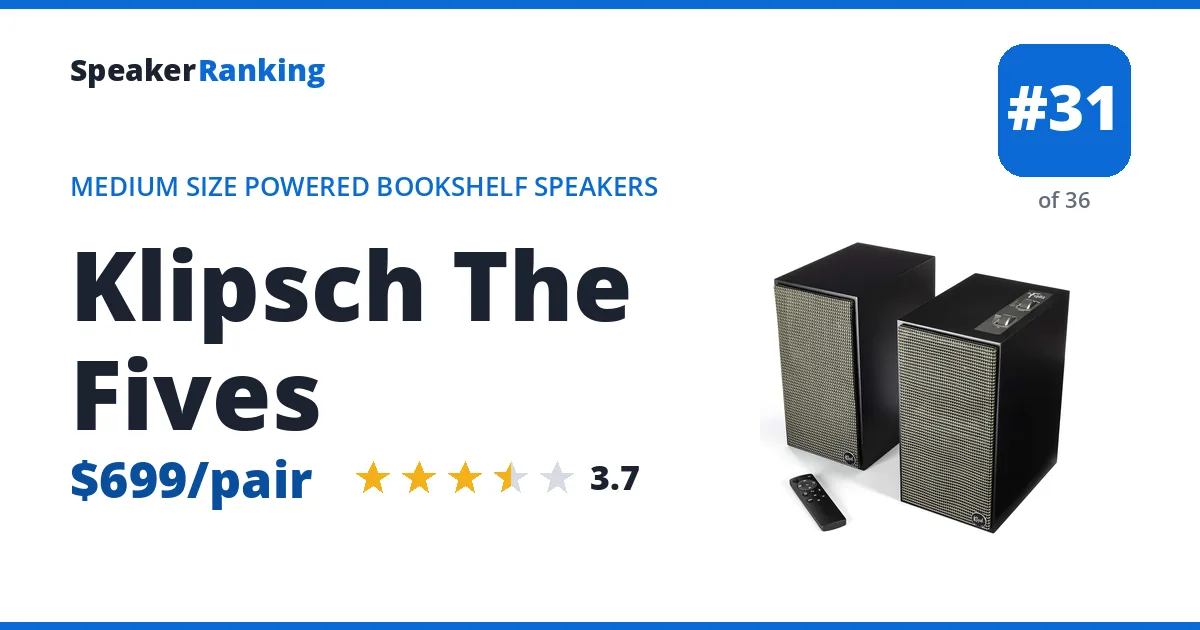
Pros: In the tested Bass Cut mode, Erin’s Klippel data gives preference scores of 4.62 standalone and 6.98 with an ideal subwoofer, with a 2.7dB midrange response span. That mode offers considerably better tonal balance than the bass-heavy default behavior. HDMI ARC, phono/line input, digital inputs and subwoofer output make it a versatile stereo alternative to a soundbar. Measured bass extension of 57Hz (-3dB).
Cons: The favorable score specifically requires Bass Cut mode; it does not describe every firmware or bass setting. Bass reaches -3dB around 59Hz in that configuration. The review reports increasing compression around 200Hz and below 80Hz as volume rises, reducing bass dynamics. Careful placement and a subwoofer remain useful, and the horn/woofer transition is not perfectly uniform off-axis.
Full Klipsch The Fives review and specifications →
| AES Input | No |
|---|---|
| Amplifier Power | 160W total system power (320W peak) |
| Aux Input | No |
| Bass Extension (-10dB) | 47.3Hz (measured, Erin's Audio Corner) |
| Bass Extension (-3dB) | 57Hz (measured, Erin's Audio Corner) |
| Bluetooth | Yes, 5.0 |
| Bluetooth Codecs | SBC, AAC, aptX, aptX HD |
| Coaxial Input | No |
| DSP | Dynamic Bass, Flat and Bass Cut profiles |
| Dimensions | 12"H x 6.5"W x 9.2"D (304.8 x 165.1 x 234.95 mm) |
| Drivers | 1" horn-loaded tweeter; 4.5" woofer |
| Frequency Response | 50Hz - 25kHz (Manufacturer specified) |
| HDMI Input | Yes |
| Inputs | HDMI ARC, USB, optical, Bluetooth, phono/line RCA |
| Optical Input | Yes |
| Outputs | Subwoofer |
| RCA Input | Yes |
| Spinorama Preference Score | 4.62 |
| Spinorama Preference Score with Perfect Sub | 6.98 |
| Subwoofer Output | Yes |
| TRS Input | No |
| USB Input | Yes |
| Weight | Primary 11.8 lbs (5.35 kg), Secondary 10.7 lbs (4.85 kg) |
| XLR Input | No |
- Links
- Reviews, Comparisons and Sound Samples
- Erin’s Audio Corner: Klipsch The Fives Review More from Erin’s Audio Corner →
- Erin’s Audio Corner Website: Klipsch The Fives
- Erin’s Audio Corner Measurements (spinorama.org)
- Jasper Tech: Best Bookshelf Speakers For TV & Gaming - 2025 More from Jasper Tech →
- Jasper Tech: Best Powered Bookshelf Speakers for Every Budget - 2025
- Head-to-Head Comparisons
- Klipsch The Fives vs JBL 305P MKII
- Klipsch The Fives vs Genelec 8020D
- Klipsch The Fives vs Topping MA4
- Klipsch The Fives vs KEF LS50 Wireless II
- Klipsch The Fives vs Vanatoo Transparent One Encore Plus
- Klipsch The Fives vs Devialet Phantom II 98 dB
- Klipsch The Fives vs IK Multimedia iLoud MTM MKII
- Klipsch The Fives vs Genelec 8320A
- See all 51 comparisons
 Ranked #14 of 65 in Medium Size Powered Bookshelf Speakers - KEF LS50 Wireless II: $2,999.00 per pair Amazon KEF Crutchfield eBay
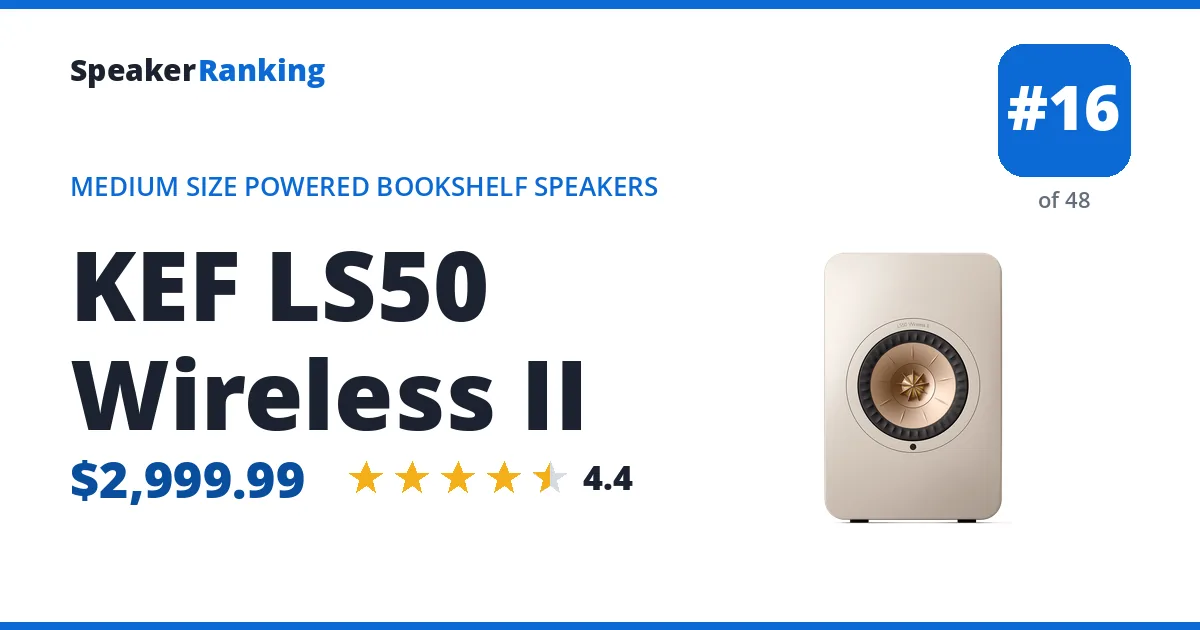
Pros: Erin’s measurements give preference scores of 4.52 standalone and 6.59 with an ideal subwoofer, with a -3dB point around 51Hz. The coincident Uni-Q layout helps preserve tonal consistency across horizontal and vertical listening positions. Low listening-window narrow-band deviation of 0.308 supports relatively clean midrange reproduction. HDMI eARC and streaming functions make it a capable all-in-one stereo system. Measured bass extension of 51.3Hz (-3dB).
Cons: The 3.0dB response span is good but not reference-leading, and dispersion still varies with frequency. Compact bass drivers limit deep-bass output. App placement adjustments are not the same as microphone-based automatic room correction. The price and primary/secondary architecture are practical trade-offs; neither driver geometry nor a single directivity statistic guarantees the best sound in every room.
Full KEF LS50 Wireless II review and specifications →
| AES Input | No |
|---|---|
| Amplifier Power | 280W (LF) + 100W (HF) per speaker, bi-amped |
| App | KEF Connect (placement EQ presets, source selection, firmware updates) |
| Aux Input | Yes |
| Bass Extension (-10dB) | 41.5Hz (measured, spinorama.org) |
| Bass Extension (-3dB) | 51.3Hz (measured, spinorama.org) |
| Bluetooth | Yes, 4.2 |
| Coaxial Input | Yes |
| Dimensions | 12" x 7.9" x 12.2" (305 x 200 x 311 mm) each |
| Drivers | Uni-Q coincident array: 130mm aluminum woofer + 25mm MAT aluminum dome tweeter |
| EQ | Yes, fixed placement presets (desk/bookshelf/wall-mount) - no automatic room correction |
| Frequency Response | 45Hz - 28kHz ±3dB |
| HDMI Input | Yes |
| Inputs | HDMI eARC, optical, digital coaxial, 3.5mm analog, USB-A (service), Ethernet |
| Maximum SPL | 108dB at 1m (manufacturer specified) |
| Optical Input | Yes |
| Outputs | RCA subwoofer |
| RCA Input | No |
| Spinorama Preference Score | 4.52 |
| Spinorama Preference Score with Perfect Sub | 6.59 |
| Subwoofer Output | Yes |
| TRS Input | No |
| USB Input | No |
| Weight | 44.3 lbs (20.1 kg) for the pair |
| XLR Input | No |
- Links
- Reviews, Comparisons and Sound Samples
- Head-to-Head Comparisons
- KEF LS50 Wireless II vs JBL 305P MKII
- KEF LS50 Wireless II vs Vanatoo Transparent One Encore Plus
- KEF LS50 Wireless II vs IK Multimedia iLoud MTM MKII
- KEF LS50 Wireless II vs Klipsch The Fives
- KEF LS50 Wireless II vs Genelec 8020D
- KEF LS50 Wireless II vs Kali Audio SM-5
- KEF LS50 Wireless II vs Devialet Phantom II 98 dB
- KEF LS50 Wireless II vs Kali Audio IN-5
- See all 44 comparisons
 Ranked #34 of 65 in Medium Size Powered Bookshelf Speakers - Neumi BS5P-ARC: $219.99 per pair Amazon eBay
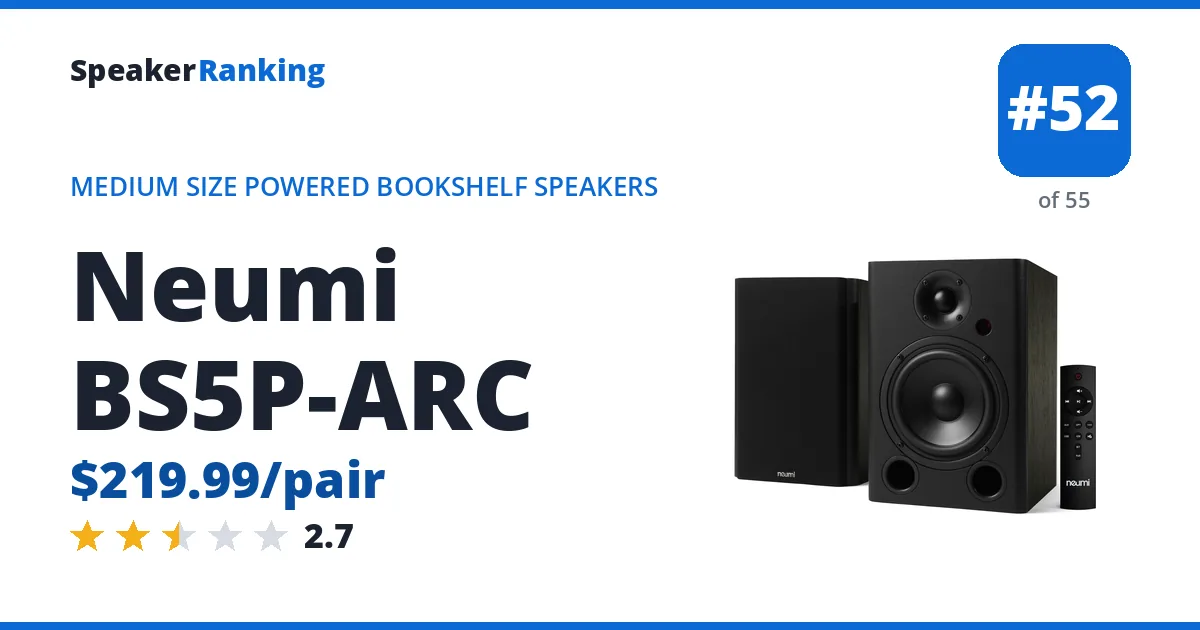
Pros: Erin’s selected measurements give a 2.6dB midrange span and a 6.13 ideal-subwoofer preference score, indicating better tonal performance above the bass than its former near-bottom position suggested. HDMI ARC makes it a convenient low-cost TV stereo system.
Cons: The standalone score drops to 2.94. The published response reaches -3dB around 113Hz and -6dB around 83Hz, so bass balance is a significant limitation in that measured configuration. It is not the same model or dataset as the original BS5P. The score alone cannot establish clean output, and a subwoofer should not be assumed to solve crossover or room-integration issues automatically.
Full Neumi BS5P-ARC review and specifications →
| AES Input | No |
|---|---|
| Amplifier Power | 75W total (37.5W per channel) |
| Aux Input | No |
| Bluetooth | Yes |
| Coaxial Input | Yes |
| Country | China |
| Dimensions | 10.6H x 7.2W x 8.5D in each |
| Drivers | 1" silk dome tweeter with integrated waveguide, 5" poly-cone woofer |
| Enclosure | 2-way active |
| Frequency Response | 50Hz - 20kHz (Typical In-Room) (Manufacturer specified) |
| HDMI Input | Yes |
| Inputs | HDMI ARC, Bluetooth, USB-C, optical, coaxial, RCA analog |
| Optical Input | Yes |
| RCA Input | Yes |
| Spinorama Preference Score | 2.94 |
| Spinorama Preference Score with Perfect Sub | 6.13 |
| TRS Input | No |
| USB Input | Yes |
| Weight | 24.9 lbs (11.3 kg) pair |
| XLR Input | No |
- Links
- Reviews, Comparisons and Sound Samples
- Head-to-Head Comparisons
 Ranked #38 of 65 in Medium Size Powered Bookshelf Speakers - Onkyo GX-30ARC: $349 per pair Onkyo eBay
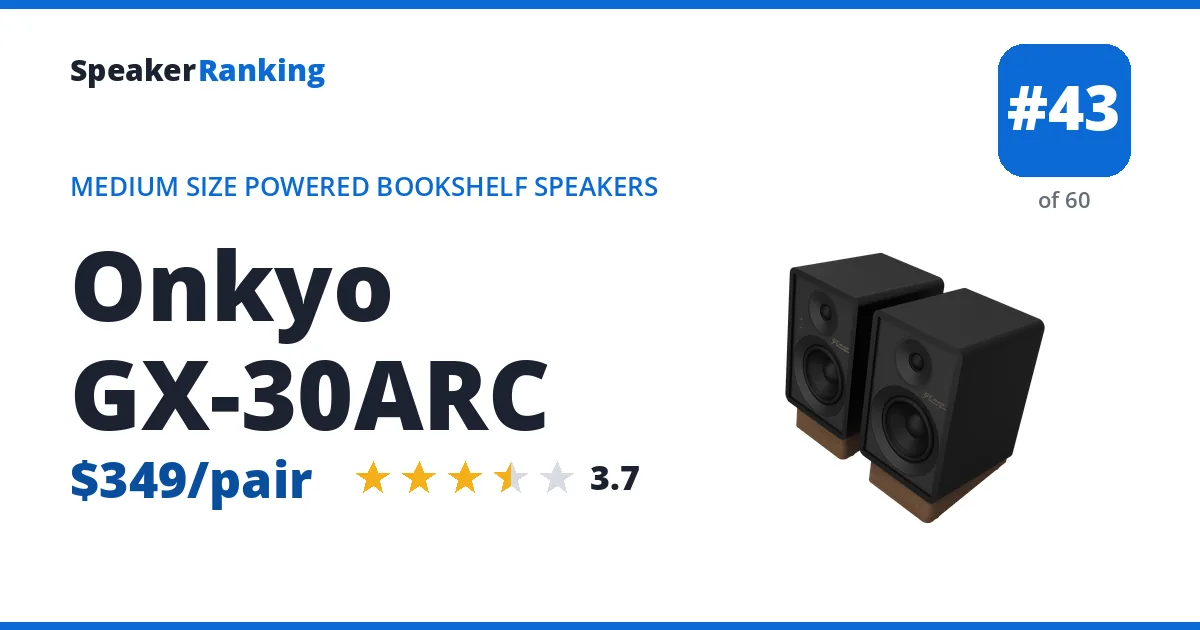
Pros: HDMI ARC, USB-C, optical and analog inputs make it a convenient compact system for a desk or TV. Erin’s Klippel data gives a 2.82 standalone preference score and 5.55 with an ideal subwoofer. The midrange response spans 3.8dB, offering usable but not reference-level tonal performance.
Cons: The response rises toward the treble by about 0.48dB per octave. Bass reaches -3dB around 74Hz, not the lower LFX value used inside the preference model. Vertical listening position affects crossover balance. Its extensive connectivity does not compensate for response irregularities, and the published tonal data alone does not establish maximum clean output.
Full Onkyo GX-30ARC review and specifications →
| AES Input | No |
|---|---|
| Amplifier Power | Class D amplification |
| Aux Input | Yes |
| Bluetooth | Yes, 5.3 |
| Coaxial Input | No |
| Country | Japan (design) |
| Dimensions | approx. 8.7H x 5.8W x 7.9D in each |
| Drivers | 1" tweeter, 4" woofer |
| Enclosure | 2-way powered, rear-ported |
| Frequency Response | 55Hz - 20kHz (Manufacturer specified) |
| HDMI Input | Yes |
| Inputs | HDMI ARC, USB-C, optical, phono/line, 3.5mm aux, Bluetooth 5.3 |
| Optical Input | Yes |
| Outputs | Subwoofer |
| RCA Input | No |
| Spinorama Preference Score | 2.82 |
| Spinorama Preference Score with Perfect Sub | 5.55 |
| Subwoofer Output | Yes |
| TRS Input | No |
| USB Input | Yes |
| Weight | 6.2 lbs (2.8 kg) (primary speaker) |
| XLR Input | No |
- Links
- Reviews, Comparisons and Sound Samples
- Head-to-Head Comparisons
Large Size Powered Bookshelf Speakers
 Ranked #39 of 67 in Large Size Powered Bookshelf Speakers - Klipsch The Nines: $999.99 per pair Crutchfield eBay
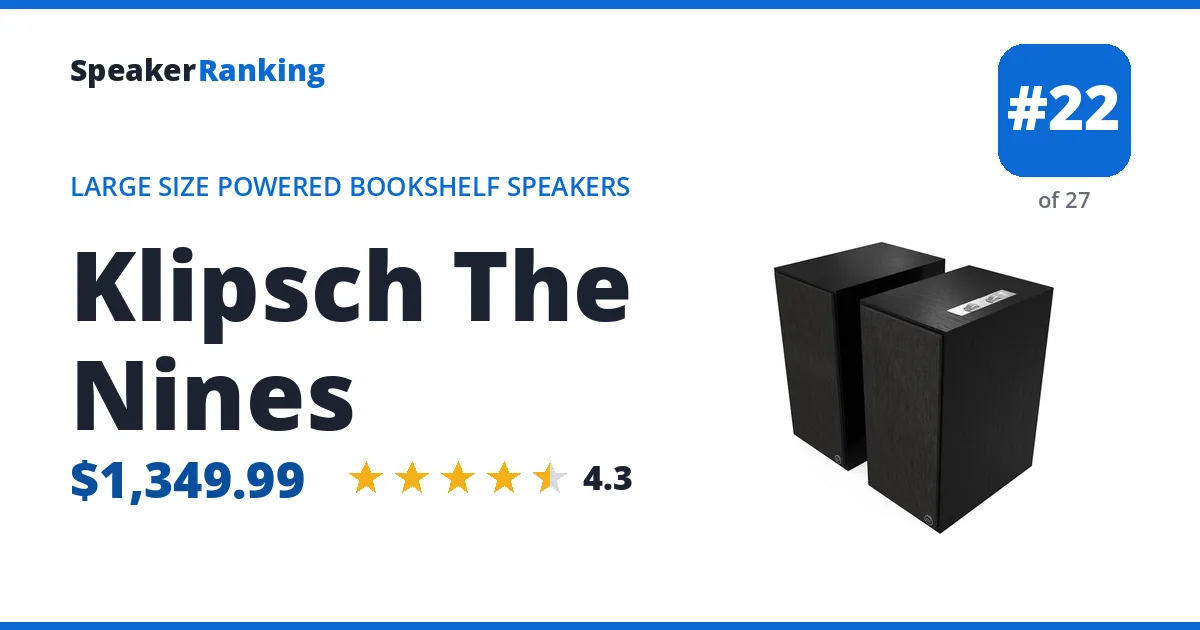
Pros: The 1.7dB response span from 300Hz to 5kHz supports even mids, and measured -3dB extension is 42.5Hz. Extensive consumer connections and app adjustment make it convenient for TV and music, while the horn provides a focused listening presentation. Measured bass extension of 41Hz (-3dB), with a measured sensitivity of 82.5dB.
Cons: The 5.99 ideal-subwoofer score reflects limitations beyond the narrow midband span. Horizontal coverage is relatively focused, so placement matters for multiple seats. The reviewer preferred reduced treble, and bass limiting at higher playback levels means the large woofer is not a guarantee of unlimited output.
Full Klipsch The Nines review and specifications →
| AES Input | No |
|---|---|
| Amplifier Power | 240W total (480W peak; 100W LF + 20W HF per powered speaker) |
| App | Klipsch Connect (bass/mid/treble EQ) |
| Aux Input | Yes |
| Bass Extension (-10dB) | 31Hz (measured, Erin's Audio Corner) |
| Bass Extension (-3dB) | 41Hz (measured, Erin's Audio Corner) |
| Bluetooth | Yes, 5.0 |
| Bluetooth Codecs | SBC, AAC, aptX, aptX HD |
| Coaxial Input | No |
| Dimensions | 19.13"H x 9.5"W x 13.38"D |
| Drivers | 8" high-excursion fiber-composite woofer, 1" titanium LTS vented tweeter with Tractrix horn |
| Frequency Response | 34Hz - 25kHz +/-3dB (manufacturer specified) |
| HDMI Input | Yes |
| Inputs | HDMI ARC, Bluetooth 5.0, phono/line RCA, 3.5mm, USB, optical |
| Maximum SPL | 115dB at 1m (stereo pair, manufacturer specified) |
| Optical Input | Yes |
| Outputs | Subwoofer |
| RCA Input | Yes |
| Sensitivity | 82.5dB (measured at 0.30V/1m, Erin's Audio Corner) |
| Spinorama Preference Score | 4.42 |
| Spinorama Preference Score with Perfect Sub | 5.99 |
| Subwoofer Output | Yes |
| TRS Input | No |
| USB Input | Yes |
| Weight | 28.4 lbs (12.9 kg) primary, 26.9 lbs (12.2 kg) secondary |
| Woofer Cabinet | rear-ported bass reflex |
| XLR Input | No |
- Links
- Reviews, Comparisons and Sound Samples
- Head-to-Head Comparisons
- Klipsch The Nines vs JBL 306P MKII
- Klipsch The Nines vs JBL 708P
- Klipsch The Nines vs JBL 4329P
- Klipsch The Nines vs JBL M2 Master Reference Monitor
- Klipsch The Nines vs APS Klasik 2020
- Klipsch The Nines vs Genelec 8040B
- Klipsch The Nines vs Kali Audio LP-6
- Klipsch The Nines vs Emotiva Airmotiv 6s
- See all 32 comparisons
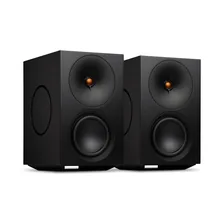 Ranked #47 of 67 in Large Size Powered Bookshelf Speakers - Cambridge Audio L/R X: $2,399.00 per pair Amazon eBay
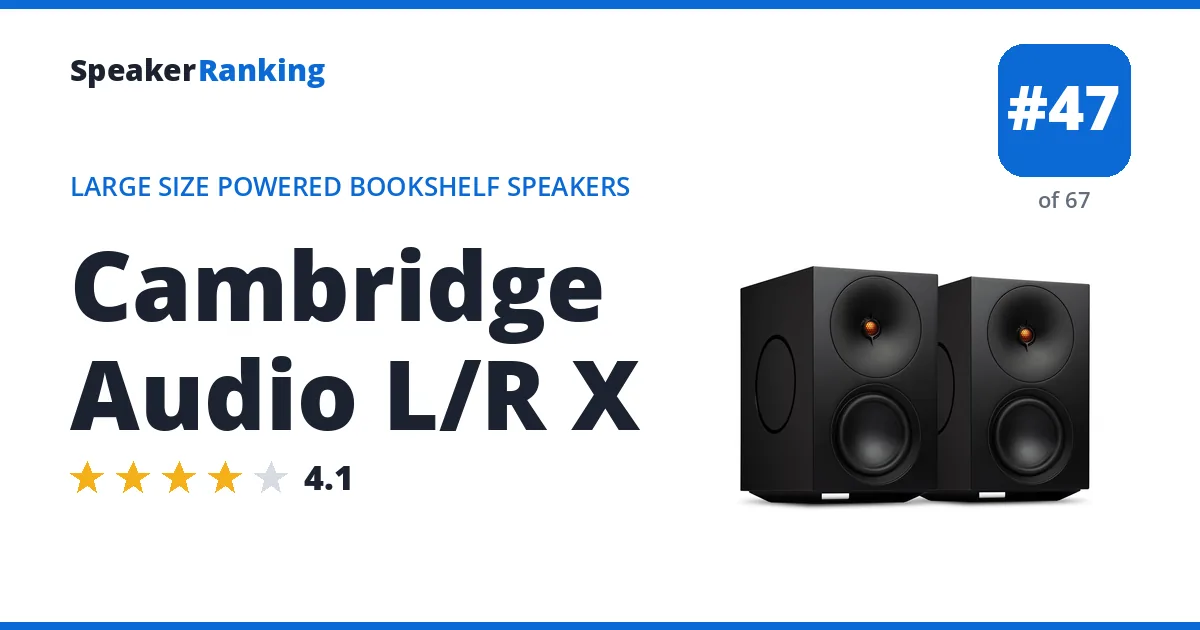
Pros: A 2.5-way active design with a 28mm aluminum tweeter, a front-facing 5-inch mid-woofer, a second 5-inch woofer at the base whose passband overlaps the first (the source of the “.5”), and dual 6-inch side-firing passive radiators per speaker. Erin’s Audio Corner measured wide, even horizontal dispersion (a broad flare out to about the -6dB point around 1.5 to 3kHz) and deeper extension than the smaller L/R S, with an F3 of about 43Hz and F10 of about 37Hz. In-app DSP for room size, speaker distance from the front wall, and reflective surface type gave an audible change in bass tightness in testing. Connectivity covers HDMI eARC, RCA aux, a moving-magnet phono input, optical digital, USB-C, USB-A, Wi-Fi streaming, and a subwoofer output, making it a full living-room hub rather than just a stereo pair. Measured bass extension of 43Hz (-3dB).
Cons: On-axis response is less linear than the L/R S, with dips in the bass, a peak around 1-2kHz, and a dip spanning the upper mid-range into the lower treble; Cambridge confirmed the dip is a deliberate DSP notch for a tweeter breakup resonance rather than a driver flaw, but it was audible as a mild suck-out in an AB pink-noise comparison. Vertical dispersion is narrower and asymmetric than the L/R S, at about plus 20 to minus 10 degrees, because the greater distance between the tweeter and mid-woofer creates more lobing, so listening height and stand placement matter more. Multitone distortion rides close to the 3% threshold at 96dB measured at 1 meter in the far field, limiting headroom for loud, wide-band material. Output falls off quickly below about 50Hz, so home-theater use with deep bass content benefits from an added subwoofer.
Full Cambridge Audio L/R X review and specifications →
| AES Input | No |
|---|---|
| Amplifier Power | 800W total (400W per speaker) |
| App | Yes |
| Aux Input | No |
| Bass Extension (-10dB) | 37Hz (measured, Erin's Audio Corner) |
| Bass Extension (-3dB) | 43Hz (measured, Erin's Audio Corner) |
| Bluetooth | Yes |
| Bluetooth Codecs | SBC, AAC |
| Coaxial Input | No |
| DSP | Yes, room size, wall distance, and reflective surface correction |
| Dimensions | 7.9" (200 mm) W x 330mm H x 260mm D (each) |
| Drivers | 28mm aluminum tweeter, 2x 5" mid-woofers, 2x 6" side-firing passive radiators |
| Frequency Response | 35Hz - 24kHz (±3dB, manufacturer specified) |
| HDMI Input | Yes |
| Inputs | HDMI eARC, RCA aux, RCA phono (MM), optical digital, USB-C, USB-A, Ethernet, Wi-Fi |
| Optical Input | Yes |
| Outputs | Subwoofer |
| RCA Input | Yes |
| Subwoofer Output | Yes |
| TRS Input | No |
| USB Input | Yes |
| Weight | 22.9 lbs (10.4kg) each |
| XLR Input | No |
- Links
- Reviews, Comparisons and Sound Samples
- Head-to-Head Comparisons
- Cambridge Audio L/R X vs Focal Alpha 65 EVO
- Cambridge Audio L/R X vs Adam Audio T8V
- Cambridge Audio L/R X vs Adam Audio T7V
- Cambridge Audio L/R X vs Presonus Eris Studio 8
- Cambridge Audio L/R X vs Palmer Orbit 11
- Cambridge Audio L/R X vs Edifier R2850DB
- Cambridge Audio L/R X vs Klipsch The Sevens
- Cambridge Audio L/R X vs Kali Audio IN-8 V2
- See all 17 comparisons
Large Size Powered Floorstanding Speakers
 Ranked #1 of 6 in Large Size Powered Floorstanding Speakers - KEF LS60: $5,999.99 per pair Amazon Crutchfield eBay
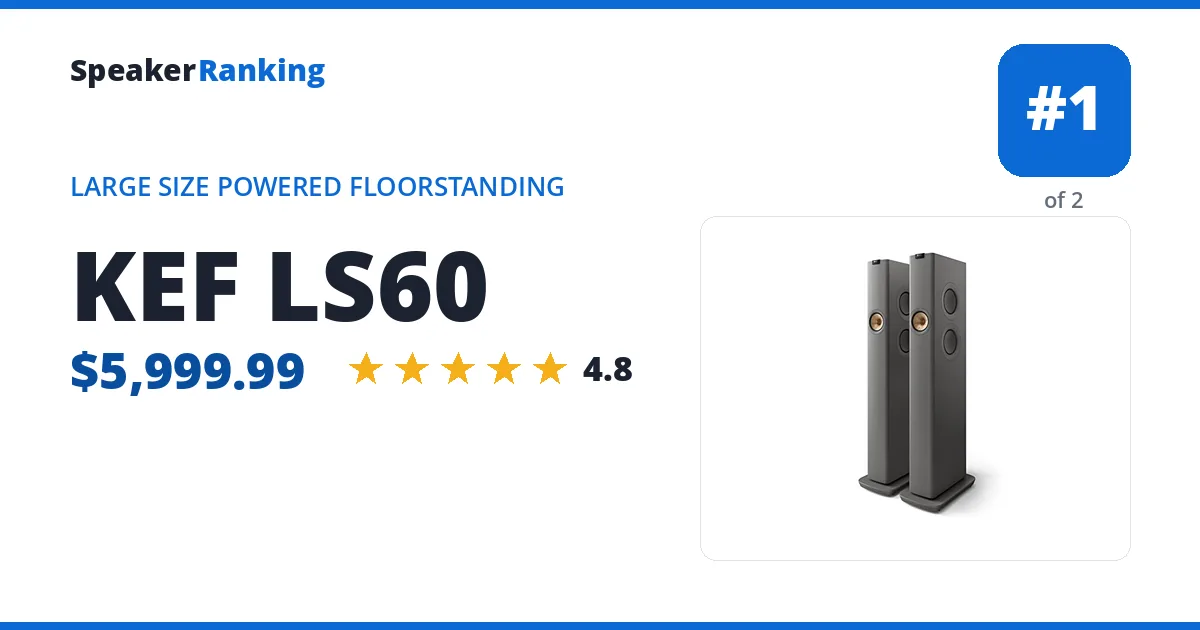
Pros: Erin’s on-axis measurement combines a 1.9dB response span from 300Hz to 5kHz with a 7.22 ideal-subwoofer preference score, supporting even vocal and instrumental balance. Extended-mode bass reaches roughly 25Hz at -3dB. The coaxial Uni-Q arrangement maintains unusually consistent tonality across listening positions, while HDMI, digital and analog inputs plus network streaming make this a convenient complete music and TV system. Measured bass extension of 23Hz (-3dB), with a measured sensitivity of 97.7dB.
Cons: A diffraction dip around 9kHz can soften cymbal shimmer when aimed directly at the listener; 10-20 degrees of toe-out helps. DSP limiting reduces bass reach and dynamic output at high volume, so its deep low-level extension is not a promise of the same performance on loud peaks. App placement and tone controls are less flexible than parametric room correction. Each roughly 31kg tower is awkward to move.
Full KEF LS60 review and specifications →
| AES Input | No |
|---|---|
| Amplifier Power | 700W (500W LF Class D + 100W MF Class D + 100W HF Class AB) |
| App | Yes (KEF Connect) |
| Aux Input | No |
| Bass Extension (-10dB) | <20Hz (measured, Erin's Audio Corner) |
| Bass Extension (-3dB) | 23Hz (measured, Erin's Audio Corner) |
| Bluetooth | Yes (5.0 with SBC, AAC) |
| Bluetooth Codecs | SBC, AAC |
| Coaxial Input | Yes |
| DSP | Yes (Music Integrity Engine) |
| Dimensions | 42.9"H x 8.3"W x 15.5"D (1089.7 x 210.8 x 393.7 mm) |
| Drivers | 4 x 135 mm (5.25 in.) Uni-Core Force Cancelling Driver: woofers, 100 mm (4in.) aluminium cone midrange, 19 mm (0.75 in.) vented aluminium dome with Metamaterial Absorption Technology tweeter |
| EQ | Yes (Normal and Expert modes, room adaptation) |
| Frequency Response | 31Hz - 24kHz (±3dB) (Manufacturer specified) |
| HDMI Input | Yes |
| Inputs | Wifi, Optical, Digital coaxial, RCA, HDMI eARC, Ethernet |
| Maximum SPL | 111dB @ 1m (pink noise) (manufacturer specified) |
| Optical Input | Yes |
| Outputs | Subwoofer RCA |
| RCA Input | Yes |
| Sensitivity | 97.7dB (measured at 0.3V/1m, Erin's Audio Corner) |
| Spinorama Preference Score | 6.57 |
| Spinorama Preference Score with Perfect Sub | 7.22 |
| Streaming Services | Yes (AirPlay 2, Chromecast, Roon Ready, Spotify Connect, Tidal Connect, Amazon Music, Qobuz, Deezer) |
| Subwoofer Output | Yes |
| TRS Input | No |
| USB Input | No |
| Weight | 69 lbs (31.3 kg) each |
| Wi-Fi | Yes (dual-band) |
| XLR Input | No |
- Links
- Reviews, Comparisons and Sound Samples
- Head-to-Head Comparisons