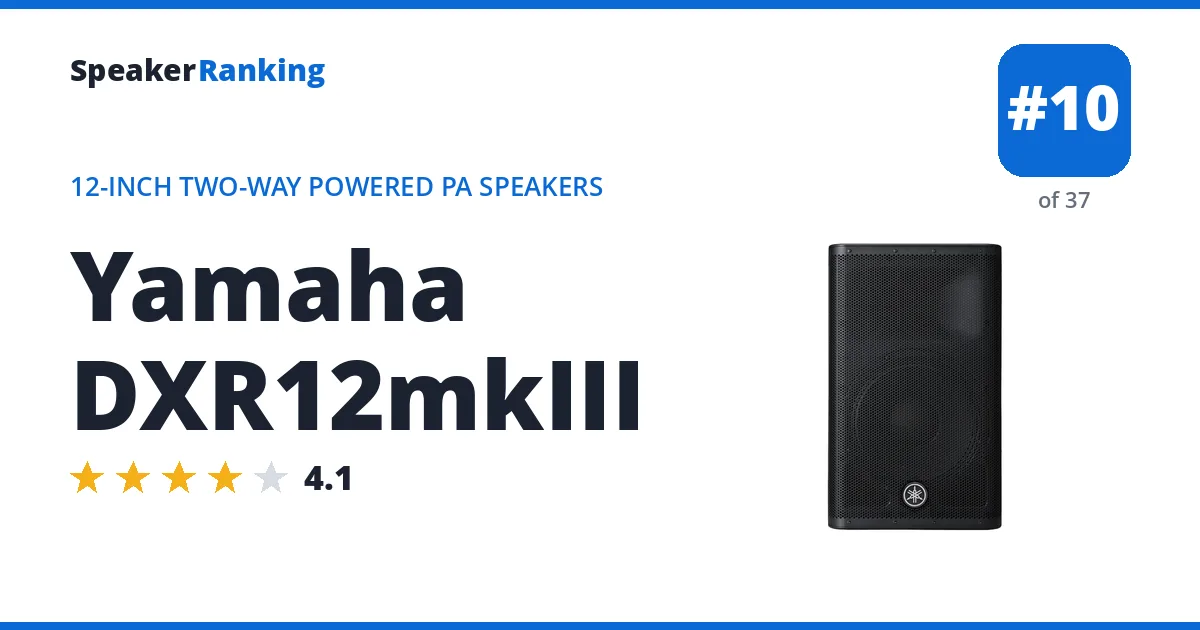
Short answer: the Yamaha DXR12mkIII. It ranks #10 of 37 12-inch two-way powered pa speakers by sound quality at $999.99; the Axiom ED120A ranks #14 and costs $1790, so there is not much of a tradeoff to weigh.
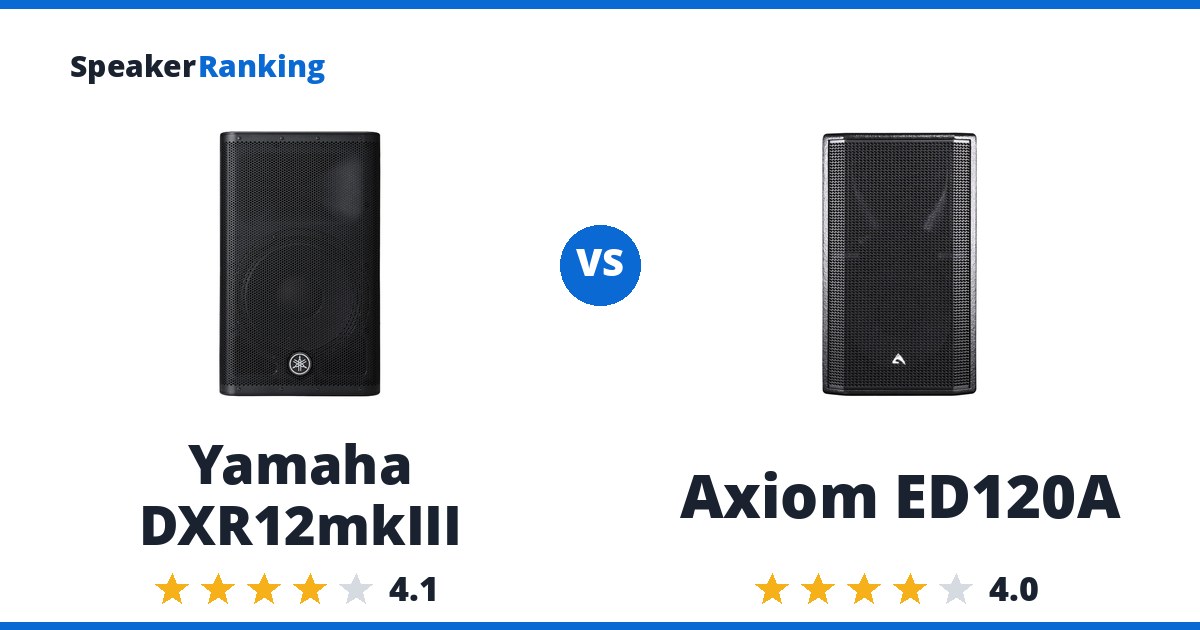
What the Yamaha DXR12mkIII offers: The third-generation DXR raises claimed output to 134dB and adds 2000W amplification, app-based control and more capable onboard DSP while staying light at 17.4kg. Medium-quality vendor data shows measured extension around 60Hz. Watch for: The truncated Spinorama data does not produce a preference score, so its tonal advantage over the proven DXR12mkII is not yet quantified. Wireless connectivity is for remote control, not a substitute for a wired production-audio input.
What the Axiom ED120A offers: High-quality vendor Spinorama data gives it a 4.94 ideal-subwoofer preference score and 52Hz bass extension, a solid tonal showing for a professional cabinet. CORE DSP, PRONET remote control and an asymmetric rotatable horn add useful installation flexibility. Watch for: The 132dB claimed peak is competitive rather than class-leading, and the asymmetric 60°-to-100° pattern needs more deliberate aiming than a conventional symmetric horn. Availability and service coverage are less broad than the mainstream QSC, JBL, Yamaha and RCF choices.
Buy the Yamaha DXR12mkIII. It ranks higher for sound quality than the Axiom ED120A and costs less, so the other one has nothing left to offer.
Looking for alternatives? See the complete PA & Live Sound rankings.
Specifications Side By Side
| Yamaha DXR12mkIII | Axiom ED120A | |
|---|---|---|
| Price | $999.99 | $1,790.00 |
| Ranked | #10 of 37 in 12-Inch Two-Way Powered PA Speakers | #14 of 37 in 12-Inch Two-Way Powered PA Speakers |
| Configuration | Active 2-way bass-reflex PA speaker | Active 2-way bass-reflex PA speaker |
| Drivers | 12" woofer, 1" throat/1.75" diaphragm compression driver | 12" woofer, 1.4" compression driver |
| Frequency Response | 50Hz - 20kHz (-10dB, manufacturer specified) | 65Hz - 17kHz (-6dB, manufacturer specified) |
| Dimensions | 23.6"H x 14.4"W x 13.8"D (600 x 366 x 350 mm) | 24"H x 14.2"W x 12.2"D (610 x 360 x 310 mm) |
| Bass Extension (-3dB) | 60Hz (measured, vendor Spinorama data) | 60Hz (measured, vendor Spinorama data) |
| Coverage | 90° x 60° | 60°-100° asymmetric x 60° |
| Maximum SPL | 134dB peak (manufacturer specified) | 132dB peak (manufacturer specified) |
| Inputs | Balanced mic/line inputs and link output | XLR input and link; EtherCON control network |
| Amplifier Power | 2000W peak / 1000W RMS (1700W LF + 300W HF peak) | 1,200W continuous (900W LF + 300W HF Class D, manufacturer specified) |
| Crossover Frequency | 1800Hz (FIR-X) | - |
| Cabinet Material | PP plastic | 15mm reinforced phenolic birch plywood |
| Rigging | 3 x M10 points plus U-bracket points; 35mm dual-angle pole mount | M10 and M6 fly points; pole-mount socket |
| DSP | Yes, FIR-X tuning, Drive Motion Calibration and D-Remote | Yes, CORE processing with PRONET control |
| Bluetooth | Bluetooth 5.0 audio streaming and D-Remote control | No |
| Weight | 38.4 lbs (17.4 kg) | 41.9 lbs (19 kg) |
| Network Control | - | PRONET control over EtherCON/CANBUS |
| Spinorama Preference Score | - | 2.51 |
| Spinorama Preference Score with Perfect Sub | - | 4.94 |
Related Speaker Comparisons
More top alternatives to Yamaha DXR12mkIII:
- QSC K12.2 vs Yamaha DXR12mkIII
- KV2 Audio EX12 vs Yamaha DXR12mkIII
- JBL PRX912 vs Yamaha DXR12mkIII
- RCF KX 32-A vs Yamaha DXR12mkIII
- RCF ART 932-A vs Yamaha DXR12mkIII
Prices on this page were last checked September 16, 2026 at 12:41 AM UTC. Product prices and availability are accurate as of that date/time and are subject to change; the price and availability shown on Amazon at the time of purchase will apply to the purchase of this product.
As an eBay Partner, we may be compensated if you make a purchase.
The Two Speakers In Full
 Yamaha DXR12mkIII: $999.99 Amazon B&H Photo Video Guitar Center eBay
Pros: The third-generation DXR raises claimed output to 134dB and adds 2000W amplification, app-based control and more capable onboard DSP while staying light at 17.4kg. Medium-quality vendor data shows measured extension around 60Hz. Measured bass extension of 60Hz (-3dB).
Cons: The truncated Spinorama data does not produce a preference score, so its tonal advantage over the proven DXR12mkII is not yet quantified. Wireless connectivity is for remote control, not a substitute for a wired production-audio input.
Full Yamaha DXR12mkIII review and specifications →
| Amplifier Power | 2000W peak / 1000W RMS (1700W LF + 300W HF peak) |
|---|---|
| Bass Extension (-3dB) | 60Hz (measured, vendor Spinorama data) |
| Bluetooth | Bluetooth 5.0 audio streaming and D-Remote control |
| Cabinet Material | PP plastic |
| Configuration | Active 2-way bass-reflex PA speaker |
| Coverage | 90° x 60° |
| Crossover Frequency | 1800Hz (FIR-X) |
| DSP | Yes, FIR-X tuning, Drive Motion Calibration and D-Remote |
| Dimensions | 23.6"H x 14.4"W x 13.8"D (600 x 366 x 350 mm) |
| Drivers | 12" woofer, 1" throat/1.75" diaphragm compression driver |
| Frequency Response | 50Hz - 20kHz (-10dB, manufacturer specified) |
| Inputs | Balanced mic/line inputs and link output |
| Maximum SPL | 134dB peak (manufacturer specified) |
| Rigging | 3 x M10 points plus U-bracket points; 35mm dual-angle pole mount |
| Weight | 38.4 lbs (17.4 kg) |
- Links
- Reviews, Comparisons and Sound Samples
- Head-to-Head Comparisons
- Yamaha DXR12mkIII vs RCF ART 912-A
- Yamaha DXR12mkIII vs HK Audio LINEAR 7 112 XA
- Yamaha DXR12mkIII vs RCF NX 932-A
- Yamaha DXR12mkIII vs RCF ART 932-A
- Yamaha DXR12mkIII vs Yamaha DXR12mkII
- Yamaha DXR12mkIII vs RCF KX 32-A
- Yamaha DXR12mkIII vs JBL PRX912
- Yamaha DXR12mkIII vs Yamaha DZR12
- See all 23 comparisons
 Axiom ED120A: $1,790.00 eBay
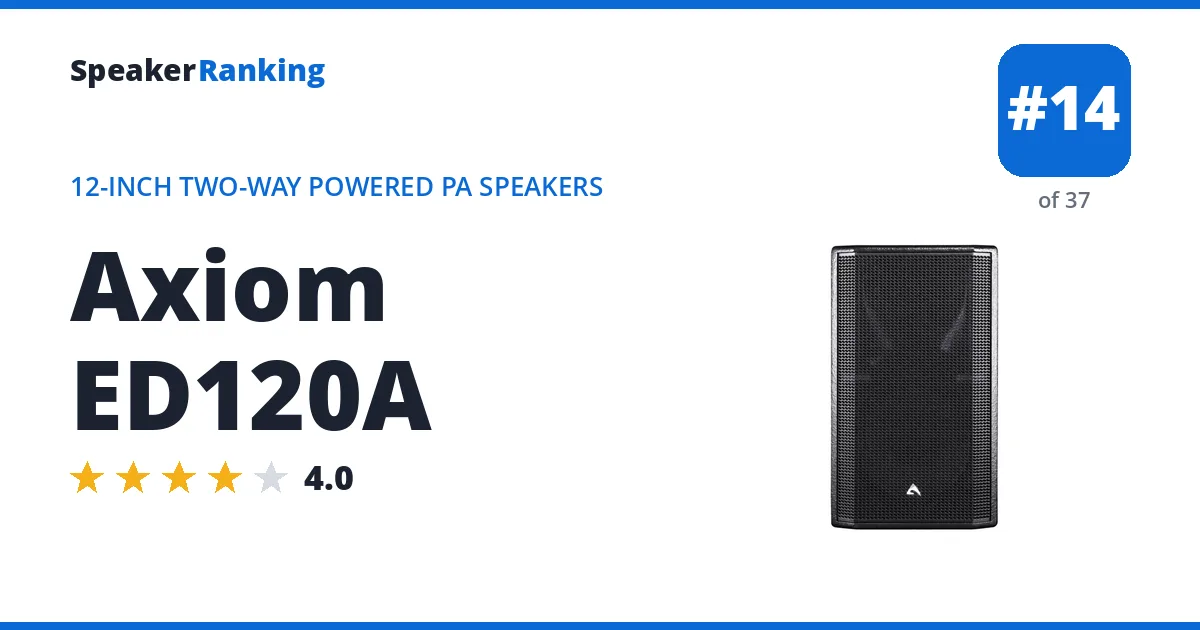
Pros: High-quality vendor Spinorama data gives it a 4.94 ideal-subwoofer preference score and 52Hz bass extension, a solid tonal showing for a professional cabinet. CORE DSP, PRONET remote control and an asymmetric rotatable horn add useful installation flexibility. Measured bass extension of 60Hz (-3dB).
Cons: The 132dB claimed peak is competitive rather than class-leading, and the asymmetric 60°-to-100° pattern needs more deliberate aiming than a conventional symmetric horn. Availability and service coverage are less broad than the mainstream QSC, JBL, Yamaha and RCF choices.
Full Axiom ED120A review and specifications →
| Amplifier Power | 1,200W continuous (900W LF + 300W HF Class D, manufacturer specified) |
|---|---|
| Bass Extension (-3dB) | 60Hz (measured, vendor Spinorama data) |
| Bluetooth | No |
| Cabinet Material | 15mm reinforced phenolic birch plywood |
| Configuration | Active 2-way bass-reflex PA speaker |
| Coverage | 60°-100° asymmetric x 60° |
| DSP | Yes, CORE processing with PRONET control |
| Dimensions | 24"H x 14.2"W x 12.2"D (610 x 360 x 310 mm) |
| Drivers | 12" woofer, 1.4" compression driver |
| Frequency Response | 65Hz - 17kHz (-6dB, manufacturer specified) |
| Inputs | XLR input and link; EtherCON control network |
| Maximum SPL | 132dB peak (manufacturer specified) |
| Network Control | PRONET control over EtherCON/CANBUS |
| Rigging | M10 and M6 fly points; pole-mount socket |
| Spinorama Preference Score | 2.51 |
| Spinorama Preference Score with Perfect Sub | 4.94 |
| Weight | 41.9 lbs (19 kg) |
- Links
- Reviews, Comparisons and Sound Samples
- Head-to-Head Comparisons