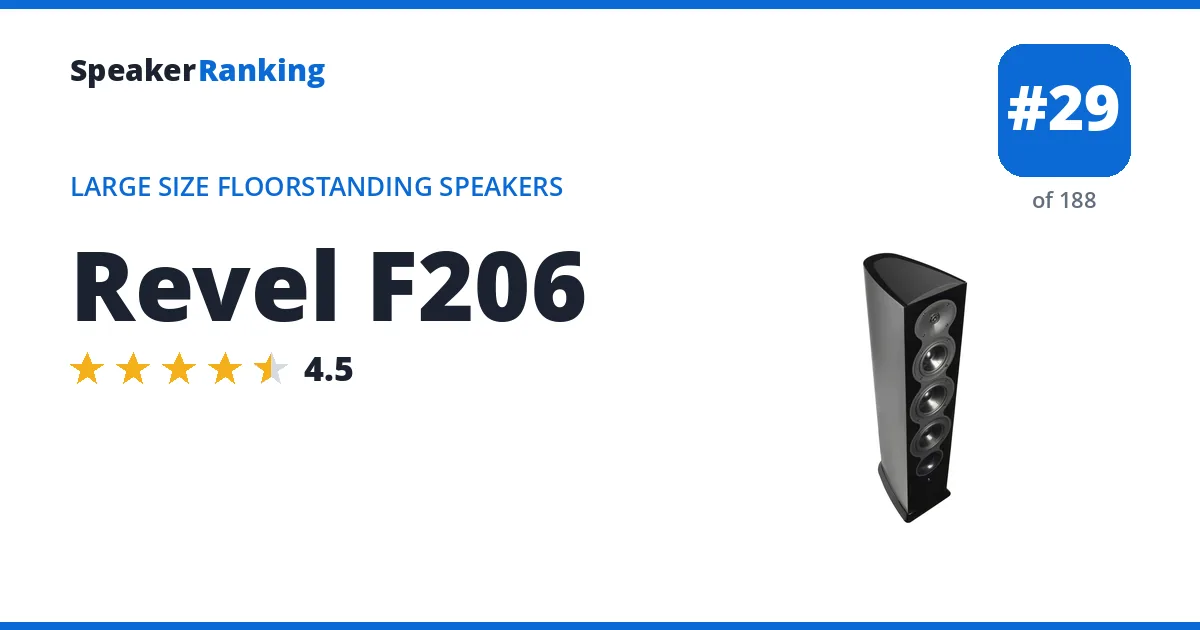
Short answer: both are discontinued, so this only matters if you are buying used. Used, the Revel F206 is the better pick: it ranks #29 of 188 floorstanding speakers by sound quality (rated 4.5/5), against #124 (rated 3.8/5) for the Definitive Technology BP-9020. If you want one new, the Revel F226Be replaces the Revel F206 and is rated 4.6/5 at $8,469.90.
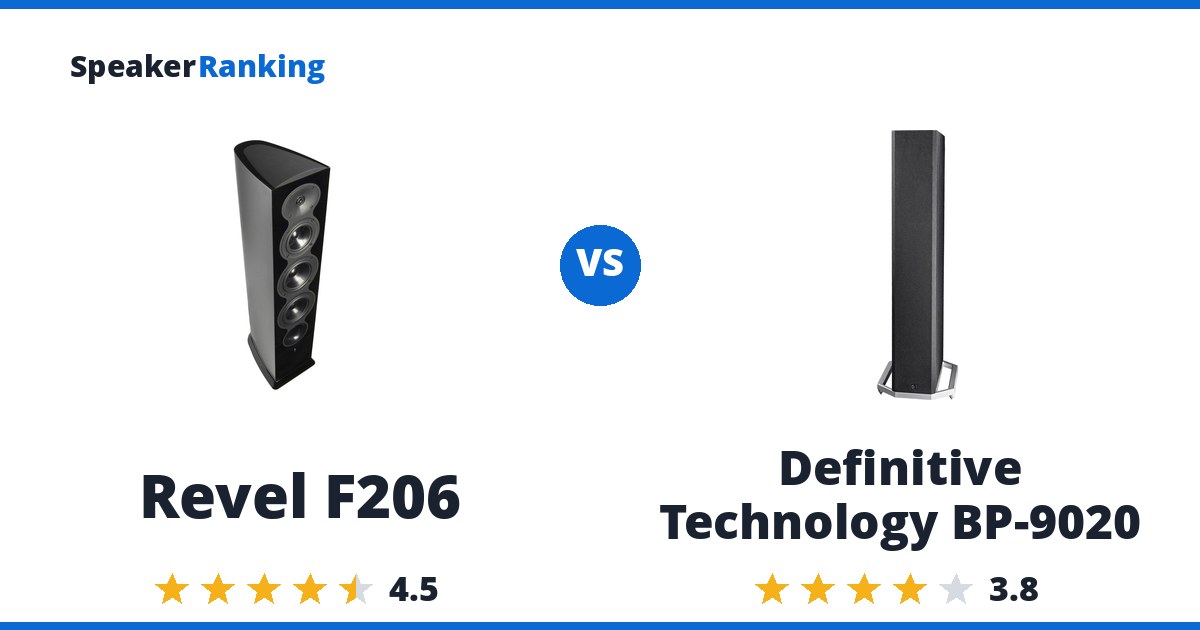
The Revel F206 is the better-sounding choice. CEA2034 spinorama shows a pretty even on-axis response. Watch for: Some directivity error and a small peak around 4.5kHz show up alongside the directivity error around 3kHz.
The Definitive Technology BP-9020 is the deeper-bass pick. Integrated powered 8” side-firing subwoofer with a 150-watt Class D amplifier provides exceptional sub-bass extension down to an F3 of 35Hz and F10 of 29Hz without requiring a standalone subwoofer enclosure. Its bass reaches about 35Hz before falling 3dB, against 60Hz for the Revel F206. The catch: Significant high-frequency boost creates notable treble brightness and noticeable sibilance on vocal s-sounds.
Buy the Revel F206 only if you find one used in good condition; both are discontinued, and it is the better rated of the two. For a new speaker, buy the Revel F226Be, which replaces the Revel F206.
Still deciding? The full Passive Home rankings cover every ranked option.
Specifications Side By Side
| Revel F206 | Definitive Technology BP-9020 | |
|---|---|---|
| Price | $2,000 per pair used, Discontinued | $500 per pair Discontinued |
| Ranked | #29 of 188 in Large Size Floorstanding Speakers | #124 of 188 in Large Size Floorstanding Speakers |
| Bass Extension (-10dB) | 34Hz (measured, Audio Science Review) | 29Hz (measured, Erin’s Audio Corner) |
| Bass Extension (-3dB) | 60Hz (measured, Audio Science Review) | 35Hz (measured, Erin’s Audio Corner) |
| Dimensions | 40.3”H x 8.4”W x 12.2”D (1023.6 x 213.4 x 309.9 mm) | 35.3”H x 11”W x 13”D (895.4 x 279.4 x 330.2 mm) |
| Impedance | 4 ohms nominal (3.3 ohms minimum, measured by Audio Science Review) | 8 ohms nominal |
| Drivers | Dual 6.5” (16.5 cm) Aluminum Cone, Cast-frame Woofers, 5.25” (13.3 cm) Aluminum Cone, Cast-frame Midrange, 1” (2.5 cm) Aluminum Tweeter with Acoustic Lens Waveguide | 1 in. annealed aluminum dome tweeter, two 3.5 in. BDSS midrange (front), one 3.5 in. BDSS midrange (rear), 8 in. powered subwoofer |
| Sensitivity | 87dB (measured, Audio Science Review) | 87.7dB (measured average, Erin’s Audio Corner) |
| Weight | 57.3 lbs (26 kg) each | 30 lbs (13.6 kg) each |
| Woofer Cabinet | ported, front | ported, slot |
| Spinorama Preference Score | 5.51 | 5.08 |
| Spinorama Preference Score with Perfect Sub | 7.52 | 6.53 |
| DIY Kit | No | No |
Related Speaker Comparisons
More worthwhile head-to-heads for Revel F206:
- Revel F206 vs KEF Blade Two Meta
- MoFi SourcePoint 888 vs Revel F206
- Revel F328Be vs Revel F206
- KEF R5 Meta vs Revel F206
- Revel F206 vs Revel F226Be
Prices on this page were last checked October 7, 2026 at 9:25 PM UTC. Product prices and availability are accurate as of that date/time and are subject to change; the price and availability shown on Amazon at the time of purchase will apply to the purchase of this product.
As an eBay Partner, we may be compensated if you make a purchase.
The Two Speakers In Full
 Revel F206: $2,000 per pair used Discontinued eBay
Newer model: the Revel F226Be, ranked higher, rated 4.6/5.
Same family: the Revel M105 (smaller bookshelf, rated 4.2/5), the Revel M106 (larger bookshelf, rated 4.6/5), the Revel F208 (larger floorstanding, ranked higher, rated 4.5/5), the Revel Performa3 C205 (smaller center, rated 4.1/5) and the Revel Performa3 C208 (larger center, rated 4/5).
Pros: CEA2034 spinorama shows a pretty even on-axis response. Predicted in-room response is excellent, with a smooth downward slope. Horizontal beamwidth of about ±65 degrees is wide, if a bit uneven. Distortion is very nice at 86dB SPL/1m, falling below the frequency range where human hearing is most sensitive, and stays excellent even at 96dB SPL/1m. Near-field measurements of the individual drivers show nice suppression of port and woofer resonances. Really amazing value for the performance. Measured bass extension of 60Hz (-3dB), with a measured sensitivity of 87dB.
Cons: Some directivity error and a small peak around 4.5kHz show up alongside the directivity error around 3kHz. Vertical directivity means listening position needs to stay within the tweeter axis, though the reviewer notes there is some leeway. Minimum impedance dips to 3.3 ohms, calling for an amplifier comfortable with a demanding load. Discontinued.
Full Revel F206 review and specifications →
| Bass Extension (-10dB) | 34Hz (measured, Audio Science Review) |
|---|---|
| Bass Extension (-3dB) | 60Hz (measured, Audio Science Review) |
| DIY Kit | No |
| Dimensions | 40.3”H x 8.4”W x 12.2”D (1023.6 x 213.4 x 309.9 mm) |
| Drivers | Dual 6.5” (16.5 cm) Aluminum Cone, Cast-frame Woofers, 5.25” (13.3 cm) Aluminum Cone, Cast-frame Midrange, 1” (2.5 cm) Aluminum Tweeter with Acoustic Lens Waveguide |
| Impedance | 4 ohms nominal (3.3 ohms minimum, measured by Audio Science Review) |
| Sensitivity | 87dB (measured, Audio Science Review) |
| Spinorama Preference Score | 5.51 |
| Spinorama Preference Score with Perfect Sub | 7.52 |
| Weight | 57.3 lbs (26 kg) each |
| Woofer Cabinet | ported, front |
- Links
- Reviews, Comparisons and Sound Samples
- Head-to-Head Comparisons
 Definitive Technology BP-9020: $500 per pair Discontinued eBay
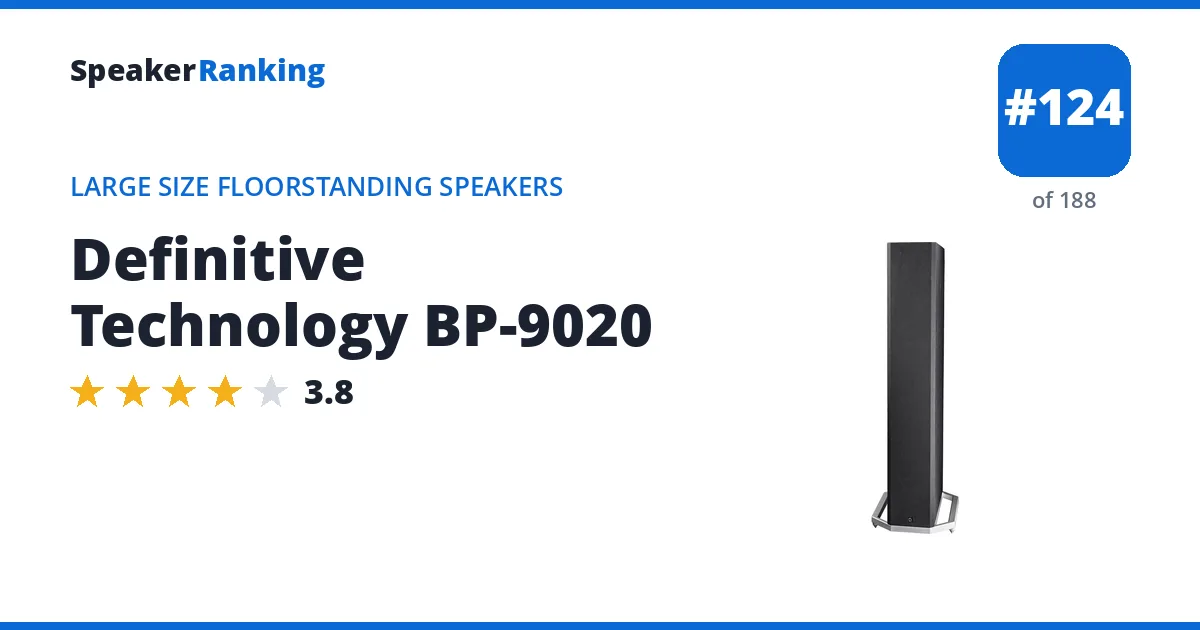
Pros: Integrated powered 8” side-firing subwoofer with a 150-watt Class D amplifier provides exceptional sub-bass extension down to an F3 of 35Hz and F10 of 29Hz without requiring a standalone subwoofer enclosure. Forward-Focused Bipolar Array technology (dual 3.5” front midrange drivers + 1” annealed aluminum dome tweeter, plus a 3.5” rear-firing midrange driver) creates a remarkably wide, spacious soundstage with broad room envelopment. On-axis frequency response stays smooth and relatively neutral when listened to directly aligned with the tweeter. Measured average sensitivity of 87.7dB SPL (2.83V/1m) allows comfortable drive from standard multi-channel receivers. Measured bass extension of 35Hz (-3dB), with a measured sensitivity of 87.7dB.
Cons: Significant high-frequency boost creates notable treble brightness and noticeable sibilance on vocal s-sounds. Bipolar rear driver radiation creates a diffuse soundstage that compromises razor-sharp imaging focus and pinpoint instrument placement. DSP-based internal limiter aggressively compresses output below 80Hz at higher listening levels, causing lower mid-bass and sub-bass impact to diminish as volume increases. Midrange clarity shows slight ‘cuppiness’ and upper-frequency directivity irregularities due to front/rear driver interaction. Discontinued.
Full Definitive Technology BP-9020 review and specifications →
| Bass Extension (-10dB) | 29Hz (measured, Erin’s Audio Corner) |
|---|---|
| Bass Extension (-3dB) | 35Hz (measured, Erin’s Audio Corner) |
| DIY Kit | No |
| Dimensions | 35.3”H x 11”W x 13”D (895.4 x 279.4 x 330.2 mm) |
| Drivers | 1 in. annealed aluminum dome tweeter, two 3.5 in. BDSS midrange (front), one 3.5 in. BDSS midrange (rear), 8 in. powered subwoofer |
| Impedance | 8 ohms nominal |
| Sensitivity | 87.7dB (measured average, Erin’s Audio Corner) |
| Spinorama Preference Score | 5.08 |
| Spinorama Preference Score with Perfect Sub | 6.53 |
| Weight | 30 lbs (13.6 kg) each |
| Woofer Cabinet | ported, slot |
- Links
- Reviews, Comparisons and Sound Samples
- Head-to-Head Comparisons
- Definitive Technology BP-9020 vs SVS Ultra Evolution Pinnacle
- Definitive Technology BP-9020 vs Polk T50
- Definitive Technology BP-9020 vs Klipsch RP-6000F II
- Definitive Technology BP-9020 vs Dynaudio Emit 30
- Definitive Technology BP-9020 vs Klipsch RP-8000F II
- Definitive Technology BP-9020 vs Focal Aria Evo X N°2
- Definitive Technology BP-9020 vs Klipsch RP-5000F II
- Definitive Technology BP-9020 vs KEF Q11 Meta
- See all 36 comparisons