Short answer: the Revel Concerta2 F35. It ranks #30 of 188 floorstanding speakers by sound quality, rated 4.5/5, at $900. The Polk Audio XT60 ranks #147, rated 3.5/5, at $370, $530 cheaper, not enough of a saving to outweigh the sound-quality gap.
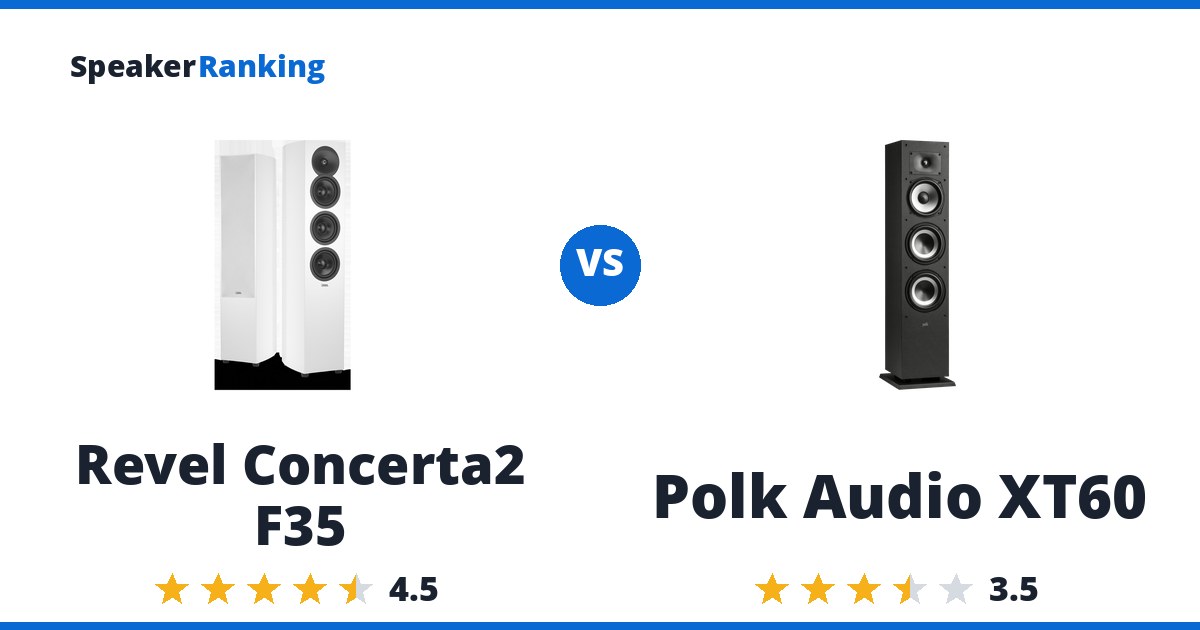
The Revel Concerta2 F35 is the better-sounding choice. Two-and-a-half-way, four-driver design: a 1” aluminum dome tweeter on a waveguide, a 5.25” mid-range, and dual 5.25” mid-bass drivers in a rear-ported cabinet. The catch: F3 of 61Hz and F10 of 39Hz mean a subwoofer is needed for real bass extension.
The Polk Audio XT60 is the deeper-bass option. Passive-radiator-loaded design (6.5” woofer plus two 6.5” passive radiators) gives deeper bass than the driver size alone would suggest: 43.9Hz at -3dB / 38.1Hz at -10dB, genuinely competitive extension for a budget tower. Its bass reaches about 43.9Hz before falling 3dB, against 70Hz for the Revel Concerta2 F35. Watch for: Bass alignment Q (lfq 0.96) is the highest, least-controlled figure in this entire batch, consistent with owner reports of a slightly loose, boomy low end at higher volumes.
Buy the Revel Concerta2 F35. It is rated higher for sound quality, and the $530 saving on the Polk Audio XT60 is not enough to make up the difference.
Looking for alternatives? See the complete Passive Home rankings.
Specifications Side By Side
| Revel Concerta2 F35 | Polk Audio XT60 | |
|---|---|---|
| Price | $900 per pair | $370 per pair |
| Ranked | #30 of 188 in Large Size Floorstanding Speakers | #147 of 188 in Large Size Floorstanding Speakers |
| Bass Extension (-10dB) | 50Hz (measured, Erin’s Audio Corner) | 38.1Hz (measured, spinorama.org) |
| Bass Extension (-3dB) | 70Hz (measured, Erin’s Audio Corner) | 43.9Hz (measured, spinorama.org) |
| Dimensions | 40.3”H x 8.4”W x 12.2”D (1023.6 x 213.4 x 309.9 mm) | 19.05 x 92.5 x 23.09cm (7.5 x 36.4 x 9.09 in) each |
| Impedance | 6 ohms nominal (3.8 ohms minimum, measured by Erin’s Audio Corner) | 4/8-ohm compatible |
| Sensitivity | 89.4dB (measured, Erin’s Audio Corner; 90dB manufacturer specified) | 86dB (1W/1m) |
| Drivers | 3x 5.25” deep anodized aluminum cone woofers, 1” Aluminum Tweeter | 1” Terylene dome tweeter, 6.5” bilaminate polypropylene woofer, 2x 6.5” passive radiators |
| Weight | 41 lbs (18.6 kg) each | 20 lbs (9.07 kg) each |
| Woofer Cabinet | ported, rear | Passive radiator-loaded |
| Spinorama Preference Score | 5.35 | 5.19 |
| Spinorama Preference Score with Perfect Sub | 7.30 | 7.13 |
| DIY Kit | No | No |
Related Speaker Comparisons
How Revel Concerta2 F35 compares with other leading options:
- GR-Research NX-Treme vs Revel Concerta2 F35
- KEF Blade Two Meta vs Revel Concerta2 F35
- MoFi SourcePoint V10 Master Edition vs Revel Concerta2 F35
- MoFi SourcePoint 888 vs Revel Concerta2 F35
- Revel Concerta2 F35 vs Revel F328Be
Prices on this page were last checked October 7, 2026 at 9:25 PM UTC. Product prices and availability are accurate as of that date/time and are subject to change; the price and availability shown on Amazon at the time of purchase will apply to the purchase of this product.
As an eBay Partner, we may be compensated if you make a purchase.
The Two Speakers In Full
 Revel Concerta2 F35: $900 per pair Crutchfield eBay
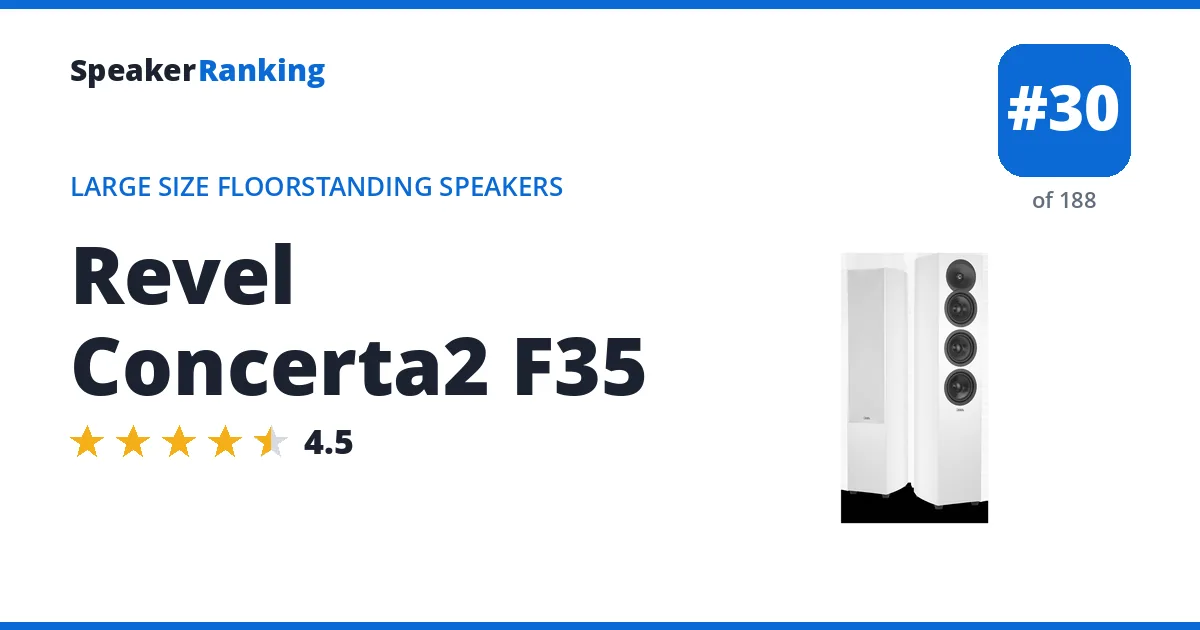
Same family: the Revel Concerta2 M16 (bookshelf, rated 4.1/5), the Revel Concerta2 F36 (larger floorstanding, ranked higher, estimated 4.6/5) and the Revel Concerta2 C25 (center, rated 4.1/5).
Pros: Two-and-a-half-way, four-driver design: a 1” aluminum dome tweeter on a waveguide, a 5.25” mid-range, and dual 5.25” mid-bass drivers in a rear-ported cabinet. Measured sensitivity of 89.4dB closely matches the 90dB spec, and distortion looks good at both 86dB and 96dB, holding up well even with a high-pass filter applied. At its sale price of $900/pair, down from full retail, the reviewer calls it a “no-brainer,” undercutting comparable budget floorstanders like the ELAC DF63. Frequency response and directivity mismatches are largely EQ-able, since most of what shows up in measurements traces to physical tweeter/mid-range separation rather than a fundamental flaw. Compression is fairly well controlled for the price: about 1dB of loss around 100Hz under long-term compression, described as “par for the course” at this cost. Measured bass extension of 70Hz (-3dB), with a measured sensitivity of 89.4dB.
Cons: F3 of 61Hz and F10 of 39Hz mean a subwoofer is needed for real bass extension. A dip in the lower midrange/2-3kHz region reduces attack and detail, and a peak around 5kHz adds some edge and sibilance in the lower treble. A peak in off-axis energy around 3kHz reflects off sidewalls at roughly 60-70° off-axis and arrives louder than the direct sound: this specific issue can’t be fixed with EQ (boosting the direct sound would boost the stronger reflection too) and would need acoustic absorption to properly address, though the reviewer considers it a minor, optional fix at this price. A couple of minor resonances appear in the impedance plot, including one around 300Hz that may partly explain a subtle sense of vocal warmth noticed in listening, though it’s more likely room-related. Minimum impedance around 3.8 ohms. Short-term compression testing shows some increased distortion in the tweeter and higher-frequency compression at loud output.
Full Revel Concerta2 F35 review and specifications →
| Bass Extension (-10dB) | 50Hz (measured, Erin’s Audio Corner) |
|---|---|
| Bass Extension (-3dB) | 70Hz (measured, Erin’s Audio Corner) |
| DIY Kit | No |
| Dimensions | 40.3”H x 8.4”W x 12.2”D (1023.6 x 213.4 x 309.9 mm) |
| Drivers | 3x 5.25” deep anodized aluminum cone woofers, 1” Aluminum Tweeter |
| Impedance | 6 ohms nominal (3.8 ohms minimum, measured by Erin’s Audio Corner) |
| Sensitivity | 89.4dB (measured, Erin’s Audio Corner; 90dB manufacturer specified) |
| Spinorama Preference Score | 5.35 |
| Spinorama Preference Score with Perfect Sub | 7.30 |
| Weight | 41 lbs (18.6 kg) each |
| Woofer Cabinet | ported, rear |
- Links
- Reviews, Comparisons and Sound Samples
- Audio Science Review Revel Concerta2 F35 More from Audio Science Review →
- Erin’s Audio Corner: Revel F35 Review: Great Sound, Lower Price! More from Erin’s Audio Corner →
- Erin’s Audio Review Website Revel Concerta2 F35
- Audio Science Review Measurements (spinorama.org)
- Erin’s Audio Corner: You’ve Never Seen a Review Like This. Revel F35 Review (Part 1).
- Head-to-Head Comparisons
- Revel Concerta2 F35 vs Revel F206
- Revel Concerta2 F35 vs Perlisten S7t
- Revel Concerta2 F35 vs Revel F228Be
- Revel Concerta2 F35 vs Revel F208
- Revel Concerta2 F35 vs Focal Chora 816
- Revel Concerta2 F35 vs JBL HDI-3800
- Revel Concerta2 F35 vs KEF R5
- Revel Concerta2 F35 vs KEF Reference 203
- See all 55 comparisons
 Polk Audio XT60: $370 per pair Amazon B&H Photo Video Crutchfield eBay
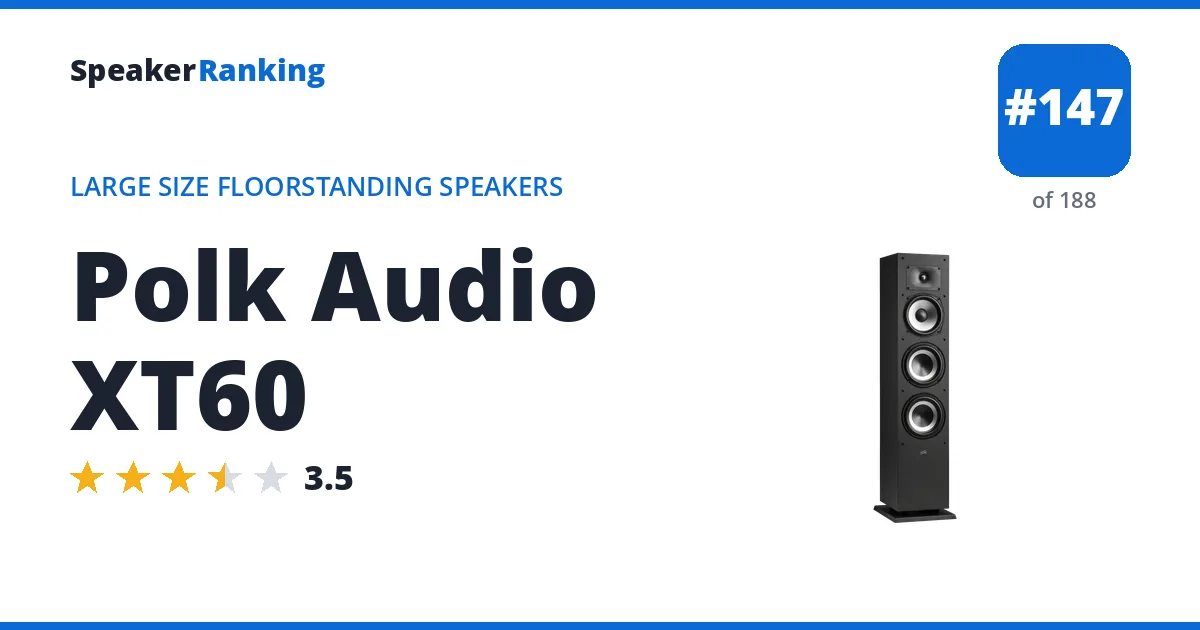
Same family: the Polk Audio XT15 (smaller bookshelf, rated 3.7/5), the Polk Monitor XT20 (larger bookshelf, rated 3.4/5), the Polk Audio XT70 (larger floorstanding, ranked higher, rated 3.6/5), the Polk Audio XT30 (smaller center, rated 3.6/5), the Polk Audio XT35 (larger center, rated 4.1/5), the Polk Audio Monitor XT10 (smaller subwoofer, estimated 3.1/5) and the Polk Audio Monitor XT12 (larger subwoofer, estimated 3.3/5).
Pros: Passive-radiator-loaded design (6.5” woofer plus two 6.5” passive radiators) gives deeper bass than the driver size alone would suggest: 43.9Hz at -3dB / 38.1Hz at -10dB, genuinely competitive extension for a budget tower. Hi-Res Audio certified, Dolby Atmos/DTS:X compatible, and works with either 4- or 8-ohm amplifier outputs. Measured bass extension of 43.9Hz (-3dB).
Cons: Bass alignment Q (lfq 0.96) is the highest, least-controlled figure in this entire batch, consistent with owner reports of a slightly loose, boomy low end at higher volumes. On-axis response is also relatively uneven, with narrow-band deviation of about 0.51dB. The vinyl-wrapped (not wood veneer) cabinet reads as budget up close per owner reviews, and at least one owner reported blowing a driver under sustained heavy bass: some caution is warranted with bass-heavy source material at volume.
Full Polk Audio XT60 review and specifications →
| Bass Extension (-10dB) | 38.1Hz (measured, spinorama.org) |
|---|---|
| Bass Extension (-3dB) | 43.9Hz (measured, spinorama.org) |
| DIY Kit | No |
| Dimensions | 19.05 x 92.5 x 23.09cm (7.5 x 36.4 x 9.09 in) each |
| Drivers | 1” Terylene dome tweeter, 6.5” bilaminate polypropylene woofer, 2x 6.5” passive radiators |
| Impedance | 4/8-ohm compatible |
| Sensitivity | 86dB (1W/1m) |
| Spinorama Preference Score | 5.19 |
| Spinorama Preference Score with Perfect Sub | 7.13 |
| Weight | 20 lbs (9.07 kg) each |
| Woofer Cabinet | Passive radiator-loaded |
- Links
- Reviews, Comparisons and Sound Samples
- Head-to-Head Comparisons
- Polk Audio XT60 vs Magnepan LRS+
- Polk Audio XT60 vs Polk Audio XT70
- Polk Audio XT60 vs Polk Signature Elite ES60
- Polk Audio XT60 vs JBL Stage 2 280F
- Polk Audio XT60 vs Focal Aria Evo X N°2
- Polk Audio XT60 vs Polk T50
- Polk Audio XT60 vs Definitive Technology BP-9020
- Polk Audio XT60 vs Klipsch RP-6000F II
- See all 39 comparisons