Short answer: the Revel Concerta2 F35. It ranks #30 of 188 floorstanding speakers by sound quality, rated 4.5/5, at $900; the KEF Q11 Meta ranks #103, rated 4.0/5, and costs $2,499.98, so there is not much of a tradeoff to weigh.
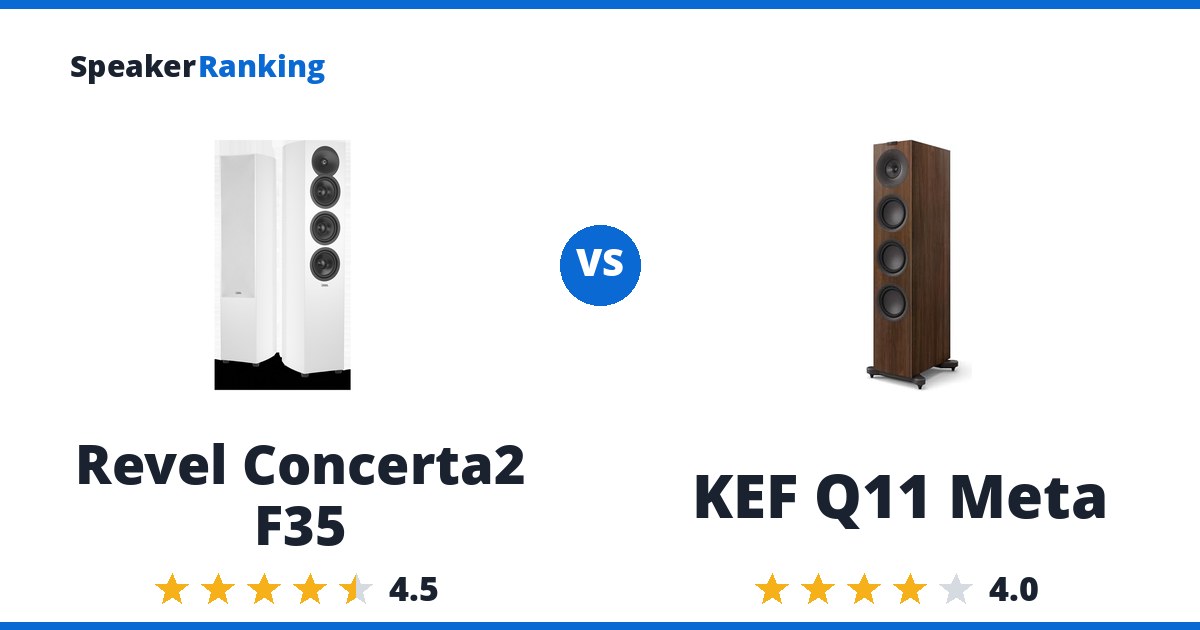
The Revel Concerta2 F35 is the better-sounding pick. Two-and-a-half-way, four-driver design: a 1” aluminum dome tweeter on a waveguide, a 5.25” mid-range, and dual 5.25” mid-bass drivers in a rear-ported cabinet. The catch: F3 of 61Hz and F10 of 39Hz mean a subwoofer is needed for real bass extension.
The KEF Q11 Meta is the more accurate, deeper-bass option. Three-way tower design with a coaxial layout: a 3/4” aluminum dome tweeter (with KEF’s Metamaterial Absorption Technology behind it) mounted at the center of a 4” mid-range, plus three 6.5” bass drivers. Its measured preference score, a predictor of how neutral it sounds, is 6.72 against 5.35 for the Revel Concerta2 F35. Its bass reaches about 60Hz before falling 3dB, against 70Hz for the Revel Concerta2 F35. The catch: Genuinely dark-sounding on raw on-axis measurement, and needs a typical room with sidewall reflections (within about 6 feet/2 meters) to sound properly neutral: in a large room with little sidewall interaction, it may sound too dull for some listeners.
Buy the Revel Concerta2 F35. It is rated higher for sound quality than the KEF Q11 Meta and costs less, so it is the default pick unless a specific strength of the other one matters more to you.
Looking for alternatives? See the complete Passive Home rankings.
Specifications Side By Side
| Revel Concerta2 F35 | KEF Q11 Meta | |
|---|---|---|
| Price | $900 per pair | $2,499.98 per pair |
| Ranked | #30 of 188 in Large Size Floorstanding Speakers | #103 of 188 in Large Size Floorstanding Speakers |
| Bass Extension (-10dB) | 50Hz (measured, Erin’s Audio Corner) | 29Hz (measured, Erin’s Audio Corner) |
| Bass Extension (-3dB) | 70Hz (measured, Erin’s Audio Corner) | 60Hz (measured, Erin’s Audio Corner) |
| Dimensions | 40.3”H x 8.4”W x 12.2”D (1023.6 x 213.4 x 309.9 mm) | 43.8”H x 12.5”W x 15”D (1112.8 x 317.5 x 381.0 mm) |
| Impedance | 6 ohms nominal (3.8 ohms minimum, measured by Erin’s Audio Corner) | 4 ohms nominal (3.2 ohms minimum, measured, Erin’s Audio Corner) |
| Sensitivity | 89.4dB (measured, Erin’s Audio Corner; 90dB manufacturer specified) | 88.6dB (measured, Erin’s Audio Corner) |
| Drivers | 3x 5.25” deep anodized aluminum cone woofers, 1” Aluminum Tweeter | 25mm tweeter + dual 165mm drivers |
| Weight | 41 lbs (18.6 kg) each | 106.9 lbs (48.5 kg) |
| Woofer Cabinet | ported, rear | ported, rear |
| Spinorama Preference Score | 5.35 | 6.72 |
| Spinorama Preference Score with Perfect Sub | 7.30 | 8.03 |
| DIY Kit | No | No |
Related Speaker Comparisons
More worthwhile head-to-heads for Revel Concerta2 F35:
- GR-Research NX-Treme vs Revel Concerta2 F35
- KEF Blade Two Meta vs Revel Concerta2 F35
- MoFi SourcePoint V10 Master Edition vs Revel Concerta2 F35
- MoFi SourcePoint 888 vs Revel Concerta2 F35
- Revel Concerta2 F35 vs Revel F328Be
Prices on this page were last checked October 7, 2026 at 9:25 PM UTC. Product prices and availability are accurate as of that date/time and are subject to change; the price and availability shown on Amazon at the time of purchase will apply to the purchase of this product.
As an eBay Partner, we may be compensated if you make a purchase.
The Two Speakers In Full
 Revel Concerta2 F35: $900 per pair Crutchfield eBay
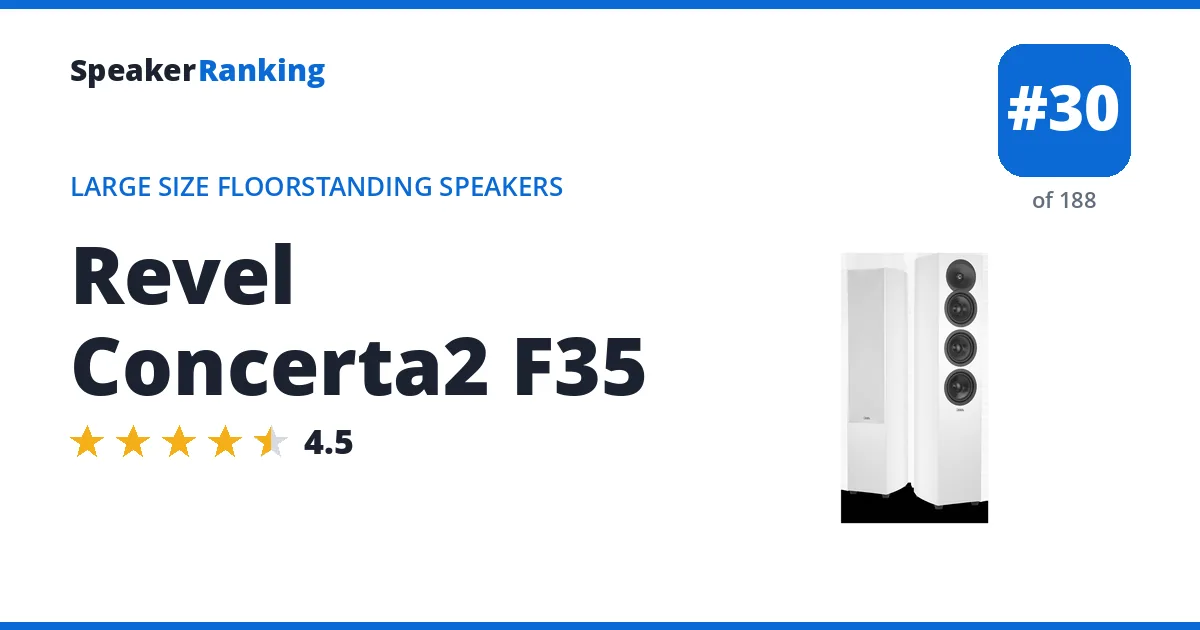
Same family: the Revel Concerta2 M16 (bookshelf, rated 4.1/5), the Revel Concerta2 F36 (larger floorstanding, ranked higher, estimated 4.6/5) and the Revel Concerta2 C25 (center, rated 4.1/5).
Pros: Two-and-a-half-way, four-driver design: a 1” aluminum dome tweeter on a waveguide, a 5.25” mid-range, and dual 5.25” mid-bass drivers in a rear-ported cabinet. Measured sensitivity of 89.4dB closely matches the 90dB spec, and distortion looks good at both 86dB and 96dB, holding up well even with a high-pass filter applied. At its sale price of $900/pair, down from full retail, the reviewer calls it a “no-brainer,” undercutting comparable budget floorstanders like the ELAC DF63. Frequency response and directivity mismatches are largely EQ-able, since most of what shows up in measurements traces to physical tweeter/mid-range separation rather than a fundamental flaw. Compression is fairly well controlled for the price: about 1dB of loss around 100Hz under long-term compression, described as “par for the course” at this cost. Measured bass extension of 70Hz (-3dB), with a measured sensitivity of 89.4dB.
Cons: F3 of 61Hz and F10 of 39Hz mean a subwoofer is needed for real bass extension. A dip in the lower midrange/2-3kHz region reduces attack and detail, and a peak around 5kHz adds some edge and sibilance in the lower treble. A peak in off-axis energy around 3kHz reflects off sidewalls at roughly 60-70° off-axis and arrives louder than the direct sound: this specific issue can’t be fixed with EQ (boosting the direct sound would boost the stronger reflection too) and would need acoustic absorption to properly address, though the reviewer considers it a minor, optional fix at this price. A couple of minor resonances appear in the impedance plot, including one around 300Hz that may partly explain a subtle sense of vocal warmth noticed in listening, though it’s more likely room-related. Minimum impedance around 3.8 ohms. Short-term compression testing shows some increased distortion in the tweeter and higher-frequency compression at loud output.
Full Revel Concerta2 F35 review and specifications →
| Bass Extension (-10dB) | 50Hz (measured, Erin’s Audio Corner) |
|---|---|
| Bass Extension (-3dB) | 70Hz (measured, Erin’s Audio Corner) |
| DIY Kit | No |
| Dimensions | 40.3”H x 8.4”W x 12.2”D (1023.6 x 213.4 x 309.9 mm) |
| Drivers | 3x 5.25” deep anodized aluminum cone woofers, 1” Aluminum Tweeter |
| Impedance | 6 ohms nominal (3.8 ohms minimum, measured by Erin’s Audio Corner) |
| Sensitivity | 89.4dB (measured, Erin’s Audio Corner; 90dB manufacturer specified) |
| Spinorama Preference Score | 5.35 |
| Spinorama Preference Score with Perfect Sub | 7.30 |
| Weight | 41 lbs (18.6 kg) each |
| Woofer Cabinet | ported, rear |
- Links
- Reviews, Comparisons and Sound Samples
- Audio Science Review Revel Concerta2 F35 More from Audio Science Review →
- Erin’s Audio Corner: Revel F35 Review: Great Sound, Lower Price! More from Erin’s Audio Corner →
- Erin’s Audio Review Website Revel Concerta2 F35
- Audio Science Review Measurements (spinorama.org)
- Erin’s Audio Corner: You’ve Never Seen a Review Like This. Revel F35 Review (Part 1).
- Head-to-Head Comparisons
- Revel Concerta2 F35 vs Revel F206
- Revel Concerta2 F35 vs Perlisten S7t
- Revel Concerta2 F35 vs Revel F228Be
- Revel Concerta2 F35 vs Revel F208
- Revel Concerta2 F35 vs Focal Chora 816
- Revel Concerta2 F35 vs JBL HDI-3800
- Revel Concerta2 F35 vs KEF R5
- Revel Concerta2 F35 vs KEF Reference 203
- See all 55 comparisons
 KEF Q11 Meta: $2,499.98 per pair Amazon eBay
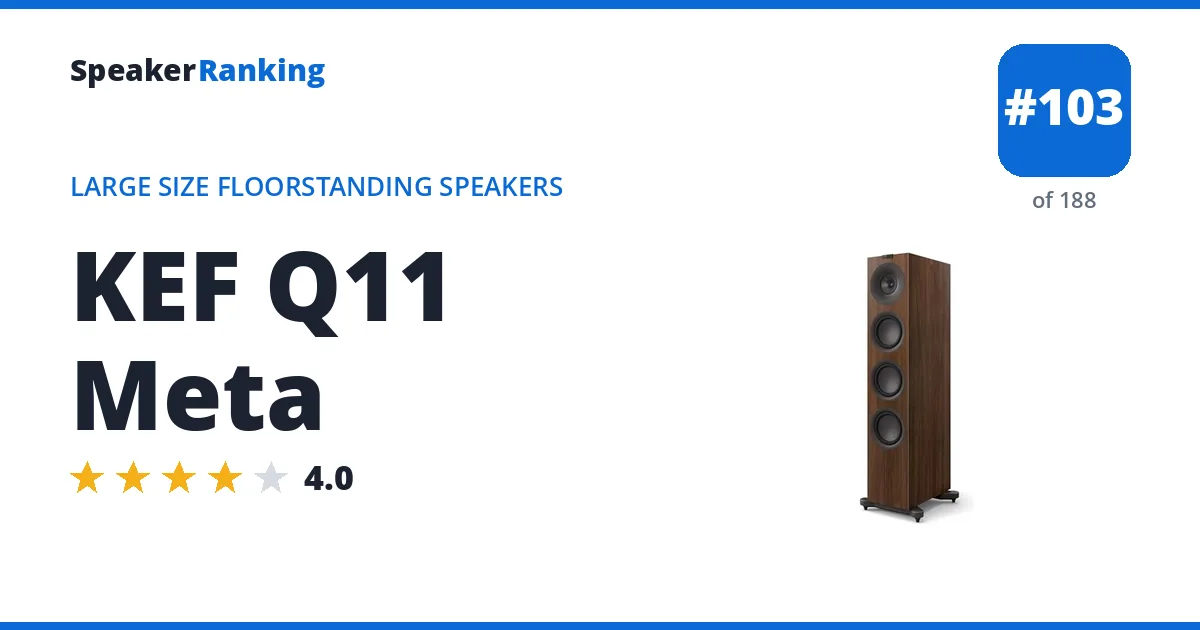
Same family: the KEF Q1 Meta (smallest bookshelf, rated 3.6/5), the KEF Q4 Meta (bookshelf, estimated 3.4/5), the KEF Q3 Meta (bookshelf, rated 3.4/5), the KEF Q Concerto Meta (largest bookshelf, rated 4.6/5), the KEF Q7 Meta (smaller floorstanding, ranked lower, estimated 3.5/5) and the KEF Q6 Meta (center, rated 3.9/5).
Pros: Three-way tower design with a coaxial layout: a 3/4” aluminum dome tweeter (with KEF’s Metamaterial Absorption Technology behind it) mounted at the center of a 4” mid-range, plus three 6.5” bass drivers. Extremely linear estimated in-room response when placed correctly, thanks to a deliberately declining on-axis response paired with well-controlled directivity: a technically sound design philosophy, even though it reads as “dark” in raw anechoic on-axis measurements. In-room bass extension to about 40-50Hz when placed near a wall, thanks to extended bass-shelf tuning. Sounds excellent whether pointed directly at the listener or toed out a full 30° parallel to the back wall: unusually flexible placement. More vertical listening leeway than standard non-coaxial two-way designs, thanks to the coincident tweeter/midrange. Distortion looks good at both 86dB and 96dB, and multitone distortion holds up well too. Comes with a plinth/outrigger kit for stability given its floorstanding height (about 43-44”). Measured bass extension of 60Hz (-3dB), with a measured sensitivity of 88.6dB.
Cons: Genuinely dark-sounding on raw on-axis measurement, and needs a typical room with sidewall reflections (within about 6 feet/2 meters) to sound properly neutral: in a large room with little sidewall interaction, it may sound too dull for some listeners. Must be placed close to a rear wall (about 1 foot) to get proper bass: pulling it out to the “standard” 3-foot audiophile recommendation causes bass output to drop off noticeably. Horizontal radiation of about ±50° is narrower than the reviewer’s preferred ±60°, giving a slightly less enveloping soundstage than some rivals. Notably darker than sibling KEF models in the same product family: measures 2-5dB less top-end energy than the R3 Meta and a few dB less than the Q Concerto Meta. Minor lingering resonances appear in burst decay measurements between 500Hz-1kHz. The tweeter shows some strain at very high output volumes, a limitation the reviewer notes is common even among more budget-friendly speakers generally.
Full KEF Q11 Meta review and specifications →
| Bass Extension (-10dB) | 29Hz (measured, Erin’s Audio Corner) |
|---|---|
| Bass Extension (-3dB) | 60Hz (measured, Erin’s Audio Corner) |
| DIY Kit | No |
| Dimensions | 43.8”H x 12.5”W x 15”D (1112.8 x 317.5 x 381.0 mm) |
| Drivers | 25mm tweeter + dual 165mm drivers |
| Impedance | 4 ohms nominal (3.2 ohms minimum, measured, Erin’s Audio Corner) |
| Sensitivity | 88.6dB (measured, Erin’s Audio Corner) |
| Spinorama Preference Score | 6.72 |
| Spinorama Preference Score with Perfect Sub | 8.03 |
| Weight | 106.9 lbs (48.5 kg) |
| Woofer Cabinet | ported, rear |
- Links
- Reviews, Comparisons and Sound Samples
- Head-to-Head Comparisons