Short answer: both are discontinued, and they are rated the same for sound quality (#80 and #79 of 119 powered bookshelf speakers). Either one is only an option used, so choose on condition and price. If you want one new, the JBL 308P MKII ranks #34 at $298.
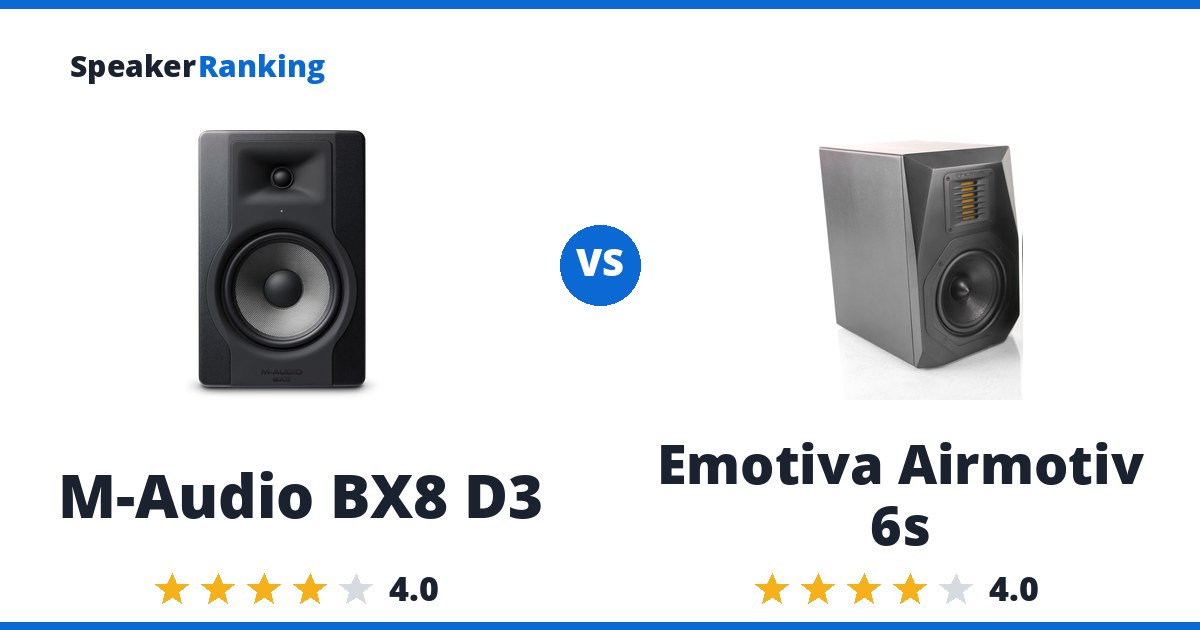
Why pick the M-Audio BX8 D3: An 8 inch studio monitor with useful bass and simple analog connections for a straightforward studio setup. The catch: A 3.9dB response span from 300Hz to 5kHz and downward tonal tilt suggest a darker, less even presentation than the leaders.
The case for the Emotiva Airmotiv 6s: Nearfield studio monitors with useful output and analog XLR and RCA inputs, best with a subwoofer for deep bass. Watch for: The 3.0dB response span from 300Hz to 5kHz includes lower-midrange unevenness that can change vocal weight.
Buy the M-Audio BX8 D3 or the Emotiva Airmotiv 6s, whichever you find used in better condition; both are discontinued. For a new speaker, start with the JBL 308P MKII instead.
Looking for alternatives? See the complete Powered Home rankings.

An 8 inch studio monitor with useful bass and simple analog connections for a straightforward studio setup.

Nearfield studio monitors with useful output and analog XLR and RCA inputs, best with a subwoofer for deep bass.
Prices on this page were last checked October 23, 2026 at 8:27 AM UTC. Product prices and availability are accurate as of that date/time and are subject to change; the price and availability shown on Amazon at the time of purchase will apply to the purchase of this product.
As an eBay Partner, we may be compensated if you make a purchase.
Specifications Side By Side
| M-Audio BX8 D3 | Emotiva Airmotiv 6s | |
|---|---|---|
| Price | $258 per pair Discontinued | $800 per pair Discontinued |
| Ranked | #80 of 119 in Large Size Powered Bookshelf Speakers | #79 of 119 in Large Size Powered Bookshelf Speakers |
| Enclosure | 2-way active, rear-ported MDF | - |
| Drivers | 1.25” silk-dome tweeter, 8” Kevlar woofer | 6.5” AirMotiv low-frequency transducer, 60x32mm AirMotiv tweeter |
| Dimensions | 15.1H x 9.8W x 11.9D in | 13.5” x 8.5” x 12.8” (343 x 216 x 324 mm) (H x W x D) |
| Weight | 23.1 lbs (10.5 kg) each | 24.9 lbs (11.3 kg) each |
| Amplifier Power | 150W each (80W LF, 70W HF) | 210W total (100W tweeter, 110W woofer) |
| Inputs | Balanced XLR and 1/4” TRS | XLR, RCA |
| Country | United States (design) | - |
| Spinorama Preference Score | 4.65 | - |
| Spinorama Preference Score with Perfect Sub | 6.66 | - |
| XLR Input | Yes | Yes |
| RCA Input | No | Yes |
| TRS Input | Yes | No |
| Optical Input | No | No |
| Coaxial Input | No | No |
| USB Input | No | No |
| HDMI Input | No | No |
| AES Input | No | No |
| Aux Input | No | No |
| Bluetooth | No | No |
| Frequency Response | 37Hz - 22kHz (Manufacturer specified) | 42Hz - 25kHz (+0/-3dB) (Manufacturer specified) |
| Bass Extension (-3dB) | - | 49.1Hz (measured, Audio Science Review) |
| Bass Extension (-10dB) | - | 37.6Hz (derived, log-interpolated between spinorama.org -9dB/-12dB points) |
| App | - | No |
| EQ | - | Yes (built-in presets) |
| DSP | - | No |
Frequency Response Compared
Both speakers’ spinorama measurements, overlaid. A flatter line is more neutral: peaks sound forward or harsh, dips sound recessed. Each curve is shifted so its average from 300 Hz to 3 kHz sits at 0 dB, so loudness differences between the two are removed and only the shape is compared.
Measurement data: M-Audio BX8 D3 (measured by Audio Science Review) and Emotiva Airmotiv 6s (measured by Audio Science Review), via spinorama.org.
Related Speaker Comparisons
How Emotiva Airmotiv 6s compares with other leading options: