Short answer: the Kinera Celest Phoenixcall. It ranks #702 of 1398 in-ear headphones by sound quality, rated 3.6/5, at $129.99; the Kinera Celest Phoenixcall 2.0 ranks #909, rated 3.4/5, and costs $169, which makes this an easy call rather than a real tradeoff.
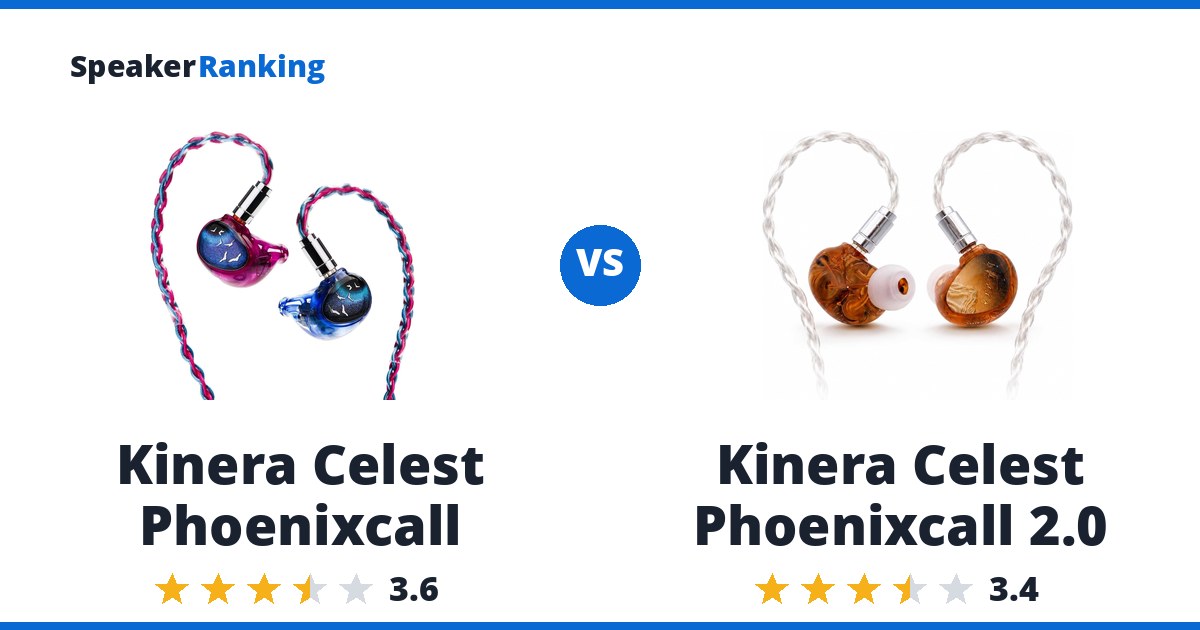
What the Kinera Celest Phoenixcall does well: The median of 16 hobbyist measurements gives it a solid Harman preference score of 69 with a 2.38 dB spread. The catch: A 6.1 dB peak near 1.5 kHz can make cymbals and sibilance sound sharp.
Why pick the Kinera Celest Phoenixcall 2.0: A tribrid with a coaxial dual dynamic driver, two balanced armatures and two planar drivers whose response stays close to target, at 2.4 dB deviation, with sub bass extending fully to 20 Hz. Watch for: Upper bass is almost 4 dB above target, which thickens the sound, and presence sits about 3 dB low with a dip near 3.7 kHz, so voices sound a little recessed.
Buy the Kinera Celest Phoenixcall. It is rated higher for sound quality than the Kinera Celest Phoenixcall 2.0 and costs less, so only choose the other one for a particular feature it does better.
Want more options? Browse the full Headphones rankings.

The median of 16 hobbyist measurements gives it a solid Harman preference score of 69 with a 2.38 dB spread.
Amazon $129.99 eBay
A tribrid with a coaxial dual dynamic driver, two balanced armatures and two planar drivers whose response stays close to target, at 2.4 dB deviation, with sub bass extending fully to 20 Hz.
Amazon $169.00 eBayPrices on this page were last checked October 19, 2026 at 10:32 PM UTC. Product prices and availability are accurate as of that date/time and are subject to change; the price and availability shown on Amazon at the time of purchase will apply to the purchase of this product.
As an eBay Partner, we may be compensated if you make a purchase.
Specifications Side By Side
| Kinera Celest Phoenixcall | Kinera Celest Phoenixcall 2.0 | |
|---|---|---|
| Price | $129.99 | $169.00 |
| Ranked | #702 of 1398 in In-Ear Headphones | #909 of 1398 in In-Ear Headphones |
| Form Factor | In-ear | In-ear |
| Back | Closed | Closed |
| Connection | Wired | Wired |
| Driver Type | Tribrid | Tribrid |
| Drivers | 1 x dynamic + 2 x balanced armature + 2 x 6mm planar | 1 x 8mm coaxial dual dynamic + 2 x balanced armature (1 Knowles, 1 custom) + 2 x 6mm planar |
| Impedance | 32 ohms | 11 ohms |
| Frequency Response | 20Hz - 40kHz (Manufacturer specified) | - |
| Weight | 0 lbs (9.8 g) | - |
| Harman Preference Score | 69 (median of 16 squig.link measurements, calibrated to AutoEQ) | 66 (median of 3 squig.link measurements, calibrated to AutoEQ) |
| Deviation From Target | 2.38 dB standard deviation | 2.36 dB standard deviation |
| Tonal Tilt | -0.06 (negative is warmer, positive brighter) | -0.83 (negative is warmer, positive brighter) |
| Sub-bass Extension | Within 6 dB of target down to 20 Hz (-1.1 dB at 30 Hz) | Within 6 dB of target down to 20 Hz (+0.2 dB at 30 Hz) |
| Sensitivity | 103 dB | 108 dB |
Frequency Response Compared
Both headphones’ measurements overlaid on the Harman target. Above the target sounds louder in that range, below it quieter. Each curve is the median of several independent measurements, shifted so its 500 Hz to 2 kHz average sits at 0 dB, so only the tuning is compared.
Measurement data: the Kinera Celest Phoenixcall from aftersound, arn, audioamigo, eliseaudio, hoods, isaiahse, jaytiss, koi, mmagtech, nymz, pw, theaudiostore, therollo9, timmyv, tonedeafmonk and treblewellxtended; the Kinera Celest Phoenixcall 2.0 from digaoreviews, flare and jaytiss, all via squig.link.
Related Headphone Comparisons
How Kinera Celest Phoenixcall compares with other leading options: