Short answer: the KEF R3 ranks #15 of 130 bookshelf speakers by sound quality at $2200; the Philharmonic BMR (v1) ranks #36 at $2200. With prices this close, go by the sound-quality ranking rather than the cost.
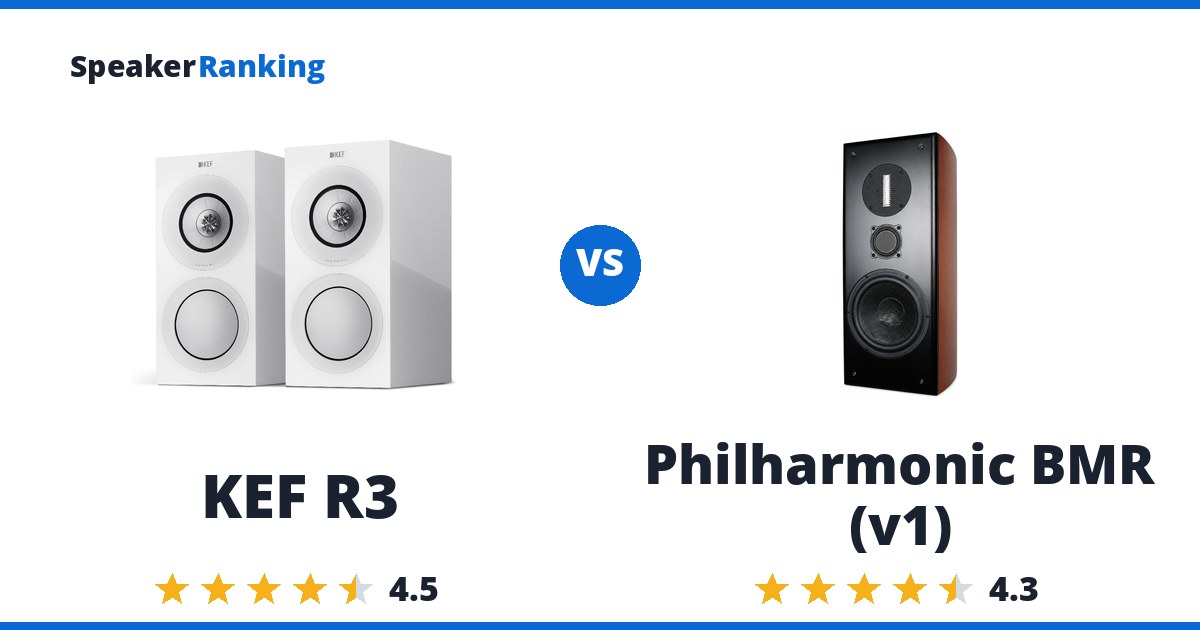
What the KEF R3 offers: True three-way stand-mount with a 6.5-inch woofer below KEF’s 5-inch Uni-Q midrange/1-inch tweeter. Erin measured approximately 86-87dB/2.83V/1m sensitivity, exceptionally low sub-1% distortion at 86dB and orderly directivity in both planes. The coaxial geometry maintains image stability across seats, while Flexible Port Technology avoids the strong midrange port resonance common to rear-vented competitors. A 110W Parasound drove it successfully in Erin’s listening. Watch for: The low-frequency alignment rolls gradually rather than delivering high-output sub-bass; KEF specifies 58Hz +/-3dB and Erin’s high-level data supports using an 80Hz subwoofer crossover. Narrow high-frequency features and natural Uni-Q narrowing toward the top octave make toe angle audible, although off-axis tracking remains smooth. Sensitivity is moderate, the cabinet weighs almost 30 lb, and this original R3 lacks the Meta successor’s MAT absorber.
What the Philharmonic BMR (v1) offers: Large three-way combining a Scan-Speak 7-inch paper/carbon woofer, 2.5-inch Tectonic balanced-mode midrange and RAAL 64-10 ribbon. Erin measured approximately +/-1.5dB linearity from 80Hz upward, very broad +/-40-degree-or-better horizontal coverage and about 83dB/2.83V/1m sensitivity. The port is tuned in the mid/low-30Hz region without audible chuffing, the midrange provides unusually expansive staging, and distortion remained subjectively unobtrusive. Watch for: The measured 83dB sensitivity and roughly 4-ohm load demand meaningful external amplification. A 1-2dB shelf below about 300Hz reduces warmth unless corrected, while a response/impedance feature near 250-300Hz corresponded with Erin’s sense of resonance. The ribbon produces narrower vertical than horizontal radiation, and second-order high-frequency distortion plus dynamic enhancement near 3kHz appeared in testing. This was an earlier cabinet/version, not the current v2.
Buy the KEF R3. It ranks higher for sound quality than the Philharmonic BMR (v1) at the same price, so the other one has nothing left to offer.
Want more options? Browse the full Passive Home rankings.
Specifications Side By Side
| KEF R3 | Philharmonic BMR (v1) | |
|---|---|---|
| Price | $2,200 per pair | $2,395 per pair |
| Ranked | #15 of 130 in Large Size Bookshelf Speakers | #36 of 130 in Large Size Bookshelf Speakers |
| Bass Extension (-3dB) | Approximately 58Hz (manufacturer specified; consistent with Erin's measured roll-off) | Approximately 62Hz relative to mean (measured, Erin's Audio Corner website) |
| Bass Extension (-10dB) | 35.2Hz (measured, Audio Science Review) | 37.8Hz (measured, Erin's Audio Corner) |
| Sensitivity | Approximately 86-87dB/2.83V/1m (measured, Erin's Audio Corner) | Approximately 83dB/2.83V/1m (measured, Erin's Audio Corner) |
| Impedance | 8 ohms nominal; suitable for Erin's 4/8-ohm-rated amplifier | Approximately 4 ohms nominal (measured, Erin's Audio Corner) |
| Drivers | 1" tweeter coaxial with 5" midrange; 6.5" woofer | RAAL 64-10 ribbon; 2.5" BMR midrange; 7" Scan-Speak woofer |
| Dimensions | 16.6"H x 7.9"W x 13.2"D | - |
| Woofer Cabinet | ported, rear Flexible Port | ported |
| Port Tuning | - | Mid/low-30Hz range (measured, Erin's Audio Corner) |
| Spinorama Preference Score | - | 5.24 |
| Spinorama Preference Score with Perfect Sub | - | 6.90 |
Related Speaker Comparisons
How KEF R3 compares with other leading options:
- KEF R3 vs Perlisten S4b
- KEF Reference 1 Meta vs KEF R3
- KEF R3 vs GR-Research NX-Studio
- AsciLab C6B vs KEF R3
- KEF R3 vs Audio First Cadentia 3
Prices on this page were last checked September 16, 2026 at 12:41 AM UTC. Product prices and availability are accurate as of that date/time and are subject to change; the price and availability shown on Amazon at the time of purchase will apply to the purchase of this product.
As an eBay Partner, we may be compensated if you make a purchase.
The Two Speakers In Full
 KEF R3: $2,200 per pair Amazon eBay
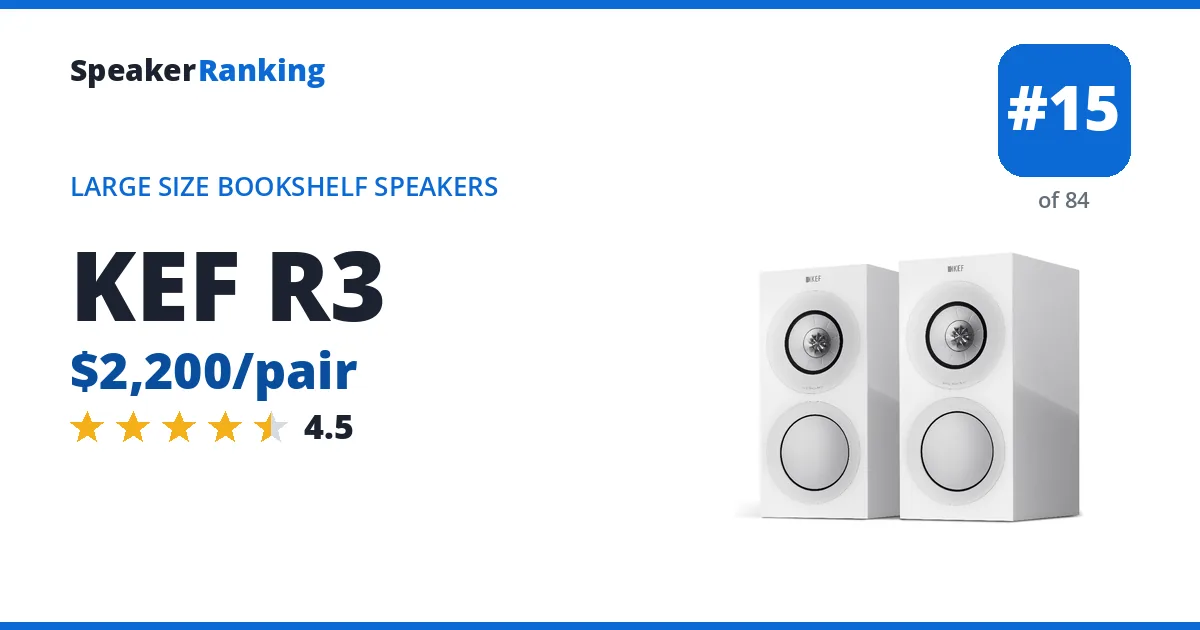
Pros: True three-way stand-mount with a 6.5-inch woofer below KEF’s 5-inch Uni-Q midrange/1-inch tweeter. Erin measured approximately 86-87dB/2.83V/1m sensitivity, exceptionally low sub-1% distortion at 86dB and orderly directivity in both planes. The coaxial geometry maintains image stability across seats, while Flexible Port Technology avoids the strong midrange port resonance common to rear-vented competitors. A 110W Parasound drove it successfully in Erin’s listening. Measured bass extension of 35.2Hz (-10dB), with a measured sensitivity of 87dB.
Cons: The low-frequency alignment rolls gradually rather than delivering high-output sub-bass; KEF specifies 58Hz +/-3dB and Erin’s high-level data supports using an 80Hz subwoofer crossover. Narrow high-frequency features and natural Uni-Q narrowing toward the top octave make toe angle audible, although off-axis tracking remains smooth. Sensitivity is moderate, the cabinet weighs almost 30 lb, and this original R3 lacks the Meta successor’s MAT absorber.
Full KEF R3 review and specifications →
| Bass Extension (-10dB) | 35.2Hz (measured, Audio Science Review) |
|---|---|
| Bass Extension (-3dB) | Approximately 58Hz (manufacturer specified; consistent with Erin's measured roll-off) |
| Dimensions | 16.6"H x 7.9"W x 13.2"D |
| Drivers | 1" tweeter coaxial with 5" midrange; 6.5" woofer |
| Impedance | 8 ohms nominal; suitable for Erin's 4/8-ohm-rated amplifier |
| Sensitivity | Approximately 86-87dB/2.83V/1m (measured, Erin's Audio Corner) |
| Woofer Cabinet | ported, rear Flexible Port |
- Links
- Reviews, Comparisons and Sound Samples
- Head-to-Head Comparisons
 Philharmonic BMR (v1): $2,395 per pair Philharmonic Audio eBay
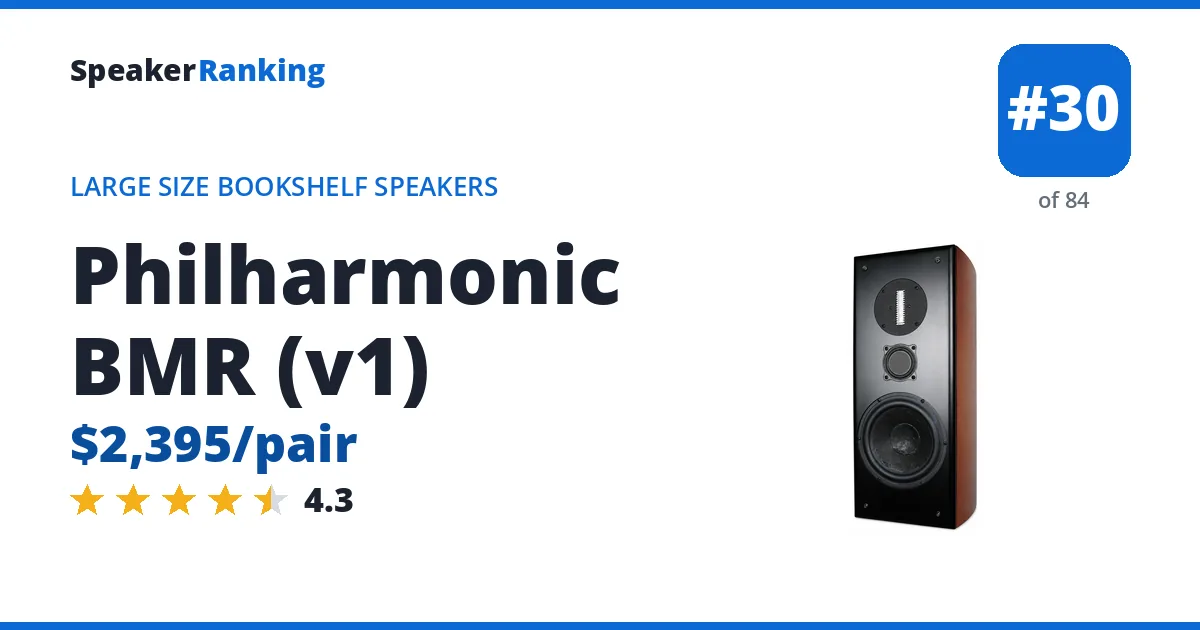
Pros: Large three-way combining a Scan-Speak 7-inch paper/carbon woofer, 2.5-inch Tectonic balanced-mode midrange and RAAL 64-10 ribbon. Erin measured approximately +/-1.5dB linearity from 80Hz upward, very broad +/-40-degree-or-better horizontal coverage and about 83dB/2.83V/1m sensitivity. The port is tuned in the mid/low-30Hz region without audible chuffing, the midrange provides unusually expansive staging, and distortion remained subjectively unobtrusive. Measured bass extension of 62Hz (-3dB), with a measured sensitivity of 83dB.
Cons: The measured 83dB sensitivity and roughly 4-ohm load demand meaningful external amplification. A 1-2dB shelf below about 300Hz reduces warmth unless corrected, while a response/impedance feature near 250-300Hz corresponded with Erin’s sense of resonance. The ribbon produces narrower vertical than horizontal radiation, and second-order high-frequency distortion plus dynamic enhancement near 3kHz appeared in testing. This was an earlier cabinet/version, not the current v2.
Full Philharmonic BMR (v1) review and specifications →
| Bass Extension (-10dB) | 37.8Hz (measured, Erin's Audio Corner) |
|---|---|
| Bass Extension (-3dB) | Approximately 62Hz relative to mean (measured, Erin's Audio Corner website) |
| Drivers | RAAL 64-10 ribbon; 2.5" BMR midrange; 7" Scan-Speak woofer |
| Impedance | Approximately 4 ohms nominal (measured, Erin's Audio Corner) |
| Port Tuning | Mid/low-30Hz range (measured, Erin's Audio Corner) |
| Sensitivity | Approximately 83dB/2.83V/1m (measured, Erin's Audio Corner) |
| Spinorama Preference Score | 5.24 |
| Spinorama Preference Score with Perfect Sub | 6.90 |
| Woofer Cabinet | ported |
- Links
- Reviews, Comparisons and Sound Samples
- Head-to-Head Comparisons
- Philharmonic BMR (v1) vs ELAC VELA BS 403
- Philharmonic BMR (v1) vs Selah Audio Integrity
- Philharmonic BMR (v1) vs Ascend Acoustics Sierra-2EX V2
- Philharmonic BMR (v1) vs Ascend Acoustics Sierra-LX
- Philharmonic BMR (v1) vs Wharfedale Linton 85
- Philharmonic BMR (v1) vs Emotiva Airmotiv XB2
- Philharmonic BMR (v1) vs ELAC Debut 3.0 DB63
- Philharmonic BMR (v1) vs Selah Audio Purezza
- See all 49 comparisons