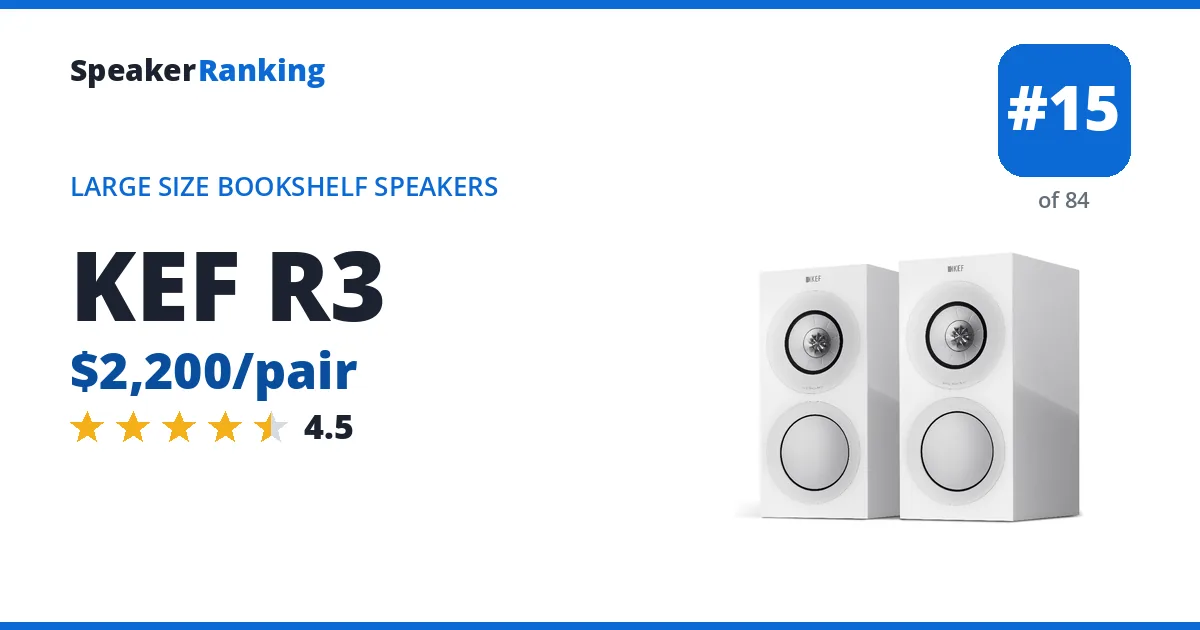
Short answer: the KEF R3 ranks #15 of 130 bookshelf speakers by sound quality at $2200; the Philharmonic BMR Monitor ranks #76 at $2200. Close enough in price that the sound-quality gap is the deciding factor.
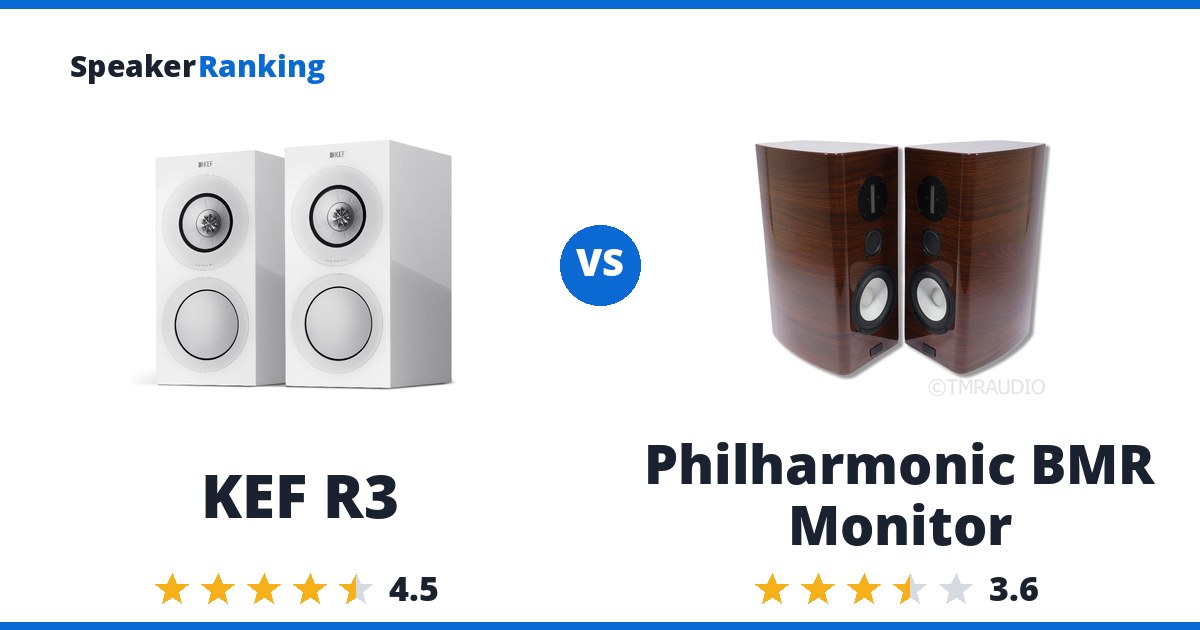
What the KEF R3 offers: True three-way stand-mount with a 6.5-inch woofer below KEF’s 5-inch Uni-Q midrange/1-inch tweeter. Erin measured approximately 86-87dB/2.83V/1m sensitivity, exceptionally low sub-1% distortion at 86dB and orderly directivity in both planes. The coaxial geometry maintains image stability across seats, while Flexible Port Technology avoids the strong midrange port resonance common to rear-vented competitors. A 110W Parasound drove it successfully in Erin’s listening. Watch for: The low-frequency alignment rolls gradually rather than delivering high-output sub-bass; KEF specifies 58Hz +/-3dB and Erin’s high-level data supports using an 80Hz subwoofer crossover. Narrow high-frequency features and natural Uni-Q narrowing toward the top octave make toe angle audible, although off-axis tracking remains smooth. Sensitivity is moderate, the cabinet weighs almost 30 lb, and this original R3 lacks the Meta successor’s MAT absorber.
What the Philharmonic BMR Monitor offers: Three-way design combining a 6” SB Acoustics mid-woofer, a 2.5” Tectonic balanced-mode radiator (BMR) for the midrange, and a ribbon tweeter - premium component choices relative to the asking price. A clear improvement over the V1: the earlier version’s overly hot, plateauing treble has been resolved, leaving a genuinely good in-room response outside of one specific area. Extremely wide horizontal radiation of about ±70-80°, creating an enveloping, wide soundstage that illuminates the sidewalls. Well-built, attractive cabinet. Midrange and tweeter show no stress or elevated distortion even at higher output - all the compression and distortion issues trace back to the mid-woofer alone. Watch for: A 1-2dB bump around 2-3kHz creates a “glare” on vocals, guitars, and strings that the reviewer noticed consistently across many tracks. The extremely wide radiation trades off against imaging precision - instrument placement became noticeably more diffuse and harder to pinpoint in a narrower, more reflective room, though it improved substantially in a larger, more open room with less sidewall interaction. A suspected resonance around 500Hz shows up as an imbalance in sound power and horizontal directivity measurements, loosely correlating with a vague sense of resonance the reviewer heard subjectively. Moderate sensitivity (about 84.1dB anechoic) and a mid-woofer that runs out of steam under real stress - distortion exceeds 3% even at 100Hz at 96dB, and the reviewer notes SB Acoustics’ published excursion specs tend to overstate real-world linear excursion by nearly 2x. Significant compression appears at 102dB: the woofer audibly unloads around 120Hz, and the ribbon tweeter also compresses heavily at high output - not well suited to very loud two-channel listening (above about 90dB at 4 meters). In-room bass rolls off around 50Hz, so a subwoofer is recommended for most music. Benefits noticeably from a few bands of EQ if available.
Buy the KEF R3. It ranks higher for sound quality than the Philharmonic BMR Monitor at the same price, so the other one has nothing left to offer.
Want more options? Browse the full Passive Home rankings.
Specifications Side By Side
| KEF R3 | Philharmonic BMR Monitor | |
|---|---|---|
| Price | $2,200 per pair | $2200 per pair |
| Ranked | #15 of 130 in Large Size Bookshelf Speakers | #76 of 130 in Large Size Bookshelf Speakers |
| Bass Extension (-3dB) | Approximately 58Hz (manufacturer specified; consistent with Erin's measured roll-off) | 47Hz (measured, Erin's Audio Corner) |
| Bass Extension (-10dB) | 35.2Hz (measured, Audio Science Review) | 32Hz (measured, Erin's Audio Corner) |
| Sensitivity | Approximately 86-87dB/2.83V/1m (measured, Erin's Audio Corner) | 84dB (measured, Erin's Audio Corner) |
| Impedance | 8 ohms nominal; suitable for Erin's 4/8-ohm-rated amplifier | 4 ohms nominal (3 ohms minimum above 80Hz, measured by Erin's Audio Corner) |
| Drivers | 1" tweeter coaxial with 5" midrange; 6.5" woofer | 6" Ceramic woofer, Balanced Mode Radiator 2.5" midrange, RAAL 64-10X OEM tweeter |
| Dimensions | 16.6"H x 7.9"W x 13.2"D | 20"H x 8"W x 12.5"D (508 x 203.2 x 317.5 mm) |
| Woofer Cabinet | ported, rear Flexible Port | ported, rear |
| Weight | - | 32 lbs (14.5 kg) each |
Related Speaker Comparisons
More worthwhile head-to-heads for KEF R3:
- KEF R3 vs Perlisten S4b
- KEF Reference 1 Meta vs KEF R3
- KEF R3 vs GR-Research NX-Studio
- AsciLab C6B vs KEF R3
- KEF R3 vs Audio First Cadentia 3
Prices on this page were last checked September 16, 2026 at 12:41 AM UTC. Product prices and availability are accurate as of that date/time and are subject to change; the price and availability shown on Amazon at the time of purchase will apply to the purchase of this product.
As an eBay Partner, we may be compensated if you make a purchase.
The Two Speakers In Full
 KEF R3: $2,200 per pair Amazon eBay
Pros: True three-way stand-mount with a 6.5-inch woofer below KEF’s 5-inch Uni-Q midrange/1-inch tweeter. Erin measured approximately 86-87dB/2.83V/1m sensitivity, exceptionally low sub-1% distortion at 86dB and orderly directivity in both planes. The coaxial geometry maintains image stability across seats, while Flexible Port Technology avoids the strong midrange port resonance common to rear-vented competitors. A 110W Parasound drove it successfully in Erin’s listening. Measured bass extension of 35.2Hz (-10dB), with a measured sensitivity of 87dB.
Cons: The low-frequency alignment rolls gradually rather than delivering high-output sub-bass; KEF specifies 58Hz +/-3dB and Erin’s high-level data supports using an 80Hz subwoofer crossover. Narrow high-frequency features and natural Uni-Q narrowing toward the top octave make toe angle audible, although off-axis tracking remains smooth. Sensitivity is moderate, the cabinet weighs almost 30 lb, and this original R3 lacks the Meta successor’s MAT absorber.
Full KEF R3 review and specifications →
| Bass Extension (-10dB) | 35.2Hz (measured, Audio Science Review) |
|---|---|
| Bass Extension (-3dB) | Approximately 58Hz (manufacturer specified; consistent with Erin's measured roll-off) |
| Dimensions | 16.6"H x 7.9"W x 13.2"D |
| Drivers | 1" tweeter coaxial with 5" midrange; 6.5" woofer |
| Impedance | 8 ohms nominal; suitable for Erin's 4/8-ohm-rated amplifier |
| Sensitivity | Approximately 86-87dB/2.83V/1m (measured, Erin's Audio Corner) |
| Woofer Cabinet | ported, rear Flexible Port |
- Links
- Reviews, Comparisons and Sound Samples
- Head-to-Head Comparisons
 Philharmonic BMR Monitor: $2200 per pair Philharmonicaudio eBay
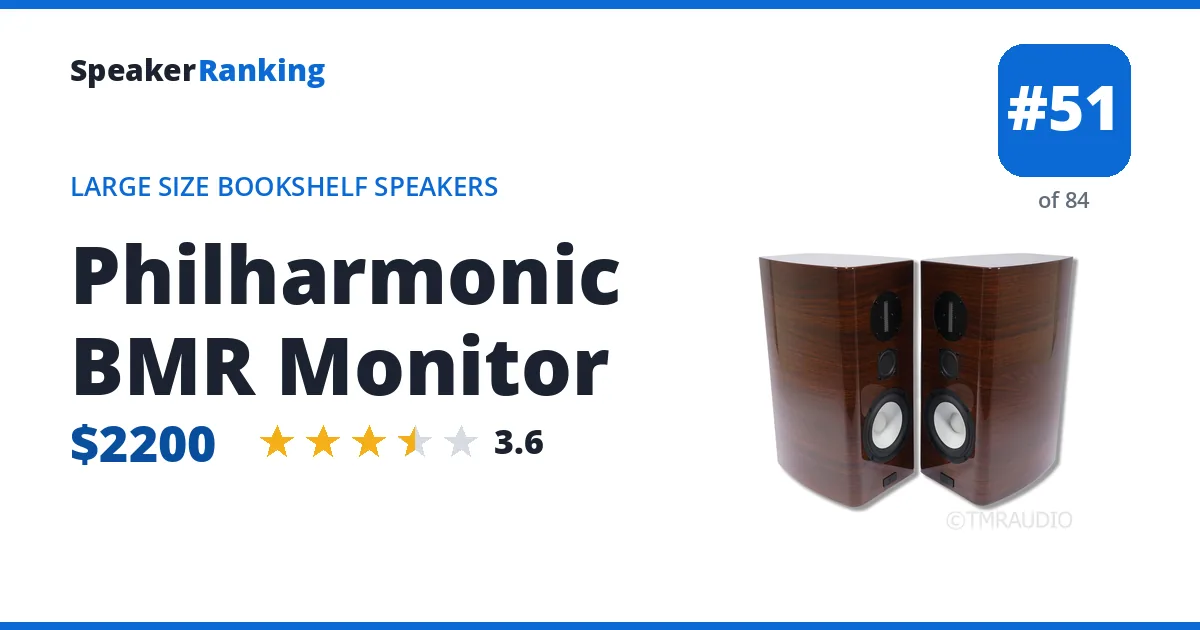
Pros: Three-way design combining a 6” SB Acoustics mid-woofer, a 2.5” Tectonic balanced-mode radiator (BMR) for the midrange, and a ribbon tweeter - premium component choices relative to the asking price. A clear improvement over the V1: the earlier version’s overly hot, plateauing treble has been resolved, leaving a genuinely good in-room response outside of one specific area. Extremely wide horizontal radiation of about ±70-80°, creating an enveloping, wide soundstage that illuminates the sidewalls. Well-built, attractive cabinet. Midrange and tweeter show no stress or elevated distortion even at higher output - all the compression and distortion issues trace back to the mid-woofer alone. Measured bass extension of 47Hz (-3dB), with a measured sensitivity of 84dB.
Cons: A 1-2dB bump around 2-3kHz creates a “glare” on vocals, guitars, and strings that the reviewer noticed consistently across many tracks. The extremely wide radiation trades off against imaging precision - instrument placement became noticeably more diffuse and harder to pinpoint in a narrower, more reflective room, though it improved substantially in a larger, more open room with less sidewall interaction. A suspected resonance around 500Hz shows up as an imbalance in sound power and horizontal directivity measurements, loosely correlating with a vague sense of resonance the reviewer heard subjectively. Moderate sensitivity (about 84.1dB anechoic) and a mid-woofer that runs out of steam under real stress - distortion exceeds 3% even at 100Hz at 96dB, and the reviewer notes SB Acoustics’ published excursion specs tend to overstate real-world linear excursion by nearly 2x. Significant compression appears at 102dB: the woofer audibly unloads around 120Hz, and the ribbon tweeter also compresses heavily at high output - not well suited to very loud two-channel listening (above about 90dB at 4 meters). In-room bass rolls off around 50Hz, so a subwoofer is recommended for most music. Benefits noticeably from a few bands of EQ if available.
Full Philharmonic BMR Monitor review and specifications →
| Bass Extension (-10dB) | 32Hz (measured, Erin's Audio Corner) |
|---|---|
| Bass Extension (-3dB) | 47Hz (measured, Erin's Audio Corner) |
| Dimensions | 20"H x 8"W x 12.5"D (508 x 203.2 x 317.5 mm) |
| Drivers | 6" Ceramic woofer, Balanced Mode Radiator 2.5" midrange, RAAL 64-10X OEM tweeter |
| Impedance | 4 ohms nominal (3 ohms minimum above 80Hz, measured by Erin's Audio Corner) |
| Sensitivity | 84dB (measured, Erin's Audio Corner) |
| Weight | 32 lbs (14.5 kg) each |
| Woofer Cabinet | ported, rear |
- Links
- Reviews, Comparisons and Sound Samples
- Head-to-Head Comparisons
- Philharmonic BMR Monitor vs Dynaudio Emit 20
- Philharmonic BMR Monitor vs Klipsch RP-600M II
- Philharmonic BMR Monitor vs Mission LX-3 MKII
- Philharmonic BMR Monitor vs GR-Research X-LS Encore
- Philharmonic BMR Monitor vs Polk Signature Elite ES20
- Philharmonic BMR Monitor vs Ascend CBM-170 SE2
- Philharmonic BMR Monitor vs Dynaudio Special Forty
- Philharmonic BMR Monitor vs ELAC Debut 2.0 B6.2
- See all 47 comparisons