Short answer: the Sony MDR-M1, though neither ranks well in its class. Both are rated 2.8/5 for sound quality (#380 and #377 of 481 over-ear headphones), and the Sony MDR-M1 costs $268 against $347.99 for the JBL Tour One M3, and with sound quality even, the cheaper one is the better buy. Both are rated below 3.0/5 among the 481 over-ear headphones, so if sound quality matters, consider the HIFIMAN Ananda Nano instead, ranked #6 at $319.
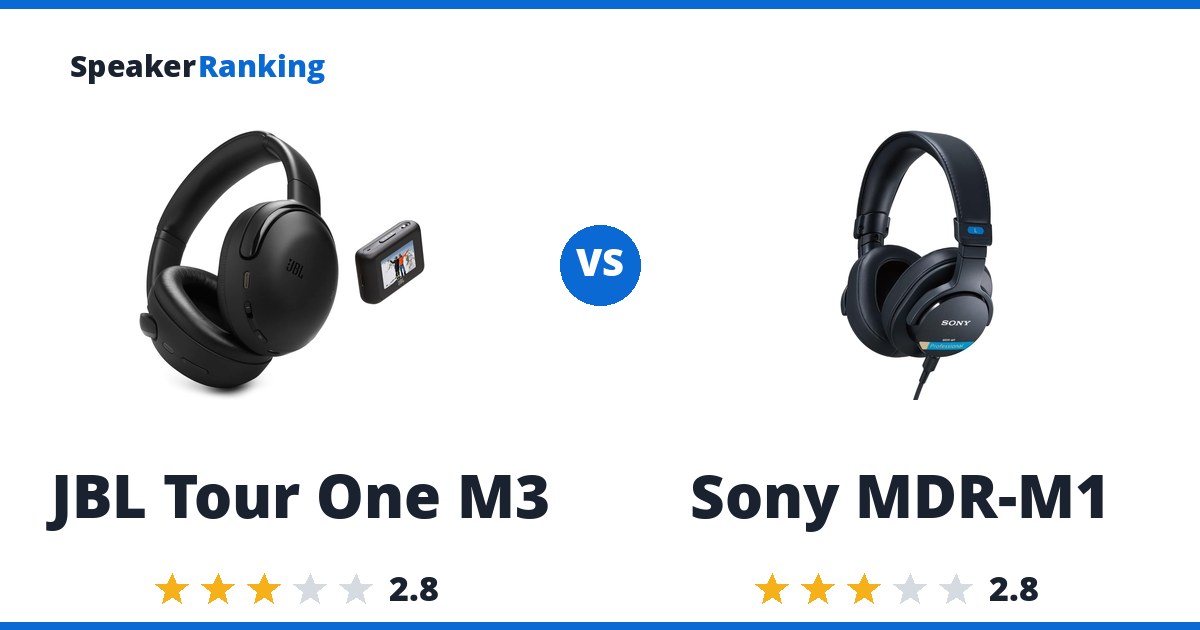
Why pick the JBL Tour One M3: Active noise cancelling is paired with a long claimed battery life of 40 hours with ANC on and 70 hours with it off. The tradeoff: In two hobbyist measurements on squig.link it scores 55.7 for Harman preference, held back by a 4.9 dB presence dip in the 3 to 6 kHz range and a 10 dB dip near 9.2 kHz.
The case for the Sony MDR-M1: This closed back studio design weighs only 0.5 lbs (216 g) and blocks outside sound while leaking little. Watch for: Hobbyist measurements put its preference score at 55, with a 10.2 dB dip near 4 kHz and presence about 5.6 dB below target that push vocals and guitars back and soften detail.
Buy the Sony MDR-M1. Both are rated the same for sound quality, and it costs $79.99 less than the JBL Tour One M3.
Still deciding? The full Headphones rankings cover every ranked option.

Active noise cancelling is paired with a long claimed battery life of 40 hours with ANC on and 70 hours with it off.
Amazon $347.99 eBay
This closed back studio design weighs only 216 g and blocks outside sound while leaking little.
Amazon $268.00 eBayPrices on this page were last checked October 16, 2026 at 5:46 PM UTC. Product prices and availability are accurate as of that date/time and are subject to change; the price and availability shown on Amazon at the time of purchase will apply to the purchase of this product.
As an eBay Partner, we may be compensated if you make a purchase.
Specifications Side By Side
| JBL Tour One M3 | Sony MDR-M1 | |
|---|---|---|
| Price | $347.99 | $268.00 |
| Ranked | #377 of 481 in Over-Ear Headphones | #380 of 481 in Over-Ear Headphones |
| Form Factor | Over-ear | Over-ear |
| Harman Preference Score | 56 (median of 2 squig.link measurements, calibrated to AutoEQ) | 55 (median of 3 squig.link measurements, calibrated to AutoEQ) |
| Deviation From Target | 2.91 dB standard deviation | 2.99 dB standard deviation |
| Tonal Tilt | -1.41 (negative is warmer, positive brighter) | -1.36 (negative is warmer, positive brighter) |
| Sub-bass Extension | Within 6 dB of target down to 20 Hz (+0.8 dB at 30 Hz) | Within 6 dB of target down to 20 Hz (+2.5 dB at 30 Hz) |
| Connection | Wireless and wired | Wired |
| Back | Closed | Closed |
| Driver Type | Dynamic | Dynamic |
| Drivers | 1 x 40mm dynamic | 1 x 40mm dynamic |
| Impedance | 18 ohms | 50 ohms |
| Sensitivity | 122 dB SPL@1kHz | 102 dB/mW |
| Weight | 0.6 lbs (278 g) | 0.5 lbs (216 g) |
| Frequency Response | 10Hz - 40kHz (Manufacturer specified) | 5Hz - 80kHz (Manufacturer specified) |
| Active Noise Cancelling | Yes | - |
| Battery Life | 40 hours with ANC (70 without, Manufacturer specified) | - |
| Bluetooth Version | 5.3 | - |
| Bluetooth Codecs | SBC, AAC, LC3, LDAC | - |
| Built-in Microphone | Yes | No |
Related Headphone Comparisons
How JBL Tour One M3 compares with other leading options: