Short answer: the GR-Research X-LS Encore. The Zu Audio Method is high-sensitivity, measured about 90-90.7dB through the 300Hz-3kHz vocal range, but it has a severe suckout in the 1.5-3kHz range, down as much as 19dB below the mean, which removes attack and clarity. The X-LS Encore ranks #83 of 130 against #128 of 130 and shows a slight upper-bass depression and lower-bass peaking on-axis.
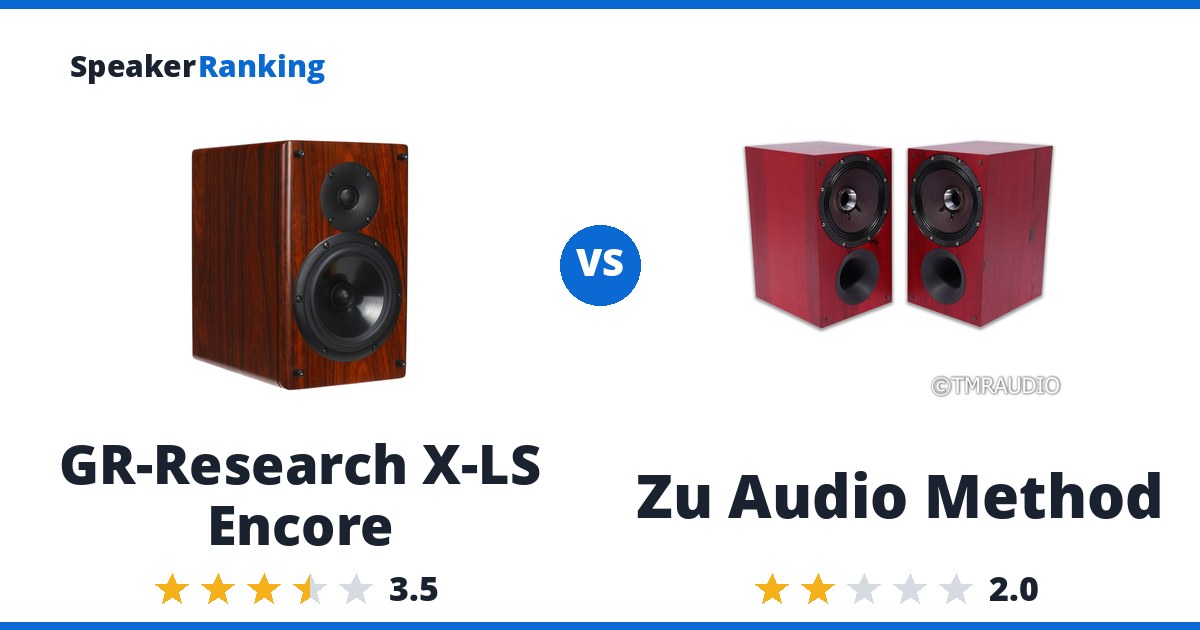
What the GR-Research X-LS Encore gets right: An amazing value, especially if you managed to snag one of these built by AV123 in the early 2000s for $200-300. CEA2034 spinorama shows. The tradeoff: A slight depression in the upper bass and some peaking in the lower bass shows up on-axis.
On the Zu Audio Method side: High-sensitivity design (measured about 90-90.7dB average through the 300Hz-3kHz vocal range). The tradeoff: A severe suckout in the 1.5-3kHz range (down as much as 19dB below the mean at its worst) removes attack and clarity from brass, woodwinds.
Buy the GR-Research X-LS Encore. It is rated higher for sound quality, and saving $600 with the Zu Audio Method does not make up for the sound-quality gap.
Looking for alternatives? See the complete Passive Home rankings.
Specifications Side By Side
| GR-Research X-LS Encore | Zu Audio Method | |
|---|---|---|
| Price | $1300 per pair | $700 per pair |
| Ranked | #83 of 130 in Large Size Bookshelf Speakers | #128 of 130 in Large Size Bookshelf Speakers |
| Bass Extension (-10dB) | 44Hz (measured, Audio Science Review) | 56Hz (measured, Erin's Audio Corner) |
| Bass Extension (-3dB) | 64Hz (measured, Audio Science Review) | 92Hz (measured, Erin's Audio Corner) |
| Dimensions | 13.5"H x 8.5"W x 12.1"D (342.9 x 215.9 x 308 mm) | 15"H x 8.7"W x 11"D (381.0 x 222.0 x 280.0 mm) |
| Impedance | 8 ohms | 8 ohms |
| Sensitivity | 84.4dB (measured by Audio Science Review; 87dB manufacturer specified) | 91dB |
| Drivers | 6.5" Peerless M-165 paper composite cone, non-resonant polymer frame woofer, 1" Peerless India T26SG tweeter | 8" coax HE (Eminence/Zu) woofer, Eminence ASD-1001 tweeter |
| Weight | 17 lbs (7.7 kg) each | 12.1 lbs (5.5 kg) |
| Woofer Cabinet | ported | ported, front |
| Spinorama Preference Score | 5.05 (measured, spinorama.org) | -0.39 |
| Spinorama Preference Score with Perfect Sub | 7.42 (measured, spinorama.org) | 2.40 |
| DIY Kit | Yes | No |
Related Speaker Comparisons
How GR-Research X-LS Encore compares with other leading options:
- GR-Research X-LS Encore vs Perlisten S4b
- GR-Research X-LS Encore vs KEF Reference 1 Meta
- GR-Research NX-Studio vs GR-Research X-LS Encore
- AsciLab C6B vs GR-Research X-LS Encore
- Audio First Cadentia 3 vs GR-Research X-LS Encore
Prices on this page were last checked September 23, 2026 at 11:24 PM UTC. Product prices and availability are accurate as of that date/time and are subject to change; the price and availability shown on Amazon at the time of purchase will apply to the purchase of this product.
As an eBay Partner, we may be compensated if you make a purchase.
The Two Speakers In Full
 GR-Research X-LS Encore: $1300 per pair Gr-research eBay
Pros: An amazing value, especially if you managed to snag one of these built by AV123 in the early 2000s for $200-300. CEA2034 spinorama shows a generally flat on-axis response, especially in the listening window. Predicted in-room response is generally smooth and on-target. Distortion at 86dB SPL/1m is pretty clean above 200Hz. Measured bass extension of 64Hz (-3dB), with a measured sensitivity of 84.4dB.
Cons: A slight depression in the upper bass and some peaking in the lower bass shows up on-axis, along with directivity error in the crossover region. Vertical directivity requires staying within about 20 degrees of the tweeter axis. At 96dB SPL/1m distortion becomes “rather unhappy,” with bass distortion, a possible woofer issue around 2kHz, and a tweeter problem above 7kHz. As a DIY kit, it requires building the cabinet and crossover yourself.
Full GR-Research X-LS Encore review and specifications →
| Bass Extension (-10dB) | 44Hz (measured, Audio Science Review) |
|---|---|
| Bass Extension (-3dB) | 64Hz (measured, Audio Science Review) |
| DIY Kit | Yes |
| Dimensions | 13.5"H x 8.5"W x 12.1"D (342.9 x 215.9 x 308 mm) |
| Drivers | 6.5" Peerless M-165 paper composite cone, non-resonant polymer frame woofer, 1" Peerless India T26SG tweeter |
| Impedance | 8 ohms |
| Sensitivity | 84.4dB (measured by Audio Science Review; 87dB manufacturer specified) |
| Spinorama Preference Score | 5.05 (measured, spinorama.org) |
| Spinorama Preference Score with Perfect Sub | 7.42 (measured, spinorama.org) |
| Weight | 17 lbs (7.7 kg) each |
| Woofer Cabinet | ported |
- Links
- Reviews, Comparisons and Sound Samples
- Head-to-Head Comparisons
- GR-Research X-LS Encore vs Dynaudio Special Forty
- GR-Research X-LS Encore vs Mission LX-3 MKII
- GR-Research X-LS Encore vs ELAC Debut 2.0 B6.2
- GR-Research X-LS Encore vs SVS Prime Bookshelf
- GR-Research X-LS Encore vs KEF Q3 Meta
- GR-Research X-LS Encore vs Polk Monitor XT20
- GR-Research X-LS Encore vs Philharmonic BMR Monitor
- GR-Research X-LS Encore vs Sonus Faber Lumina II
- See all 47 comparisons
 Zu Audio Method: $700 per pair Zuaudio eBay
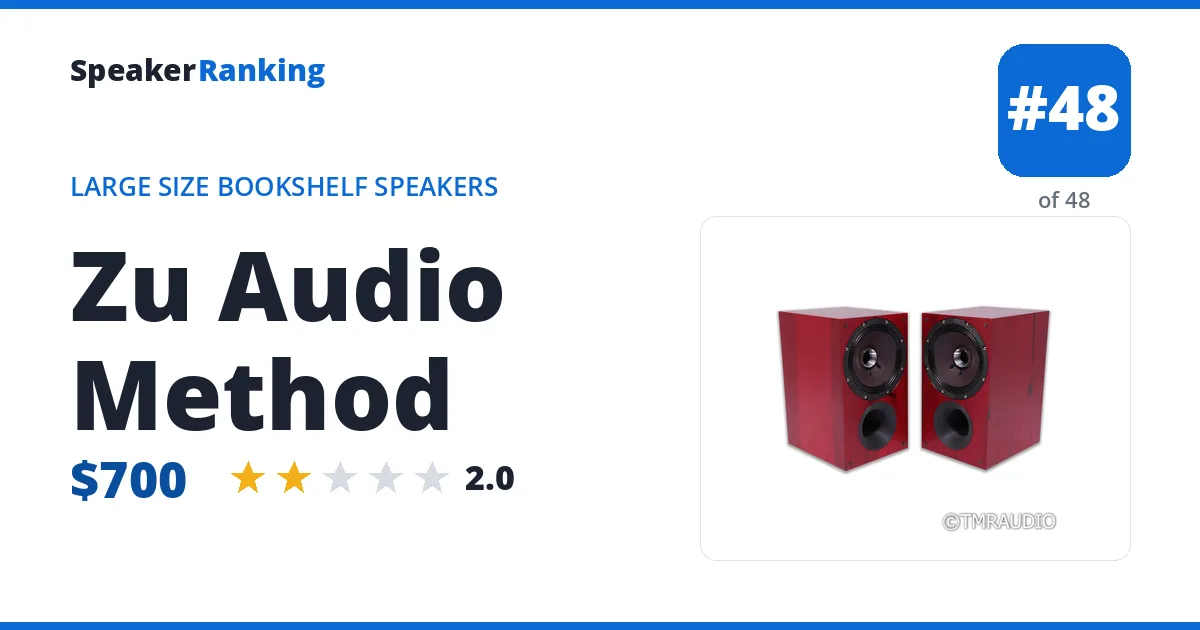
Pros: High-sensitivity design (measured about 90-90.7dB average through the 300Hz-3kHz vocal range), making it easy to drive to loud levels with modest amplifier power. Not a difficult electrical load - minimum impedance around 5.8 ohms, compatible with most 8-ohm-rated amplifiers, though Class A/AB amps should have good ventilation given a 3-ohm minimum EPDR. Verified not to be a defective unit: both speakers in the pair measured consistently with each other, and an independent reviewer’s own measurements of the same model matched the findings here. Measured bass extension of 92Hz (-3dB).
Cons: A severe suckout in the 1.5-3kHz range (down as much as 19dB below the mean at its worst) removes attack and clarity from brass, woodwinds, and snares, and gives an overall laid-back, unengaging character. Erratic, inconsistent high-frequency response - alternating between accentuated and subdued at different frequencies - makes cymbals, hi-hats, and sibilant vocal sounds behave unpredictably from track to track. Directivity is poor and inconsistent with frequency, meaning off-axis (sidewall-reflected) energy is actually louder than the direct sound in several bands - a problem that fundamentally cannot be corrected with EQ, since boosting the direct sound would boost the already-too-loud reflections even more. High sensitivity comes at the direct cost of bass extension: F3 of 92Hz and F10 of 56Hz mean essentially no meaningful bass. Despite the high sensitivity, dynamic headroom is poor rather than better as often assumed - distortion in the higher frequencies creates what the reviewer calls an “electronic glare.” Third-order harmonic distortion peaks sharply around 6-7kHz, contributing to an edgy, metallic quality on cymbals and hi-hats, and multitone distortion crosses the reviewer’s 3% threshold. Instantaneous compression testing shows serious dynamic-range issues specifically in the treble (a dip around 2kHz, a peak around 4kHz, and a large dip across 5-7kHz). Vertical radiation has an unusually narrow sweet spot, since the midrange driver beams while the tweeter stays wide, creating a mismatch. Switching to a high-output-impedance amplifier shifts the response by roughly 1-1.5dB in places but doesn’t come close to correcting the fundamental frequency-response problems. Toeing the speakers out reduces some of the on-axis dip’s severity but doesn’t restore a properly immersive soundstage, since off-axis and on-axis response remain too different from each other.
Full Zu Audio Method review and specifications →
| Bass Extension (-10dB) | 56Hz (measured, Erin's Audio Corner) |
|---|---|
| Bass Extension (-3dB) | 92Hz (measured, Erin's Audio Corner) |
| DIY Kit | No |
| Dimensions | 15"H x 8.7"W x 11"D (381.0 x 222.0 x 280.0 mm) |
| Drivers | 8" coax HE (Eminence/Zu) woofer, Eminence ASD-1001 tweeter |
| Impedance | 8 ohms |
| Sensitivity | 91dB |
| Spinorama Preference Score | -0.39 |
| Spinorama Preference Score with Perfect Sub | 2.40 |
| Weight | 12.1 lbs (5.5 kg) |
| Woofer Cabinet | ported, front |
- Links
- Reviews, Comparisons and Sound Samples
- Head-to-Head Comparisons
- Zu Audio Method vs Polk Monitor XT20
- Zu Audio Method vs ELAC Debut 2.0 B6.2
- Zu Audio Method vs Klipsch RP-600M II
- Zu Audio Method vs HiVi Swans 3.1A Sehlin Sound Solutions mod
- Zu Audio Method vs ELAC Debut 3.0 DB63
- Zu Audio Method vs MoFi SourcePoint 10
- Zu Audio Method vs KEF Q Concerto Meta
- Zu Audio Method vs KEF R3 Meta
- See all 10 comparisons