Short answer: both are discontinued, so this only matters if you are buying used. Used, the Empire Ears Valkyrie is the better pick: it ranks #598 of 971 in-ear headphones by sound quality (rated 3.4/5), against #661 (rated 3.1/5) for the Empire Ears Valkyrie MKII. If you want one new, the ThieAudio Monarch MKIII ranks #1 at $999.

What the Empire Ears Valkyrie does well: A tribrid with a dynamic woofer, armature and electrostatic tweeter that measures well for its class (Harman score 66), with about 3.5 dB of extra bass for a fuller low end. The catch: Discontinued, replaced by the Valkyrie MK II, and Empire Ears closed in 2026, so support is gone.
What the Empire Ears Valkyrie MKII does well: Bass is lifted about 6 dB with extension to 20 Hz, giving kick drums and bass lines extra weight. The tradeoff: Discontinued, so it is mainly found used.
Buy the Empire Ears Valkyrie only if you find one used in good condition; both are discontinued, and it is the better rated of the two. For a new speaker, start with the ThieAudio Monarch MKIII instead.
Looking for alternatives? See the complete Headphones rankings.
Specifications Side By Side
| Empire Ears Valkyrie | Empire Ears Valkyrie MKII | |
|---|---|---|
| Price | $1,099 Discontinued | $1,599 Discontinued |
| Ranked | #598 of 971 in In-Ear Headphones | #661 of 971 in In-Ear Headphones |
| Form Factor | In-ear | In-ear |
| Back | Closed | - |
| Connection | Wired | Wired |
| Driver Type | Tribrid | Tribrid |
| Drivers | 1 x 9mm dynamic + 1 x balanced armature + 1 x electrostatic | 1 x dynamic + 1 x balanced armature + 1 x electrostatic |
| Impedance | 3 ohms | 3 ohms |
| Sensitivity | 96 dB at 1 kHz | - |
| Harman Preference Score | 66 (measured by HypetheSonics, via AutoEQ) | 63 (measured by crinacle, via AutoEQ) |
| Deviation From Target | 2.40 dB standard deviation | 2.46 dB standard deviation |
| Tonal Tilt | -0.16 (negative is warmer, positive brighter) | -0.64 (negative is warmer, positive brighter) |
| Sub-bass Extension | Within 6 dB of target down to 20 Hz (+6.6 dB at 30 Hz) | Within 6 dB of target down to 20 Hz (+6.4 dB at 30 Hz) |
| Frequency Response | - | 5Hz - 100kHz |
Related Headphone Comparisons
More worthwhile head-to-heads for Empire Ears Valkyrie:
- Final Audio Heaven 8 vs Final Audio Heaven V
- Final Audio Heaven 7 vs Final Audio Heaven V
- Final Audio Heaven IV vs Final Audio Heaven V
- Sennheiser Momentum True Wireless 3 vs FiiO FH3
- Sennheiser IE 40 Pro vs FiiO FH3
Prices on this page were last checked October 14, 2026 at 2:38 PM UTC. Product prices and availability are accurate as of that date/time and are subject to change; the price and availability shown on Amazon at the time of purchase will apply to the purchase of this product.
As an eBay Partner, we may be compensated if you make a purchase.
The Two Headphones In Full
 Empire Ears Valkyrie: $1,099 Discontinued eBay
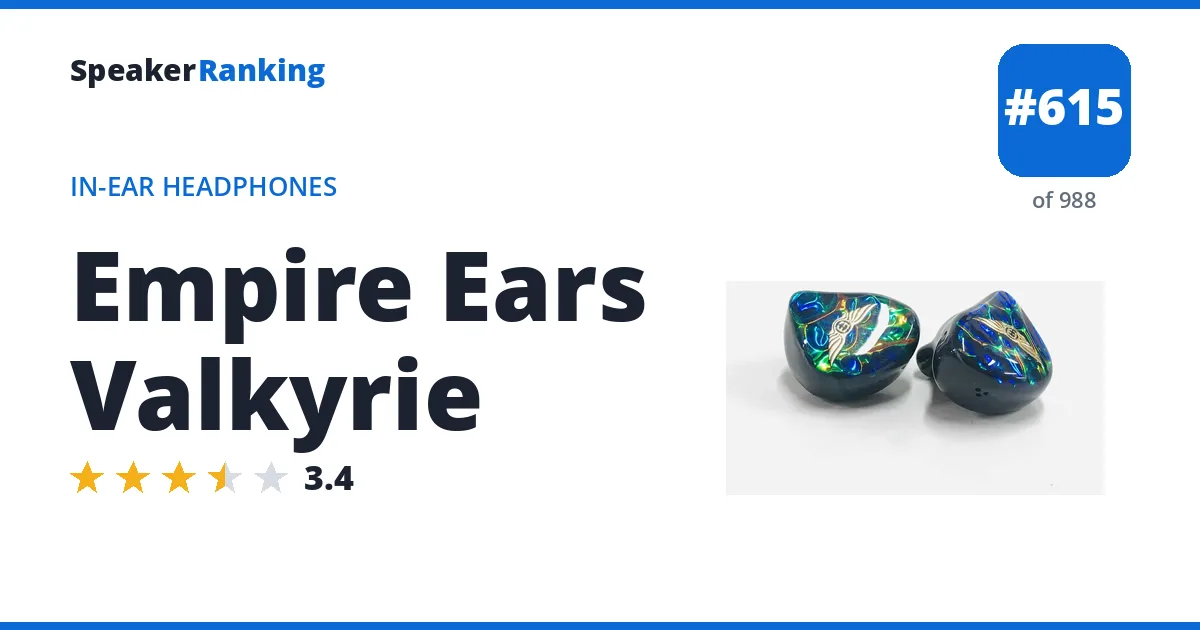
Pros: A tribrid with a dynamic woofer, armature and electrostatic tweeter that measures well for its class (Harman score 66), with about 3.5 dB of extra bass for a fuller low end.
Cons: Discontinued, replaced by the Valkyrie MK II, and Empire Ears closed in 2026, so support is gone. Treble runs about 3.4 dB above target and can sound sharp, and the 3 ohm load needs a very low output impedance source.
Full Empire Ears Valkyrie review and specifications →
| Released | 2019 (7 years ago) |
|---|---|
| Back | Closed |
| Connection | Wired |
| Deviation From Target | 2.40 dB standard deviation |
| Driver Type | Tribrid |
| Drivers | 1 x 9mm dynamic + 1 x balanced armature + 1 x electrostatic |
| Form Factor | In-ear |
| Harman Preference Score | 66 (measured by HypetheSonics, via AutoEQ) |
| Impedance | 3 ohms |
| Sensitivity | 96 dB at 1 kHz |
| Sub-bass Extension | Within 6 dB of target down to 20 Hz (+6.6 dB at 30 Hz) |
| Tonal Tilt | -0.16 (negative is warmer, positive brighter) |
EQ preset to match the Harman target
Set a preamp of -4.8 dB, then add these filters in any parametric equalizer (Wavelet, Equalizer APO, Peace, or a player with parametric EQ). Calculated by AutoEQ from its measured frequency response.
| Filter | Frequency | Gain | Q |
|---|---|---|---|
| Low shelf | 105 Hz | -3.3 dB | 0.70 |
| Peak | 787 Hz | +5.9 dB | 0.61 |
| Peak | 9,053 Hz | -4.5 dB | 1.71 |
| Peak | 1,662 Hz | -5.9 dB | 1.22 |
| Peak | 5,093 Hz | -4.4 dB | 4.18 |
| High shelf | 10,000 Hz | -2.5 dB | 0.70 |
| Peak | 74 Hz | +2.1 dB | 1.93 |
| Peak | 168 Hz | -0.7 dB | 1.67 |
| Peak | 9,211 Hz | +1.0 dB | 4.68 |
| Peak | 6,358 Hz | +0.9 dB | 6.00 |
- Reviews, Comparisons and Sound Samples
 Empire Ears Valkyrie MKII: $1,599 Discontinued eBay
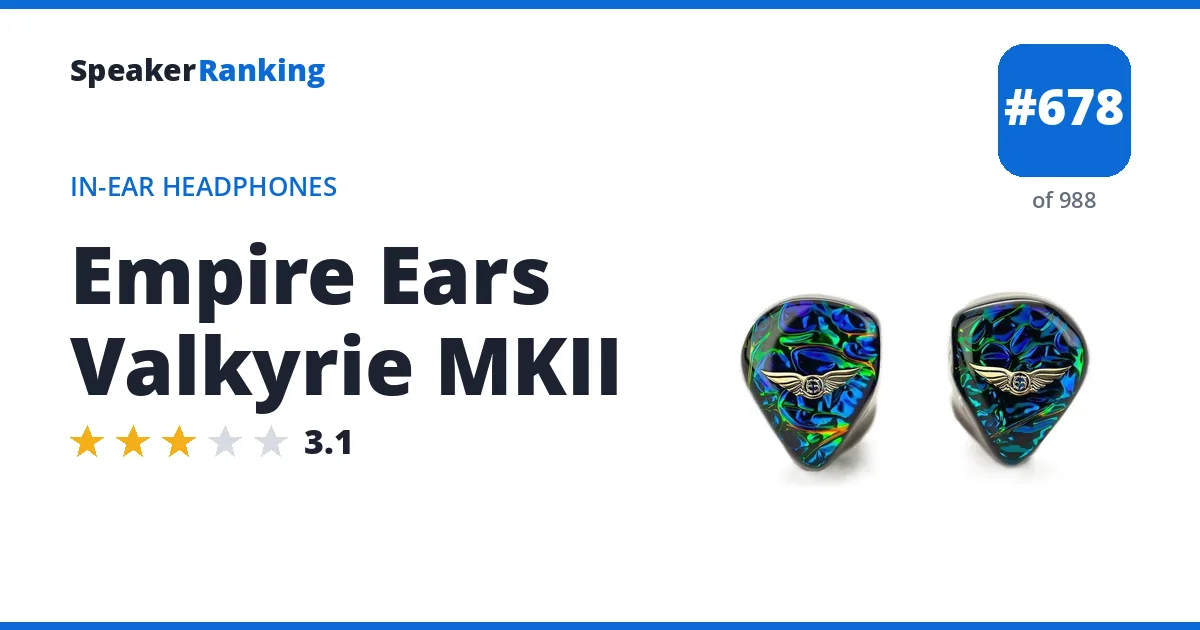
Pros: Bass is lifted about 6 dB with extension to 20 Hz, giving kick drums and bass lines extra weight. Lower mids sit within about 1 dB of target, keeping voices and guitars natural. It uses 1 x dynamic + 1 x balanced armature + 1 x electrostatic with an easy 3 ohm load.
Cons: Discontinued, so it is mainly found used. A 9 dB peak near 8.6 kHz can make cymbals and sibilance sound sharp. The 6 dB bass lift can sound boomy and mask midrange detail. A Harman score of 63 places it in the lower part of the in-ear rankings.
Full Empire Ears Valkyrie MKII review and specifications →
| Released | 2021 (5 years ago) |
|---|---|
| Connection | Wired |
| Deviation From Target | 2.46 dB standard deviation |
| Driver Type | Tribrid |
| Drivers | 1 x dynamic + 1 x balanced armature + 1 x electrostatic |
| Form Factor | In-ear |
| Frequency Response | 5Hz - 100kHz |
| Harman Preference Score | 63 (measured by crinacle, via AutoEQ) |
| Impedance | 3 ohms |
| Sub-bass Extension | Within 6 dB of target down to 20 Hz (+6.4 dB at 30 Hz) |
| Tonal Tilt | -0.64 (negative is warmer, positive brighter) |
EQ preset to match the Harman target
Set a preamp of -4.7 dB, then add these filters in any parametric equalizer (Wavelet, Equalizer APO, Peace, or a player with parametric EQ). Calculated by AutoEQ from its measured frequency response.
| Filter | Frequency | Gain | Q |
|---|---|---|---|
| Low shelf | 105 Hz | -3.7 dB | 0.70 |
| Peak | 785 Hz | +5.4 dB | 0.85 |
| Peak | 1,683 Hz | -4.3 dB | 1.34 |
| Peak | 174 Hz | -2.0 dB | 1.76 |
| Peak | 4,267 Hz | -4.1 dB | 4.96 |
| High shelf | 10,000 Hz | +2.9 dB | 0.70 |
| Peak | 5,976 Hz | +4.9 dB | 3.84 |
| Peak | 71 Hz | +1.1 dB | 1.98 |
| Peak | 4,689 Hz | -2.6 dB | 5.94 |
| Peak | 121 Hz | -0.6 dB | 2.34 |