Short answer: the DUNU SA6 MK2, if you are buying new. The DUNU SA6 ranks higher than it (#270 vs #746 of 1061 in-ear headphones, 4.2/5 vs 3.1/5) but is discontinued, so only consider it used; the DUNU SA6 MK2 is still sold new at $559.
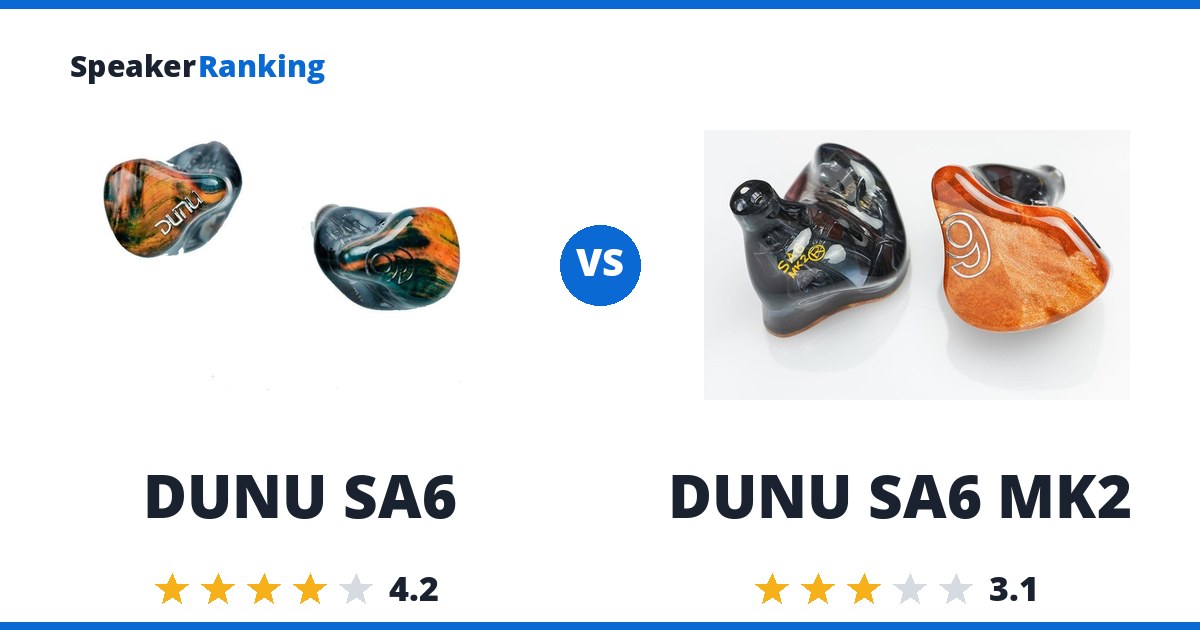
The DUNU SA6 is the better-sounding choice. The original six balanced armature SA6, which measures better across 21 measurements (score 76) than the DUNU SA6 MK2 that replaced it. The tradeoff: Discontinued, so it is mainly found used.
The case for the DUNU SA6 MK2: Bass sits close to target and holds down to 20 Hz, so low end sounds full without bloat. Watch for: Presence sits about 6.8 dB low with an 8.6 dB dip near 5.6 kHz, so vocals and instruments lose some bite.
Buy the DUNU SA6 MK2 new; the DUNU SA6 is no longer sold new, so it only makes sense as a used find.
Looking for alternatives? See the complete Headphones rankings.
Specifications Side By Side
| DUNU SA6 | DUNU SA6 MK2 | |
|---|---|---|
| Price | Discontinued | $559.00 |
| Ranked | #270 of 1061 in In-Ear Headphones | #746 of 1061 in In-Ear Headphones |
| Form Factor | In-ear | In-ear |
| Back | Closed | Closed |
| Connection | Wired | Wired |
| Driver Type | Balanced Armature | Balanced armature |
| Drivers | 6 x balanced armature (2 Sonion, 4 Knowles), tuning switch | 6 x balanced armature |
| Impedance | 60 ohms | 24 ohms |
| Sensitivity | 113 dB | - |
| Harman Preference Score | 76 (median of 21 squig.link measurements, calibrated to AutoEQ) | 63 (median of 22 squig.link measurements, calibrated to AutoEQ) |
| Deviation From Target | 1.97 dB standard deviation | 2.73 dB standard deviation |
| Tonal Tilt | -0.11 (negative is warmer, positive brighter) | -0.88 (negative is warmer, positive brighter) |
| Sub-bass Extension | Within 6 dB of target down to 20 Hz (-2.5 dB at 30 Hz) | Within 6 dB of target down to 20 Hz (-1.4 dB at 30 Hz) |
| Frequency Response | 5Hz - 40kHz | 5Hz - 40kHz |
Frequency Response Compared
Both headphones’ measurements overlaid on the Harman target. Above the target sounds louder in that range, below it quieter. Each curve is the median of several independent measurements, shifted so its 500 Hz to 2 kHz average sits at 0 dB, so only the tuning is compared.
Measurement data: the DUNU SA6 from aden, adri-n, aftersound, audioamigo, bukanaudiophile, dchpgall, dentreviews, flare, hbb, iemocean, koi, mmagtech, musicafe, nymz, precog, pw, sl0the, soundignity, superreview, therollo9 and timmyv; the DUNU SA6 MK2 from ankramutt, atechreviews, boizoff, bukanaudiophile, dl, ducbloke, eliseaudio, hbb, iemocean, jaytiss, koi, nymz, practiphile, precog, recode, sl0the, soundcheck39, soundignity, superreview, therollo9, timmyv and tonedeafmonk, all via squig.link.
Related Headphone Comparisons
More top alternatives to DUNU SA6:
- DUNU SA6 MK2 vs Moondrop Blessing 3
- Tanchjim Bunny vs TANGZU Wu Heyday
- Tanchjim Bunny vs Shuoer DZ4
- Shanling Tino vs Tanchjim Bunny
- Tanchjim Bunny vs Tanchjim Ola Bass
Prices on this page were last checked October 15, 2026 at 5:41 PM UTC. Product prices and availability are accurate as of that date/time and are subject to change; the price and availability shown on Amazon at the time of purchase will apply to the purchase of this product.
As an eBay Partner, we may be compensated if you make a purchase.
The Two Headphones In Full
 DUNU SA6 Discontinued eBay
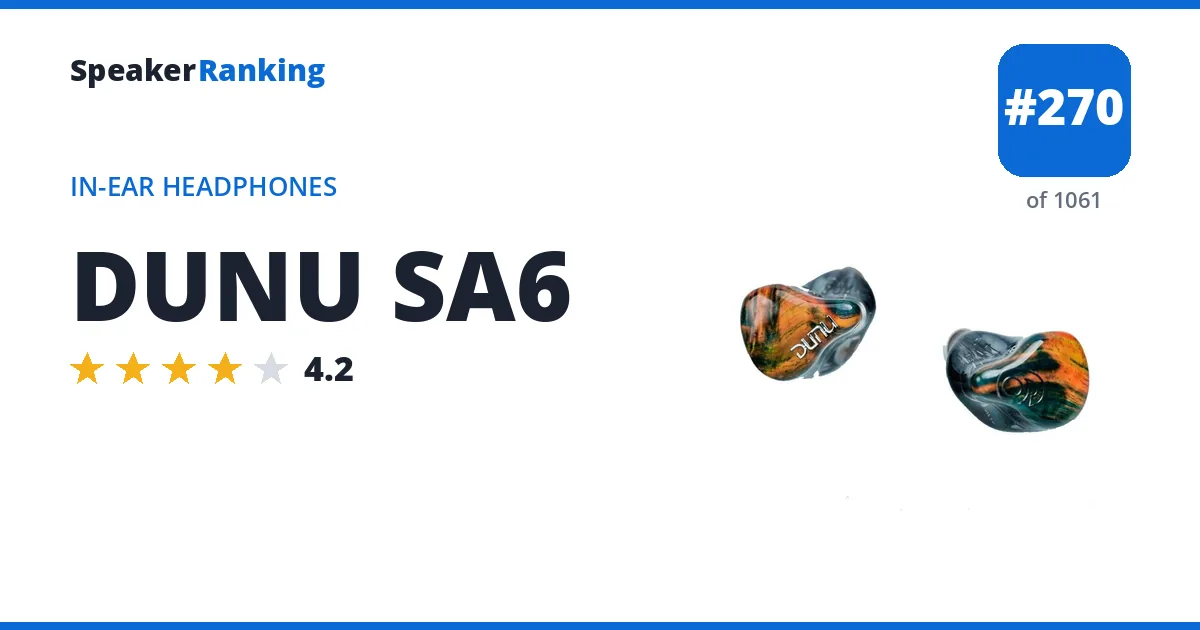
Pros: The original six balanced armature SA6, which measures better across 21 measurements (score 76) than the DUNU SA6 MK2 that replaced it.
Cons: Discontinued, so it is mainly found used. Bass sits about 2 dB and treble about 3.6 dB below target, a mid-forward balance, and sub-bass falls 2.5 dB short at 30 Hz.
Full DUNU SA6 review and specifications →
| Released | 2020 (6 years ago) |
|---|---|
| Back | Closed |
| Connection | Wired |
| Deviation From Target | 1.97 dB standard deviation |
| Driver Type | Balanced Armature |
| Drivers | 6 x balanced armature (2 Sonion, 4 Knowles), tuning switch |
| Form Factor | In-ear |
| Frequency Response | 5Hz - 40kHz |
| Harman Preference Score | 76 (median of 21 squig.link measurements, calibrated to AutoEQ) |
| Impedance | 60 ohms |
| Sensitivity | 113 dB |
| Sub-bass Extension | Within 6 dB of target down to 20 Hz (-2.5 dB at 30 Hz) |
| Tonal Tilt | -0.11 (negative is warmer, positive brighter) |
EQ Presets
Harman target
Set a preamp of -5.9 dB, then add these filters in any parametric equalizer (Wavelet, Equalizer APO, Peace, or a player with parametric EQ). Calculated by Speaker Ranking from the median of 21 squig.link measurements, in the filter layout AutoEQ uses. Predicted Harman match with this EQ: 89 out of 100, up from 76.
| Filter | Frequency | Gain | Q |
|---|---|---|---|
| Low shelf | 105 Hz | +2.6 dB | 0.70 |
| High shelf | 10,000 Hz | -0.9 dB | 0.70 |
| Peak | 90 Hz | -0.7 dB | 1.87 |
| Peak | 445 Hz | +0.9 dB | 1.83 |
| Peak | 1,299 Hz | -1.8 dB | 2.45 |
| Peak | 3,115 Hz | +2.9 dB | 4.32 |
| Peak | 5,345 Hz | +4.5 dB | 0.59 |
| Peak | 7,527 Hz | -3.5 dB | 5.97 |
Neutral target
Set a preamp of -5.9 dB, then add these filters in any parametric equalizer (Wavelet, Equalizer APO, Peace, or a player with parametric EQ). Calculated by Speaker Ranking from the median of 21 squig.link measurements, in the filter layout AutoEQ uses. Predicted Neutral match with this EQ: 91 out of 100, up from 48.
| Filter | Frequency | Gain | Q |
|---|---|---|---|
| Low shelf | 105 Hz | -5.9 dB | 0.70 |
| High shelf | 10,000 Hz | -0.9 dB | 0.70 |
| Peak | 80 Hz | -1.1 dB | 1.32 |
| Peak | 435 Hz | +0.9 dB | 1.60 |
| Peak | 1,299 Hz | -1.8 dB | 2.45 |
| Peak | 3,115 Hz | +2.9 dB | 4.32 |
| Peak | 5,345 Hz | +4.5 dB | 0.59 |
| Peak | 7,527 Hz | -3.5 dB | 5.96 |
Studio flat target
Set a preamp of -6.6 dB, then add these filters in any parametric equalizer (Wavelet, Equalizer APO, Peace, or a player with parametric EQ). Calculated by Speaker Ranking from the median of 21 squig.link measurements, in the filter layout AutoEQ uses. Predicted Studio flat match with this EQ: 92 out of 100, up from 30.
| Filter | Frequency | Gain | Q |
|---|---|---|---|
| Low shelf | 105 Hz | -8.5 dB | 0.70 |
| High shelf | 10,000 Hz | +2.0 dB | 0.70 |
| Peak | 150 Hz | -2.2 dB | 0.76 |
| Peak | 1,307 Hz | -1.9 dB | 2.17 |
| Peak | 2,954 Hz | +6.0 dB | 1.22 |
| Peak | 4,423 Hz | -1.5 dB | 6.00 |
| Peak | 5,702 Hz | +5.2 dB | 5.77 |
Warm target
Set a preamp of -5.9 dB, then add these filters in any parametric equalizer (Wavelet, Equalizer APO, Peace, or a player with parametric EQ). Calculated by Speaker Ranking from the median of 21 squig.link measurements, in the filter layout AutoEQ uses. Predicted Warm match with this EQ: 91 out of 100, up from 78.
| Filter | Frequency | Gain | Q |
|---|---|---|---|
| Low shelf | 105 Hz | +2.8 dB | 0.70 |
| High shelf | 10,000 Hz | -4.5 dB | 0.70 |
| Peak | 445 Hz | +1.2 dB | 1.35 |
| Peak | 1,358 Hz | -1.6 dB | 2.93 |
| Peak | 3,049 Hz | +2.5 dB | 5.73 |
| Peak | 5,016 Hz | +3.6 dB | 0.91 |
| Peak | 5,755 Hz | +3.1 dB | 6.00 |
| Peak | 7,582 Hz | -3.6 dB | 6.00 |
Bass target
Set a preamp of -5.9 dB, then add these filters in any parametric equalizer (Wavelet, Equalizer APO, Peace, or a player with parametric EQ). Calculated by Speaker Ranking from the median of 21 squig.link measurements, in the filter layout AutoEQ uses. Predicted Bass match with this EQ: 89 out of 100, up from 66.
| Filter | Frequency | Gain | Q |
|---|---|---|---|
| Low shelf | 105 Hz | +5.8 dB | 0.70 |
| High shelf | 10,000 Hz | -0.9 dB | 0.70 |
| Peak | 439 Hz | +0.9 dB | 1.65 |
| Peak | 1,299 Hz | -1.8 dB | 2.46 |
| Peak | 3,115 Hz | +2.9 dB | 4.32 |
| Peak | 5,345 Hz | +4.5 dB | 0.59 |
| Peak | 7,527 Hz | -3.5 dB | 5.98 |
Bright target
Set a preamp of -6.5 dB, then add these filters in any parametric equalizer (Wavelet, Equalizer APO, Peace, or a player with parametric EQ). Calculated by Speaker Ranking from the median of 21 squig.link measurements, in the filter layout AutoEQ uses. Predicted Bright match with this EQ: 84 out of 100, up from 36.
| Filter | Frequency | Gain | Q |
|---|---|---|---|
| Low shelf | 105 Hz | -6.0 dB | 0.70 |
| High shelf | 10,000 Hz | +1.3 dB | 0.70 |
| Peak | 82 Hz | -1.0 dB | 1.35 |
| Peak | 442 Hz | +0.9 dB | 1.63 |
| Peak | 1,421 Hz | -2.1 dB | 1.64 |
| Peak | 3,354 Hz | +6.0 dB | 1.03 |
| Peak | 5,549 Hz | +3.9 dB | 4.50 |
V-shaped target
Set a preamp of -6.4 dB, then add these filters in any parametric equalizer (Wavelet, Equalizer APO, Peace, or a player with parametric EQ). Calculated by Speaker Ranking from the median of 21 squig.link measurements, in the filter layout AutoEQ uses. Predicted V-shaped match with this EQ: 82 out of 100, up from 62.
| Filter | Frequency | Gain | Q |
|---|---|---|---|
| Low shelf | 105 Hz | +5.9 dB | 0.70 |
| High shelf | 10,000 Hz | +1.9 dB | 0.70 |
| Peak | 75 Hz | +0.6 dB | 0.87 |
| Peak | 309 Hz | +1.6 dB | 0.60 |
| Peak | 944 Hz | -0.9 dB | 2.28 |
| Peak | 1,314 Hz | -2.5 dB | 2.09 |
| Peak | 3,354 Hz | +6.0 dB | 0.97 |
| Peak | 5,503 Hz | +3.6 dB | 4.30 |
- Reviews, Comparisons and Sound Samples
 DUNU SA6 MK2: $559.00 Amazon $559.00 eBay
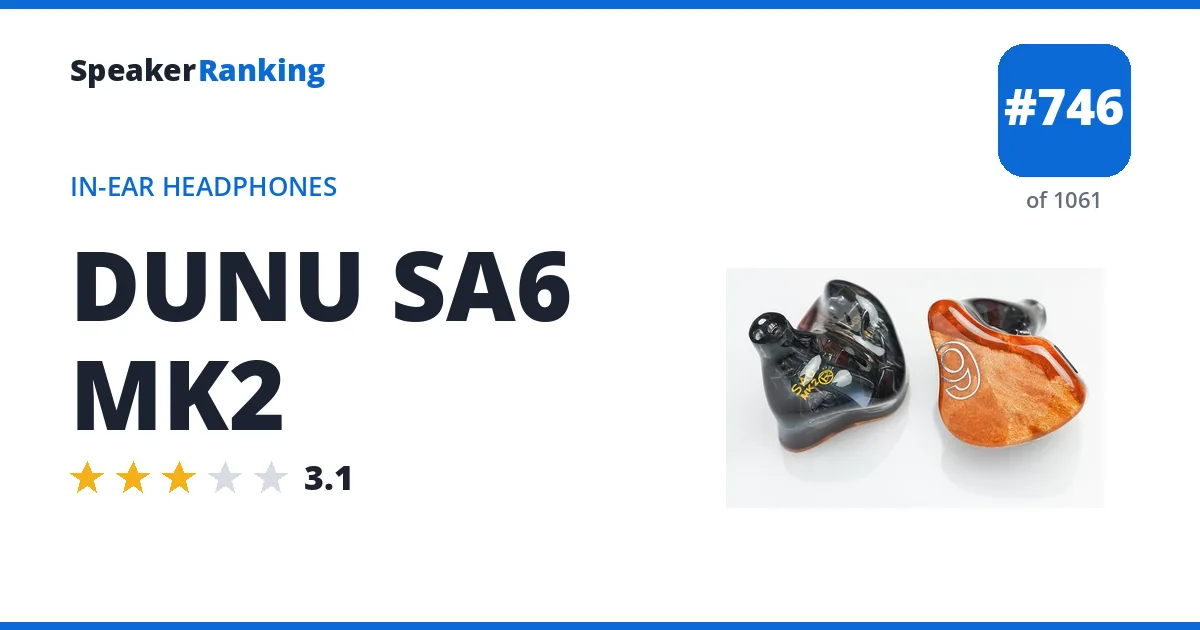
Pros: Bass sits close to target and holds down to 20 Hz, so low end sounds full without bloat. Upper treble lifts about 4.5 dB for extra air and sparkle. Lower mids sit within about 0.5 dB of target, keeping voices and guitars natural. It uses 6 x balanced armature with an easy 24 ohm load.
Cons: Presence sits about 6.8 dB low with an 8.6 dB dip near 5.6 kHz, so vocals and instruments lose some bite. A Harman score of 63 places it in the lower part of the in-ear rankings.
Full DUNU SA6 MK2 review and specifications →
| Released | May 2023 (3 years ago) |
|---|---|
| Back | Closed |
| Connection | Wired |
| Deviation From Target | 2.73 dB standard deviation |
| Driver Type | Balanced armature |
| Drivers | 6 x balanced armature |
| Form Factor | In-ear |
| Frequency Response | 5Hz - 40kHz |
| Harman Preference Score | 63 (median of 22 squig.link measurements, calibrated to AutoEQ) |
| Impedance | 24 ohms |
| Sub-bass Extension | Within 6 dB of target down to 20 Hz (-1.4 dB at 30 Hz) |
| Tonal Tilt | -0.88 (negative is warmer, positive brighter) |
EQ Presets
Harman target
Set a preamp of -6.3 dB, then add these filters in any parametric equalizer (Wavelet, Equalizer APO, Peace, or a player with parametric EQ). Calculated by Speaker Ranking from the median of 22 squig.link measurements, in the filter layout AutoEQ uses. Predicted Harman match with this EQ: 88 out of 100, up from 63.
| Filter | Frequency | Gain | Q |
|---|---|---|---|
| Low shelf | 105 Hz | +1.0 dB | 0.70 |
| High shelf | 10,000 Hz | -5.4 dB | 0.70 |
| Peak | 140 Hz | -1.8 dB | 0.93 |
| Peak | 1,207 Hz | -2.2 dB | 2.07 |
| Peak | 2,896 Hz | +2.4 dB | 2.86 |
| Peak | 5,345 Hz | +6.0 dB | 0.53 |
| Peak | 6,907 Hz | -3.2 dB | 5.75 |
Neutral target
Set a preamp of -6.4 dB, then add these filters in any parametric equalizer (Wavelet, Equalizer APO, Peace, or a player with parametric EQ). Calculated by Speaker Ranking from the median of 22 squig.link measurements, in the filter layout AutoEQ uses. Predicted Neutral match with this EQ: 89 out of 100, up from 29.
| Filter | Frequency | Gain | Q |
|---|---|---|---|
| Low shelf | 105 Hz | -7.6 dB | 0.70 |
| High shelf | 10,000 Hz | -5.4 dB | 0.70 |
| Peak | 125 Hz | -1.9 dB | 0.77 |
| Peak | 1,208 Hz | -2.2 dB | 2.07 |
| Peak | 2,284 Hz | +0.9 dB | 4.75 |
| Peak | 2,895 Hz | +2.4 dB | 2.86 |
| Peak | 5,345 Hz | +6.0 dB | 0.53 |
| Peak | 6,908 Hz | -3.2 dB | 5.75 |
Studio flat target
Set a preamp of -6.6 dB, then add these filters in any parametric equalizer (Wavelet, Equalizer APO, Peace, or a player with parametric EQ). Calculated by Speaker Ranking from the median of 22 squig.link measurements, in the filter layout AutoEQ uses. Predicted Studio flat match with this EQ: 86 out of 100, up from 10.
| Filter | Frequency | Gain | Q |
|---|---|---|---|
| Low shelf | 105 Hz | -10.2 dB | 0.70 |
| High shelf | 10,000 Hz | +0.7 dB | 0.70 |
| Peak | 171 Hz | -3.2 dB | 0.57 |
| Peak | 1,312 Hz | -2.9 dB | 1.87 |
| Peak | 2,603 Hz | +6.0 dB | 0.92 |
| Peak | 3,755 Hz | +1.3 dB | 4.43 |
| Peak | 5,345 Hz | +4.5 dB | 2.49 |
Warm target
Set a preamp of -5.1 dB, then add these filters in any parametric equalizer (Wavelet, Equalizer APO, Peace, or a player with parametric EQ). Calculated by Speaker Ranking from the median of 22 squig.link measurements, in the filter layout AutoEQ uses. Predicted Warm match with this EQ: 93 out of 100, up from 74.
| Filter | Frequency | Gain | Q |
|---|---|---|---|
| Low shelf | 105 Hz | +1.2 dB | 0.70 |
| High shelf | 10,000 Hz | -6.0 dB | 0.70 |
| Peak | 134 Hz | -1.6 dB | 1.04 |
| Peak | 1,244 Hz | -2.0 dB | 3.24 |
| Peak | 2,768 Hz | +2.0 dB | 2.57 |
| Peak | 5,345 Hz | +5.3 dB | 0.63 |
| Peak | 7,549 Hz | -2.9 dB | 5.06 |
Bass target
Set a preamp of -6.3 dB, then add these filters in any parametric equalizer (Wavelet, Equalizer APO, Peace, or a player with parametric EQ). Calculated by Speaker Ranking from the median of 22 squig.link measurements, in the filter layout AutoEQ uses. Predicted Bass match with this EQ: 89 out of 100, up from 66.
| Filter | Frequency | Gain | Q |
|---|---|---|---|
| Low shelf | 105 Hz | +4.7 dB | 0.70 |
| High shelf | 10,000 Hz | -5.4 dB | 0.70 |
| Peak | 150 Hz | -1.7 dB | 1.06 |
| Peak | 1,207 Hz | -2.2 dB | 2.07 |
| Peak | 2,896 Hz | +2.4 dB | 2.86 |
| Peak | 5,345 Hz | +6.0 dB | 0.53 |
| Peak | 6,907 Hz | -3.2 dB | 5.75 |
Bright target
Set a preamp of -6.5 dB, then add these filters in any parametric equalizer (Wavelet, Equalizer APO, Peace, or a player with parametric EQ). Calculated by Speaker Ranking from the median of 22 squig.link measurements, in the filter layout AutoEQ uses. Predicted Bright match with this EQ: 76 out of 100, up from 16.
| Filter | Frequency | Gain | Q |
|---|---|---|---|
| Low shelf | 105 Hz | -7.6 dB | 0.70 |
| High shelf | 10,000 Hz | -1.8 dB | 0.70 |
| Peak | 125 Hz | -1.9 dB | 0.74 |
| Peak | 1,201 Hz | -2.3 dB | 2.01 |
| Peak | 2,266 Hz | +0.9 dB | 4.65 |
| Peak | 2,792 Hz | +2.7 dB | 2.92 |
| Peak | 5,345 Hz | +5.8 dB | 0.50 |
| Peak | 7,000 Hz | -3.7 dB | 5.29 |
V-shaped target
Set a preamp of -6.4 dB, then add these filters in any parametric equalizer (Wavelet, Equalizer APO, Peace, or a player with parametric EQ). Calculated by Speaker Ranking from the median of 22 squig.link measurements, in the filter layout AutoEQ uses. Predicted V-shaped match with this EQ: 72 out of 100, up from 53.
| Filter | Frequency | Gain | Q |
|---|---|---|---|
| Low shelf | 105 Hz | +5.4 dB | 0.70 |
| High shelf | 10,000 Hz | -0.5 dB | 0.70 |
| Peak | 1,182 Hz | -2.8 dB | 2.29 |
| Peak | 2,694 Hz | +2.8 dB | 2.91 |
| Peak | 5,345 Hz | +5.7 dB | 0.47 |
| Peak | 7,038 Hz | -3.9 dB | 5.10 |
- Links
- Reviews, Comparisons and Sound Samples
- Head-to-Head Comparisons