Short answer: both are discontinued, so this only matters if you are buying used. Used, the Shure Aonic 50 is the better pick: it ranks #133 of 429 over-ear headphones by sound quality (rated 3.9/5), against #166 (rated 3.7/5) for the Bose QuietComfort 45. If you want one new, the Dan Clark Audio E3 ranks #1 at $2,299.
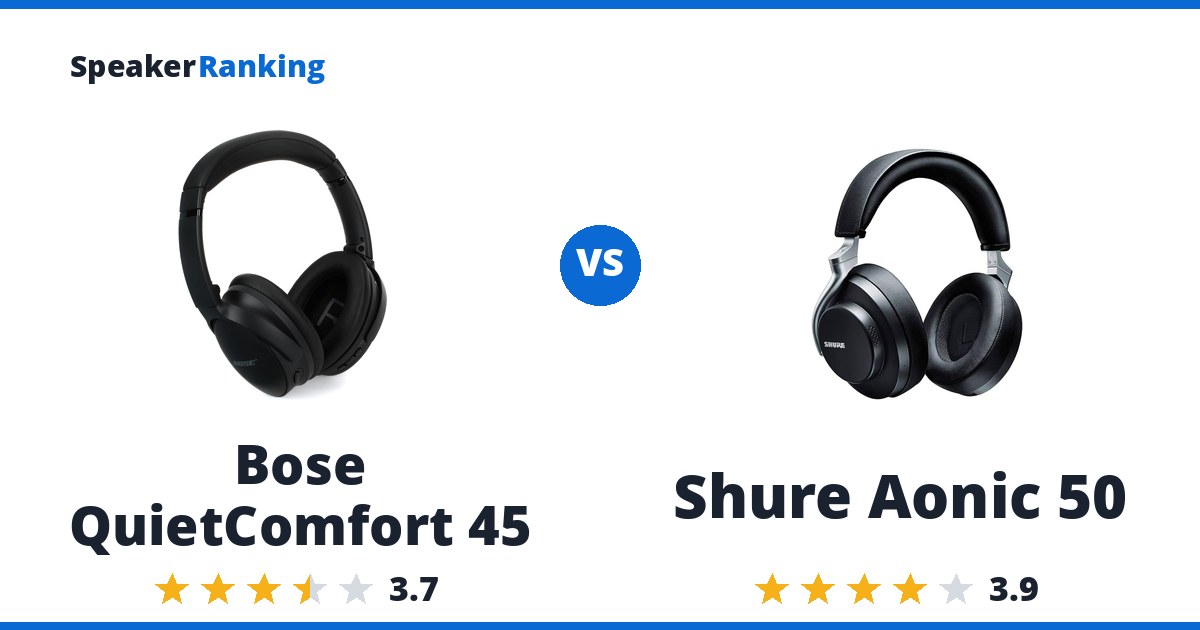
The case for the Bose QuietComfort 45: Excellent noise cancelling and a comfortable, light 0.5 lbs (240 g) build. The tradeoff: Discontinued.
What the Shure Aonic 50 does well: Measured response gives it a very good Harman preference score of 79 with a 2.57 dB spread. The tradeoff: Discontinued, so it is mainly found used.
Buy the Shure Aonic 50 only if you find one used in good condition; both are discontinued, and it is the better rated of the two. For a new speaker, start with the Dan Clark Audio E3 instead.
Want more options? Browse the full Headphones rankings.
Specifications Side By Side
| Bose QuietComfort 45 | Shure Aonic 50 | |
|---|---|---|
| Price | Discontinued | Discontinued |
| Ranked | #166 of 429 in Over-Ear Headphones | #133 of 429 in Over-Ear Headphones |
| Form Factor | Over-ear | Over-ear |
| Connection | Wireless and wired | Bluetooth |
| Weight | 0.5 lbs (240 g) | 0.7 lbs (334 g) |
| Harman Preference Score | 76 (measured by oratory1990, via AutoEQ) | 79 (measured by oratory1990, via AutoEQ) |
| Deviation From Target | 2.29 dB standard deviation | 2.57 dB standard deviation |
| Tonal Tilt | -0.63 (negative is warmer, positive brighter) | +0.17 (negative is warmer, positive brighter) |
| Sub-bass Extension | Within 6 dB of target down to 20 Hz (+2.1 dB at 30 Hz) | Within 6 dB of target down to 20 Hz (-2.2 dB at 30 Hz) |
| Bluetooth Version | 5.1 | - |
| Bluetooth Codecs | SBC, AAC | - |
| Active Noise Cancelling | Yes | - |
| Battery Life | 24 hours | - |
| Built-in Microphone | Yes | - |
| Back | - | Closed |
| Driver Type | - | Dynamic |
| Drivers | - | 1 x 50mm dynamic |
| Impedance | - | 39 ohms |
| Sensitivity | - | 97.5 dB/mW |
| Frequency Response | - | 20Hz - 22kHz |
Related Headphone Comparisons
More top alternatives to Shure Aonic 50:
- Shure Aonic 50 vs Sony WH-1000XM4
- Bose QuietComfort 25 vs Bose QuietComfort 45
- Bose QuietComfort 35 II vs Bose QuietComfort 45
- Bose QuietComfort 20 vs Bose QuietComfort 45
- Shure Aonic 4 vs Shure Aonic 50
Prices on this page were last checked October 13, 2026 at 3:17 PM UTC. Product prices and availability are accurate as of that date/time and are subject to change; the price and availability shown on Amazon at the time of purchase will apply to the purchase of this product.
As an eBay Partner, we may be compensated if you make a purchase.
The Two Headphones In Full
 Bose QuietComfort 45 Wireless Discontinued eBay
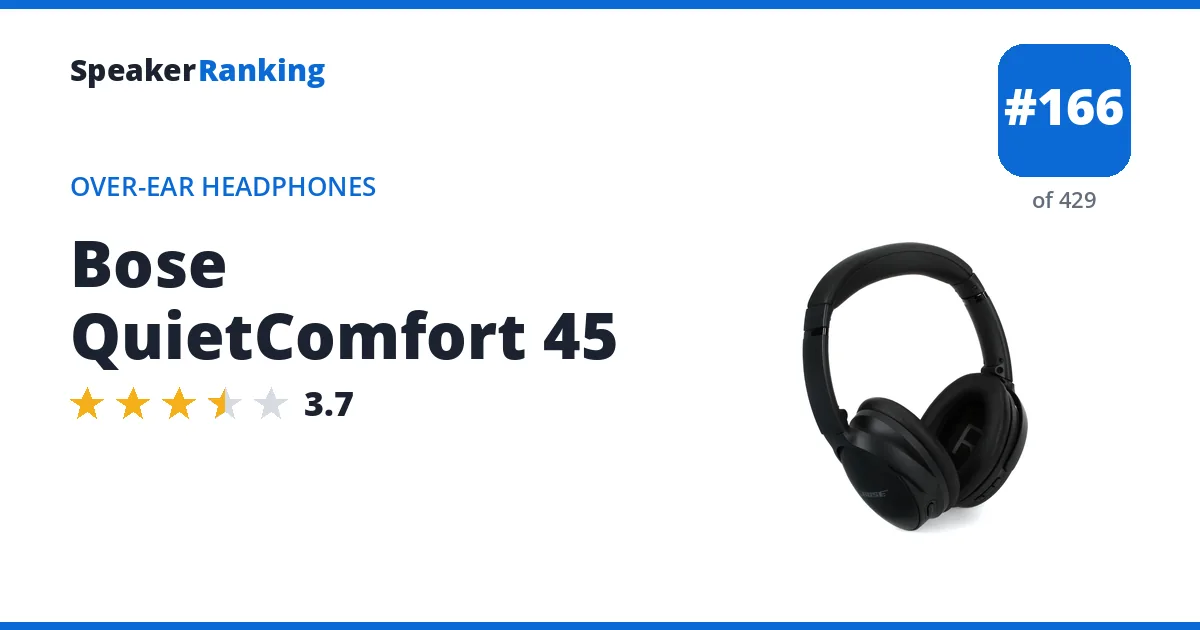
Pros: Excellent noise cancelling and a comfortable, light 240 g build. The measured tuning scores 76 on the Harman scale with a 2.29 dB spread, with clean bass about 2 dB above target that extends to 20 Hz and mids close to neutral.
Cons: Discontinued. A 9.1 dB dip near 8.7 kHz and an upper treble lift make cymbals sound uneven, and the original release had no EQ beyond a later bass and treble slider. There is no high resolution codec beyond AAC.
Full Bose QuietComfort 45 review and specifications →
| Released | Sep 2021 (5 years ago) |
|---|---|
| Active Noise Cancelling | Yes |
| Battery Life | 24 hours |
| Bluetooth Codecs | SBC, AAC |
| Bluetooth Version | 5.1 |
| Built-in Microphone | Yes |
| Connection | Wireless and wired |
| Deviation From Target | 2.29 dB standard deviation |
| Form Factor | Over-ear |
| Harman Preference Score | 76 (measured by oratory1990, via AutoEQ) |
| Sub-bass Extension | Within 6 dB of target down to 20 Hz (+2.1 dB at 30 Hz) |
| Tonal Tilt | -0.63 (negative is warmer, positive brighter) |
| Weight | 0.5 lbs (240 g) |
EQ preset to match the Harman target
Set a preamp of -2.2 dB, then add these filters in any parametric equalizer (Wavelet, Equalizer APO, Peace, or a player with parametric EQ). Calculated by AutoEQ from its measured frequency response.
| Filter | Frequency | Gain | Q |
|---|---|---|---|
| Low shelf | 105 Hz | -1.4 dB | 0.70 |
| Peak | 161 Hz | -2.2 dB | 1.15 |
| Peak | 5,490 Hz | -7.7 dB | 2.06 |
| Peak | 4,242 Hz | +3.5 dB | 0.24 |
| Peak | 2,328 Hz | -5.2 dB | 2.15 |
| High shelf | 10,000 Hz | -7.0 dB | 0.70 |
| Peak | 8,352 Hz | +2.9 dB | 1.93 |
| Peak | 390 Hz | +0.5 dB | 2.32 |
| Peak | 6,508 Hz | -1.0 dB | 5.04 |
| Peak | 70 Hz | -0.1 dB | 1.97 |
- Reviews, Comparisons and Sound Samples
- Head-to-Head Comparisons
 Shure Aonic 50 Discontinued eBay
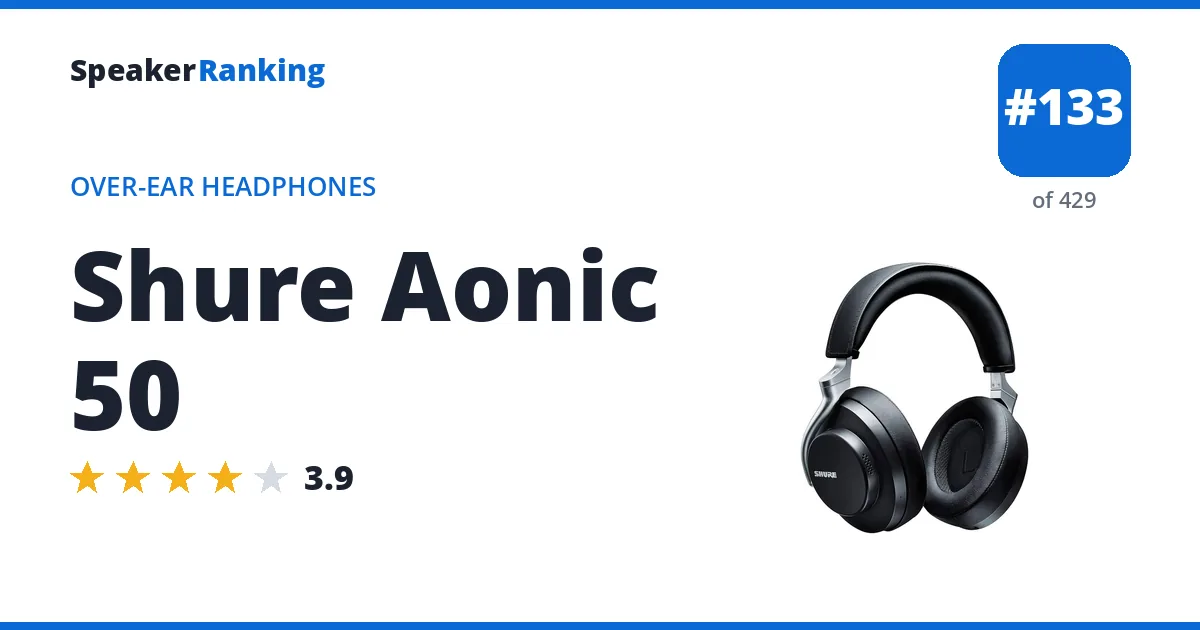
Pros: Measured response gives it a very good Harman preference score of 79 with a 2.57 dB spread. It uses 1 x 50mm dynamic.
Cons: Discontinued, so it is mainly found used. An 8.3 dB peak near 11.9 kHz can make cymbals and sibilance sound sharp. The 4.6 dB bass lift can sound boomy and mask midrange detail.
Full Shure Aonic 50 review and specifications →
| Released | Apr 2020 (6 years ago) |
|---|---|
| Back | Closed |
| Connection | Bluetooth |
| Deviation From Target | 2.57 dB standard deviation |
| Driver Type | Dynamic |
| Drivers | 1 x 50mm dynamic |
| Form Factor | Over-ear |
| Frequency Response | 20Hz - 22kHz |
| Harman Preference Score | 79 (measured by oratory1990, via AutoEQ) |
| Impedance | 39 ohms |
| Sensitivity | 97.5 dB/mW |
| Sub-bass Extension | Within 6 dB of target down to 20 Hz (-2.2 dB at 30 Hz) |
| Tonal Tilt | +0.17 (negative is warmer, positive brighter) |
| Weight | 0.7 lbs (334 g) |
EQ preset to match the Harman target
Set a preamp of -5.4 dB, then add these filters in any parametric equalizer (Wavelet, Equalizer APO, Peace, or a player with parametric EQ). Calculated by AutoEQ from its measured frequency response.
| Filter | Frequency | Gain | Q |
|---|---|---|---|
| Low shelf | 105 Hz | +5.8 dB | 0.70 |
| Peak | 471 Hz | +5.1 dB | 0.74 |
| Peak | 129 Hz | -6.0 dB | 0.68 |
| Peak | 5,309 Hz | -4.3 dB | 2.71 |
| Peak | 2,908 Hz | -3.6 dB | 5.04 |
| High shelf | 10,000 Hz | -1.6 dB | 0.70 |
| Peak | 1,894 Hz | -1.5 dB | 3.19 |
| Peak | 51 Hz | -1.3 dB | 2.33 |
| Peak | 78 Hz | +1.1 dB | 2.48 |
| Peak | 3,742 Hz | +2.0 dB | 6.00 |
- Reviews, Comparisons and Sound Samples
- Head-to-Head Comparisons