Short answer: the Simgot EA1000. Both are rated 4.6/5 for sound quality (#75 and #79 of 1291 in-ear headphones), and the Simgot EA1000 costs $259.99 against $299.99 for the Binary Chopin, with sound quality a draw, the lower price decides it.
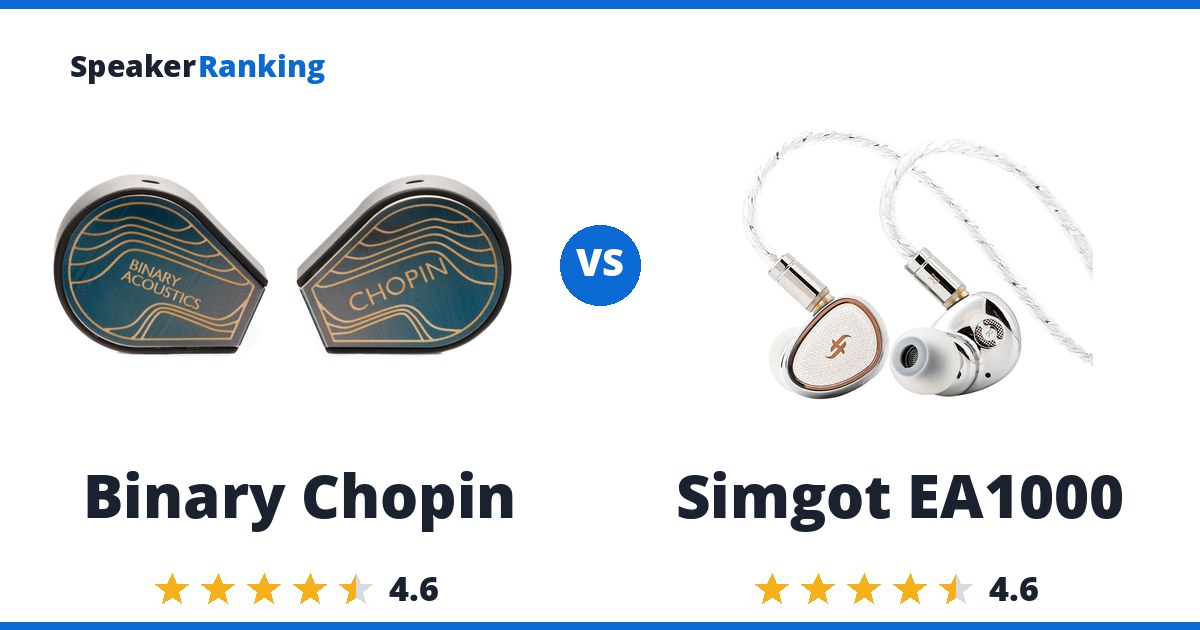
The case for the Binary Chopin: The median of 10 hobbyist measurements gives it an excellent Harman preference score of 81 with a 1.36 dB spread, and its mids sit within about 0.5 dB of target, so vocals and instruments sound natural. The catch: A 4.1 dB peak near 8.4 kHz can make cymbals and sibilance sound sharp.
Why pick the Simgot EA1000: Measured 34 times by hobbyists on squig.link, it lands at a preference score of 80.6 with a perfectly neutral overall tilt. Watch for: Sub-bass trails target by about 1.7 dB and sits 2.5 dB down at 30 Hz, so the deepest synth and organ notes have less rumble than the midbass suggests.
Buy the Simgot EA1000. Both are rated the same for sound quality, and it costs $40 less than the Binary Chopin.
Want more options? Browse the full Headphones rankings.

The median of 10 hobbyist measurements gives it an excellent Harman preference score of 81 with a 1.36 dB spread, and its mids sit within about 0.5 dB of target, so vocals and instruments sound natural.
Hangout Audio $299.99 eBay
Measured 34 times by hobbyists on squig.link, it lands at a preference score of 80.6 with a perfectly neutral overall tilt.
Amazon $259.99 eBayPrices on this page were last checked October 16, 2026 at 5:46 PM UTC. Product prices and availability are accurate as of that date/time and are subject to change; the price and availability shown on Amazon at the time of purchase will apply to the purchase of this product.
As an eBay Partner, we may be compensated if you make a purchase.
Specifications Side By Side
| Binary Chopin | Simgot EA1000 | |
|---|---|---|
| Price | $299.99 | $259.99 |
| Ranked | #79 of 1291 in In-Ear Headphones | #75 of 1291 in In-Ear Headphones |
| Form Factor | In-ear | In-ear |
| Back | Closed | Closed |
| Harman Preference Score | 81 (median of 10 squig.link measurements, calibrated to AutoEQ) | 81 (median of 34 squig.link measurements, calibrated to AutoEQ) |
| Deviation From Target | 1.36 dB standard deviation | 1.58 dB standard deviation |
| Tonal Tilt | -0.31 (negative is warmer, positive brighter) | +0.00 (negative is warmer, positive brighter) |
| Sub-bass Extension | Within 6 dB of target down to 20 Hz (-0.2 dB at 30 Hz) | Within 6 dB of target down to 20 Hz (-2.5 dB at 30 Hz) |
| Connection | Wired | Wired |
| Driver Type | Hybrid (1 dynamic + 4 balanced armature) | Dynamic |
| Drivers | 1 x 8mm dynamic + 4 x balanced armature | 1 x 10mm dynamic + 1 x 6mm passive radiator |
| Impedance | 12 ohms | 16 ohms |
| Sensitivity | 122 dB/Vrms | 127 dB/Vrms |
| Built-in Microphone | No | - |
| Frequency Response | - | 10Hz - 50kHz (Manufacturer specified) |
Frequency Response Compared
Both headphones’ measurements overlaid on the Harman target. Above the target sounds louder in that range, below it quieter. Each curve is the median of several independent measurements, shifted so its 500 Hz to 2 kHz average sits at 0 dB, so only the tuning is compared.
Measurement data: the Binary Chopin from adri-n, aftersound, aquaphobic, audioamigo, boizoff, cammyfi, dchpgall, doltonius, fahryst, hobbytalk, ianfann, iemocean, jaytiss, musicafe, practiphile, sai, sl0the, therollo9, timmyv and vortexreviews; the Simgot EA1000 from achoreviews, atechreviews, bedrock, boizoff, bryaudioreviews, csi-zone, dl, eliseaudio, fahryst, gadgetgenerations, gadgetrytech, hbb, hobbytalk, hu-fi, ianfann, joycesreview, kazi, kuping-sensi, loomynarty, musicafe, obodio, practiphile, pw, regancipher, rg, sl0the, soundcheck39, soundignity, superreview, suporsalad, theaudiostore, therollo9, tonedeafmonk and treblewellxtended, all via squig.link.
Related Headphone Comparisons
More top alternatives to Simgot EA1000: