Short answer: the Palmer Orbit 11 for better sound quality, the ADAM Audio T7V for the lower price. The Palmer Orbit 11 ranks #61 of 119 powered bookshelf speakers, rated 4.2/5, at $1,532. The ADAM Audio T7V ranks #95, rated 3.9/5, at $579.98, $952.02 cheaper.
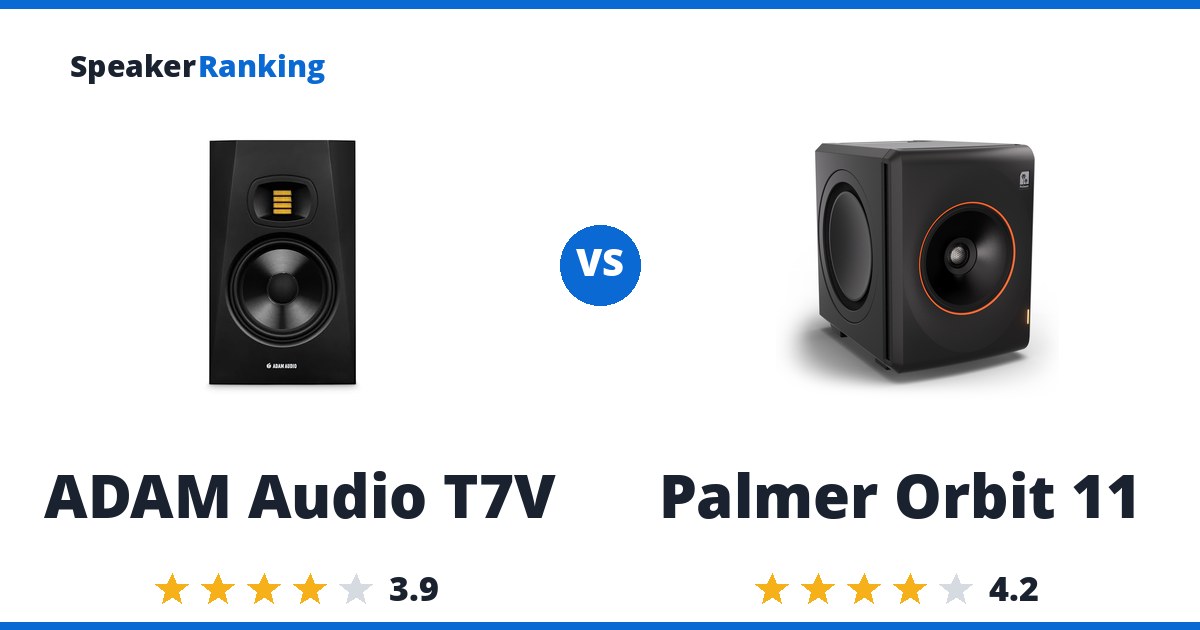
What the ADAM Audio T7V does well: Audioholics’ measurements provide useful evidence about the midrange and treble, with a digitized 2.4dB response span from 300Hz to 5kHz. The catch: Correct listening height is important for the two-way crossover.
The Palmer Orbit 11 is the better-sounding, deeper-bass choice. A 27.8Hz measured -3dB point provides genuinely deep standalone bass. Its bass reaches about 27.8Hz before falling 3dB, against 65Hz for the ADAM Audio T7V. The tradeoff: Its 7.10 ideal-subwoofer score is more modest than the narrow midrange span alone suggests; response outside that band and off-axis behavior also matter.
Buy the ADAM Audio T7V when the price outweighs sound quality for you, and the Palmer Orbit 11 when sound quality outweighs the price instead.
Looking for alternatives? See the complete Powered Home rankings.
Specifications Side By Side
| ADAM Audio T7V | Palmer Orbit 11 | |
|---|---|---|
| Price | $579.98 per pair | $1,532 per pair |
| Ranked | #95 of 119 in Large Size Powered Bookshelf Speakers | #61 of 119 in Large Size Powered Bookshelf Speakers |
| Bass Extension (-3dB) | approx. 65Hz, extrapolated from the reviewer’s directly-computed -6dB point of 45.4Hz (measured, Audio Science Review) | 27.8Hz (measured, spinorama.org) |
| Bass Extension (-10dB) | approx. 45Hz, extrapolated from the reviewer’s directly-computed -6dB point of 45.4Hz (measured, Audio Science Review) | 21.5Hz (measured, spinorama.org) |
| Dimensions | 13.7”H x 8.3”W x 11.5”D (348 x 210.8 x 292.1 mm) | 8.5” x 11.5” x 11.5” (217 x 293 x 292 mm) each |
| Frequency Response | 39Hz - 25kHz (-6dB) (Manufacturer specified) | 28Hz - 28kHz (-3dB) (Manufacturer specified) |
| Inputs | XLR, RCA | XLR (balanced analog), AES3 (digital, via XLR) |
| Weight | 15.7 lbs (7.1 kg) | 30.6 lbs (13.9 kg) each |
| Drivers | 7” (178mm) woofer | 1” tweeter + 6.5” midrange (coaxial), 2x 8” woofers |
| App | No | - |
| Bluetooth | No | No |
| EQ | Yes (Room adjustment) | - |
| DSP | No | - |
| Amplifier Power | 70w Per Speaker | 1000W peak / 400W RMS total; Tri-amped Class D |
| XLR Input | Yes | Yes |
| RCA Input | Yes | No |
| TRS Input | No | No |
| Optical Input | No | No |
| Coaxial Input | No | No |
| USB Input | No | No |
| HDMI Input | No | No |
| AES Input | No | Yes |
| Aux Input | No | No |
| Maximum SPL | - | 116dB peak at 1m |
| Spinorama Preference Score | - | 6.20 |
| Spinorama Preference Score with Perfect Sub | - | 7.10 |
Frequency Response Compared
Both speakers’ spinorama measurements, overlaid. A flatter line is more neutral: peaks sound forward or harsh, dips sound recessed. Each curve is shifted so its average from 300 Hz to 3 kHz sits at 0 dB, so loudness differences between the two are removed and only the shape is compared. The two were measured by different sources, so small differences, especially in the bass, can come from the measurement setup rather than the speakers.
Measurement data: ADAM Audio T7V (measured by an independent reviewer) and Palmer Orbit 11 (measured by Audio Science Review), via spinorama.org.
Related Speaker Comparisons
More worthwhile head-to-heads for Palmer Orbit 11:
- Palmer Orbit 11 vs AsciLab C8C
- Mesanovic CDM65 vs Palmer Orbit 11
- Neumann KH 150 vs Palmer Orbit 11
- Buchardt A10 vs Palmer Orbit 11
- GGNTKT M1 vs Palmer Orbit 11
Prices on this page were last checked October 15, 2026 at 5:41 PM UTC. Product prices and availability are accurate as of that date/time and are subject to change; the price and availability shown on Amazon at the time of purchase will apply to the purchase of this product.
As an eBay Partner, we may be compensated if you make a purchase.
The Two Speakers In Full
 ADAM Audio T7V: $579.98 per pair Amazon $289.99 eBay
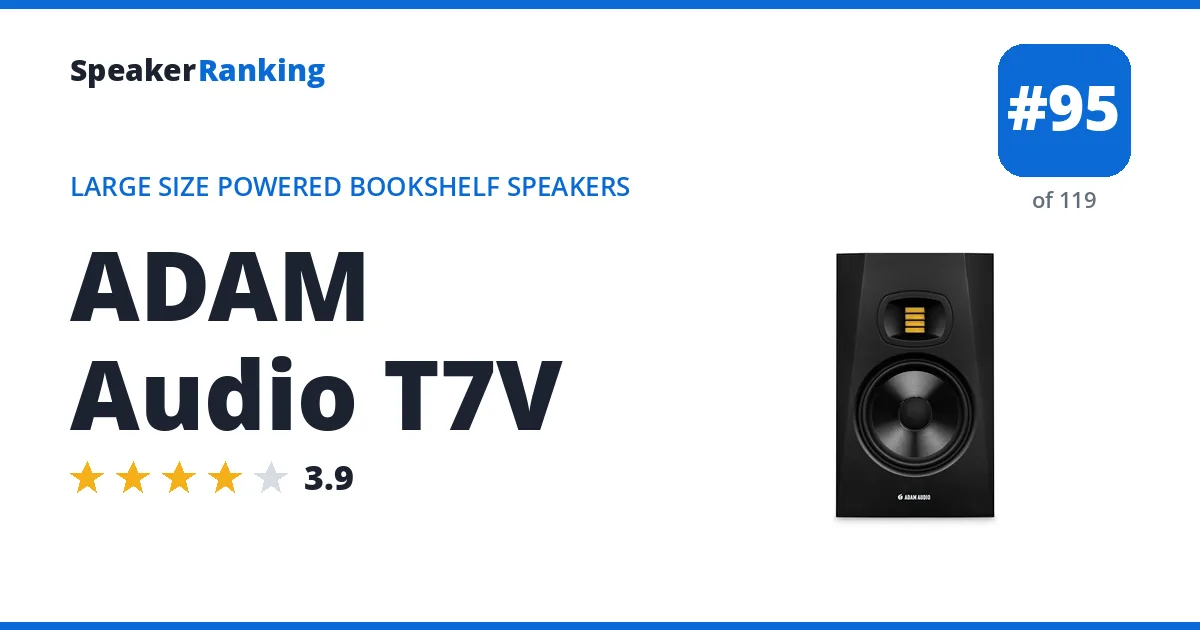
Same family: the ADAM Audio T5V (smaller bookshelf, rated 4/5) and the ADAM Audio T8V (larger bookshelf, ranked higher, rated 3.9/5).
Pros: Audioholics’ measurements provide useful evidence about the midrange and treble, with a digitized 2.4dB response span from 300Hz to 5kHz. Basic tonal controls and analog connections suit a straightforward nearfield system. Measured bass extension of 65Hz (-3dB).
Cons: Correct listening height is important for the two-way crossover. Basic shelf controls offer less adjustment flexibility than parametric room correction.
Full ADAM Audio T7V review and specifications →
| Released | 2018 (8 years ago) |
|---|---|
| AES Input | No |
| Amplifier Power | 70w Per Speaker |
| App | No |
| Aux Input | No |
| Bass Extension (-10dB) | approx. 45Hz, extrapolated from the reviewer’s directly-computed -6dB point of 45.4Hz (measured, Audio Science Review) |
| Bass Extension (-3dB) | approx. 65Hz, extrapolated from the reviewer’s directly-computed -6dB point of 45.4Hz (measured, Audio Science Review) |
| Bluetooth | No |
| Coaxial Input | No |
| DSP | No |
| Dimensions | 13.7”H x 8.3”W x 11.5”D (348 x 210.8 x 292.1 mm) |
| Drivers | 7” (178mm) woofer |
| EQ | Yes (Room adjustment) |
| Frequency Response | 39Hz - 25kHz (-6dB) (Manufacturer specified) |
| HDMI Input | No |
| Inputs | XLR, RCA |
| Optical Input | No |
| RCA Input | Yes |
| TRS Input | No |
| USB Input | No |
| Weight | 15.7 lbs (7.1 kg) |
| XLR Input | Yes |
- Links
- Reviews, Comparisons and Sound Samples
- Audio Science Review Measurements More from Audio Science Review →
- DSAUDIO.review: DSAUDIO.review Adam Audio A7X vs Adam Audio T7V sound.DEMO More from DSAUDIOreview →
- DSAUDIO.review: DSAUDIO.review Tannoy Gold 7 vs Adam Audio T7V sound.DEMO
- DSAUDIO.review: Adam Audio T7V vs Yamaha HS7 Sound & Frequency Response Comparison
- DSAUDIO.review: DSAUDIO.review Focal Alpha 65 EVO vs Adam Audio T7V sound.DEMO
- DSAUDIO.review: DSAUDIO.review Adam Audio T7V vs Adam Audio A5X sound.DEMO
- DSAUDIO.review: Adam Audio T5V vs Adam Audio T7V Sound & Frequency Response Comparison
- DSAUDIO.review: Kali LP-6 vs Adam Audio T7V Sound & Frequency Response Comparison
- DSAUDIO.review: KRK Rokit 7 G4 RP7G4 vs Adam Audio T7V Sound & Frequency Response Comparison
- DSAUDIO.review: Adam Audio T7V vs JBL 306P MKII Sound & Frequency Response Comparison
- Audioholics Review Measurements
- Audioholics Measurements (spinorama.org)
- Head-to-Head Comparisons
 Palmer Orbit 11: $1,532 per pair Thomann $766 eBay
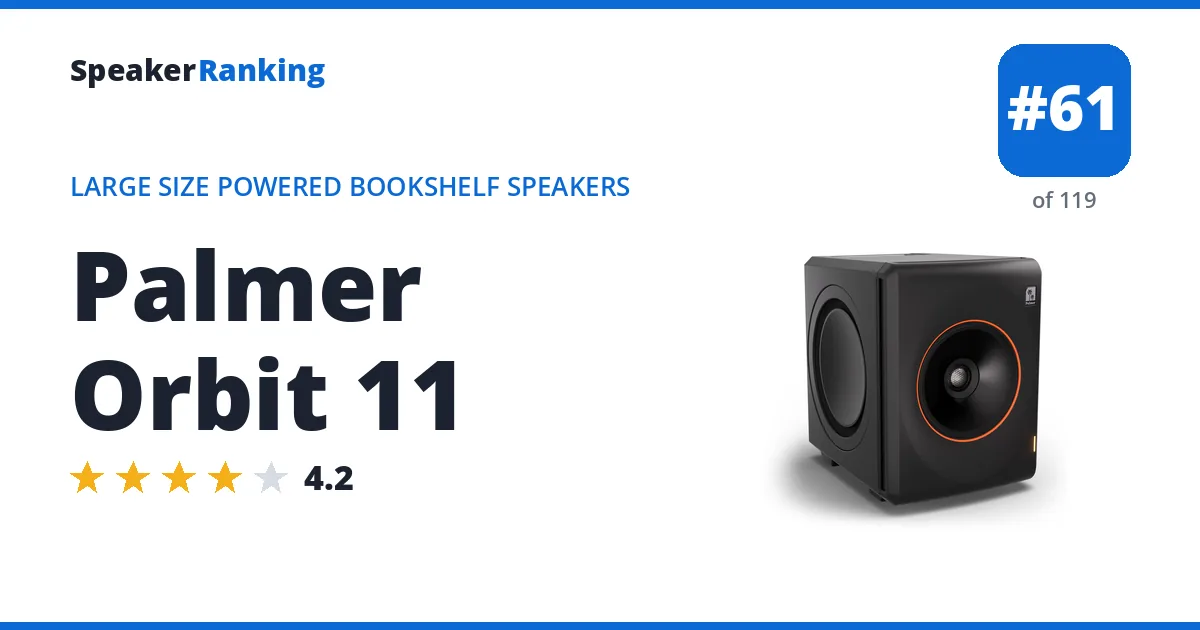
Pros: A 27.8Hz measured -3dB point provides genuinely deep standalone bass. The 1.8dB response span from 300Hz to 5kHz supports even mids, and the coaxial arrangement offers a compact acoustic source for nearfield listening. A cardioid front baffle reduces rear and side room reflections. Measured bass extension of 27.8Hz (-3dB).
Cons: Its 7.10 ideal-subwoofer score is more modest than the narrow midrange span alone suggests; response outside that band and off-axis behavior also matter. Deep-bass extension does not prove high-level headroom. Studio-oriented connections and setup are less convenient than an all-in-one consumer pair. It has XLR analog and AES3 digital connections only, with no RCA or TRS.
Full Palmer Orbit 11 review and specifications →
| Released | Feb 2026 (8 months ago) |
|---|---|
| AES Input | Yes |
| Amplifier Power | 1000W peak / 400W RMS total; Tri-amped Class D |
| Aux Input | No |
| Bass Extension (-10dB) | 21.5Hz (measured, spinorama.org) |
| Bass Extension (-3dB) | 27.8Hz (measured, spinorama.org) |
| Bluetooth | No |
| Coaxial Input | No |
| Dimensions | 8.5” x 11.5” x 11.5” (217 x 293 x 292 mm) each |
| Drivers | 1” tweeter + 6.5” midrange (coaxial), 2x 8” woofers |
| Frequency Response | 28Hz - 28kHz (-3dB) (Manufacturer specified) |
| HDMI Input | No |
| Inputs | XLR (balanced analog), AES3 (digital, via XLR) |
| Maximum SPL | 116dB peak at 1m |
| Optical Input | No |
| RCA Input | No |
| Spinorama Preference Score | 6.20 |
| Spinorama Preference Score with Perfect Sub | 7.10 |
| TRS Input | No |
| USB Input | No |
| Weight | 30.6 lbs (13.9 kg) each |
| XLR Input | Yes |
- Links
- Reviews, Comparisons and Sound Samples
- Head-to-Head Comparisons
- Palmer Orbit 11 vs Focal Trio6 ST6
- Palmer Orbit 11 vs HEDD Type 07 A-Core
- Palmer Orbit 11 vs Cambridge Audio L/R X
- Palmer Orbit 11 vs Focal Alpha 65 EVO
- Palmer Orbit 11 vs ADAM Audio A7V
- Palmer Orbit 11 vs Kali Audio IN-8 V2
- Palmer Orbit 11 vs Kali Audio LP-6 V2
- Palmer Orbit 11 vs Yamaha HS8
- See all 20 comparisons